Blog | Actian Life | | 5 min read

Why Partner With Actian: A Strategic Alliance for Success

why become a global partner with actian

Now more than ever, data management, integration, and analytics are crucial components of business success for data-driven organizations. Companies seeking to innovate, scale, and make decisions with confidence need trusted vendors that can provide modern, comprehensive, and easy-to-use technologies that solve business challenges and generate new value from data.

This is where Actian’s partner program stands out. It offers opportunities for you to complement your solutions with Actian products and services to meet customers’ current and future data needs. No single vendor can meet the diverse and complex data needs of today’s businesses, making strategic alliances essential to provide robust and tailored solutions to customers.

Partner With Actian and Expand Your Reach

Partnering with a technology leader like Actian is not just a strategic move—it is essential when you want to stay competitive, reach new customers, and continue adding value for current customers. Collaborating with Actian can support innovation, streamline operations, and provide access to innovative technologies that strengthen customers’ tech stacks and offer a connected ecosystem.

The Actian partner program is designed to optimize the strengths of our modern and expanding product portfolio by integrating our offerings with your technologies and services. By forming strategic partnerships with Actian, you can unlock the full potential of your data products and services while benefiting from a robust network of technologies, expert services, and solution partners. 

Actian’s Unique Partner Value Proposition

As a forward-thinking data technology company, Actian offers a modern data management and data intelligence portfolio that enables customers to easily connect, govern, and analyze their data. Our solutions enable businesses to seamlessly manage data across cloud, on-premises, and hybrid environments—and have confidence in their decision-making.

More than 42 million users around the world use our products, with over 20,000 businesses trusting our scalable technologies. When you partner with Actian, you gain several distinct advantages:

  • Comprehensive Training and Support. Actian invests heavily in its partners, which is why coming soon, we’ll offer training and certification courses that ensure you are equipped to deliver the best possible solutions to customers​. This investment in skills development translates into greater customer satisfaction and higher success rates for joint projects.
  • Flexible Go-to-Market (GTM) Models. You can leverage a variety of GTM strategies through a partnership with Actian. Whether through co-branding, co-participation at events, or access to marketing development funds, Actian ensures that its partners are positioned for success​.
  • Competitive Compensation. With margin-sharing models and generous incentives, you can benefit from substantial financial benefits. These incentives are designed to promote long-term, mutually beneficial relationships, rather than focusing on short-term gains​.

4 Types of Partnerships Supported by Actian

Actian’s flexibility extends to the types of partnerships it supports, ensuring that vendors with various solutions can benefit from the partner program:

  1. Cloud Providers. Cloud adoption continues to accelerate, with companies looking for efficient ways to migrate to and manage their data in the cloud. Actian’s rapid onboarding process and hybrid capabilities make it easy for cloud providers to offer comprehensive data management solutions to customers.
  2. Systems Integrators. Systems integrators can enhance their service offerings by implementing Actian’s database and data management technologies into their client projects. This drives revenue while also boosting customer satisfaction by delivering purpose-built solutions that address specific business challenges​.
  3. ISVs/OEMs. Independent software vendors (ISVs) and original equipment manufacturers (OEMs) can embed Actian technologies into their products, offering differentiating features such as advanced data integration and analytics capabilities. This allows these businesses to stand out in their respective markets while benefiting from Actian’s extensive technologies and support​.
  4. Technology Alliances. Actian partners with other technology leaders to deliver powerful joint solutions. By embedding Actian’s data management and analytics tools into their own technologies, tech partners can provide enhanced value to customers and gain a competitive edge​.

Why You Should Partner With Actian

Partnering with Actian allows you to leverage a proven data portfolio that accelerates transformation and modernization, enabling customers to make confident, data-driven decisions that grow their business. Core reasons to partner with Actian include:

  • Access to Cutting-Edge Technology. Actian’s portfolio is designed to integrate seamlessly with existing infrastructures, providing businesses with scalable, reliable, and high-performance data solutions. This enables both partners and customers to stay ahead of the curve in terms of innovation and technological advancement.
  • Mutual Success Focus. Actian’s partnership philosophy is centered on long-term relationships rather than transactional engagements. We work closely with partners, aligning goals and objectives to ensure mutual success. This commitment to collaboration helps you exceed customer expectations, delivering projects that consistently outperform competitors​.
  • Global Reach and Expertise. Actian’s global presence, extensive customer base, and experience working with leading companies position you for success in any market. Our deep expertise—spanning more than 50 years—in data management allows you to offer industry-leading solutions to a wide range of industries and geographies​.

Partner With Actian to Unlock New Opportunities

Joining Actian’s partner program is an opportunity to grow your business, enhance your technology stack offerings, and deliver value-driven solutions to customers. Our combination of industry-leading products, expert support, and a collaborative partnership model ensures that your company is well equipped to tackle the challenges your customers face with modern data management.

Whether you are a cloud provider, systems integrator, ISV, OEM, or looking to form a technology alliance, partnering with Actian will empower your business to scale and innovate. Our commitment to partners, supported by comprehensive partner benefits, makes Actian an ideal choice for vendors like yours that are seeking to advance their data capabilities offerings.

Actian’s track record of success, commitment to its partners, and industry-leading solutions make it a standout partner in today’s data-driven world. Explore the opportunities that come with joining the Actian partner program and unlock new pathways to success. Get signed up today!


The Internet of Things (IoT) is reshaping industries by connecting physical devices to the digital realm. As IoT devices proliferate, they generate vast amounts of data, offering unprecedented insights into operations, customer behavior, and market trends. 

According to IoT Analytics, there were 16.6 billion connected IoT devices by the end of 2023 (a growth of 15% over 2022). IoT Analytics expects this to grow 13% to 18.8 billion by the end of 2024. 

To fully harness the potential of this data deluge, a robust data governance framework is essential.

Why Data Governance Matters in IoT

Data governance is the practice of managing the availability, usability, integrity, and security of an organization’s data assets. In the context of IoT, it ensures that data is collected, stored, processed, and analyzed in a consistent, reliable, and compliant manner. Here are some key reasons why data governance is crucial for IoT success:

  1. Regulatory Compliance: IoT devices often collect and process sensitive personal data, necessitating adherence to stringent regulations like GDPR, CCPA, and HIPAA. Data governance ensures that organizations can demonstrate compliance and avoid hefty fines.
  2. Data Quality: IoT devices can generate inaccurate or incomplete data due to various factors, such as sensor malfunctions or network connectivity issues. Data governance helps identify and rectify data quality issues, ensuring that decisions are based on reliable information.
  3. Data Security: IoT devices are potential targets for cyberattacks, making data security a paramount concern. Data governance establishes policies and procedures to protect sensitive data from unauthorized access, breaches, and data loss.
  4. Data Privacy: IoT devices often collect personal data, raising privacy concerns. Data governance helps organizations implement measures to protect individuals’ privacy rights and comply with data privacy regulations.
  5. Data Accessibility: A well-governed data environment empowers users to access and analyze data, regardless of their technical expertise. Data governance fosters data literacy and enables data-driven decision-making across the organization.

Key Capabilities of a Data Governance Framework

A comprehensive data governance framework incorporates various capabilities to ensure data quality, security, and compliance. Let’s delve into some of the critical capabilities:

  1. Data Catalog: A data catalog provides a centralized repository of information about data assets, including their definitions, metadata, and relationships. It enables users to discover and understand data, accelerating data analysis and insights.
  2. Business Glossary: A business glossary defines common business terms and their meanings, ensuring consistent understanding across the organization. It helps bridge the gap between technical and business users, facilitating effective communication and collaboration.
  3. Data Lineage: Data lineage traces the journey of data from its source to its destination, revealing how data is transformed and used. It helps identify data dependencies, assess impact, and troubleshoot data quality issues.
  4. Data Discovery: Data discovery tools enable users to search, explore, and visualize data. They help users find relevant data, understand its context, and gain insights without requiring deep technical skills.
  5. Data Quality: Data quality management ensures that data is accurate, complete, consistent, timely, and relevant. It involves monitoring data quality metrics, implementing data cleansing and validation processes, and establishing data quality standards.

Democratizing Data Access Through Data Governance

Data governance plays a crucial role in democratizing data access, making data-driven insights available to a wider audience within the organization. By establishing clear data standards, providing user-friendly tools, and fostering a data-driven culture, organizations can empower employees to make informed decisions.

Benefits of Democratizing Data Access:

  • Enhanced Decision-Making: Data-driven insights enable better decision-making at all levels of the organization.
  • Increased Innovation: Access to data fosters creativity and innovation, leading to new products and services.
  • Improved Operational Efficiency: Data-driven insights can streamline processes and reduce costs.
  • Enhanced Customer Experience: Data-driven personalization and customer insights improve customer satisfaction.

Data governance is no longer an option but a necessity for IoT success. By implementing a robust data governance framework, organizations can unlock the full potential of their IoT data, ensuring regulatory compliance, data quality, security, and accessibility. By democratizing data access, organizations can empower their workforce, drive innovation, and achieve sustainable growth.

Our recent acquisition enables us to offer our customers a unified data intelligence and governance solution to seamlessly discover, govern, and maximize the value of their data assets. 

The platform is a cloud-native Data Intelligence Platform with universal connectivity that supports metadata management applications from search and exploration to data catalog, lineage, governance, compliance and enterprise data marketplace. Powered by an adaptive knowledge graph, the Actian Data Intelligence Platform enables organizations to democratize data access and generate a 360-degree view of their assets, including the relationships between them.

Discover the platform by signing up for a demo.


Blog | Data Management | | 7 min read

Flip the Script on Data Management With a Next-Gen Data Catalog

next gen data catalog

As you’re probably experiencing firsthand, businesses are generating and handling more data than ever before, creating an urgent need for sophisticated tools for data management. Traditional data catalogs, while once effective, often fall short in providing the agility and accessibility needed by modern organizations. Managing, organizing, and making sense of your data requires easy-to-use tools that go beyond yesterday’s metadata management solutions to provide the speed, functionality, and features your business needs.

Enter next-generation data catalogs—innovative solutions that are designed to transform the way you discover, govern, and leverage your data. These cutting-edge data catalogs offer intuitive interfaces, advanced automation, and robust governance features that empower all users, making them essential for any company striving to harness the full power of its data assets.

As you focus on making data more accessible and actionable, next-generation data catalogs can help. They have emerged as a critical component in the modern data landscape.   

How Next-Generation Data Catalogs Differ From Traditional Solutions

Traditional data catalogs have served businesses well for years, providing a repository to store and manage metadata and helping organizations locate critical data assets. However, these catalogs are often bulky, slow, and expensive, creating barriers to broader adoption, especially by non-technical users.

In addition, legacy data catalogs typically come with hefty license fees and require significant manual effort to classify and manage data. In contrast, next-generation data catalogs provide faster, more cost-effective, and user-friendly solutions designed to meet the needs of modern businesses. Next-gen data catalogs offer:

  • Cloud-Native Architecture. Traditional data catalogs are often tied to on-premises systems, which can limit scalability and accessibility. Modern catalogs are built natively for the cloud, offering a flexible, scalable architecture that grows with your business.

The architecture allows you to integrate a wide range of cloud platforms, applications, and on-premises systems seamlessly for a connected ecosystem. A cloud-native architecture also makes it easier to manage data in hybrid or multi-cloud environments, ensuring the catalog can adapt as your infrastructure evolves.

  • Ease of Use. One key differentiator of next-generation data catalogs is their focus on ease of use. Traditional solutions often require specialized skills to navigate, limiting their usability to data professionals and technical users. Next-gen catalogs, on the other hand, are designed with the non-technical user in mind.

These modern catalogs feature intuitive user interfaces and automated workflows that simplify the process of finding, accessing, and utilizing data, making them accessible to a broader range of users within your organization. Whether it’s through natural language search or user-friendly data lineage displays, these catalogs empower you to work with data without requiring deep technical expertise. Ultimately, this helps democratize the data flow process.

  • Enhanced Data Governance and Compliance. While traditional catalogs have long supported data governance, next-generation catalogs take it a step further by automating much of the data governance process. These solutions offer role-based access controls, automatic metadata tagging, and support for business glossaries, making it easier to manage sensitive information and ensure compliance with regulations like the General Data Protection Regulation (GDPR) or California Consumer Privacy Act (CCPA).

Some next-gen catalogs even incorporate advanced capabilities to automatically detect and classify sensitive data. They can then provide real-time alerts and insights to prevent data breaches.

  • Cost-Effective Solutions. The pricing model of traditional data catalogs has been a significant barrier for many organizations, with enterprise licenses costing upwards of $150,000 annually, according to a report from Eckerson Group “Next-Generation Data Catalogs.” In contrast, modern catalogs offer competitive pricing models, often at a fraction of the cost.

For example, the report notes that the annual cost for next-gen data catalogs typically ranges from $70,000 to $90,000. Lower costs, combined with new features and reduced manual effort, make these catalogs an attractive option for businesses of all sizes.

5 Ways the Actian Data Intelligence Platform Stands Out for Its Next-Generation Data Catalog

Among the modern data catalogs on the market, the Actian Data Intelligence Platform stands out as a modern solution for modernizing your data management practices. It offers an ideal platform and data catalog for data-driven organizations like yours to democratize data, centralize and unify all enterprise metadata, and offer a single source of truth.

Five key reasons to use the Actian Data Intelligence Platform include:

  1. A Focus on Simplicity and User Experiences. Actian Data Intelligence Platform is focused on delivering simplicity—and this is reflected in the platform’s clean and intuitive user interface. The platform offers two user interfaces: Actian Explorer for business users who need to discover and explore data, and Actian Studio for data stewards responsible for managing and governing data assets. This separation of interfaces ensures that both technical and non-technical users can interact with the data catalog in ways that are most relevant to their roles.
  1. Enterprise Data Marketplace Integration. What sets Actian apart from many of its competitors is its Enterprise Data Marketplace. This feature allows business domains within your organization to share data products seamlessly, enabling greater collaboration and data democratization across departments. When users look to access a data product, the platform routes those requests through third-party workflow systems, like those from Jira or ServiceNow, to ensure governance policies are followed while maintaining ease of use. 
  1. Advanced Metadata Management and Federation. The Actian Data Intelligence Platform is built on a knowledge graph that supports multiple metamodels, allowing each business domain to create its own data catalog tailored to its specific needs. These domain-specific catalogs can then be combined into an enterprise catalog, providing a holistic view of your data landscape. This flexibility is crucial when operating across multiple business units or geographies because it allows you to maintain a unified data catalog while accommodating the unique requirements of each domain.
  1. Seamless Integration and Interoperability. With more than 70 proprietary data connectors, the Actian solution integrates with a wide range of data platforms, cloud applications, and on-premises systems. This ensures that the catalog can pull metadata from virtually any source within your organization, providing a comprehensive view of your data ecosystem. Additionally, by integrating with third-party applications such as Monte Carlo and Soda, you benefit from data quality monitoring to maintain high levels of data accuracy and reliability.
  1. Future-Ready Without the Hype. While many next-gen data catalogs are rushing to integrate AI features, Actian takes a measured approach, only adopting new technologies that have proven value to customers. For example, the Actian platform uses GenAI to summarize long descriptions and improve usability in targeted areas. This approach ensures that the platform remains cutting-edge without overwhelming users with unproven features.

A Strategic Investment in Data-Driven Success

As you continue to navigate the complexities of the digital age, the need for robust, scalable, and user-friendly data management solutions is more critical than ever. Next-generation data catalogs, like the one from the Actian Data Intelligence Platform, offer a powerful alternative to traditional solutions, providing enhanced usability, governance, and cost-efficiency.

Investing in a next-generation data catalog is not just a smart choice—it’s a strategic imperative. Actian Data Intelligence Platform, with its focus on simplicity, integration, and innovation, is well-positioned to help you gain maximum value from your data and drive meaningful business outcomes.

Actian Data Intelligence Platform is more than just a data catalog: it bundles at no cost a data marketplace for publishing and consuming data products, putting Actian on the cutting-edge of all data catalogs,” according to the Eckerson Group.

Experience the platform for yourself with an Actian product tour.


Blog | Data Governance | | 7 min read

Stop Wasting Data: Build a Future-Proof Strategy With Data Governance

Build a Future-Proof Strategy With Data Governance

These days, it’s hard to find a company that isn’t trying to better itself and become data-driven with advanced analytics, AI, or Generative AI. Enterprises across industries of all types are scrambling to integrate new, emerging technologies into their environments, hoping to get the much-vaunted promise of increased productivity and enhanced capabilities as quickly as they can.

What most organizations promptly discover as part of that process, however, is that getting their data assets organized in a way that will allow them to fully take advantage of these technologies is much harder than it first appears. The reasons are many – from a complex mix of data formats, data silos and data management tools, to uncertainty around how to best manage the process, the data preparation and organization – and collectively, these factors are fast becoming a major stumbling block for many companies.

In fact, according to a recent survey by TECHnalysis Research of IT decision makers in over 1,000 U.S. companies that are doing work with GenAI, Data Preparation and Integration is one of the top five challenges that companies face. In an interesting twist, in an Actian survey of 550 professionals (70% of which were director or higher) in 6 countries and 7 industries, 79% indicated that they believe they’re prepared for GenAI. However, when Gartner asked people in charge of AI data readiness, only 4% said they were ready.

Another problem is that most organizations don’t have any organized governance plans for their data. That same TECHnalysis Research survey found that just under 30% of large enterprises (1,000+ employees) and a whopping 64% of medium businesses (100-999 employees) don’t have governance plans of any kind for their GenAI projects.

One key issue is that many people don’t fully understand what data governance optimization is and why it’s important. On top of that, even organizations that have started to put together data governance policies and procedures don’t know best practices to ensure that they’re getting the right kind of data fed into their algorithms and large language models (LLMs). The net result is a large percentage of organizations aren’t using their critical data as effectively as they could be and that, in turn, typically translates into customized models and applications that aren’t as effective or as productive as they were expected to be. In fact, according to Gartner, by 2027, 60% of organizations will fail to realize the anticipated value of their AI use cases due to incohesive ethical governance frameworks.

To address these issues, companies clearly need not only a wide range of tools to best organize, manage and prepare their data for use, but also a framework and set of guidelines. This ensures that the most effective policies and procedures for acquiring and using data are in place to maximize the return on investment of implementing these emerging technologies.

That’s where a company like Actian, a division of HCL Software, comes into play. Actian currently offers a range of tools designed to organize and optimize a company’s data assets for a wide variety of innovative technologies, including GenAI. This is essential because, as many businesses have already discovered, the quality of the output that an application creates is utterly dependent on the quality of the data its underlying model is trained on. It’s a classic case of garbage in, garbage out—or more positively, high-quality data in, effective, impactful and trustworthy results out.

Actian’s suite of tools tackles everything from data organization to advanced analytics, all designed towards optimizing large volumes of data for ingestion. In particular, the company’s tools have a strong focus on metadata, which is quickly proving to be an essential part of the training process. Essentially, the more accurately and thoroughly an organization’s data can be documented or described via metadata, the more effectively a company can use that data in its training process for multiple applications, including GenAI. Plus, well-documented data can help reduce hallucinations and other misleading output that all LLMs are still occasionally prone to produce.

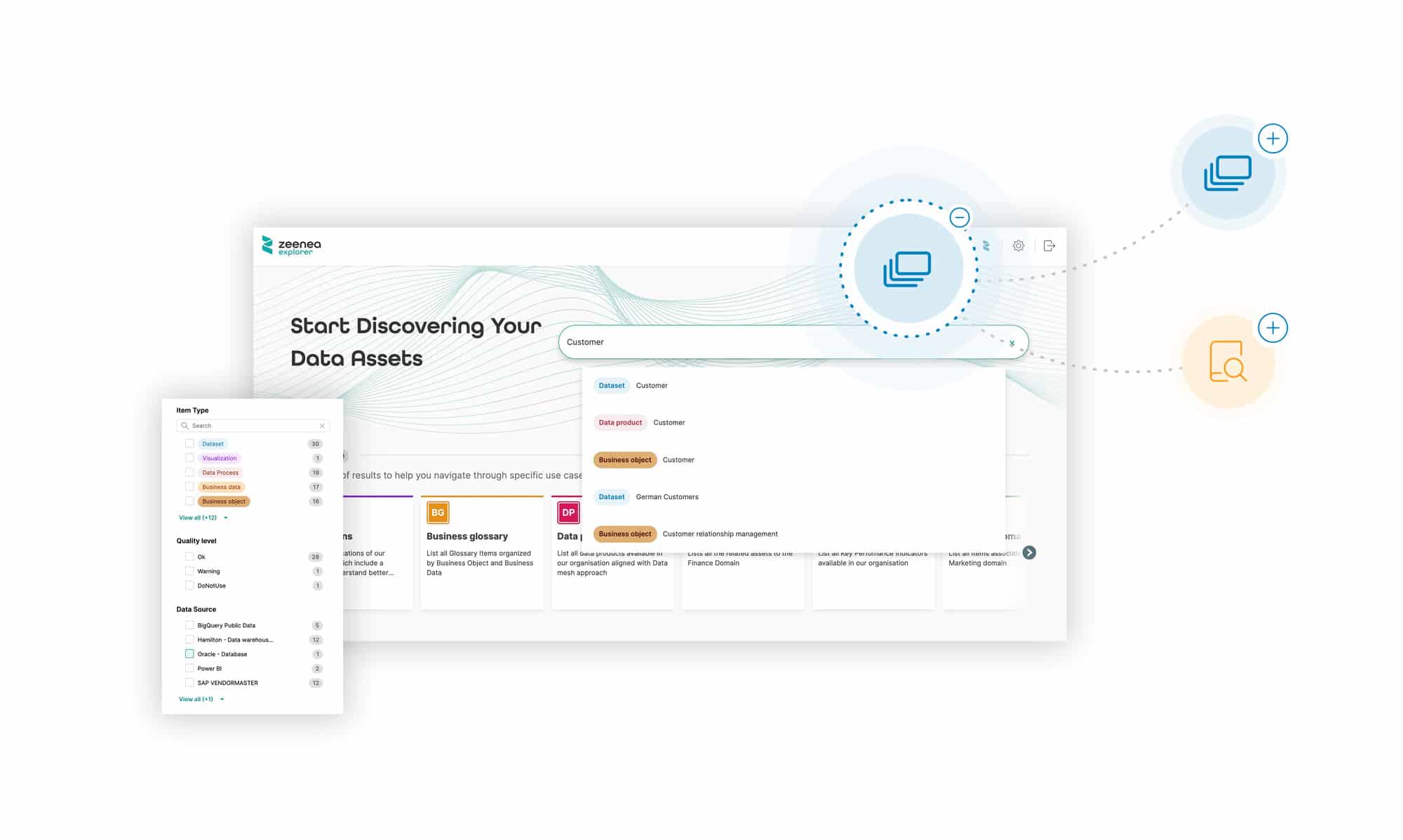
To help broaden its range of capabilities in these areas, Actian recently completed the purchase of Zeenea, a company that’s built a Data Intelligence Platform centered around a Data Catalog. Actian Data Intelligence Platform’s Data Catalog lets companies organize all their various data assets into a single catalog structure that leverages metadata to create a single searchable repository. This, in turn, helps data consumers within an organization find the information they need via either simple text-based searches or a visual Knowledge Graph. The Knowledge Graph utilizes semantic metadata to link together numerous independent data sources and provide context and easy-to-see visual connections across these data assets.

The latest enhancement to these catalog capabilities is the company’s new Actian Federated Data Catalog, which takes the data cataloging concept to a new level by integrating its capabilities across an organization. This federated catalog leverages a domain-oriented data management approach where the teams most familiar with the data manage their own data assets, permissions, and governance in a dedicated data catalog. Domains can then publish their most valuable data assets in a shared Enterprise Data Marketplace, ready to be consumed as products by all business functions within the organization. By using the same principles and concepts across these different domains, organizations end up with a decentralized, yet consistent data management structure that provides an easier and more effective method for sharing critical data. Most importantly, they do so in a manner that provides a consistent set of governance principles, helping them avoid potential regulatory and other data compliance issues.

In addition to these data preparation and organization tools, Actian also provides its customers with a tested, mature set of data governance solutions and a comprehensive data governance framework to ensure best practices can be leveraged across the data preparation process.

Actian’s effective Data Governance Framework provides a straightforward but comprehensive set of policies and procedures that can help ensure that organizations of different types and with different needs can all get the most from their data assets. More than just a list of rules to follow, the framework has suggestions on organizational structure, questions and topics to be addressed in meetings, strategies for implementing some of the key concepts, and more.

The framework is also designed to help ensure buy-in across an organization’s critical decision-makers—a key make or break point for many advanced projects—as well as offer important practical benefits. For example, a properly followed framework can help organizations stay within any regulatory and legal requirements to which they might be subject, avoid data-driven bias in the output results, prevent loss of critical IP, address any potential ethical issues, and much more.

There’s no question that new technologies, like GenAI and the new kinds of applications the technology is enabling, are opening up some amazing new potential for companies to improve their productivity, stay ahead of their competitors, enhance their bottom line, and become truly “data driven.” At the same time, as with many other new technologies, it’s also opening up the potential for new types of risks and challenges.

As a result, companies who are eager to jump into the new exciting applications of data, like GenAI, need to be certain that they’re well prepared for the adventure. Taken together, Actian’s set of data preparation tools along with the Actian Data Intelligence Platform, Federated Data Catalog and governance framework can help companies have a smooth, organized, and comprehensive data preparation process. Given how important this process is and how much it can impact the ultimate success or failure of advanced data initiatives, it’s clear that it’s a topic that organizations of all types and sizes need to get much smarter about now.


Big data remains more important than ever to meet the goals of businesses in just about every industry imaginable. Because of data’s value, new advancements are being made every year to help organizations optimize and manage the data they collect and store to the fullest extent possible.  

Cloud computing and AI have driven recent advancements in big data integration, helping make data more accessible and higher-quality while remaining secure. And the future of data integration looks even brighter, with innovations currently on the horizon that will allow greater access and better stewardship than ever before. Let’s look at some of the most impactful data integration trends made recently and innovations you’ll hopefully see soon. 

Here are eight recent trends and technologies that have contributed to improvements in data integration and will impact future best practices for data integration architectures. If these advancements aren’t on your radar yet, they may be soon. 

1. Real-Time Data Integration

Waiting for large volumes of data to be processed before you can gain insights from them is a thing of the past. With a move from batch processing to real-time integration that uses change data capture, you can extract the information you need from your most crucial data quicker than ever — even in real-time. You can analyze massive data repositories by employing parallel processing without straining your system resources, giving you insights at the speed of business. 

2. Cloud Computing

Cloud computing has been around for decades, but recent advancements are making it easier for non-coders to set up data storage in the cloud instead of data lakes and data warehouses on physical servers. Cloud computing makes unifying disparate data sources and accessing data much easier, faster, and less costly, and now, no-code and low-code solutions are making it easier to create cloud-native architectures. With edge computing now being integrated into cloud computing tools, data integration can move even faster. 

3. The Convergence of ELT and ETL

Because many businesses are moving their data repositories from data lakes to cloud servers, deciding whether to use extract, load, and transform (ELT) or extract, transform, and load (ETL) processes for data integration is becoming less common. A new data integration process with continuous transformations, sometimes called extract, transform, load, and transform (ETLT), is emerging to improve data quality by constantly refining the data for data mesh distribution.

4. No-Code and Low-Code Data Integration

Emerging no-code and low-code — also called “self-service” — cloud architecture tools are improving speed for the future of data integration, but they’re also making overall data integration processes much easier. Many data integration tools and data platforms are being streamlined so that professionals without coding experience can perform collection and analysis tasks that once required specialized expertise. Overcoming data integration challenges for those without coding knowledge means you can share data with more stakeholders who find it valuable. 

5. IoT Data Integration

The Internet of Things (IoT) is a system of internet-enabled electronic devices that can share data with each other. The type and complexity of data these devices can share — and feed into your repository — is advancing, but so is how that real-time data is integrated for business uses. The ever-increasing use of 5G and 5G RedCap makes transmitting data from things like health monitoring devices faster; edge computing advancements make processing the data faster and simplified, while more intuitive iPaaS solutions are making it easier to organize and manage data from multiple data-collecting apps. 

6. The Emergence of Data Mesh

First conceived in 2019, this data integration trend provides a business-minded alternative to data lakes that has become popular with organizations that collect large amounts of data, like Netflix and PayPal. Instead of storing data in a central location, it is distributed directly to the sources who need it, allowing faster access and dissemination. Remember that because data is moving straight from collection to analysis, you need to have a structured data conversion process in place so that those receiving the data can make sense of it. 

7. AI and Machine Learning

Possibly the most significant critical drivers in making the future of data integration faster, more accessible, and higher quality are advanced artificial intelligence and machine learning capabilities. Thanks to the recent evolution of AI, systems and processes that once required expert coders to build are now being constructed seamlessly into data integration platforms that allow more people to access trusted data. Machine learning is advanced enough to facilitate retail customer data integration from images, videos, and text, for example, but it also constantly refines and focuses data to make it easier to analyze buying habits. While their impact may not be noticeable now, AI and machine learning will begin streamlining and improving your data integration platforms and tools to increase efficiency, accessibility, and quality. 

8. Data Security and Governance

As more data integration processes move to cloud servers, rely less on coded systems and routines, and perform functions in real-time, there’s a huge need for increased cybersecurity and a more nuanced data governance framework. Many of these advancements aim to get more data to stakeholders who need it most but may not be as familiar with protecting it as data professionals are. To this end, Zero-Trust Architecture (ZTA) is becoming more popular, and data access permissions will become more stringent. This requires data governance professionals to focus more on stewardship and access control models that limit access or make it more sophisticated to prevent unauthorized access to data.  

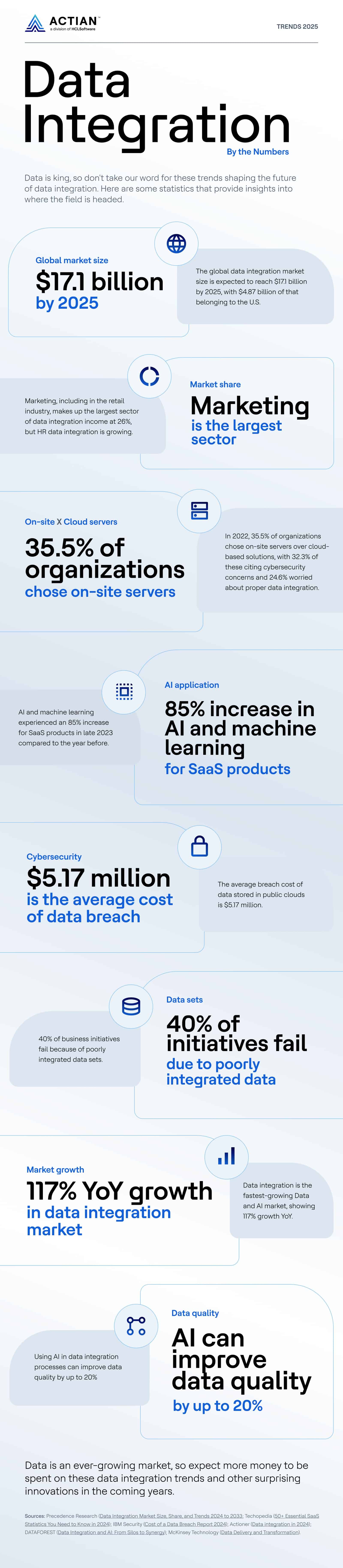
Data is king, so don’t take our word for these trends shaping the future of data integration. Here are some statistics that provide insights into where the field is headed. 

  • The global data integration market size is expected to reach $17.1 billion by 2025, with $4.87 billion of that belonging to the U.S. 
  • Marketing, including in the retail industry, makes up the largest sector of data integration income at 26%, but HR data integration is growing.
  • In 2022, 35.5% of organizations chose on-site servers over cloud-based solutions, with 32.3% of these citing cybersecurity concerns and 24.6% worried about proper data integration.
  • AI and machine learning experienced an 85% increase for SaaS products in late 2023 compared to the year before.
  • The average breach cost of data stored in public clouds is $5.17 million.
  • 40% of business initiatives fail because of poorly integrated data sets.
  • Data integration is the fastest-growing Data and AI market, showing 117% growth year-over-year (YoY).
  • Using AI in data integration processes can improve data quality by up to 20%.


Download the Data Integration Infographic

Looking Ahead

Since 2023, there has been no expense spared in developing generative AI technology, and the evolution of this technology shows no sign of stopping. Expect to see more AI, GenAI, and machine learning integrations in data processing tools, which should increase the quality of all kinds of data. These technologies should also make processes more streamlined, which can help overcome data integration challenges organizations have concerning cloud-based services. The lines between implementing ELT or ETL will continue to be blurred as more organizations adopt cloud computing, and data structuring and processing become more automated by AI and machine learning. 

Data is an ever-growing market, so expect more money to be spent on these data integration trends and other surprising innovations in the coming years.  

A Cutting-Edge Data Integration Platform

You can find many of these data integration trends already hard at work in hybrid integration platforms (HIPs) and solutions like DataConnect from Actian. You can automate data pipelines with low- or no-code, institute business rules and data quality standards that are automatically incorporated into your workflow, and enable real-time data connections.


Blog | Databases | | 4 min read

Experience Actian Vector 7.0: A Faster, More Powerful Analytics Database

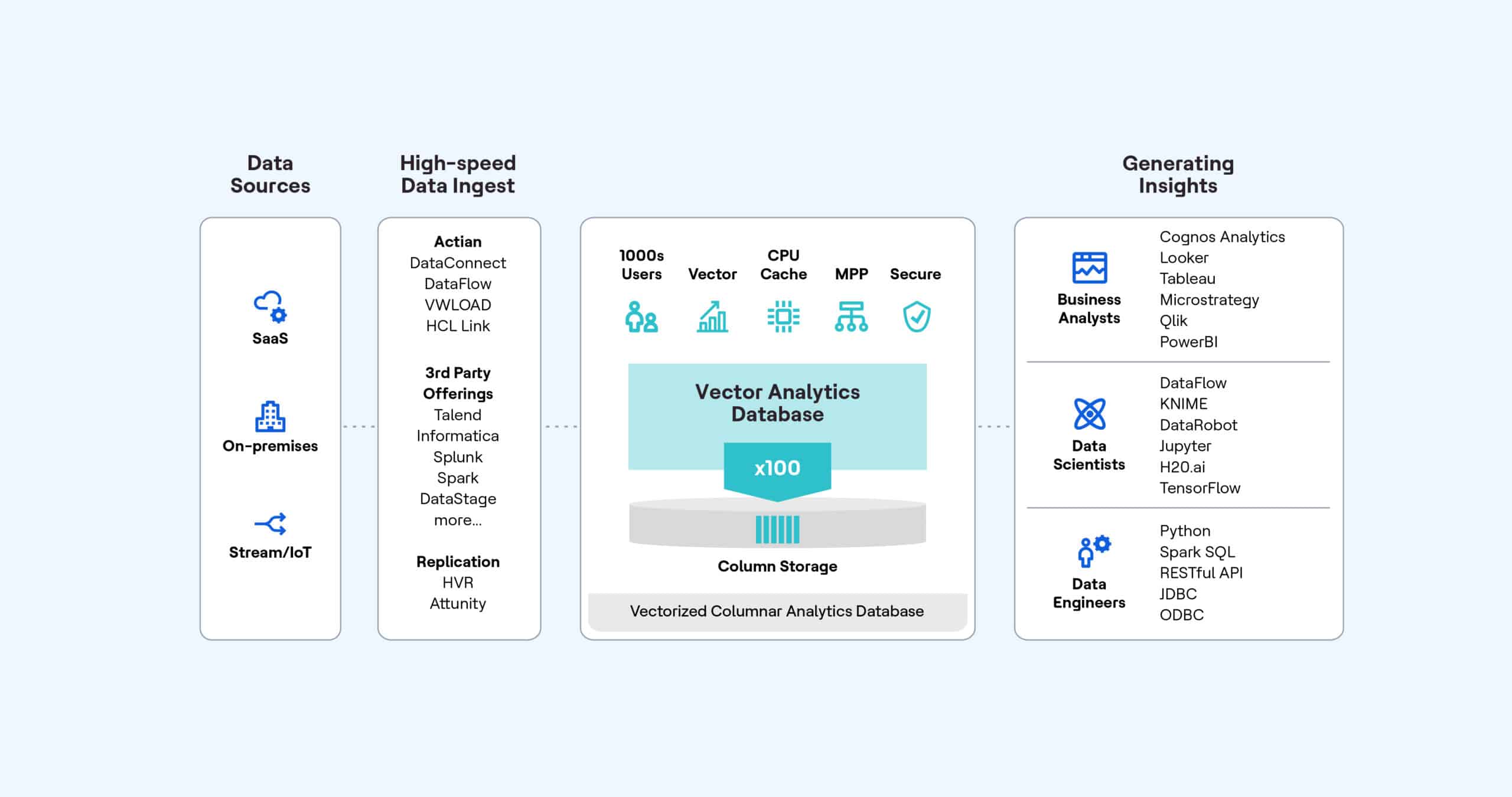
Actian Vector Overview Chart

Slow BI reporting and analytics speed indicate that your database is not performing at the high level needed to support modern analytics tools, applications, and real-time insights. This is not only a drag for data and IT teams that slows down their productivity, it can cripple your business growth. Slow time to insights has a ripple effect, delaying business decisions, missing opportunities, and losing a competitive advantage. It also undermines confidence in the data.

If you’re using an outdated database, you’re at a distinct business disadvantage. Legacy databases can’t keep up with:

  • Integrating diverse data sources and rapidly growing data volumes.
  • Processing workloads for real-time data analysis use cases.
  • Providing flexible and secure data deployments on-premises and in the cloud.

Actian Vector 7.0 Raises the Bar for Analytics

Real-time data analytics is a powerful differentiator for businesses seeking a competitive edge. Actian Vector delivers exactly that—and more. Now with the Vector 7.0 launch, querying large–even extremely large–data sets for analytics can be done in milliseconds, allowing database admins to maintain blazing-fast ingest rates for real-time analytics.

“Because Actian Vector can deliver extraordinary performance using only a small number of commodity compute nodes, the solution has exceeded the performance and functionality benchmarks of Netezza while lowering the overall cost of ownership. By replacing its legacy technology, the bank estimates it will save $20 million over five years.”–Global Bank

What’s New in Vector 7.0

At Actian, our goal is simple: Make the Vector analytics database even better. We’ve empowered organizations across industries—including healthcare, transportation, retail, manufacturing, financial services, and more—to use the Vector analytics database for their most critical analytic workloads. 

Like many of your peers, these companies demand more than a traditional database—they need a modern technology that can handle high-performance workloads to meet the demands of real-time analytics.

With 7.0, Actian Vector Delivers a Host of Upgrades

Our new release enables you to:

  • Drive greater performance and scalability to improve the speed and efficiency of data processing and reduce query response times. The database does this with:
    • Auto Partitioning improves the efficiency of data processing. Optimized partitioning leads to faster query execution and better resource management, allowing users to focus on analysis rather than database tuning.
  • Increase developer productivity by speeding up developer cycles with tools to quickly test scenarios, create more responsive applications, and handle complex queries. You can benefit from:
    • Developer SDK provides developers with the tools needed to create more responsive and scalable applications, catering to both large-scale enterprise requirements and real-time, low-latency environments. This ultimately speeds up development cycles and enhances product quality.
    • Table Cloning enables users to quickly test scenarios, restore data to a prior state, and reduce storage costs. There is no additional storage cost incurred for the cloned tables.
    • Advanced External Tables enhances the flexibility and scalability of the External Tables feature by allowing users to perform complex and customized data operations directly within their analytics workflows.
    • Spark UDFs allow for complex computations while enabling advanced data transformations and analytics.
    • REGEX Pattern Matching allows for more advanced search functionalities, enabling users to efficiently handle complex queries and improve data retrieval accuracy.
  • Power machine learning (ML) workloads to perform model inferencing for real-time workloads with a “bring your own pre-trained model” approach.  
    • ML Inference using TensorFlow streamlines the ML inference workflow, reducing data transfer time and enabling real-time analysis, leading to more timely and actionable insights.

Analyze Data No Matter Where it Resides

Vector can be deployed as an on-premises solution on Windows and Linux and as a private or managed cloud on Google Cloud, Amazon Web Services (AWS), and Microsoft Azure. You can also choose a hybrid approach. Organizations with sensitive workloads can realize the true potential of hybrid cloud by bringing compute power to the place where their data resides–both on-prem and in the cloud. You can leverage the same database engine, physical data model, ETL/ELT tools, and BI tools across clouds. 

Want to experience Vector 7.0 today? Click here to request a personalized demo.


What is Data Visualization: A Comprehensive Guide

Data volumes are expanding at a pace that challenges even the most mature analytics teams. Organizations capture information from cloud applications, mobile devices, transactions, websites, APIs, IoT sensors, and internal systems every second. Without a plan for interpreting this activity, businesses struggle to extract the meaning hidden inside it.

This is where data visualization offers enormous value. Modern companies rely on visual tools to understand behavior, monitor performance, and guide strategic decisions based on facts rather than assumptions.

This comprehensive guide explains what data visualization is, how it works, why it matters, and how data visualization tools combined with powerful data analytics platforms like Actian help teams analyze information with greater clarity, accuracy, and speed.

What is Data Visualization?

Data visualization is the process of transforming raw, unstructured, or complex data into visual formats that people can understand at a glance. Charts, maps, heatmaps, graphs, and diagrams provide structure and context, allowing users to interpret the meaning behind the numbers. When used effectively, visual data analysis helps teams spot trends, evaluate performance, and understand correlations that influence business outcomes.

The goal of data visualization is to make data usable. When organizations apply the right data visualization tools, information becomes easier to explore. Users can filter data, adjust timeframes, compare categories, and drill into specific variables that help answer critical questions. This ability to interact with information is the foundation of interactive dashboards, which are now standard features in modern analytics workflows.

Why Organizations Depend on Data Visualization

As organizations grow, the amount and variety of information they collect increases dramatically. Text files, metrics, customer profiles, logs, system events, images, and transactional data all carry important signals. Trying to interpret these details manually or through traditional reports can lead to slow decisions and outdated insights. Visualizing this information through business intelligence solutions helps present data in formats that deliver clarity and accuracy.

Meeting the Challenge of Data Uncertainty

Even businesses with strong analytics capabilities often struggle with fragmented, inconsistent, or incomplete information. Multiple systems generate data in different formats. Without a unified approach to visual data analysis, teams spend more time reconciling data than interpreting it. This slows down decision-making and limits the ability to spot early warnings or new opportunities.

Visualization solves this by consolidating information into intuitive displays. When combined with real-time data insights, visualization becomes one of the most powerful ways to understand what is happening across digital environments.

How Data Visualization Works Behind the Scenes

Before organizations can visualize their information, they must move through several essential steps: collecting, validating, enriching, storing, and preparing their data. High-quality data visualization tools automate many of these processes and ensure that data enters the visualization layer in a usable format. When visualization is embedded within modern data analytics platforms, businesses can unify multiple datasets and contextualize them within a single location.

This integration is especially valuable for organizations that depend on consistency and trust. Without reliable data, even the most attractive visualizations cannot support accurate decision-making. Actian supports this by helping teams manage data pipelines, optimize performance, and maintain the reliability needed for strong visualization practices.

The Benefits of Effective Data Visualization

1. Uncovers Hidden Insights

Tables and spreadsheets often bury meaningful patterns beneath large numbers of rows and columns. Visual formats reveal these patterns quickly and highlight relationships that would otherwise remain hidden. When paired with real-time data insights, retailers, manufacturers, healthcare systems, and financial institutions can personalize outreach, adjust inventory, and fine-tune operations based on what they see in the moment.

2. Reveals Connections That Traditional Reporting Misses

Modern organizations rely on many different systems. Sales, marketing, operations, finance, and support all generate information independently. Visualization helps bridge these silos using interactive dashboards that combine data into a unified story. This allows analysts to detect correlations and trends across departments. When this capability is delivered through business intelligence solutions or powerful data analytics platforms, teams gain complete operational visibility.

3. Speeds Up Decision-Making

Decision-making slows when teams must compare multiple reports, request new queries, or wait for updated spreadsheets. Data visualization tools eliminate these delays. Users can explore and interpret data instantly, which improves responsiveness at every level of the organization. With visual data analysis, decision-makers spend less time searching for answers and more time acting on them.

4. Enables Personalization for Different Audiences

Executives need high-level indicators. Analysts need detail. Operations teams need current performance metrics. Visualization supports all of these requirements by presenting the same underlying information in different formats. Interactive dashboards allow viewers to customize the way they interact with data and help ensure that every audience receives insights in the most meaningful way.

5. Makes Data Exploration More Accessible and Engaging

Accessibility is one of the biggest advantages of data visualization. When teams use visuals to explore metrics, they gain confidence in their conclusions. This encourages them to expand their analysis and look beyond the initial question. The combination of flexible display options and real-time data insights helps teams uncover new opportunities and avoid blind spots.

Practical Use Cases for Data Visualization

Strengthening Sales and Customer Engagement

Many organizations use data visualization to understand customer behavior and identify purchasing patterns. With the right tools, teams can track data quality, monitor engagement, and personalize product recommendations. Retailers often use visual data analysis to reduce friction during the buying process, strengthen retention, and optimize promotions.

Improving Financial and Operational Performance

Market trends, commodity pricing, currency fluctuations, and demand shifts are easier to interpret visually. Organizations that manage financial risk can benefit from data visualization tools because visual formats make it easier to spot turning points or emerging trends. When supported by robust data analytics platforms, teams can react faster and protect margins more effectively.

Supporting Risk Management, Security, and Crisis Response

When unexpected events occur, timing matters. Interactive dashboards help organizations understand what is happening across multiple systems and how to respond. Weather disruptions, supply chain delays, security alerts, and fraud signals all become easier to manage when supported by clear visuals. Teams using business intelligence solutions can create consolidated views of risk that help guide real-time action.

How Actian Supports Stronger Data Visualization

Actian helps organizations unify, manage, and prepare their data so they can maximize the value of visualization. With fast ingestion, reliable pipelines, and optimized queries, Actian enables teams to integrate data visualization tools easily and run them at scale. When organizations build their analytics strategy with Actian, they gain the flexibility to support visual data analysis across teams and applications.

Actian also helps ensure that interactive dashboards deliver accurate, real-time data insights, which strengthens trust in the organization’s intelligence systems. By supporting a complete ecosystem of business intelligence solutions, Actian empowers businesses to turn raw information into outcomes that drive growth and operational strength.

Build a Stronger Data Strategy with Visualization

As the variety, velocity, and volume of enterprise data continue to grow, thoughtful analysis becomes more important. Visualization helps teams understand what is happening faster and with greater accuracy. With the right foundation and the support of modern data analytics platforms, organizations can use data visualization to improve decision-making, increase agility, and uncover opportunities that fuel long-term success.

Explore the Actian Data Intelligence Platform to strengthen your data strategy and unlock the full value of your analytics.


Blog | Databases | | 2 min read

Imagine New Possibilities With HCL Informix®

two people discussing the possibilities of hcl informix

Driving Business Success With HCL Informix®

HCL Informix delivers fast, reliable, and scalable transactions that drive mission-critical operations for small businesses and large enterprises, reducing friction and increasing business productivity. Thousands of forward-thinking organizations around the globe trust the HCL Informix brand to help them solve their toughest data challenges and transform how they power their businesses with data.

The HCL Informix Use Case Selection Guide is designed for developers, database administrators, and application product leaders looking to use HCL Informix to address a wide range of powerful business use cases, or modernize their existing ones. These examples feature challenges from real-world customer experiences to serve as a guide for understanding what is possible with HCL Informix:  

Retail & Supply Chain Management

Rapid changes in product supply and demand make it difficult to understand how much product to make or keep on hand at any point in time. Additionally, external factors such as weather, global health crises, and natural disasters can create sudden shifts in the supply chain that can be difficult to manage.

Factory Maintenance

Factories rely on complex machinery and equipment to reach optimal productivity. Regular maintenance, including preventative maintenance, is crucial to prevent unexpected breakdowns, minimize downtime, and ensure optimal production.

Gaming & Gambling

Online gaming and gambling operators must handle millions of transactions, particularly during peak events like races and tournaments. To ensure an accurate ledger of these transactions, the database must efficiently manage high volumes of data while maintaining performance and accuracy.

Explore More Use Cases

Download The HCL Informix Use Case Selection Guide to explore more of the challenges businesses face and how HCL Informix can help resolve them.

> Get the eBook

For additional best practices, or to customize a strategy for your organization, connect with one of our Actian partners or specialists.

Informix is a trademark of IBM Corporation in at least one jurisdiction and are used under license.

Blog | Data Management | | 7 min read

Get to Know the Value of the Actian Data Intelligence Platform

get-to-know-zeenea-blog-hero

Actian Data Intelligence Platform is a cloud-native SaaS data discovery and metadata management solution that democratizes data access and accelerates your data-driven business initiatives. It is designed to help you efficiently find, understand, and trust enterprise data assets. As businesses like yours look to create and connect massive amounts of data from diverse sources, you need the ability to consolidate, govern, and make sense of that data to ensure confident decision-making and drive innovation.

The Actian platform is unique in the marketplace. It leverages a knowledge graph and automated processes to simplify the management of data and metadata while enhancing the overall user experience. At its core, the Actian Data Intelligence Platform functions as a smart data catalog to deliver a sophisticated solution that goes beyond basic data inventory. By utilizing a dynamic metamodel and advanced search capabilities, the platform lets you effectively explore, curate, and manage data assets across the organization.

5 Key Capabilities of the Actian Data Intelligence Platform

The game-changing data intelligence platform solves challenges such as managing the ever-increasing volume of data assets, meeting the needs of a growing number of data producers and data consumers, and closing the knowledge gap caused by a lack of data literacy in many organizations. It can connect to all of your data sources in seconds, less time than it took you to read this.

The platform offers capabilities that include:

Automated Metadata Management and Inventory

One of the platform’s standout features is its ability to automatically gather and manage metadata from different data sources. By leveraging built-in scanners, the platform runs through various databases, applications, and data storage systems to build an accurate inventory of data assets. This approach eliminates the need for manual input, reducing the likelihood of errors and ensuring that data inventories are always up to date.

For instance, the platform can automatically connect, consolidate, and link metadata from systems such as relational databases, file systems, cloud solutions, and APIs​. This approach also allows the platform to generate valuable metadata insights such as data profiling, which helps identify patterns, top values, and distributions of null values within datasets​.

Metamodeling for Flexibility and Scalability

Actian’s metamodel is the backbone of its flexibility. Unlike static data catalogs, the Actian Data Intelligence Platform allows you to create and evolve your metamodel based on your specific use cases. This means you can define new object classes or attributes as your data management needs grow​.

As the platform scales, so does the metamodel, allowing for continuous adaptation and expansion of the data catalog. This flexibility is critical for businesses operating in fast-paced environments with ever-evolving data governance requirements.

Knowledge Graph-Driven Search and Discovery

The knowledge graph architecture is one of the most powerful features of the platform. It underpins the platform’s search engine, which allows you to navigate through complex datasets easily. Unlike traditional flat-index search engines, Actian’s search engine integrates natural language processing (NLP) and semantic analysis to provide more relevant and meaningful results​.

This means you can quickly find the most relevant datasets, even when you aren’t exactly sure what you’re looking for. For instance, business analysts looking for customer data might not know the exact technical terms they need, but with Actian’s intuitive search, they can use everyday language to find the appropriate datasets.

Role-Based Interfaces: Actian Studio and Actian Explorer

These applications cater to different user needs. Actian offers two distinct interfaces:

    • Actian Studio is designed for data stewards and administrators responsible for managing and curating data. The tool helps ensure the accuracy, completeness, and governance of the data within the catalog​.
    • Actian Explorer is a user-friendly interface tailored for business users or data consumers. It allows them to search, filter, and explore data assets with ease, without requiring deep technical knowledge​.

This dual-interface approach ensures that each user type can interact with the platform in a way that suits their needs and role within your organization.

Security and Compliance

The platform is SOC 2 Type II certified and ISO 27001 compliant, meaning it meets the highest security standards required by industries such as banking, healthcare, and government​. This makes the platform a trusted solution to manage sensitive data and for those doing business in heavily regulated sectors. 

Sample Use Cases for the Actian Data Intelligence Platform

Organizations across industries can benefit from the data discovery capabilities offered by the Actian platform. Use cases include:

Data Governance for Financial Services

In the financial services sector, data governance is critical to ensure regulatory compliance and maintain operational efficiency. The Actian Data Intellligence Platform can be used to automate the documentation of data lineage, classify sensitive data, and ensure proper access controls are in place. Financial institutions can use the Actian Data Intelligence Platform’s metadata management to track the flow of data across various systems, ensuring full compliance with regulations such as GDPR.

Customer 360 Insights for Retailers

Retail businesses generate vast amounts of customer data across various channels, such as in-store purchases, online transactions, or marketing interactions. With the Actian Data Intelligence Platform, retailers can consolidate this data into a single source of truth, ensuring that business teams have the accurate, up-to-date data they need for customer analytics and to personalize marketing campaigns. The platform’s search and discovery capabilities allow marketing teams to easily find datasets related to customer behavior, preferences, and trends.

Improving Operational Efficiency for Healthcare

In healthcare, maintaining high data quality is essential for improving patient outcomes and complying with regulations. Hospitals and other healthcare organizations can use the Actian Data Intelligence Platform to govern and manage patient data, ensure data accuracy, and streamline reporting processes. Actian’s role-based interfaces make it easy for healthcare administrators to navigate complex datasets while ensuring sensitive information remains secure​.

Scaling Data Discovery for Telecommunications

Telcos manage complex data ecosystems with data sources ranging from IoT devices to customer management systems. The platform’s ability to automate metadata management and its scalable metamodel gives telcos the ability to effectively track, manage, and discover data across their vast infrastructure. This ensures that data teams can quickly find operational data to improve services and identify areas for innovation.

The Value of Actian for Modern Businesses

Your business demands a holistic view of data assets to facilitate their effective use. This requires the data lineage and metadata management capabilities enabled by the Actian Data Intelligence Platform. The platform enables you to gain more value from your data by:

Enhancing Decision-Making

By providing a comprehensive overview of your data landscape, the Actian Data Intelligence Platform helps you make more informed decisions. The ability to quickly find and trust data means you can act faster and with greater confidence.

Improving Data Governance

Actian Data Intelligence Platform facilitates strong data governance by enabling you to automatically track data lineage, classify assets, and manage compliance requirements. This is particularly valuable in industries like finance and healthcare where regulations demand high levels of oversight and transparency.

Increasing Operational Efficiency

The platform’s automation capabilities free up valuable time for data stewards and administrators, allowing them to focus on higher-value tasks instead of manual data cataloging. This, in turn, reduces operational bottlenecks and improves the overall efficiency of data teams.

Future-Proofing Data Management

As you grow and your data needs evolve, Actian’s flexible architecture ensures that you can continue to scale your data catalog without running into limitations. The dynamic metamodel allows you to adapt to new use cases, technologies, and governance requirements as they emerge​.

Build Trust in Your Data Assets

The Actian Data Intelligence Platform provides modern businesses like yours with a smart, scalable, and secure solution for data management and discovery. Its robust features, including automated metadata management, role-based interfaces, and advanced search capabilities, can give you confidence in data governance and discovery as well as your ability to fully optimize your data assets.

If you’re looking to improve operational efficiency, enhance decision-making, and ensure strong data governance, the Actian Data Intelligence Platform offers a modern platform to achieve these goals. Experience it for yourself with a personalized demo. 


Summary

  • Defines data confidence as the assurance that information driving strategic decisions is accurate, reliable, and timely.
  • Identifies data quality, accessibility, and integration as the three critical pillars required to turn raw information into a competitive asset.
  • Emphasizes the need for future-proof, scalable technology stacks that can handle increasing data volumes without sacrificing operational performance.
  • Outlines five strategic steps to build trust, including investing in data quality tools, breaking down silos, and empowering non-technical teams with data access.
  • Positions the Actian Data Platform as a solution for modern organizations to confidently navigate complex hybrid or multi-cloud environments.

It’s no surprise to any of today’s business leaders that data technologies are experiencing unprecedented and rapid change. The rise of artificial intelligence (AI), its subset Generative AI (GenAI), machine learning, and other advanced technologies has enabled new and emerging opportunities at a pace never experienced before.

Yet with these opportunities comes a series of challenges, such as navigating data privacy regulations, ensuring data quality and governance, and managing the increasing complexity of data integration across multiple systems. For modern organizations, staying ahead of these challenges hinges on one critical asset—data.

Data has become the lifeblood of innovation, strategy, and decision-making for forward-looking organizations. Companies that leverage data effectively can identify trends faster, make smarter decisions, and maintain a competitive edge. However, data in itself is not enough. To truly capitalize on its potential, organizations must have confidence in their data, which requires having data that’s trusted and easy to use.

What Does Data Confidence Mean?

At its core, confidence in data means trusting that the data informing decision-making is accurate, reliable, and timely. Without this assurance, data-driven insights can be flawed, leading to poor decision-making, missed opportunities, and distrust in the data.

Confidence in data comes from three key factors:

Data Quality

Poor data quality can lead to disastrous results. Whether it’s incomplete data, outdated or duplicated information, or inconsistent data values, low-quality data reduces the accuracy of insights and predictions. Ensuring decisions are based on accurate information requires data to be cleansed, validated, and maintained regularly. It should also be integrated organization-wide to avoid the pervasive problem of data silos.

Data Accessibility

Even if an organization has high-quality data, it’s of little use if it’s fragmented or difficult to access. For businesses to function effectively, they need a seamless flow of data across departments, systems, and processes. Ensuring data is accessible to all relevant stakeholders, applications, and systems is crucial for achieving operational efficiency and becoming a truly data-driven organization.

Data Integration

Today’s businesses manage an ever-growing volume of data from numerous sources, including customer data, transaction data, and third-party data. Without technology and processes in place to integrate all these data sets into a cohesive, single source of information, businesses face a disjointed view of their operations. A well-integrated data platform provides a unified view, enabling more strategic, insightful, and confident decision-making.

An Ever-Evolving Data Management Environment

As the business landscape shifts, the environment in which data is managed, stored, and analyzed also evolves. Traditional data management systems are no longer sufficient for handling the large volume, variety, and velocity of data bombarding modern organizations. That’s why today’s business environment demands modern, high-performance, scalable data solutions that can grow with them and meet their future needs.

The rise of cloud computing, AI, and edge computing has introduced new possibilities for businesses, but they have also added layers of complexity. To navigate this increasingly intricate ecosystem, businesses must be agile, capable of strategically adapting to new technologies while maintaining confidence in their data.

With the rapid pace of innovation, implementing new tools is not enough. Companies must also establish a strong foundation of trust in their data. This is where a modern data management solution becomes invaluable, enabling organizations to optimize the full power of their data with confidence.

Confidence in Technology: The Backbone of Innovation

Confidence isn’t just about the data—it extends to the various technologies that businesses rely on to process, analyze, and store that data. Businesses require scalable, flexible technology stacks that can handle growing workloads, perform a range of use cases, and adapt to changing demands.

Many organizations are transitioning to hybrid or multi-cloud environments to better support their data needs. These environments offer flexibility, enabling businesses to deploy data solutions that align with their unique requirements while providing the freedom to choose where data is stored and processed for various use cases.

Not surprisingly, managing these sophisticated ecosystems requires a high level of confidence in the underlying technology infrastructure. If the technology fails, data flow is disrupted, decisions are delayed, and business operations suffer. To prevent this, organizations require reliable systems that ensure seamless data management, minimize downtime, and maintain operational efficiency to keep the business running smoothly.

Confidence in technology also means investing in future-proof systems that can scale alongside the organization. As data volumes continue to grow, the ability to scale without sacrificing performance is critical for long-term success. Whether companies are processing operational data in real time or running complex analytical workloads, the technology must be robust enough to deliver consistent, high-quality results.

5 Steps to Build Confidence in Data

Ultimately, the goal of any data strategy is to drive better business outcomes. Data-driven decision-making has the power to transform how businesses operate, from improving customer experiences to optimizing supply chains to improving financial performance. Achieving these outcomes requires having confidence in the decisions themselves.

This is where analytics and real-time insights come into play. Organizations that can harness data for real-time analysis and predictions are better equipped to respond to market changes, customer needs, and internal challenges. The ability to make data-driven decisions with confidence allows businesses to innovate faster, streamline operations, and accelerate growth.

For organizations to trust their data and the systems that manage it, they need to implement a strategy focused on reliability, usability, and flexibility. Here are five ways businesses can build confidence in their data:

Invest in Data Quality Tools

Implementing data governance policies and investing in tools to clean and maintain data help ensure that information is accurate and reliable. Performing regular audits and monitoring can prevent data integrity issues before they impact decision-making.

Ensure Seamless Data Integration

Data from various sources must be integrated into a single, unified platform while maintaining quality. By breaking down silos and enabling smooth data flows, businesses can gain a holistic view of their operations, leading to more informed decisions.

Leverage Scalable Technology

Modern data platforms offer the flexibility to handle both current and future workloads. As business needs evolve, having a scalable system allows organizations to expand capacity without disrupting operations or sacrificing performance.

Empower All Departments With Data Accessibility

Data should be easily accessible to all teams and individuals who need it, not just data scientists or those with advanced IT skills. When everyone in the organization can leverage data without barriers, it fosters a culture of collaboration and innovation.

Adapt to Emerging Technologies

Staying ahead of technological advancements is key to maintaining a competitive edge. Businesses should evaluate new technologies like GenAI, machine learning, and edge computing to understand how they can enhance their data strategies.

Why Choose Actian for Your Data Needs?

For businesses navigating an era of exponential change, having confidence in their data and technology is essential for success. Actian can foster that confidence. As an industry leader with more than 50 years of experience, Actian is committed to delivering trusted, easy-to-use, and flexible solutions that meet the data management needs of modern organizations in any industry.

For example, the Actian Data Platform enables businesses to connect, govern, and analyze their data with confidence, ensuring they can make informed decisions that drive growth. With a unified, high-performance data platform and a commitment to innovation, Actian helps organizations turn challenges into opportunities and confidently embrace whatever is next.

Explore how Actian can help your business achieve data-driven success today.


In recent years, Generative AI has emerged as a revolutionary force in artificial intelligence, providing businesses and individuals with groundbreaking tools to create new data and content.

So, what exactly is GenAI? The concept refers to a type of artificial intelligence that is designed to generate new content rather than simply analyze or classify existing data. It leverages complex machine learning models to create outputs such as text, images, music, code, and even video by learning patterns from vast datasets.

Generative AI systems, like large language models (LLMs), use sophisticated algorithms to understand context, style, and structure. They can then apply this understanding to craft human-like responses, create art, or solve complex problems. These models are trained on enormous amounts of data, allowing them to capture nuanced patterns and relationships. As a result, they can produce outputs that are often indistinguishable from human-created content–and do it in a fraction of the time as humans.

The following survey, conducted by TDWI, shows that utilizing Generative AI is a major priority for companies in 2024. It ranks alongside other top initiatives like machine learning and upskilling business analysts, indicating that businesses are keen to explore and implement Generative AI technologies to enhance their analytics capabilities.

tdwi graph for analytics

Given that high level of priority, understanding five core truths around Generative AI helps to demystify its capabilities and limitations while showcasing its transformative potential:

Generative AI Uses Predictions to Generate Data

At its core, Generative AI leverages predictions made by deep learning algorithms to generate new data, as opposed to traditional AI models that use data to make predictions. This inversion of function makes Generative AI unique and powerful, capable of producing realistic images, coherent text, audio, or even entire datasets that have never existed before.

Example: Consider Generative Pre-trained Transformer, better known as GPT, models that predict the next word in a sentence based on the preceding words. With each prediction, these models generate fluid, human-like text, enabling applications like chatbots, content creation, and even creative writing. This capability is a radical shift from how traditional AI models simply analyze existing data to make decisions or classifications.

Why it Matters: The ability to generate data through predictive modeling opens the door to creative applications, simulation environments, and even artistic endeavors that were previously unimaginable in the AI world.

Generative AI is Built on Deep Learning Foundations

Generative AI stands on the shoulders of well-established deep learning algorithms such as Generative Adversarial Networks (GANs), Variational Autoencoders (VAEs), and Transformer models like GPT. These frameworks power the generation of realistic images, text, and other forms of content.

    • GANs: Used extensively for creating high-quality images, GANs pit two networks against each other—a generator and a discriminator. The generator creates images, while the discriminator judges their quality, gradually improving the output.
    • VAEs: These models enable the creation of entirely new data points by understanding the distribution of the data itself, often used in generative tasks involving audio and text.
    • Transformers (GPT): The backbone of LLMs, transformers utilize self-attention mechanisms to handle large-scale text generation with impressive accuracy and fluency.

Why it Matters: These deep learning foundations provide the generative power to these models, enabling them to create diverse types of outputs. Understanding these algorithms also helps developers and AI enthusiasts choose the right architecture for their Generative AI tasks, whether for generating art, music, text, or something entirely different.

Generative AI Stands Out in Conversational Use Cases

A key strength of Generative AI is in applications where humans interact conversationally with AI systems. This differs from traditional AI and machine learning applications, which typically stand out in scenarios where the system is making decisions on behalf of humans. In Generative AI, dialogue-driven interactions come to the forefront.

Example: Chatbots powered by GPT models can converse with users in natural language, answering questions, providing recommendations, or even assisting in customer service. These models shine in areas where continuous interaction with users is essential for delivering valuable outputs.

Why it Matters: The conversational capability of Generative AI redefines user experiences. Instead of using structured, predefined outputs, users can ask open-ended questions and get context-aware responses, which makes interactions with machines feel more fluid and human-like. This represents a monumental leap in fields like customer service, education, and entertainment, where AI needs to respond dynamically to human inputs.

Generative AI Fosters “Conversations With Data”

One of the most exciting developments in Generative AI is its ability to let users have “conversations with data.” Through Generative AI, even non-technical users can interact with complex datasets and receive natural-language responses based on the data.

Example: Imagine a business analyst querying a vast dataset: Instead of writing SQL queries, the analyst simply asks questions in plain language (e.g., “What were the sales in Q3 last year?”). The generative model processes the query and produces accurate, data-driven answers—making analytics more accessible and democratized.

Why it Matters: By lowering the barrier to entry for data analysis, Generative AI makes it easier for non-technical users to extract insights from data. This democratization is a huge leap forward in industries like finance, healthcare, and logistics, where data-driven decisions are crucial, but data skills may be limited.

Generative AI Facilitates “Conversations With Documents”

Another pivotal truth about Generative AI is its capacity to facilitate “conversations with documents,” allowing users to access knowledge stored in vast repositories of text. Generative AI systems can summarize documents, answer questions, and even pull relevant sections from large bodies of text in response to specific queries.

Example: In a legal setting, a lawyer could use a Generative AI system to analyze large case files. Instead of manually combing through hundreds of pages, the lawyer could ask Generative AI to summarize key rulings, precedents, or legal interpretations, greatly speeding up research and decision-making.

Why it Matters: In industries where professionals deal with large amounts of documentation—such as law, medicine, or academia—the ability to have a “conversation” with documents saves valuable time and resources. By providing context-aware insights from documents, Generative AI helps users find specific information without wading through reams of text.

Changing How We Interact With Technology

These truths about Generative AI shed some light on the capabilities and potential of this groundbreaking technology. By generating data through predictions, leveraging deep learning foundations, and enabling conversational interactions with both data and documents, Generative AI is reshaping how businesses and individuals interact with technology.

As we continue to push the boundaries of Generative AI, it is crucial to understand how these truths will shape future applications, driving innovation across industries. Whether organizations are building chatbots, analyzing data, or interacting with complex documents, Generative AI stands as a versatile and powerful tool in the modern AI toolbox. To make sure an organization’s data is ready for Generative AI, get our checklist.


Blog | Databases | | 3 min read

The Essential Guide to Modernizing HCL Informix Applications

guide to modernizing hcl informix

Organizations like yours face increasing pressure to modernize their legacy applications to remain competitive and meet customer needs. HCL Informix, a robust and reliable database platform, has been a cornerstone of many businesses for decades. Now, as technology advances and business needs change, HCL Informix can play a new role—helping you to reevaluate and modernize your applications.

In the HCL Informix Modernization Checklist, I outline four steps to planning your modernization journey:

  1. Start building your business strategy.
  2. Evaluate your existing Informix database environment.
  3. Kick off your modernization project.
  4. Learn, optimize, and innovate.

Throughout this modernization series, we will dedicate a blog to each of these steps, delving into the strategic considerations, technical approaches, and best practices so you can get your project started on the right track.

Start Building Your Business Strategy

Establish Your Application Modernization Objectives

The initial step in any application migration and modernization project is to clearly define the business problems you are trying to solve and optimize your project planning to best serve those needs. For example, you may be facing challenges with: 

  • Security and compliance
  • Stability and reliability 
  • Performance bottlenecks and scalability 
  • Web and modern APIs
  • Technological obsolescence
  • Cost inefficiencies

By defining these parameters, you can set a clear objective for your migration and modernization efforts. This will guide your decision-making process and help in selecting the right strategies and technologies for a successful transformation.

Envision the End Result

Understanding the problem you want to address is crucial, but it’s equally important to develop a solution. Start by envisioning an ideal scenario. For instance, consider goals like:

  • Real-time responses
  • Scale to meet user demand
  • Update applications with zero downtime
  • Zero security incidents
  • 100% connectivity with other applications
  • Deliver the project on time and on budget
  • Complete business continuity

Track Progress With Key Performance Indicators

Set key performance indicators (KPIs) to track progress toward your goals and objectives. This keeps leadership informed and motivates the team. Some sample KPIs might look like: 

kpis for hcl informix

Identify the Capabilities You Want to Incorporate into Your Applications

With your vision in place, identify capabilities you wish to incorporate into your applications to help you meet your KPIs. Consider incorporating capabilities like:

  • Cloud computing.
  • Third-party solutions and microservices.
  • Orchestration and automation.
  • DevOps practices.
  • APIs for better integration.

Evaluate each capability and sketch an architecture diagram to determine if existing tools meet your needs. If not, identify new services required for your modernization project.

Get Your Modernization Checklist

For more best-practice approaches to modernizing your Informix applications, download the HCL Informix Modernization Checklist.

Get the Checklist >

Informix® is a trademark of IBM Corporation in at least one jurisdiction and is used under license.