Summary

  • Explains why Actian partnered with PGA TOUR pro Michael Kim as a data-driven brand sponsorship.
  • Highlights Kim’s analytical approach to golf as a model for enterprise data and AI discipline.
  • Connects trusted data, repeatable decisions, and competitive advantage across sports and business.
  • Shows how authentic alignment builds brand trust beyond traditional B2B marketing.
  • Positions the partnership as a shared commitment to data intelligence and performance.

A while back, a colleague told me and others in our company something we never forgot: “PGA Tour professional golfer Phil Mickelson closes more deals for a software vendor than any of its salespeople.” I can’t personally verify the exact math, but I can tell you why the story sticks. It captures the real value of a great sponsorship.

Done right, a sponsorship is not about celebrity for celebrity’s sake. It’s about trust, relevance, and repeated moments where your brand shows up, and shows up credibly, in places your audience already cares about.

That’s exactly why Actian is partnering with PGA TOUR professional Michael Kim. We announced our multi-year sponsorship with Kim in December 2025. You’ll see our Actian logo on Kim’s apparel across PGA TOUR events, and that’s only the beginning.

Kim is the right fit for Actian because his approach to golf is a perfect lens for what modern enterprises are trying to do with data and AI. They are all taking a data-driven approach to find ways to improve processes and achieve excellence. 

Why Michael Kim’s Approach is Different From His Peers

Every elite athlete uses data now. The difference is how openly and how rigorously they use it.

Kim has built a reputation as one of pro golf’s most analytically transparent players. He doesn’t just reference data and metrics in passing. He breaks down the why behind his performance, such as strokes gained, ball speed, dispersion patterns, course fit, and the small adjustments that impact his game over time.

What interests me about Kim’s use of data is that he treats it as an operating system, not a highlight reel. Data doesn’t only tell the story about past performances. It’s the foundation for making better decisions every day, while under pressure. That mindset is what we’re enabling at Actian for our enterprise customers.

Golf is a Masterclass in Data for Competitive Advantage

Think about all that happens before a single golf swing. There’s wind, lie, turf conditions, pin placement, risk tolerance, and confidence in club selection that impact the game, plus the player’s own patterns across thousands of shots.

Kim told us he uses data analytics to break down where he’s strong, like certain approach distances, and where he needs to improve. He can then build a plan for his particular game using trusted insights.

He uses ShotLink tracking data, looks at dispersion rates, and compares club performance for different shots. In addition, he works with a data scientist as part of his extended professional team that includes his caddie, coach, trainers, and the rest of his golfing ecosystem.

That’s not just being data-driven. That’s being data-disciplined.

This is the business equivalent of what leaders are asking of their organizations right now. The ask is to stop thinking they know how the business is performing without validating it with data, and to stop stitching together spreadsheets and dashboards that don’t tell a complete story. Instead, leaders need to start making decisions they can explain, defend, and repeat, especially as AI becomes embedded in everyday workflows.

Kim summed up the philosophy in our news announcement. He needs certainty and confidence that his analytics are built on reliable, trustworthy data, and he sees Actian as sharing that core belief.

Our Sponsorship Story and Why it Makes Me Smile

Like a lot of partnerships, the one between Actian and Kim didn’t start with a perfect spreadsheet.

We explored options, looking for someone who is not only established with name recognition but also actually uses data. The reality of top-tier sponsorships is that there are only so many “logo slots” on a hat, bag, collar, sleeve, and chest of an athlete. Typically, the biggest names often already have full cards and very high price tags.

Then my husband, who heard me talking about the sponsorship with a co-worker, told me simply, “You should work with Michael Kim.”

My husband follows Kim on social media and kept telling me, “This guy is very data-driven, and he’s honest talking about it.” When I got into meetings with Actian management and started reviewing options, Kim’s name kept rising to the top, not just because he’s a winning golfer, but because the narrative fit is effortless.

I then discovered a personal connection that made the partnership even better. Kim grew up in San Diego and went to Torrey Pines High School—the same school one of my kids graduated from, and another is now attending.

When Kim and I finally met in person, it was one of those moments where I said, “Okay, this partnership is not a coincidence.” 

Brand Recognition That Delivers Value

Let’s be honest. Awareness is part of the goal of our partnership. In that area, Kim is already delivering.

He’s active on X, engages with fans, and enjoys talking data. When he announced our sponsorship, the post generated tens of thousands of views. This is exposure we simply don’t get from a typical B2B campaign, no matter how good the copy and design are. That’s tens of thousands of people who may not know Actian yet, but now associate our brand with performance, discipline, and smart use of data.

Yet what matters is that the attention is earned because the partnership makes sense. As our press release notes, the collaboration connects one of golf’s most analytical players with a leader in data intelligence. 

When Kim Wins, Actian Wins

Kim has already proven he can win at the highest levels, including victories at the John Deere Classic and the 2025 FedEx French Open. That’s the simple magic of a partnership like this: when he’s in contention, our logo is there. When his story gets told, the story is inherently about data, precision, and trust. When he talks about the numbers, people connect the dots to Actian.

That’s not a stretch. That’s alignment.

At Actian, we help organizations discover, trust, and activate data with the governance, context, and quality businesses require. Kim shows what it looks like when that discipline becomes a competitive advantage.

In 2026 and beyond, we plan to keep governing the game with a partner who truly plays it that way. Find out more about how Kim and Actian win with data.


Summary

  • Explains what AI observability is and why traditional monitoring falls short.
  • Highlights how observability improves data quality, incident response, and ML operations.
  • Outlines key features like real-time monitoring, anomaly detection, and integrations.
  • Compares leading AI observability tools, including Actian, Arize, Fiddler, and WhyLabs.
  • Guides organizations on choosing and implementing the right AI observability platform.

In an era dominated by AI-powered systems and machine learning models, observability has taken on a whole new dimension. That’s why traditional monitoring tools often fall short in capturing the dynamic behaviors of AI systems.

AI observability is the practice of understanding, monitoring, and gaining insights into the internal workings of AI and machine learning (ML) systems. These tools allow teams to track performance, diagnose anomalies, and ensure that models behave reliably in real-world settings. Unlike traditional observability, AI observability must consider evolving data, model drift, prediction quality, and interdependencies across ML pipelines.

Why Businesses Need AI Observability Tools

AI observability tools aren’t just helpful. They’re essential. As businesses continue to integrate AI into critical processes, observability ensures that these systems operate transparently, quickly, and efficiently. These tools enable organizations to:

Enhance Data Accuracy and Reliability

AI models are only as good as the data they ingest. When data pipelines break or incoming data diverges significantly from training data, model performance suffers. Observability tools help detect data quality issues early, flagging missing values, skewed distributions, or shifts in data sources before they impact business decisions.

Streamline Incident Management

AI systems can fail silently—or spectacularly. Observability platforms provide alerting mechanisms and root cause analysis that streamline incident response. Whether it’s a sharp drop in model accuracy or an increase in failed predictions, AI observability tools help data engineers quickly isolate the problem and resolve it.

Improve Operational Efficiency

ML operations teams manage model versioning, retraining, deployment, and monitoring. AI observability platforms centralize this information, reducing the manual effort required to track performance metrics, monitor for drift, and ensure models are performing as expected across environments.

Key Features of AI Observability Tools

The best AI observability platforms are equipped with a suite of features and capabilities that provide comprehensive oversight across the AI lifecycle. These include:

Real-Time Monitoring and Alerts

These tools track key metrics such as latency, throughput, and accuracy, in real time. If something goes awry, they send alerts to stakeholders so they can take immediate action. Real-time monitoring ensures minimal data downtime and helps maintain user trust.

Anomaly Detection and Analysis

AI observability tools use statistical techniques and sometimes even AI itself to detect unusual behavior. They can identify issues such as data drift, model performance degradation, or unexpected changes in user input patterns. Once an issue is flagged, the tools typically offer root cause analysis to speed up remediation.

Integration With Existing Systems

A good observability platform integrates seamlessly with existing data lakes, model training frameworks like TensorFlow or PyTorch, deployment tools like MLflow or Kubeflow, and cloud environments such as AWS, Azure, and Google Cloud. This makes adoption smoother and minimizes workflow disruption.

Leading AI Observability Tools: A Comparison

  Arize AI Fiddler AI WhyLabs Actian Data Observability
Primary Focus ML observability and performance debugging Explainability, fairness, and compliance Data and model observability at scale Full-stack observability for data pipelines, analytics platforms, and ML workflows
Best For Data scientists monitoring production models Enterprises with strict compliance and ethical requirements Data engineering teams and large-scale model deployment Enterprises using Actian or other platforms for analytics and AI
Real-Time Monitoring Yes Yes Yes Yes
Integration Capabilities MLflow, SageMaker, Google Cloud, and others Common MLOps and data science platforms Airflow, Databricks, SageMaker Deep integration with Actian Data Intelligence Platform, DataConnect, and hybrid data environments
User Interface Modern, intuitive dashboards tailored for ML teams Business-friendly and compliance-oriented UI Engineer-focused, requires more setup DataOps-style dashboards for monitoring data pipelines and workloads
Deployment Options Cloud-based and hybrid Cloud, on-prem, and hybrid options Cloud-native, with lightweight SDKs On-premises, cloud, and hybrid
Pricing Model Volume-based; flexible tiers Enterprise-grade pricing Freemium with usage-based enterprise tiers Typically bundled with Actian platform subscriptions or licensed per deployment
Compliance & Security Enterprise security features SOC 2, GDPR, HIPAA-ready Strong privacy controls and data governance Enterprise-grade security; supports industry compliance needs
Best Feature Highlight Embeds visualizer and real-time model debugging Built-in fairness and explainability dashboards Agentless architecture with deep data observability End-to-end visibility for data pipelines and analytics workloads
Notable Customers Adobe, eBay, Spotify Chime, GSK, US Bank Zillow, Fortune 500 companies U.S. government, healthcare providers, global enterprises

Choosing AI Observability Tools

Choosing the right tool involves more than comparing feature checklists. Here’s how leading platforms stack up in key areas:

Pricing and Scalability

  • Arize AI offers a flexible pricing model based on volume and feature access. It scales well for large enterprises with many models in production.
  • Fiddler AI leans toward enterprise customers, with pricing reflecting its extensive compliance and security features.
  • WhyLabs provides scalable observability and offers a freemium model to encourage experimentation before full-scale adoption.
  • Actian Data Observability can be bundled with Actian’s platforms, with pricing tied to platform usage or enterprise license agreements. It scales effectively across complex enterprise environments.

User Experience and Support

  • Arize AI provides a modern UI that caters to data scientists, making it easy to debug and visualize model behavior.
  • Fiddler AI features a clean, business-oriented interface with a focus on explainability and compliance, supported by strong enterprise-grade customer service.
  • WhyLabs is geared toward engineering teams, offering deep documentation and integrations, although the UI may be less intuitive for non-technical users.
  • Actian Data Observability delivers a DataOps-style dashboard that aligns well with infrastructure and data teams. It’s especially optimized for users within the Actian ecosystem and benefits from dedicated enterprise support channels.

Customization and Flexibility

  • Arize AI offers customizable dashboards and metrics, supporting a wide range of model types and deployment strategies.
  • Fiddler AI excels in compliance customization, allowing users to tailor bias detection, model explainability, and reporting to meet industry regulations.
  • WhyLabs emphasizes pipeline integration and flexibility, letting teams adapt observability configurations directly into data workflows.
  • Actian Data Observability provides tight integration and customization for Actian platforms, along with strong flexibility for monitoring complex data environments in Actian and other platforms.

How AI Observability Tools Work

Behind the dashboards and alerts, AI observability tools rely on a sophisticated architecture that collects, processes, and visualizes key data points across the ML lifecycle. The tools handle:

Data Collection and Processing

The tools typically connect to data pipelines, APIs, and models serving the infrastructure to ingest logs, metrics, and predictions. Some tools employ agents or software development kits (SDKs), while others rely on integrations with cloud-native services. The raw data is then processed to surface trends, patterns, and anomalies.

Visualization and Reporting

Dashboards are a core component, providing at-a-glance views of model performance, latency, drift, and other metrics. Some tools allow users to create custom visualizations or export reports for stakeholders. The visual layer bridges the gap between technical users and business decision-makers.

Actionable Insights and Automation

Modern tools provide intelligent insights and automation. This might include auto-generating tickets in incident management systems, triggering model retraining workflows, or recommending parameter changes based on observed performance issues.

Choosing the Right AI Observability Tool

Selecting the right AI observability tool involves a mix of introspection, vendor research, and strategic planning.

Assessing Business Needs

Start by asking:

  • How many models do we have in production?
  • What are our compliance requirements?
  • Do we need real-time or batch observability?
  • Who are the end users: data scientists, engineers, or business analysts?

Answers to these questions can help prioritize which features matter most.

Evaluating Vendor Offerings

Demo multiple platforms. Most providers offer trial periods or sandbox environments. Evaluate:

  • Integration with your stack.
  • Dashboard usability.
  • Alert customization.
  • Support for model explainability and compliance.

Actian offers a vendor evaluation checklist to help organizations select the best option.

Planning for Implementation

Once a tool is selected, a phased rollout is ideal. Begin with a pilot project involving one or two high-impact models. This allows teams to validate the tool’s efficacy, identify training needs, and measure ROI before full-scale deployment.

Frequently Asked Questions

Below are some of the most frequently asked questions about AI observability and tools.

What is the role of AI in observability?

AI enhances observability by identifying patterns, detecting anomalies, and predicting potential failures across systems. AI is often used in observability tools to process high volumes of telemetry data, surfacing issues faster than traditional rule-based systems.

How do AI observability tools differ from traditional monitoring solutions?

Traditional monitoring focuses on infrastructure health, which includes aspects such as CPU, memory, and uptime. AI observability, in contrast, tracks data quality, model drift, prediction accuracy, and fairness. It’s designed for the probabilistic nature of machine learning rather than deterministic systems.

What are the challenges in implementing AI observability tools?

Key challenges include:

  • Integrating with diverse data and model infrastructures.
  • Managing costs at scale.
  • Interpreting complex model behaviors for non-technical stakeholders.
  • Ensuring compliance and data privacy.

Actian Data Observability Helps Maintain Clean, Efficient Data Pipelines

Actian Data Observability is at the forefront of AI observability tools, offering wide-ranging integration with existing platforms and hundreds of data sources. Ready to see how it transforms the way organizations handle their data? Schedule a full demonstration to experience its capabilities.


Blog | Data Management | | 7 min read

Why is Metadata Management Important for Data Visualization?

why is metadata management important

Summary

  • Effective metadata management provides context for data visualization, ensuring charts rely on trusted, well-defined information.
  • Tools supporting data lineage allow users to trace metrics to their source, verifying accuracy and building trust in data intelligence.
  • Metadata improves data quality by detecting errors early, helping analysts use data discovery to find approved, reliable datasets.
  • It strengthens data governance frameworks by documenting ownership, ensuring that visual insights comply with industry regulations.

Organizations today depend on data visualization to make complex information easier to interpret. Charts, dashboards, and visual reports help decision-makers quickly identify patterns and trends, but the quality of those visuals depends entirely on the underlying data. When the source data is incomplete, inconsistent, or unclear, visualizations can mislead rather than inform. That is where metadata management becomes essential.

Metadata, or data about data, provides the context that allows teams to understand where information originates, how it has been transformed, and how it should be used. Without it, even the most advanced visualization tools cannot deliver reliable insights.

Understanding how metadata management supports data visualization also highlights its central role in data intelligence. Metadata connects the dots between data governance, data lineage, and data quality, forming the foundation for complete, trusted analytics across the enterprise.

What is Metadata Management?

Before diving into the connection between metadata and visualization, it helps to define the concept itself. Many organizations still ask: what is metadata management, and why does it matter?

At its simplest, metadata management is the process of organizing, storing, and maintaining metadata so that it can be easily accessed and understood. Metadata describes information such as data source, structure, ownership, definitions, and transformations. For example, a column labeled “Revenue” in a dashboard might include metadata about which accounting system it comes from, how often it is updated, and what currency it uses.

When properly managed, metadata enables teams to trace each visualization back to its original data source. This is the cornerstone of data lineage, which allows analysts to verify accuracy and understand how different systems interact. In short, metadata management tools help establish confidence in analytics outputs by making the data’s full journey transparent.

The Role of Metadata in Data Visualization

Data visualization is about turning numbers and text into meaningful stories. Yet, the value of those stories depends on context. A dashboard showing sales growth is only useful if viewers can trust that the numbers are complete and comparable across regions or time periods. Metadata provides that essential context.

Effective metadata management allows data visualization platforms to automatically surface details such as source system, refresh frequency, and data owner. It supports data discovery, enabling users to find and use the most relevant data without relying on IT. Analysts can search through a data catalog to locate approved datasets, check definitions, and understand usage policies before creating visualizations.

Metadata also ensures that visuals remain accurate over time. As datasets evolve, metadata management tools track schema changes, version histories, and transformation rules. This improves data quality by reducing errors caused by outdated or mismatched data sources. Visualizations stay aligned with current business definitions, making insights consistent across teams.

Connecting Metadata Management to Data Intelligence

Data intelligence represents an organization’s ability to turn raw information into actionable insights. It requires visibility, context, and trust, which are three things metadata delivers.

When metadata management is integrated into a broader data intelligence strategy, teams can make more informed decisions about how data is used. For instance, if a visualization relies on multiple sources, metadata helps identify which system serves as the single source of truth. This transparency strengthens data governance by enforcing policies on data access, compliance, and privacy.

Strong data governance frameworks depend on metadata to document data ownership and stewardship. This ensures that visualizations comply with regulatory requirements while maintaining accuracy. In highly regulated industries such as finance or healthcare, the ability to demonstrate data lineage is essential for audits and compliance reviews. Metadata makes that traceability possible.

Enhancing Data Quality Through Metadata

Accurate visuals rely on high-quality data. Without effective metadata management, errors can easily propagate through dashboards and reports. Analysts may inadvertently visualize outdated information, duplicate datasets, or inconsistent values.

With robust metadata management tools, organizations can detect and resolve data quality issues early. Metadata captures the source and transformation rules for each data element, enabling automated checks for completeness, consistency, and accuracy. This helps visualization tools surface alerts when metrics deviate from defined business logic.

By improving data quality, metadata also enhances data discovery. Users can confidently explore and visualize information, knowing that they are working with reliable datasets. Teams spend less time verifying accuracy and more time interpreting insights.

Building Trust Through Data Lineage

Trust is fundamental to any visualization effort. Executives must believe that what they see on a dashboard reflects reality. Data lineage (the ability to trace each data point from its origin through every stage of processing) is critical for that trust.

Metadata management enables comprehensive data lineage by capturing details about how data moves across systems. When a metric appears on a visualization, metadata allows users to trace it back to the original data source and see how it was transformed along the way. This transparency helps identify potential inconsistencies or bottlenecks that could affect accuracy.

For analysts, lineage information simplifies troubleshooting. If a visualization suddenly shows unexpected results, they can check metadata to determine whether the issue lies with a data feed, transformation rule, or visualization setting. This saves valuable time and helps maintain confidence in business intelligence outputs.

How Metadata Management Tools Support Visualization

Modern metadata management tools go beyond basic cataloging. They integrate directly with data visualization platforms and data catalogs, providing a unified view of the data ecosystem.

These tools automatically capture technical and business metadata, allowing users to search for datasets, review definitions, and understand usage restrictions. When linked to visualization tools, metadata becomes dynamic, displaying context such as data owner, last update, and quality score directly within dashboards.

By connecting metadata management tools to data catalogs, organizations empower self-service analytics. Business users can explore and visualize data with confidence, guided by clear definitions and governed access. This alignment strengthens both data governance and data quality, ensuring visual insights remain reliable and compliant.

The Strategic Value of Metadata in Data Intelligence

For organizations pursuing digital transformation, metadata management is more than a technical necessity. It is a strategic enabler of data intelligence. When metadata is captured and maintained effectively, it transforms how teams collaborate, innovate, and make decisions.

Imagine an enterprise where every analyst can instantly verify data lineage, confirm data quality, and find relevant datasets through a central data catalog. Visualization becomes faster, more accurate, and more meaningful. Insights are based on trusted, well-documented data rather than assumptions.

This unified approach also supports automation and AI initiatives. Machine learning models, for example, rely on consistent and well-labeled data. Metadata management ensures that model inputs are transparent and auditable, improving explainability and reducing bias. As a result, metadata strengthens both visualization and predictive analytics within a broader data intelligence strategy.

Bringing it All Together

To truly unlock the value of data visualization, organizations must look beyond charts and dashboards. The clarity and insight those visuals deliver depend on the metadata beneath them. Through effective metadata management, businesses can ensure data is accurate, traceable, and properly governed.

By leveraging metadata management tools, teams gain the visibility needed to understand their data lineage, improve data quality, and enhance data discovery. Connecting these capabilities through a data catalog supports a stronger framework for data governance and fuels data-driven innovation.

In the end, metadata management is about enabling intelligence. When metadata informs visualization, every chart and dashboard becomes a trusted reflection of the organization’s reality.

Master Metadata Management With Actian

Actian helps organizations harness the full potential of their data through advanced integration, analytics, and management solutions. To see how Actian can strengthen your metadata management strategy and enhance your approach to data intelligence, schedule a demo of the Actian Data Intelligence Platform.


Blog | AI & ML | | 5 min read

Your AI Strategy is Missing One Critical Element

fast company marc potter executive board

Summary

  • Explains why only 5% of AI pilots deliver value without strong data governance.
  • Shows how poor governance amplifies AI risks like bias, compliance failures, and fines.
  • Highlights data governance as a strategic, executive-led business discipline.
  • Connects trusted, governed data to faster, scalable, and reliable AI outcomes.
  • Positions data governance as a competitive advantage in the AI era.

Originally appeared in Fast Company. Read the original article here.

AI hype has convinced executives that it is the solution to every business challenge. However, a recent MIT study found that only 5% of AI pilots create value, while the other 95% yield zero return.

Data governance offers a discipline that determines whether your AI systems produce reliable decisions or costly mistakes. Successful AI implementations and informed business decisions rely on well-governed data that provides accurate, secure, and accessible information. For most companies, well-governed data is their biggest untapped advantage.

Here’s the catch: Treat data governance like an IT concern, and you’ll struggle to get past the experimental phase.

The Perception Problem

The root causes of AI failure become clear when examining the data governance landscape. An Actian study found that 83% of organizations face governance and compliance challenges. Yet C-suite leaders rate their data governance maturity 12% higher than operational managers and analysts who work with data daily.

This overlooked discipline separates market leaders from followers.

To understand the consequences of weak data governance, look at any given week’s news headlines to see the impact on businesses worldwide.

In the past, poor data quality resulted in inconvenient dashboards and occasionally revised reports. Today, that same questionable data represents potential security breaches, reputational damage, and massive regulatory fines.

For example, since GDPR enforcement began in 2018, European regulators have issued over €5.65 billion in fines. The largest category of fines? Non-compliance with basic data processing principles.

How Data Governance Enables AI Success

Winning companies organize and govern data that matters. They embed governance by design to catch quality issues at the start, rather than retroactively cleaning up issues later.

As a result, employees can easily find the data necessary when needed, and can trust that data enough to act decisively. When employees trust the data, they spend more time creating value and less time second-guessing information.

More importantly, AI systems act on the same trusted data to make reliable automated decisions at scale. The benefits compound quickly, offering strategic agility.

Why Data Governance Requires Executive Leadership

Strong data foundations require deliberate leadership from the top. Data governance fails when executives delegate it entirely to IT or treat it as a compliance checkbox. Governance succeeds when executives champion it as an enabler of AI investments to deliver value.

In addition to AI, data governance touches every strategic priority in your business. Board reports, risk management, competitive positioning, and regulatory compliance all depend on clean data.

The reality is that cultural change starts at the top. If leadership treats data governance as optional, everyone else will likely follow suit. If executives prioritize data quality and security in decision-making, data governance becomes part of the company’s DNA.

Beyond cultural change, effective governance requires investment in tools, policies, processes, training, and resources. With the support of top leadership, it receives the funding it deserves.

Not long ago, companies treated cybersecurity as an IT concern. According to the Harvard Law School Forum on Corporate Governance, organizations that elevated cybersecurity through board oversight and specialized risk or audit committees realized a 372% higher shareholder return than peers without this structure.

Data governance is following the same pattern, but the urgency of AI raises the stakes and compresses the timeline for action.

The AI Amplification Effect

Data governance challenges become more dangerous when AI enters the picture. AI uses data to automatically make decisions that can multiply every governance failure exponentially.

Poor data quality, perhaps, was  just merely annoying in the past, but is a serious risk when AI acts on it. If your data isn’t properly governed and AI is used inappropriately, you’re not just dealing with a bad report. You could be facing simultaneous events of algorithmic bias, compliance violations, or thousands of poor customer decisions.

Consider these scenarios:

  • An AI pricing algorithm using customer data begins charging different rates, inadvertently discriminating against protected groups and creating legal exposure.
  • An AI-powered customer service agent trained on purchase history starts inferring health conditions from buying patterns, causing systematic HIPAA penalties.
  • A recommendation engine trained on outdated inventory data suggests unavailable products to thousands of customers, damaging satisfaction scores.

However, the inverse is also true — well-governed data becomes a strategic multiplier. Organizations with strong governance frameworks can deploy AI for:

  • Automated pricing that’s both competitive and compliant.
  • Customer service systems that respect privacy while personalizing experiences.
  • Recommendation engines that consistently suggest relevant, available products.

When companies eliminate data uncertainty, they can launch AI initiatives in weeks rather than months, automate decisions that others handle manually, and beat their competitors to market.

The Strategic Imperative

With strong governance, companies deploy AI with confidence. Those without data governance fall behind. The gap widens every quarter because data governance has become today’s strategic imperative and tomorrow’s innovation engine.

However, successful governance relies on executive sponsorship and instilling the discipline that determines whether AI delivers lasting business value or costly disappointment.

The real decision, then, is not whether to invest in data governance. It’s whether you are willing to let other competitors seize that advantage first. Companies with leaders who commit now will set the pace for the next wave of AI-driven transformation. Everyone else will follow.


Summary

  • Explains why data and AI observability are critical for reliable, fair, and accurate AI-driven decisions.
  • Defines the five pillars of data observability: freshness, volume, schema, distribution, and lineage.
  • Outlines how Actian Data Observability connects, monitors, alerts, and remediates data issues.
  • Highlights ML-driven anomaly detection, no-code monitoring, and human-in-the-loop collaboration.
  • Showcases Actian’s secure, scalable, and compliant observability architecture.

Organizations are increasingly relying on artificial intelligence (AI) to oversee or assist in managing data systems that inform decisions, drive automation, and enhance customer experiences. As these systems become more complex, observability (the ability to monitor, understand, and troubleshoot data and AI pipelines) has emerged as a critical concept. Data and AI observability ensure not only the health of systems but also the reliability, accuracy, and fairness of the insights they generate. 

Understanding Data Observability

Data observability refers to comprehensive visibility into the health and performance of data systems, encompassing data pipelines, quality, lineage, and infrastructure. At its core, it enables teams to detect and diagnose problems within data workflows before they impact downstream applications and users. 

This form of observability is essential in managing modern data architectures where data flows through multiple stages—from ingestion to transformation to analysis. When any part of this flow is compromised, such as through data corruption, schema changes, or delays, observability tools alert teams, enabling them to respond proactively. 

These are the five pillars of data observability. 

  • Freshness: Ensures that data is up to date and delivered on time. This pillar helps teams monitor latency and identify when pipelines are delayed or failing. 
  • Volume: Tracks the amount of data moving through pipelines to detect anomalies such as missing records or unexpected spikes, which may indicate upstream issues. 
  • Schema: Observes changes to data structure, including column additions, deletions, or type changes, which can break downstream processes if not properly managed.
  • Distribution: Analyzes statistical properties of data (e.g., mean, min, max) to spot outliers or data drift that could signal data integrity problems. 
  • Lineage: Provides visibility into data flow and dependencies, enabling teams to trace issues to their source and understand the impact of changes across systems. 

How Actian Data Observability Works

AI is not only a subject of observability, but a central component in the process. Through Actian Data Observability, organizations can ensure the overall health of their data systems and avoid cloud cost surges by leveraging Apache Spark-based, purpose-built cloud data architecture. Here’s how the process works. 

Step One: Connection to Data Sources

Actian’s data observability system connects to organizations’ existing data infrastructure, including data lakes, warehouses, and lakehouses. This includes over 250 connections to help ensure widespread data ingestion and observability over all data streams. 

“No-code” connection allows native support for raw and open table data formats as well, such as: 

  • Iceberg
  • Hudi
  • Delta 

Step Two: Continuous Data Monitoring

Once the system is connected to all sources of data, it performs comprehensive and continuous monitoring of the data ecosystem. Data health is analyzed and assessed according to the five pillars of data observability listed above. 

What makes this process different with Actian is: 

  • No-code analysis and reporting on data health.
  • Data lineage analysis for quick anomaly detection.
  • Anomaly detection driven by machine learning (ML) 

Step Three: Alerts and Human-in-Loop Collaboration

The third step in the process involves triage alerts. When any issue arises, the system sends alerts to the organization. Teams then become involved in the human-in-the-loop part of the process, working with the AI to resolve the problems. 

Step Four: Issue Remediation

Finally, the AI and human elements of the system work together to fine-tune data contracts (ensuring future consistency in formatting), manually fix data issues, or adjust the data quality workflow to both correct problems and avoid future ones.  

Key Components of Actian Data Observability

Now that we’ve discussed the steps in the ML-driven data observability process, let’s talk about a few of the key features of Actian’s product. 

Data Health Dashboards and Quality Reports

Data health dashboards provide a high-level macroscopic view of every facet of the data pipeline. With automated data quality reports, teams receive key information on KPIs without the need for extended setup time. Additionally, they enable the automation of data quality workflows for scalable AI workloads. 

Consistency Through Data Layers

Actian Data Observability monitors data at all stages and layers, including bronze, silver, and gold layers. This helps catch potential issues in the bronze layer before they are propagated downstream in the silver and gold layers. Prevent problems in the consumption part of the data pipeline by identifying and addressing these issues early. 

Open, Scalable Architecture

Scalable cloud-based architecture means that organizations using Actian Data Observability don’t have to worry about cloud computing surges or spikes. In addition, the system fully integrates with over 250 data sources (both modern and legacy sources), third-party data catalogs, and engines for ticketing, workflow, and orchestration. 

Security and Compliance

Security and compliance are top concerns for most organizations when it comes to any data product or service. Actian utilizes a Virtual Private Cloud (VPC) to maintain all data within the organization’s virtual environment, which is secured through both at-rest and in-transit encryption. This approach ensures data safety through role-based permissions and authentication. Using AI observability, organizations can help ensure they stay compliant with industry regulations, including GDPR, CCPA, HIPAA, and PCI-DSS. 

Enhancing AI Observability With Actian

Actian offers tools that enhance AI observability by enabling real-time data processing, robust integration capabilities, and intelligent analytics. With Actian Data Observability, businesses can unify data sources and monitor AI performance with greater clarity and control. Schedule a full demonstration today. 


Blog | Data Intelligence | | 9 min read

ROI in Data: From Financial Justification to Value Creation

ROI in Data: From Financial Justification to Value Creation

Summary

  • ROI is now essential to justify data and AI investments to CFOs.
  • Key metrics include ROI, IRR, payback period, and TCO.
  • Two approaches: project-level ROI and data-asset-level ROI.
  • Value drivers include cost savings, productivity, risk reduction, and revenue.
  • Actian enables continuous, measurable ROI through governance, observability, and metadata.

As the year comes to an end, December becomes a pivotal moment for strategic and budget planning. This is when data executives — including CDOs/CDAIOs, heads of data, and analytics leaders — must translate technical ambition into clear financial language to secure funding for the next fiscal year.

In this context, metrics such as Return on Investment (ROI), Total Cost of Ownership (TCO), payback period, Internal Rate of Return (IRR), and Net Present Value (NPR) stop being purely financial concepts and become core elements of data strategy.

The challenge is that data initiatives have historically been justified qualitatively (e.g., “data is strategic” or “data is the new gold/oil/etc.”) rather than quantitatively. That approach no longer works:

As a result, data leaders must demonstrate clearly and credibly that investments in data:

  • Reduce operational and technology costs.
  • Increase productivity.
  • Enable new revenue streams.
  • Mitigate operational, regulatory, and compliance risks.

In short, ROI has become the common language between data leaders and finance. It ensures that data strategy is grounded in measurable financial KPIs rather than FOMO, or Fear of Missing Out, that’s fueled by hype and buzzwords that rarely survive beyond the next planning cycle.

Complementary Approaches to Calculating ROI in Data

  1. ROI of the Initiative as a Whole (Classic Financial and Strategic View) The most familiar and typically CFO-mandated approach is calculating ROI at the project or platform level.This answers the fundamental question:“If we invest X, what financial return do we get over time?”

    Classic ROI Formula
    roi current value of investment
    ROI is intuitive and easy to communicate, making it ideal for portfolio prioritization and executive decision-making. However, it should not be used in isolation.

    Payback Period: Why Time Matters
    The payback period measures how long it takes for cumulative benefits to offset the initial investment.
    • Shorter payback periods reduce financial risk.
    • They are especially attractive in uncertain economic conditions.
    • CFOs often use payback as a risk filter before looking at longer-term value metrics.

    For data and analytics programs, a payback under 18 to 24 months is often considered strong, particularly when benefits come from cost avoidance, productivity gains, or platform consolidation.

    Payback answers a simple but powerful question:

    “How fast do we get our money back?”

    Internal Rate of Return (IRR): Efficiency of Capital

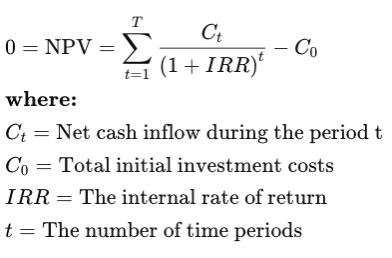
    While ROI shows how much value is created, IRR shows how efficiently that value is created over time. IRR is the discount rate at which the Net Present Value (NPV) of all future cash flows equals zero. In simple terms, IRR indicates the rate of return a project or investment is expected to generate over a time period (typically one year).

    Put simply, IRR answers the question:

    “Is this investment growing fast enough to justify the money tied up in it?”

    Mathematically, IRR is the rate that satisfies:
    irr formula

    IRR is particularly useful when:

    • Comparing multiple initiatives with different lifespans.
    • Benchmarking against the company’s cost of capital.
    • Prioritizing investments competing for the same budget.

    If IRR exceeds the organization’s hurdle rate or Weighted Average Cost of Capital (WACC), the investment is financially attractive.

    ROI vs. IRR: When to Use Each

    Metric Best Used For Key Strength Limitation
    ROI Executive justification Simple, intuitive Ignores time value of money
    IRR Investment comparison Time-adjusted efficiency Less intuitive, harder to explain
    Payback Risk assessment Speed of return Ignores long-term value

    Together, these metrics provide a balanced financial narrative.

    Real-World Example: Actian at GEMA

    A concrete illustration is the GEMA case study, analyzed by Nucleus Research. By deploying the Actian Data Intelligence Platform, GEMA achieved:

    • 140% ROI.
    • 15-month payback period.
    • 94% IRR over three years.
    • Over €1M/year in technology cost savings.
    • €2.25M in productivity gains.
    • More than 400 certified data products and 11 AI models in production.

    This level of return was possible because the Actian platform acted not just as another tool, but as a value multiplier, enabling cost reductions, productivity gains, and monetization of data products and AI projects. This was only possible through governed, high-quality data and metadata — delivered by the platform through its flexible and lightweight data governance framework, laid out on its robust cloud-native architecture.

  2. ROI of the Data Itself (Tactical and Operational View) While project-level ROI secures funding, it does not answer a critical operational question: “Which data assets actually create value?”This leads to a second, increasingly important approach: ROI at the data-asset level. Instead of treating data platforms as monolithic investments, this approach evaluates ROI for:
    • Datasets
    • Dashboards and reports
    • Analytical models
    • Data products

    Common and practical methods include these five:

    1. Time Savings: Quantifying hours saved by analysts and business users through trusted, reusable data assets.
    2. Adoption and Reuse: Measuring how many teams/domains consume the same asset to avoid duplication, which reduces data storage and processing costs, and improves usability.
    3. Decision Enablement: Linking data assets to the operational, tactical, or strategic decisions they support, helping data teams prioritize initiatives based on business impact.
    4. Risk Reduction: Estimating avoided costs related to data errors, regulatory breaches, compliance issues, or misuse of sensitive data.
    5. Revenue Impact: Capturing direct data monetization or indirect effects on revenue drivers such as churn reduction, pricing optimization, and cross-sell opportunities.

    Taken together, this approach transforms data assets into measurable economic units, enabling value-driven prioritization rather than effort-driven delivery.

    However, achieving this in practice requires the definition of a dedicated ROI calculation methodology — either developed internally or adapted from existing market frameworks. In most cases, these frameworks must be tailored to the organization’s industry, business model, and data maturity, each bringing its own advantages and trade-offs.

    There is no off-the-shelf solution that can automatically calculate ROI for data assets in a standardized way. Each data asset may require a different ROI logic depending on factors such as its intended use cases, criticality to the business, regulatory exposure, and the specific industry or segment in which the organization operates. As a result, operationalizing data-level ROI is as much a governance and operating model challenge as it is a technical one.

  3. When Each Approach Applies—and Why Both are Required
    Scenario Project ROI Data-Asset ROI
    Budget approval ✅ Critical ⚠️ Supporting
    Strategic planning ✅ Critical ⚠️ Supporting
    Backlog prioritization ❌ N/A ✅ Critical
    Data mesh & data products ⚠️ Supporting ✅ Critical
    Value-based governance ❌ N/A ✅ Critical

    Bottom line:

    • Project-level ROI secures the CFO’s approval and justifies the initial investment.
    • Data-level ROI ensures sustained value realization over time.
    • Operationalizing data-level ROI requires a tailored methodology, not a one-size-fits-all solution, reflecting the unique context, use cases, and economic impact of each asset.

    How Actian Enables and Scales ROI in Data

    actian solution architecture for data roi

    Actian Solution Architecture for Data ROI

    Turning ROI from a theoretical exercise into a scalable, repeatable capability requires an architecture that connects data quality, cost signals, and business context into a single analytical flow. The solution architecture illustrated above shows how Actian enables this end-to-end.

    Rather than treating ROI as a one-time business case exercise, this approach embeds the ROI calculation directly into the data operating model, making it observable, explainable, and continuously updated.

    Data Observability: Quality Signals that Ground ROI in Reality

    Actian Data Observability — or equivalent solutions from other vendors — provides the foundational signals required to make the ROI calculation objective and defensible.

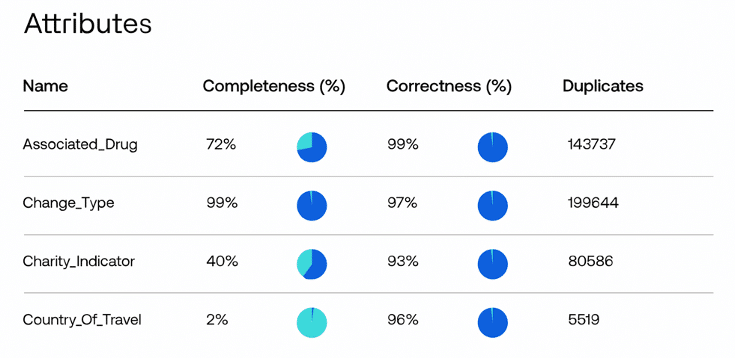
    By continuously monitoring datasets, pipelines, and data products, this layer generates data quality metrics such as freshness, completeness, accuracy, volume anomalies, and schema drift.
    data quality attributes

    Examples of Data Quality Metrics

    These metrics directly influence ROI in two ways. First, they expose hidden costs caused by poor data quality (reprocessing, rework, incident resolution, failed analytics, or AI pipelines). Second, they act as leading indicators of value because high-quality, reliable data drives adoption, reuse, and faster decision-making.

    Exposed via APIs and/or webhooks, these signals become structured inputs for ROI calculations, replacing subjective assessments with measurable evidence.

    Actian Data Intelligence: The Semantic and Governance Core of Data ROI

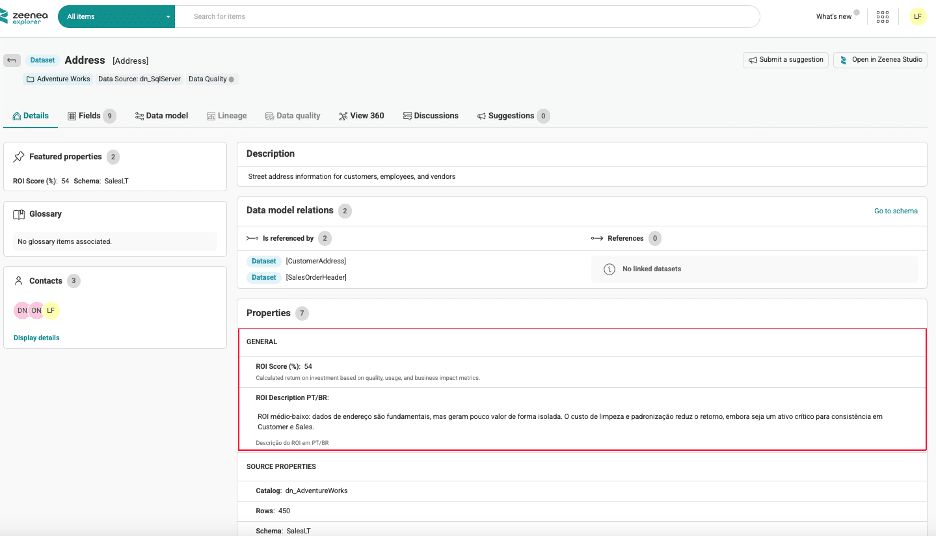
    Actian Data Intelligence Platform is the central nervous system of the architecture. It catalogs all data assets and enriches them with curated, governed metadata that gives ROI its business meaning. The platform also stores the ROI for all managed data assets, as shown by the custom properties highlighted in red in the image below.
    tracking dataset roi

    Tracking Dataset ROI on Actian Data Intelligence Platform With Custom Properties

    Beyond ownership, lineage, and certification, the platform integrates data quality metrics from observability tools and associates them directly with each asset. Through its business glossary and federated data catalogs, it also captures critical business context, such as asset criticality, regulatory exposure, domain ownership, and supported use cases.

    This context is made programmatically available via the Actian MCP Server, enabling ROI calculations to incorporate not just technical metrics, but business relevance. Without this layer, ROI would be reduced to infrastructure efficiency; with it, ROI becomes a business-aligned metric.

    ROI Engine: ROI Calculation and Aggregation at Scale

    Actian Data Platform acts as the analytical engine that operationalizes ROI.

    It ingests and aggregates signals from multiple sources — data observability tools, infrastructure monitoring platforms, and the Actian Data Intelligence Platform — and applies business rules, weighting models, and asset-specific formulas to compute ROI. This allows organizations to support multiple ROI methodologies in parallel, tailored by industry, domain, and/or asset type.

    The resulting ROI scores are continuously updated and pushed back to the Actian Data Intelligence Platform via APIs, where they become visible to data producers and consumers alike. This closes the feedback loop between data quality, usage, and value.

    From Justification to Continuous ROI Governance

    As previously explored, beyond generating ROI directly through its adoption, the Actian Data Intelligence Platform lays the foundation for a complete solution architecture that automates ROI measurement for managed data assets, connecting usage, quality, business impact, and financial value. Together, the components in the Actian Solution Architecture for Data ROI form a closed-loop solution that transforms ROI into an operational capability rather than a static justification exercise.

    In a world where AI initiatives consume growing portions of the data budget, success is no longer defined by experimentation, but by the ability to continuously prove value. That is the strategic role of Actian: turning data into governed, measurable, and profitable assets.


Summary

  • Data intelligence involves collecting and refining raw data into valuable information to understand markets and ecosystems.
  • While Business Intelligence focuses on operational processes, Data Intelligence is oriented toward shaping future strategies.
  • Key benefits include faster decision-making based on real-time data, reduced risk exposure, and improved cost control.
  • The process follows a structured path from collection and cleaning to analysis and final decision support.

(Post revised 12/28/25)

The term data intelligence refers to all the methods and processes that contribute to the collection and analysis of data to identify key trends that can be used to understand a market or ecosystem. In other words, data intelligence consists of refining a large volume of raw data to turn it into exploitable and valuable information.

In this article, you will discover all you need to know about data intelligence, from its definition to the advantages it can bring to your company.

Understanding Data Intelligence

Companies undergoing a digital transformation collect and generate large volumes of data. This data from different sources (sometimes third-party data sources) is important to collect and essential to classify, understand, analyze, and thus enhance. This is the very definition of data intelligence. This discipline, which is part of data science, aims to identify, via raw data, value-added information likely to facilitate decision-making in an organization.

The raw data collected must be considered a precious resource that must be transformed and refined to reveal all its subtlety. Data intelligence reveals the information to be extracted from the data. Data intelligence can, for instance, be used to identify growth or development opportunities for a company, predict the impact of economic changes on an ecosystem, or get ahead of competitors regarding new market trends.

How Data Intelligence Works

Data intelligence transforms raw data into meaningful insights through a structured, repeatable process. While tools and technologies may vary, most data intelligence systems follow the same core stages:

1. Data Collection

Data is gathered from multiple sources such as databases, applications, sensors, websites, and user interactions. These sources can include both structured data (like spreadsheets or transaction records) and unstructured data (like text, images, or logs).

2. Data Integration and Cleaning

Collected data is combined into a unified view. During this step, errors, duplicates, and inconsistencies are identified and corrected. Cleaning and standardizing the data ensures accuracy and reliability before analysis begins.

3. Data Processing and Storage

The prepared data is processed and stored in systems designed for analysis, such as data warehouses or data lakes. This allows large volumes of data to be accessed efficiently and securely.

4. Analysis and Modeling

Analytical techniques—ranging from basic statistics to machine learning models—are applied to uncover patterns, trends, and relationships. This step turns data into insights, such as identifying risks, predicting outcomes, or highlighting opportunities.

5. Visualization and Reporting

Insights are presented through dashboards, charts, and reports that make complex findings easy to understand. Clear visualizations help users quickly grasp what the data is showing and why it matters.

6. Decision Support and Action

Finally, insights are used to inform decisions and guide actions. Organizations can optimize processes, improve performance, and adapt strategies based on evidence rather than guesswork.

Together, these steps allow Data Intelligence to continuously convert data into actionable knowledge, supporting smarter and more confident decision-making.

What are the Differences Between Data Intelligence and Business Intelligence?

Regarding data, disciplines sometimes tend to overlap and tangle in their names and vocations. For example, we often mistake data intelligence with business intelligence, which has very different goals. Indeed, data intelligence aims to create the conditions for structuring data assets with a view to subsequent exploitation. Business intelligence, on the other hand, is a process that adds value to data once it has been refined by data intelligence.

To summarize, data intelligence contributes to organizing the available information within the company, and business intelligence organizes the company’s activity according to the available information. Therefore, data intelligence is a discipline that is firmly oriented towards the elaboration of future strategies (to identify investment opportunities, for example), whereas business intelligence is based on the understanding of operational processes.

In any case, data intelligence and business intelligence remain intrinsically linked because they both contribute to making your company’s decision-making processes more fluid.

The Company Objectives for Data Intelligence

Are you considering embarking on a data intelligence project? To do so, you need to set a clear roadmap and define clear company objectives. Data intelligence allows you to analyze your organization’s performance and implement corrective measures where improvements can be made.

Because data intelligence relies on the analysis of a wide range of data, it allows for advanced correlations to create extremely fine-grained, in-depth analyses. For instance, if your company has a strong online presence, data intelligence will also allow you to understand and anticipate your customers’ behavior by exploiting navigation cookies.

What are the Benefits of Data Intelligence?

Let’s take a look at some of the benefits companies and organizations can expect by implementing a data intelligence system.

Better Decision Making

It’s in your best interest to leverage data intelligence to better leverage your data assets. Indeed, the first benefit of data intelligence is the acceleration of decision-making processes. Forget intuition and risky bets: decisions are based on real-time observations made and quality data.

Better Risk Management

Data intelligence also means reducing your risk exposure so you can make decisions based on the knowledge you gain from your data. Less risk of error in strategic decisions also translates into better cost control. Data intelligence helps identify duplicate data and unnecessary steps in the analysis or decision-making processes that are detrimental to your company’s productivity.

Better Understanding of Your Customers

Data intelligence allows you to be both more effective and more efficient. It is a promise to take a step back from your business to identify tomorrow’s trends before your competitors do.

Better Scalability

As data volumes grow, data intelligence systems scale to handle increased complexity. Insights gained support strategic planning and sustainable growth over time.

Introducing the Actian Data Intelligence Platform

Actian Data Intelligence Platform is a comprehensive solution designed to help organizations discover, understand, govern, and trust their data. It brings together data discovery, metadata management, data governance, and analytics into a single, integrated platform, enabling teams to turn complex data environments into clear, actionable insight.

By providing a unified view of data across cloud, on-premises, and hybrid systems, the platform makes it easier to locate relevant data assets, understand their context, and assess their quality and usage. Automated metadata collection and lineage tracking help users see where data comes from, how it is transformed, and how it is used across the organization.

Get a personalized demonstration of the platform to see how it can take your company’s data management systems to the next level.


Summary

  • Metadata management provides context, meaning, and control over data.
  • Includes types like descriptive, structural, technical, business, and lineage.
  • Improves data discovery, governance, compliance, and decision-making.
  • Enables automation, standardization, and scalability across systems.
  • Turns fragmented data into a trusted, strategic enterprise asset.

“By 2021, organizations will spend twice as much effort in managing metadata compared with 2018 to assess the value and risks associated with the data and its use.”

*Gartner, The State of Metadata Management

The Definition of Metadata Management

Metadata provides context to your data. To trust your data’s context, you must understand it. Knowing the who, what, when, where, and why of your data means knowing your metadata, otherwise known as metadata management.

With the arrival of Big Data and the various accompanying regulations, data leaders must look further into their data through metadata. Metadata is created whenever data is:

  • Created
  • Added to
  • Deleted from
  • Updated
  • Acquired.

For example, metadata in an Excel spreadsheet includes the date of creation, the name, the associated authors, the file size, etc. In addition, metadata could also include titles and comments made in the document.

In the past, a form of metadata management would be to look up a book’s call number in a catalog to find its location in a library. Today, metadata management is used in software solutions to comply with data regulations, set up data governance, as well as understand the data’s value. Thus, this discipline becomes essential for enterprises.

Types of Metadata

Metadata can be categorized in several ways depending on its purpose and how it is used. Understanding these metadata types helps organizations manage data more effectively and apply the right controls, tools, and standards.

Descriptive Metadata

Descriptive metadata provides information that helps identify and discover data. It includes titles, descriptions, keywords, authors, and tags, making data easier to search, understand, and reuse.

Structural Metadata

Structural metadata explains how data is organized and how different components relate to one another. Examples include schemas, table relationships, file formats, and hierarchies that define how pieces of data fit together.

Administrative Metadata

Administrative metadata supports data management and operations. It often includes:

  • Rights metadata (ownership, licensing, access permissions)
  • Lifecycle metadata (creation dates, retention rules, archival status)

Technical Metadata

Technical metadata describes the technical characteristics of data, such as data types, field lengths, indexes, system configurations, and storage locations. It is essential for developers, engineers, and system integrations.

Operational Metadata

Operational metadata captures information generated during data processing and usage. This includes job logs, processing times, error rates, and data refresh schedules, helping teams monitor performance and reliability.

Business Metadata

Business metadata adds business context to data. It includes business definitions, KPIs, calculations, and usage guidelines that help non-technical users interpret and apply data correctly.

Lineage and Provenance Metadata

This type of metadata tracks where data comes from, how it changes, and where it is used. Lineage and provenance metadata improve transparency, trust, and impact analysis when changes occur.

Security and Privacy Metadata

Security-related metadata identifies sensitivity levels, classifications (e.g., confidential, public), and privacy attributes such as personal or regulated data. It supports compliance, risk management, and access control.

Together, these metadata types provide a complete picture of data—what it is, how it is structured, how it is used, and how it should be governed.

Why Should You Implement a Metadata Management Strategy

Metadata management gives your organization clarity and control over its data ecosystem. By consistently defining, cataloging, and governing metadata, teams can quickly understand what data exists, where it comes from, and how it should be used. This shared understanding reduces confusion, speeds up analytics and reporting, and improves trust in data-driven decisions. When users can easily discover and interpret data assets, productivity increases and the risk of misusing or misinterpreting data drops significantly.

Beyond efficiency, metadata management strengthens data governance, compliance, and scalability. Clear lineage, ownership, and quality indicators make it easier to meet regulatory requirements, protect sensitive information, and enforce data standards. As data volumes and sources grow, well-managed metadata acts as a foundation that supports integration, automation, and advanced analytics initiatives. In short, implementing metadata management turns data from a fragmented resource into a strategic asset that can reliably support long-term business goals.

Benefits of Metadata Management:

  • A better understanding of the meaning of enterprise’s data assets.
  • More communication on a data’s semantics via a data catalog.
  • Data leaders are more efficient, leading to faster project delivery.
  • The use of data dictionaries and business glossaries allow the identification of synergies and the verification of coherent information.
  • Reinforcement of data documentation (deletions, archives, quality, etc.).
  • Generate audit and information tracks (risk and security for compliance).

Metadata Management Best Practices

Below, we’ve compiled a short list of best practices to implement when creating your organization’s metadata management strategy.

Establish Clear Standards and Taxonomies

Define consistent naming conventions, data definitions, and classification schemes. Standardized taxonomies reduce ambiguity, improve interoperability, and make metadata easier to understand and reuse across teams and systems.

Assign Ownership and Governance

Designate metadata owners and stewards responsible for accuracy, updates, and approvals. A governance framework helps resolve conflicts, enforce standards, and ensure accountability over time.

Automate Metadata Capture

Leverage tools and integrations to automatically collect technical and operational metadata. Automation minimizes manual effort, reduces errors, and keeps metadata synchronized with source systems.

Ensure Quality Through Validation and Audits

Apply validation rules to check completeness, accuracy, and consistency. Conduct regular audits to identify gaps, outdated entries, or noncompliance with standards.

Improve Discoverability and Lineage

Enable robust search, tagging, and lineage tracking so users can easily find data and understand its origins, transformations, and usage. This builds trust and supports better decision-making.

Document Policies and Train Teams

Maintain clear documentation of metadata policies, processes, and roles. Provide ongoing training so teams understand how to create, maintain, and use metadata effectively as systems evolve.

Manage Your Metadata With a Metadata Management Platform

With the Actian Data Intelligence Platform, transform your metadata into exploitable knowledge! Our metadata management platform automatically curates and updates your information from your storage systems. It becomes a unique, up-to-date source of knowledge for any data explorer in the enterprise.

Ready to see how the platform can transform your business’s metadata management practices? Get a personalized demonstration today.


Summary

  • AI observability provides visibility into the internal state of AI models to ensure they operate reliably and accurately.
  • It involves monitoring model performance, data drift, and bias to prevent “hallucinations” or unexpected outputs.
  • By tracking how models evolve over time, organizations can maintain high standards for safety and ethical transparency.
  • Advanced observability tools help teams quickly identify the root cause of issues, whether in the data or the model itself.

As artificial intelligence (AI) becomes a cornerstone of digital transformation across industries, it’s crucial to ensure its reliability, transparency, and performance.  AI observability is a rising discipline designed to provide insight into the internal workings of AI systems.

It empowers organizations to monitor, debug, and improve AI models and infrastructure in real time, much like how traditional observability helps manage software systems. This article explores what AI observability is, why it matters, its core components, and how businesses can implement it effectively.

Defining AI Observability

AI observability refers to the ability to monitor, understand, and explain the behavior of AI systems across their entire lifecycle—from data ingestion and model training to deployment and real-time inference. It goes beyond simple logging or monitoring by offering holistic visibility into how data, models, and infrastructure interact.

The Role of AI Observability in Modern Systems

In traditional software engineering, observability focuses on metrics, logs, and traces to ensure application health. AI observability builds on this foundation but addresses AI-specific elements such as model drift, data skew, and fairness.

Its role is multifaceted:

  • Transparency: Making black-box models more understandable.
  • Accountability: Ensuring models perform ethically and within regulatory bounds.
  • Optimization: Enhancing system performance and reducing resource waste.

With AI now embedded in mission-critical workflows (for instance, organizations are increasingly using AI for loan approvals, medical diagnoses, and fraud detection), observability isn’t just beneficial; it’s essential.

AI Observability’s Role

Let’s take a closer look at the role of AI observability within a larger organization. Below, we discuss some simple benefits that come from a consistent data observability program.

Enhancing System Reliability

AI systems are notoriously complex and sensitive to changing inputs, environments, and user behavior. AI observability enhances reliability by continuously tracking key indicators like:

  • Model accuracy and latency.
  • Input/output data trends.
  • Infrastructure availability.

This ensures that the AI system performs consistently, even in dynamic conditions.

Facilitating Proactive Issue Resolution

Rather than reacting to failures after they occur, observability allows teams to anticipate issues. For example, a spike in prediction latency or a drop in confidence scores can signal impending failure. Observability tools can trigger alerts, identify root causes, and even suggest fixes before customers or end-users are impacted.

Key Components of AI Observability

AI observability consists of several components. First, we will discuss the cycle of AI observability and then list a few ways in which a proper observability program can help organizations improve and maintain high data quality.

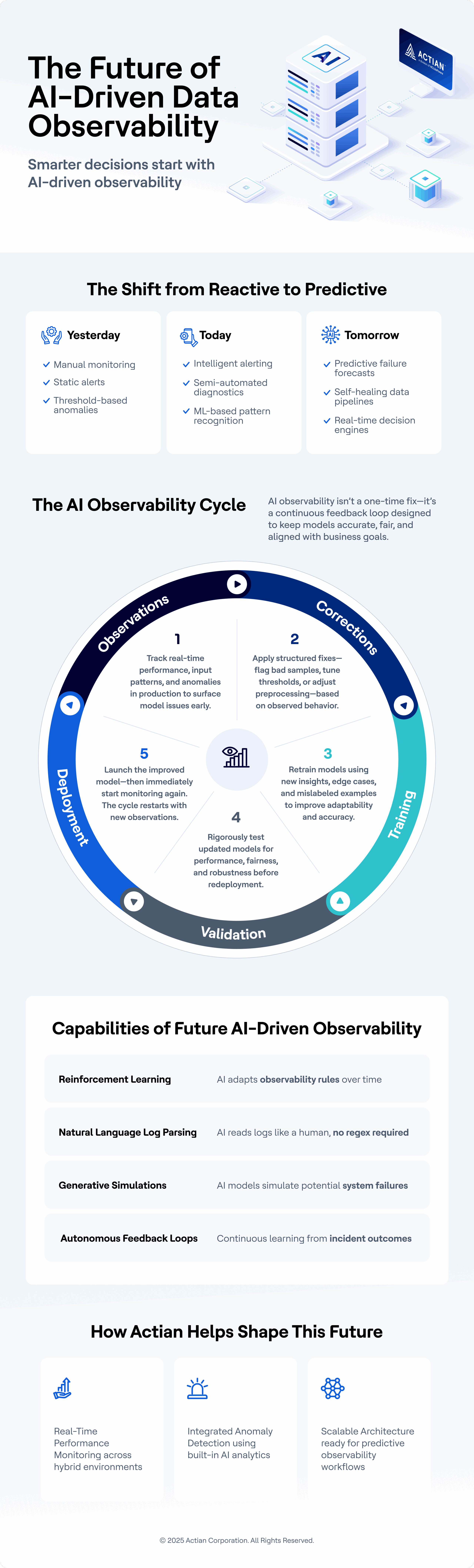
The AI Observability Cycle: From Observations to Deployment

AI observability is a continuous, iterative process that ensures models remain accurate, fair, and aligned with business goals. This process typically follows a cycle consisting of observations, corrections, training, validation, and deployment:

  1. Observations
    Observability begins with capturing real-time insights into model behavior in production. This includes tracking performance metrics, analyzing input distributions, and detecting anomalies or failure patterns. These observations provide the critical data needed to understand how a model is functioning in the wild.
  2. Corrections
    Once issues are observed, teams can apply targeted corrections. This might involve flagging problematic samples, adjusting decision thresholds, or updating preprocessing pipelines. Corrections are not always immediate model changes but rather structured inputs into the improvement process.
  3. Training
    Corrected insights inform the next training cycle. New or updated data, including edge cases and previously misclassified examples, are used to retrain the model. This step ensures the model learns from its mistakes and adapts to new patterns or distributions.
  4. Validation
    Before deployment, retrained models must be rigorously validated. This includes not only standard metrics but also robustness checks, fairness audits, and performance evaluations under various conditions. Validation ensures that changes improve the model without introducing new risks.
  5. Deployment
    Once validated, the improved model is deployed into production. However, this doesn’t mark the end of the cycle. Instead, observability tools immediately begin collecting new data and metrics, restarting the loop at the “Observations” step. This continuous deployment-feedback cycle enables sustained model performance and trustworthiness over time.

Metrics Used in AI Observability

Beyond standard metrics like accuracy or precision, AI observability dives deeper. It includes factors like:

  • Drift detection (e.g., concept and data drift).
  • Fairness and bias checks.
  • Confidence interval analysis.

These insights enable continuous evaluation and retraining of models, helping prevent deterioration over time.

System Resource Management

AI systems demand substantial computational resources. Observability also involves checking and managing resource usage, including:

  • GPU/CPU utilization.
  • Memory bottlenecks.
  • Throughput per node or container.

Monitoring system resources ensures AI workloads are optimized and cost-effective.

Challenges in Implementing AI Observability

Implementing any systematic observability program will involve some challenges, despite the numerous benefits. Below, we’ve listed some of the more common issues organizations might face when putting a robust AI observability process in place.

Overcoming Data Complexity

AI models rely on diverse and high-dimensional data. Observing data pipelines that involve real-time streams, batch processing, and third-party sources is a complex ask. Organizations must design observability solutions that can handle:

  • Unstructured data (e.g., images, text).
  • Multi-modal inputs.
  • Large-scale feature sets.

Solving this requires scalable data tracking systems and robust validation mechanisms.

Ensuring Scalability and Flexibility

As organizations deploy AI across more business units and use cases, observability systems must scale accordingly. This includes:

  • Supporting cloud-native, hybrid, and on-prem environments.
  • Integrating with multiple AI frameworks (e.g., TensorFlow, PyTorch).
  • Handling high-throughput data pipelines.

Scalability must also be matched with flexibility to support experimentation and model updates without disrupting observability.

How to Get Started With AI Observability

Here are the six steps to take when first implementing an AI observability process within an organization.

  1. Define objectives: Understand what the organization wants to observe. This could include data drift, model bias, resource usage, etc.
  2. Audit the current AI stack: Identify gaps in visibility across data, models, and infrastructure.
  3. Select observability tools: Choose solutions that align with the chosen use cases and integrate well with existing data pipelines.
  4. Start with pilot projects: Monitor a single AI system, gather feedback, and iterate across additional projects. This can help identify problems in the process before they affect things on a larger scale.
  5. Automate and scale: Once successful, apply observability practices across other models and systems.
  6. Create a governance framework: Assign roles, responsibilities, and SLAs for maintaining observability.

Tools and Technologies to Consider

Here are key tools for AI observability categorized by functionality:

  • Model Monitoring: Arize AI, Fiddler, Superwise, WhyLabs.
  • Pipeline Orchestration: Airflow, Kubeflow, Prefect.
  • Versioning & Experiment Tracking: MLflow, DVC, Weights & Biases.
  • Data Validation: Great Expectations, Evidently AI.
  • Infrastructure Monitoring: Prometheus, Grafana, Datadog.

Choosing the right combination ensures that all layers of the AI stack (data, model, and infrastructure) are continuously observable.

Actian is a leader in hybrid data analytics and is actively shaping the future of AI observability.

Here’s how the Actian Data Intelligence Platform supports AI observability:

  • Real-Time Data Monitoring: Ensures AI systems receive fresh, reliable data through built-in validation and cleansing.
  • Integrated Model Observability: Seamlessly connects model outputs with operational dashboards and alerts.
  • Cross-System Integration: Bridges AI workloads across cloud and on-prem environments, offering visibility into the full data journey.
  • Scalable Data Architecture: Supports large-scale AI deployments without compromising performance or control.

With Actian, organizations gain the infrastructure and tools needed to monitor AI pipelines, respond proactively to issues, and ensure models deliver consistent, trustworthy results.


Summary

  • Metadata is “data about data” that adds context and meaning.
  • Improves organization, searchability, and data management.
  • Types include structural, descriptive, administrative, legal, and definitional.
  • Supports governance, lineage tracking, and interoperability across systems.
  • Enables better discovery, understanding, and use of data assets.

Metadata provides essential context, meaning, and structure to raw data. Just as a library catalog helps readers understand the details of a book (like its title, author, and publisher), a data catalog uses metadata to provide the background information that allows users to understand, manage, and utilize data effectively.

In this article, we will explore why metadata is important, the different metadata categories, and how metadata is used.

What is Metadata?

Metadata is essentially data about data. It provides information about other data assets, helping describe, manage, and organize them. While the primary data holds the actual content (like a document, image, or dataset), metadata gives context and meaning to that content, making it easier to search, manage, and understand.

Why is Metadata Important?

Metadata serves as a guide to understanding, navigating, and managing data, adding significant value to data-driven processes. Here are some of the key reasons why metadata is important:

  • Organization: It helps keep data organized and easy to find, especially in large datasets or repositories.
  • Data Management: Metadata enables efficient management of data, such as tracking file versions, ensuring proper access, and facilitating backups.
  • Searchability: Metadata enhances the ability to search for and retrieve data quickly based on keywords, dates, or other descriptive criteria.
  • Interoperability: Metadata ensures that data can be understood and used correctly across different systems and platforms, improving data sharing.

5 Types of Metadata

Metadata can be categorized into several types, each serving different purposes. Let’s take a look at the main metadata types.

1. Structural Metadata

This type of metadata describes the organization and structure of data, including relationships between different components of data or how data is organized in a system. It’s often used to track data lineage. Examples include:

  • Information about how a document is divided into chapters or sections.
  • Descriptions of data formats (such as tables, columns, and rows in a database).
  • Metadata about a digital file’s parts (e.g., a multimedia file might have metadata for audio and video streams).

Structural metadata helps with navigating and understanding how data is organized or how different parts of a resource are interrelated.

2. Descriptive Metadata

This type describes the content and attributes of the data, making it easier to discover and identify. Examples include:

  • The title, author, keywords, abstract, and subject for a document.
  • The tags, descriptions, and captions for images, videos, and other media.

This type of metadata helps users find and understand the content of a dataset, file, or resource through search and discovery processes.

3. Administrative Metadata

This type of metadata describes the actions taken to preserve the data and ensure its long-term accessibility, integrity, and authenticity. Examples include:

  • Information about backup processes, format migrations, and preservation actions.
  • Integrity checks like hash values or checksums.

This type of metadata helps maintain the longevity and reliability of digital resources over time, ensuring that they remain accessible and usable in the future.

4. Legal Metadata

Legal metadata provides information on the management of resources, including technical details, permissions, and rights. Examples include:

  • File creation date, file format, and file size.
  • Access control (who can view, edit, or distribute the data).
  • Information related to rights management, such as licensing or copyright information.

This type of metadata facilitates the management, preservation, and access control of data or resources.

5. Definitional Metadata

Definitional metadata refers to metadata that provides essential information about the meaning, context, or definition of the data itself, helping users understand what the data represents and how to interpret it. It’s a specific type of metadata that focuses on the conceptual and semantic aspects of the data, often used to ensure consistency and clarity when sharing or analyzing data. Examples include:

  • The field definition in a database.
  • The column definition in a spreadsheet.
  • The units of measurement for data fields.

This metadata type ensures that everyone interprets data in the same way, especially in large datasets or across different systems.

Examples of Metadata

Let’s look at some of the common examples of metadata for images, websites, and documents.

  • For an image: Resolution, file size, format (JPEG, PNG), creation date, location (GPS coordinates if available), and camera model.
  • For a website: Title, description, keywords, author, last modified date, and HTML tags.
  • For a document: Title, author, file type, date created, and word count.

How is Metadata Used?

Metadata is used to provide information about data, making it easier to find, organize, and understand. It essentially describes the structure, characteristics, and context of a piece of data, which can be crucial for managing and interpreting large datasets. Here are some common ways metadata is used.

Data Organization

Metadata such as file size, creation date, author, and format help categorize files efficiently. In databases, metadata describes the structure of tables, columns, relationships, and constraints, helping software or users understand how to query the data and what information is available.

Data Management and Governance

Metadata can track the origin and transformations of data as it moves through different systems. This is important for ensuring data accuracy and reliability, especially in complex workflows.

Metadata also helps manage access permissions and ensures that sensitive data is protected. For example, metadata can indicate who has permission to access, modify, or share certain pieces of data.

Search, Discovery, and Retrieval

Metadata allows for more accurate and efficient searches. For example, the tags and descriptions on an image or video file provide context that enables more precise search results. In websites or digital libraries, metadata like keywords, author information, and categories help users find relevant content more easily. For example, when you search for a document on your computer, the operating system uses metadata to locate files based on attributes like file type or last modified date.

Organizing metadata in a knowledge graph can help improve searchability by providing context and links between related data.

Data Interchange and Standards

In systems that share data, metadata ensures that data can be correctly interpreted across platforms. For instance, in the case of a CSV file, metadata might specify the delimiter used or the format of dates, allowing different systems to properly import and process the data.

Metadata can be used to enforce standards in data collection, such as specifying the units of measurement, language, or other relevant attributes, ensuring consistency in datasets.

Content and Media Management

For images, audio, video, and other digital content, metadata includes details like resolution, camera settings, file type, author, copyright, and much more. This helps in organizing, editing, and even automating processes, such as automatic tagging or categorization.

Metadata in music files (like MP3s) includes information like the song title, artist, album, genre, and track number, which helps users organize and search their media libraries.

Improving User Experience

On platforms like social media or e-commerce sites, metadata can be used to recommend content or products based on user preferences and behavior. For instance, metadata about a user’s past activity might be used to suggest similar articles or products.

Metadata can be used to adjust the display of content, such as showing the release date for movies or showing a document’s last updated date.

Use the Actian Data Intelligence Platform to Manage Metadata

If an organization needs help managing and leveraging metadata for better data discovery, look no further than the Actian Data Intelligence Platform. The platform provides an active metadata management solution to power data and analytics use cases.

Our platform collects, inventories, and shares metadata throughout the organization and across all of its data sources. It leverages intelligent search to map complex relationships between data assets, users, processes, and other metadata elements. Intelligent search includes natural language processing and semantic analysis for more relevant search results.


Summary

  • Data governance tools ensure data quality, security, and compliance.
  • Automate cataloging, lineage, access control, and policy enforcement.
  • Improve efficiency, collaboration, and data accessibility.
  • Reduce risks like breaches, inconsistencies, and compliance violations.
  • Scale with growing data needs while maintaining control and trust.

Businesses rely heavily on accurate, secure, and well-managed data to drive decisions and foster growth. As organizations generate vast amounts of information, the need for effective data governance becomes increasingly crucial. Data governance tools provide a structured approach to managing, protecting, and ensuring the quality of data across an organization. These tools help establish clear policies, improve compliance, and enhance data accessibility, all while mitigating risks associated with data breaches or inconsistencies.

Let’s explore the key benefits of implementing data governance tools and how they can empower businesses to unlock the full potential of their data.

What is Data Governance?

Data governance is a set of practices, policies, and processes designed to ensure that an organization’s data is accurate, secure, and used responsibly across all departments. It involves defining clear ownership and accountability for data, setting standards for data quality, and implementing access controls to protect sensitive information.

Data governance aims to establish rules for data management, such as how data should be collected, stored, accessed, and shared, while ensuring compliance with legal and regulatory requirements. By providing a structured framework, data governance helps organizations maintain data integrity, reduce risks, and ensure that data is leveraged effectively for decision-making and operational efficiency.

What are Data Governance Tools?

Data governance tools are software solutions designed to help organizations manage, monitor, and enforce their data governance policies and practices. These tools for managing data quality, ensuring compliance, and protecting sensitive information across various systems. Often delivered through a platform, they offer features like data cataloging, metadata management, access controls, data lineage tracking, and audit trails, which help businesses maintain visibility and control over their data assets.

By automating key governance tasks, these tools streamline processes, reduce manual errors, and improve collaboration among teams, ensuring that data is accurate, secure, and accessible to the right people. Ultimately, data governance tools help organizations maximize the value of their data while helping to minimize risks associated with data mismanagement.

6 Benefits of Data Governance Tools

Data governance tools provide a wide range of advantages that enable organizations to harness the full potential of their data. Below, we explore several key benefits of implementing these tools across an organization.

1. Improved Data Quality

Data governance tools help establish and enforce data quality standards, ensuring that data is accurate, consistent, and up to date. By automating data validation and cleaning processes, these tools reduce errors and discrepancies that could otherwise hinder decision-making. This leads to more reliable insights and reduces the risk of acting on faulty information, which is crucial for driving informed business decisions.

2. Enhanced Data Security and Compliance

With increasing concerns around data privacy and stricter regulations like GDPR, CCPA, and HIPAA, organizations must prioritize data security and compliance. Data governance tools enable businesses to manage and protect sensitive data by setting up access controls, encryption, and audit trails. These tools also help monitor and enforce compliance with relevant regulations, reducing the risk of costly fines, legal repercussions, or damage to reputation.

3. Increased Operational Efficiency

Data governance tools streamline data management processes by automating tasks such as data classification, reporting, and policy enforcement. This reduces the need for manual intervention, and the time spent on maintaining data quality, allowing employees to focus on higher-value activities. Moreover, these tools promote better collaboration between teams by providing a centralized platform for managing data, fostering improved communication and decision-making.

4. Better Data Accessibility and Collaboration

Data governance tools make it easier for employees to access the data they need while ensuring that access is restricted based on role or department. By implementing a clear data ownership structure and using features like data cataloging and metadata management, these tools ensure that the right people have access to the right data at the right time. This improves collaboration across teams, enabling a more agile and data-driven organization.

5. Mitigation of Data Risks

One of the biggest advantages of data governance tools is their ability to identify and mitigate risks related to data management. By tracking data lineage, monitoring for inconsistencies, and ensuring proper data stewardship, these tools help businesses quickly identify potential issues and identify the root cause before they escalate. This proactive approach to risk management helps safeguard against data breaches, compliance violations, and reputational damage.

6. Scalability for Growing Data Needs

As organizations grow, so does their data volume and complexity. Data governance tools offer scalability, allowing businesses to manage increasing amounts of data without sacrificing quality or security. These tools can adapt to changing data environments and are equipped with features that allow businesses to scale their governance practices as they expand, ensuring that data remains properly managed even as new data sources and systems are integrated.

Actian Data Intelligence Platform as a Data Governance Tool

Actian Data Intelligence Platform is a powerful tool designed to simplify and optimize how organizations manage and access their data. It acts as a comprehensive data marketplace that enables teams to discover, access, and share trusted data across the enterprise.

By leveraging cloud-native architecture, the Actian Data Intelligence Platform seamlessly integrates with various data sources, including Cloud, ERP/CRM, NoSQL, and relational databases, ensuring universal connectivity and efficient data consolidation. The platform is powered by advanced metadata management and knowledge graph technologies, providing in-depth search capabilities, intelligent data recommendations, and enhanced data discovery. With built-in security features and compliance standards such as SOC 2 Type II and ISO 27001, the Actian Data Intelligence Platform helps organizations manage their data securely while improving governance, compliance, and operational efficiency.

Who is the Actian Data Intelligence Platform Right for?

Actian Data Intelligence Platform is ideal for organizations of all sizes and industries that need a scalable, secure, and efficient way to manage and govern their data. It is particularly well-suited for companies that deal with complex data ecosystems, where data is distributed across various sources, formats, and platforms. This includes businesses in sectors such as finance, healthcare, retail, and technology, where data governance, security, and accessibility are crucial.

Actian Data Intelligence Platform is also a great fit for data teams, including data stewards, analysts, and engineers, who require a comprehensive tool to streamline data discovery, improve collaboration, and enforce governance policies. It is well-suited for organizations looking to enhance data accessibility across teams while maintaining strict control over data quality and security.

Additionally, the Actian Data Intelligence Platform supports organizations in regulated industries that must comply with data privacy and security regulations like GDPR, HIPAA, and CCPA. Its advanced metadata management and compliance features make it an ideal choice for businesses aiming to meet these regulatory requirements with minimal effort.

Explore the Benefits of the Actian Data Intelligence Platform

Data governance tools play a pivotal role in helping organizations manage their data more effectively, ensuring its quality, security, and compliance. By implementing these tools, businesses can unlock the full potential of their data, improve operational efficiency, and mitigate risks. Actian Data Intelligence Platform, as a leading data intelligence platform, exemplifies the power of robust data governance by offering seamless data discovery, centralized management, and advanced compliance features. With the Actian Data Intelligence Platform, organizations can not only enhance data accessibility and collaboration but also enforce strong governance policies across their entire data ecosystem. Whether managing large-scale data operations or navigating complex regulatory landscapes, the Actian Data Intelligence Platform provides the tools necessary to drive data-driven success and secure a competitive edge.

Ready to see all that the Actian Data Intelligence Platform has to offer? Take an online product tour or request a personalized demo today.


Data Governance for Life Sciences: Enabling Secure, Compliant, and Insightful Innovation

Data is the backbone of the life sciences industry. From clinical trial data and genomic information to regulatory submissions and manufacturing quality metrics, organizations generate and rely on vast amounts of data every day. Managing, protecting, and using this data responsibly is critical—not just for compliance, but for accelerating innovation and improving patient outcomes. This is where life sciences data governance comes into play.

In this article, we explore what data governance means for life sciences organizations, its key components, common challenges, and best practices for effective implementation.

What is Life Sciences Data Governance?

Life sciences data governance refers to the framework of policies, processes, and standards that guide how organizations in biotechnology, pharmaceuticals, and medical research collect, store, manage, and use data.

The goal is to ensure data integrity, security, privacy, and regulatory compliance while enabling researchers, manufacturers, and decision-makers to access trusted data when and where they need it.

Effective data governance ensures that:

  • Data is accurate, consistent, and reliable across all systems and studies.
  • Sensitive research and patient data remain confidential and protected.
  • Organizations comply with global regulations like GxP, FDA 21 CFR Part 11, and GDPR.
  • Authorized personnel can access trusted data for faster insights and collaboration.

Key Components of Life Sciences Data Governance

Each organization’s data governance plan should align with its unique goals, regulatory requirements, and data ecosystem. However, several core components are universal:

1. Data Quality Management

Data quality is essential for reliable research outcomes and regulatory reporting. Processes for data validation, cleansing, and standardization help ensure that all scientific and operational data are accurate, complete, and consistent. Clean, harmonized data supports everything from discovery research to commercial manufacturing.

2. Data Security and Privacy

Life sciences organizations manage sensitive information—ranging from clinical trial data to proprietary formulations—that must be safeguarded against breaches and unauthorized access. Effective governance enforces strict privacy controls and compliance with industry standards and regulations.

3. Data Stewardship

Assigning clear ownership of data assets ensures accountability. Data stewards are responsible for maintaining data accuracy and consistency across systems, reducing duplication, and establishing trust in shared data environments.

4. Regulatory Compliance

Compliance is at the core of life sciences data governance. Frameworks must align with global regulations, including GxP, EMA, FDA, and ICH guidelines. Regular audits, documentation, and traceability ensure readiness for regulatory inspection and certification.

5. Data Access and Usage

A robust governance strategy defines who can access data and under what circumstances—ensuring that researchers, clinicians, and partners use data ethically and transparently.

6. Data Lifecycle Management

From early research to post-market surveillance, the data lifecycle spans decades. Governance frameworks must address how data is created, stored, archived, and eventually retired, ensuring traceability and compliance throughout its lifespan.

Challenges in Life Sciences Data Governance

Despite its benefits, implementing a data governance framework in life sciences comes with challenges:

  • Data Silos – Research, clinical, and manufacturing systems often operate independently, creating fragmented data landscapes that limit collaboration and insights.
  • Regulatory Complexity – Navigating multiple regional and functional compliance requirements (FDA, EMA, MHRA, etc.) adds complexity to governance programs.
  • Data Security Threats – Intellectual property and patient data are attractive targets for cybercriminals, requiring advanced protection measures.
  • Resource Constraints – Effective governance demands skilled personnel, advanced tools, and continuous monitoring—all of which require investment.
  • Cultural Resistance – Change management can be difficult when introducing standardized data practices across global R&D and operational teams.

Best Practices for Effective Life Sciences Data Governance

To build a strong data governance program, life sciences organizations should follow these best practices:

  1. Establish a Governance Framework

    • Define clear roles, responsibilities, and accountability across departments.
    • Align governance objectives with business, scientific, and regulatory goals.
  1. Promote a Data-Driven Culture

    • Educate teams about data governance principles and regulatory implications.
    • Encourage collaboration and data sharing under defined compliance boundaries.
  1. Leverage Advanced Technology Solutions

    • Use integrated data management and analytics platforms to unify data from multiple sources.
    • Implement tools for data lineage tracking, access control, and automated compliance reporting.
  1. Define Clear Data Policies and Standards

    • Standardize data formats and metadata for interoperability and reproducibility.
    • Create transparent policies for data correction, sharing, and retention.
  1. Conduct Regular Audits and Assessments

    • Continuously monitor compliance and data quality.
    • Address gaps or risks proactively to maintain readiness for regulatory audits.
  1. Ensure Transparency and Accountability

    • Maintain detailed audit trails.
    • Encourage open communication about data practices and decisions.

Benefits of Strong Life Sciences Data Governance

Organizations that implement effective data governance experience a wide range of benefits:

  • Enhanced Data Integrity – Reliable data improves research accuracy, clinical trial outcomes, and regulatory submissions.
  • Improved Compliance – Reduces the risk of regulatory violations, fines, and delays in product approvals.
  • Operational Efficiency – Streamlines processes, reduces redundancies, and enables faster decision-making.
  • Accelerated Innovation – Enables better integration of AI, machine learning, and real-world evidence through high-quality, accessible data.
  • Strengthened Partner and Patient Trust – Demonstrates commitment to data ethics and security.

The Role of Leadership in Data Governance

Strong executive leadership drives successful data governance. Leaders must:

  • Champion the importance of trusted data for innovation and compliance.
  • Allocate resources to build scalable, secure governance frameworks.
  • Foster a culture of data responsibility and continuous improvement.

Life Sciences Data Governance and Actian

Data governance in life sciences is no longer a compliance checkbox—it’s a strategic enabler of discovery, innovation, and growth. By implementing robust data governance frameworks, organizations can accelerate R&D, improve collaboration, and strengthen trust among regulators, partners, and patients.

Actian empowers life sciences organizations to make the most of their data through secure, scalable, and cloud-ready data management solutions. Actian Data Intelligence Platform provides integrated tools for data discovery, governance, and analytics—enabling trusted data access across research, clinical, and operational environments.

Request a personalized demo to see how Actian can help your life sciences organization unlock the full potential of your data.