
The Data Product Advantage: What New Global Research Reveals About AI Success


Key Takeaways
- Organizations investing in AI often struggle to move from experimentation to production due to weak data foundations.
- Data product adoption is rapidly increasing, growing from 48% in 2024 to 69% in 2026.
- Companies with mature data products are far more likely to scale AI, with 85% running multiple production AI projects.
- Data products improve AI success by ensuring governance, quality, ownership, and reusable, trusted data assets.
Insights from the 2026 BARC x Actian global research study of 300+ enterprise data leaders (revised July 2026)
Organizations across industries are investing heavily in AI. Yet many initiatives still struggle to move beyond experimentation and deliver consistent business value.
To better understand what separates AI initiatives that scale from those that stall, Actian partnered with BARC, a leading global analyst firm for data and analytics, to conduct a global research study of enterprise data leaders.
Based on insights from more than 300 respondents across industries and regions, the study examines how organizations adopt and operationalize data products and data contracts, and how these approaches influence the success of AI initiatives.
The results reveal a clear pattern: organizations that adopt data products at scale achieve significantly stronger AI outcomes.

BARC × Actian Global Research Report (2026)
AI Ambition vs. AI Reality
Many organizations today have ambitious AI strategies. However, turning those ambitions into production systems that deliver business value is far more difficult than launching pilots or proofs of concept.
AI initiatives depend on reliable data, clear ownership, and consistent data quality across systems. The research shows that trustworthy inputs for AI and decision-making are now the primary drivers behind data product adoption. Without these foundations, models may be developed successfully in isolation but struggle to operate reliably in real-world environments.
This gap between AI ambition and AI execution has become one of the defining challenges for enterprise data teams today.
The research conducted with BARC suggests that the difference often lies in how organizations manage and operationalize their data.
Data Products Have Entered the Roll-Out Phase
The research also shows that data products are moving beyond experimentation and into broader enterprise adoption.
Adoption of data products is accelerating rapidly across the organizations surveyed. In just over a year, the share of organizations using data products operationally increased from 48% in 2024 to 69% in 2026, marking a major shift in how enterprises design and manage data assets.
This suggests that the concept is evolving from an architectural idea into a practical approach for managing and delivering trusted data at scale.
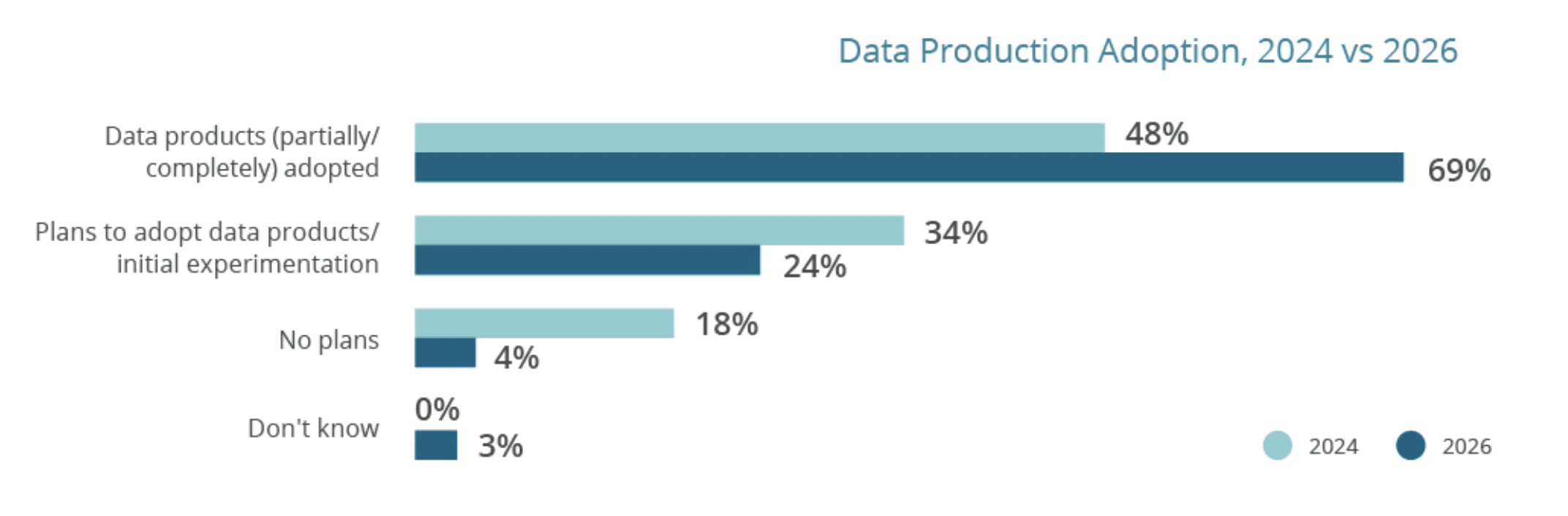
Adoption of data products across organizations. Data products are entering the enterprise roll-out phase – © BARC 2026
The Data Product Advantage
One of the most striking findings from the research is the strong correlation between data product adoption and AI maturity. Organizations that treat data as well-defined, governed, and reusable products are far more likely to move AI initiatives into production and scale them successfully.
In fact, the research shows a clear statistical gap between organizations that have scaled data products and those that have not: 85% of organizations that have established data products company-wide report three or more AI projects in production, compared to just 25% of organizations that are only experimenting with data products or not using them at all.
This suggests that data products are increasingly becoming a practical operating model for delivering reliable data to AI and analytics initiatives.
Why Data Products Matter for AI
Data products introduce several elements that are critical for AI systems to operate reliably at scale — particularly as organizations build the data foundations required for AI.
Data products typically include clearly defined data ownership, documented data contracts and schemas, built-in data quality monitoring and governance, and reusable, discoverable data assets. These elements help ensure that the data used by AI models remains consistent, trustworthy, and well governed.
As AI initiatives grow more complex, particularly with the emergence of agentic and autonomous systems, these foundations become even more important. Without reliable data pipelines and clearly defined data assets, scaling AI across an enterprise becomes extremely difficult.
Download the Full Research Report
This article introduces several key insights from the BARC x Actian global research study.
The full report, Data Products and Data Contracts in 2026: The Foundation for AI Success, explores how organizations across industries and regions are adopting and operationalizing data products and data contracts—and how these practices influence AI maturity, governance, and real-world outcomes.
Get the full report to explore the findings and learn how leading organizations are scaling AI with data products.
If you’d like to learn more about data products, watch this fireside chat by Actian CTO Emma McGrattan.
Download Full Report
Stay connected
Data insights delivered to you.
(i.e. sales@..., support@...)
