Blog | Data Analytics | | 4 min read

Digital Transformation is a Journey, Not a Destination

Digital illustration of a disc with the words "Digital transformation at the center"

Enterprises have had to adjust their business strategies to account for the rapid pace of change and transformation of the last few years. Factors such as technological innovation, decentralized work, and data volume have triggered an acceleration of digital transformation (DX) plans. For many, the COVID-19 pandemic and subsequent lockdowns also sped up the pace of digitization as businesses rushed to establish continuity plans for their distributed workforces.

As a result, this caused organizations to take a step back and assess their digital transformation initiatives and strategies to ensure they keep pace with today’s changing business environment. Customer expectations have changed as well over the past few years, as shoppers increasingly engage with brands online for their shopping needs, in addition to brick-and-mortar stores.

As such, customers expect seamless user experiences that keep them engaged and have reasons to keep interacting with the brand. Businesses today need to take stock of systems, processes and data within the enterprise to ensure they’re in place for an always-on digital transformation journey.

What to Consider Along Any Digital Transformation Journey

Digital transformation is about breaking down barriers between technology and the users who are engaging with it. These barriers commonly create inefficiencies that can slow businesses down, which have a cascading impact on their market competitiveness.

Before any digital transformation journey can begin, it’s crucial to understand your company’s desired goals and outcomes and what that means against the backdrop of the wider business strategy. Having complete alignment on what the organization hopes to get out of digital transformation will ensure that most everyone in the company, across levels and lines of business, understands their role in driving the business forward. To accelerate this effort, businesses should make efforts to educate the appropriate teams on how these changes will directly impact those who work for them. This helps drive buy-in and trust.

The process of identifying digital transformation goals and outcomes looks different for every organization. For many, it can involve assessing internal systems and mapping new technological solutions to them to achieve better business outcomes. It’s crucial that leadership takes a step back and conducts a thoughtful review, ensuring that each department and team’s needs are accounted for, and that the proposed technological solution underpins business goals. Shoehorning new solutions without a meaningful assessment of needs, goals and outcomes can kill digital transformation before it even begins.

Digitally Transformed Data

Digital transformation also seeks to knock down barriers between datasets and those who need access to the data. Silos like these impact effective customer outreach strategies and hinder a great customer experience (CX). The need for interoperability between where data is stored and those who need access to it is a critical driver of digital transformation and is one that must be prioritized.

Enabling easier access to data through digital transformation gives businesses the ability to make real-time decisions based on up-to-date data points and analytics. Given the breakneck speed of digitization, the need for agility means everything today. Whether it’s the pandemic, technological innovation, or other disruptors, the ability to react effectively to a market shift is essential. When built thoughtfully, digital transformation offers improved visibility and provides a path toward acting on timely decisions to keep pace with change.

Digital technology can drastically course-correct a business struggling with efficiency and data silos, but it should be practiced periodically, reviewed and re-assessed. Digital transformation is an ongoing journey, and not just a destination. Digital transformation truly never ends, it only continues to grow and advance alongside a business. Now is the time to take stock of digital needs, map measurable and reasonable outcomes to them, and use the power of technology to drive innovation.

We welcome you to get a consultation on your digital transformation strategies and learn how Actian can help supercharge them with data. Connect with us today.


Blog | Data Analytics | | 4 min read

How to Increase Loyalty and Brand Sentiment Through Data

icons representing the importance of increase loyalty and brand sentiment

A great customer experience (CX) can lead to more customers choosing you over your competitors. However, getting CX right can be a tricky task, especially as buyer personas and behaviors rapidly evolved because of the COVID-19 pandemic. Consumers have pivoted the way they shop, and, given the uptick in digital selling options businesses are offering, there’s more consumer choice than ever. It’s about assessing how you use data in your systems to prevent customer churn and to prioritize a superior CX.

To realize these benefits, invest in building churn prevention strategies, such as nurturing stronger long-term relationships with customers and improving forecasts. Analyze root causes behind churn and deploy surveys such as customer satisfaction (CSAT) or net promoter score (NPS). These can provide a real-time sense check on how new CX initiatives are playing out, as well as how they’ve impacted customer sentiment.

Overcome The Churn Challenge

To prevent churn, it’s helpful to understand what churn is, where it comes from, and how to measure it to better inform CX.

Customer churn is a one-time customer not coming back to a business as a repeat buyer. Unfortunately, for most businesses, some level of customer churn is going to be inevitable. Often, customers who have churned are the ones not engaging regularly with the business. Disengagement can be a direct indicator that a customer is about to hop over to a competitor.

People will also churn out of the sales funnel if products or services they’ve purchased are buggy, when there’s no adequate support, or if the customer experience was poorly executed. Additionally, customer needs constantly pivot alongside market changes and technological innovation, and customers are often eager to take their business elsewhere to try something new.

The cost of acquiring new customers is significantly higher than the cost of maintaining relationships with current customers. By not paying attention to what keeps customers happy during their lifecycle, you run the risk of having to constantly acquire new customers because you can’t hold onto the ones you have. You also risk diluting your brand in the market and weakening the sense of customer trust that you once captured.

This is why the notion of nurturing is so important for businesses to keep their customers happy and brand loyal. Taking a data-driven approach that leverages segment analysis and predictive analytics will do the trick.

Use Data to Up-Level CX

Stop guessing when making investments in customer marketing and instead tap into the wealth of data you have to build accurate profiles. Without using data that already exists on audience segments for analysis, marketing dollars can end up spent on campaigns based on old or irrelevant data.

Data sets such as previous customer touchpoints and inquiries, purchase histories, and prior service logs are all important to build a better CX. Given the importance of these data sets work to aggregate and connect them.

Traditional data analysis capabilities are limited by the volume and types of data that they can analyze, which can lead to irrelevant or inaccurate results. Data sets that inform churn prediction, such as the ones listed above, must be combined to develop a true understanding of where customers sit.

Aggregated customer profile data can also help you uncover new classifications and segments. You can use data to build churn scores that clearly indicate which customers are most vital to maintain, and how to better reach them. Businesses can also use data to develop more relevant and customized experiences for customers, as well as to offer them better support if they run into an issue.

Additionally, predictive analytics tools are instrumental to help identify customer behavioral trends and market changes early on. This gives CX teams a jump start when creating experiences that are relevant to customers, right at the needed moment in time, during their lifecycle and buying journey.

Actian Data Platform makes data easy so that businesses can connect, manage, and analyze their data to make the most informed, meaningful decisions. The Actian Data Platform is trusted, flexible, and easy to use. One solution for data integration, data management and data analytics lowers risk, cost, and complexity, while allowing easy sharing and reuse across loyalty and brand initiatives.  Creating a superior CX through team collaboration helps drive greater loyalty and create customers for life.


Blog | Actian Life | | 3 min read

Actian is a Timmy Awards Finalist

Digital trophy hovering over an iPad representing the Timmy Awards Finalists

Source: Timmy Award submission

We have exciting news to share: Actian has been named a finalist in two categories for Tech in Motion’s 8th Annual Timmy Awards! We’ve been selected as top contenders in both the “Best Tech Enterprise Employer” and “Best Tech Work Culture” categories.

Since the Timmy Awards launched in 2015, their mission has been to celebrate the best places for tech professionals to work. Today, the Timmy’s honor excellence across six best-in-tech award categories: best tech startup, manager, work culture, enterprise employer, workplace for diversity, and tech for good. The program has become a highly sought-after recognition for companies of all sizes, celebrating the continual evolution of the technology industry and the gold standard for employee experience.

The “Best Tech Work Culture” award is claimed by companies that successfully uncover employee potential through community and shared mission. These companies also inspire high-performance levels and recognize valuable contributions at every level. Recipients boast an exemplary tech work culture – across office, in-person, and hybrid – that encourages diversity, inclusivity, technical creativity, learning and meaningful recognition. One of Actian’s initiatives that displays our unique and truly special culture – and helped us stand out from the competition – is our IMPACTIAN program. We kicked off IMPACTIAN earlier this year to drive impact at Actian and beyond, focusing on corporate social responsibility (CSR) and doing good in our communities. We are specifically committed to improving food security as well as climate sustainability.

Additionally, the “Best Tech Enterprise Employer” award celebrates enterprise-level employers that foster technological growth, inclusion, and invention at all levels. This may be demonstrated through a high volume of hires, top notch employer satisfaction ratings, impressive employee retention levels, or unanimous leadership approval. Key to each top contestant of this award is that employers go above and beyond to engage their employees. Our IMPACTIAN initiative once again set us apart from other companies in this category. The program emphasizes our commitment to the fields of science, technology, engineering and mathematics (STEM), and our passion to train others in these areas. This serves as a testament to our prioritization of using innovative technology, encouraging professional growth and creative thinking, and promoting diversity, equity and inclusion.

We are incredibly honored and thrilled to be named finalists in multiple categories and to take part in this wonderful program recognizing technological innovation, work environments that value employees and their satisfaction levels, and organizations emphasizing corporate social responsibility. We couldn’t do it without our fearless leadership team and dedicated employees, who all make up Actian’s encouraging, inclusive, diverse, one-of-a-kind culture.

The finalists of the Timmy Awards will be reviewed by a panel of judges this Fall and winners will be announced on November 10. Follow along with us as we await the results of the Timmy Awards, and thank you to those who voted for us! We’re thrilled to be considered a top employer for company innovation and culture and can’t wait to see what’s next for Actian!

Are you ready to make an impact on the world and change the face of data management and integration? Join our team of enthusiastic, talented minds in a diverse, collaborative environment where you can thrive and grow. Learn more about our career openings at https://www.actian.com/company/careers/.


Blog | Data Analytics | | 5 min read

Personalization’s Role is Key to Success in the CX Game

Conceptual people network linking and personalization

A recent McKinsey study found that over 70% of consumers expect a personalized interaction with the brands they engage with, and 76% have said they’re frustrated when this doesn’t take place. This represents a razor-thin edge for businesses, who can risk losing those frustrated customers to direct competitors if their personalization efforts aren’t met.

Businesses are doing more than ever to create exceptional experiences for customers to drive and nurture loyalty and prevent them from slipping away to the competition. Businesses in heavily consumer-driven industries, such as retail, must face the fact that many different marketing and buying channels exist and that customers have more options to choose from when it comes to how and where they spend their money.

As a result, a renewed focus on making authentic, direct connections with customers and engaging with them in meaningful ways is a critical piece of the customer experience strategy. That’s why it’s important to establish strategies to meet customers where they are and give them what they need along the customer lifecycle. A personalized customer experience approach that’s at the front and center of an organization’s marketing and sales strategy sets them up for long-term success.

Personalization isn’t just an important piece of customer experience (CX), it’s the element that could make the difference between a customer for a moment and a customer for life. As products continue to move toward subscription pricing, customer longevity is the key to a company’s success. Let’s take a look at the ways personalization can be woven into the fabric of CX strategies for any business.

The Role of Personalization in CX Today

The McKinsey study also unpacks a particularly crucial reason why personalization must be prioritized: 75% of consumers have either switched stores, tried a new product, or tried out a new buying method during the COVID-19 pandemic. This spotlights just how important it is for brands to get CX right. With the overwhelming majority of shoppers saying they’re happy to try out new avenues for their purchases, brand loyalty now comes at a premium.

Consumers either expect their behavior and preferences to be known to the organizations they do business with or it becomes a subconscious expectation which translates to an experience they’ve grown accustomed to, but don’t realize it. As such, the onus is on CX and marketing teams to have a complete picture of who their customers are, learn what their needs and wants are, and how to personalize connections with them in memorable ways. Critical data points like prior purchase history and communication touchpoints are all needed to paint a 360-degree view of buyers, and this data must be sifted through and analyzed in a way that can point the arrow to their needs.

Businesses must ask themselves if they have this data, if it’s easily accessible, and if they have the systems in place to turn the data into a personalized, relevant experience for their customers. Doing this takes a well-architected tech stack and a CX team with the creativity and experience required to deliver impactful experiences.

Acting on Data

Over three-quarters of respondents (78%) to the McKinsey study said that personalized communications on their buying journey made them more likely to go back and repurchase from the brand.

This seems obvious, but it’s something that brands can often forget, especially when taking a ‘spray and pray’ approach to customer communications. Simply adding a customized first and last name to an email announcing a sale that’s being blasted out to an entire customer base is not going to come across as “personalized.” Rather, these approaches tend to leave customers feeling like they’re just a number in a spreadsheet and don’t offer them anything new in their buyer journey.

To avoid these situations, businesses must dig ixnto the data to create a narrative for more selective segments of customers. In the example above, rather than blasting every customer in the database with an email about a sale, the business could target those who have shown tendencies to convert on purchases made during price reductions, or they could target an audience who routinely buys specific products. In addition, an affinity analysis can be performed to learn customer behavior and predict a customer’s next move. Purchase history and buying patterns can help inform pricing strategies and optimize future engagement.

From a technology standpoint, this can come in the form of SaaS-based solutions that offer ways to easily create tailored customer experiences. Actian Data Platform offers a Next Best Offer recommendation engine, which combs through the customer data to make better suggestions around offers that customers would likely want to receive after certain purchases. Tools like this increase engagement among customers, and subsequently drive loyalty and brand affinity.

Personalization can be tricky to get right, especially as most businesses are trying whatever they can to be unique and relevant to their customer base. However, marketing campaigns need to be optimized to get the most engagement out of audience segments to nurture them at each step of their buying journey. Without optimizing these campaigns, businesses run the risk of not getting ROI for their marketing campaigns.

With a renewed focus on optimized marketing campaigns and personalization, businesses can leverage their customer data to create more impactful experiences that drive loyalty and keep people coming back for more, following satisfying and personalized brand experiences.


Blog | Data Intelligence | | 9 min read

The Guide to Becoming Data-Driven by Airbnb

Airbnb Data Driven

Since 2008, Airbnb has grown tremendously with over 6 million listings and 4 million hosts worldwide – becoming a viable alternative to hotels.

With the collection of extensive information on hosts, guests, the length of stay, the destinations, etc., Airbnb produces colossal volumes of data every day! In order to be able to clean, process, manage, and analyze all this data, the leader in accommodation had to implement a solid and rigid data culture in its organization.

In this article, discover the best practices implemented at Airbnb to become a data-driven company – all based on the intervention of Claire Lebarz, Head of Data Science, at the Big Data & AI Paris 2022.

The 3 Levels of Maturity of a Data Organization According to Airbnb

The term data-driven is very well-known and commonly used to describe a company that makes strategic decisions based on the analysis and interpretation of data. In a truly data-driven company, all employees and leaders harness data naturally and integrate it into their daily tasks.

According to Claire Lebarz, however, the term “data-driven” is often overused: “I prefer to think in terms of three levels of maturity that characterize a data organization: Data Busy, Data Informed, Data Powered.”
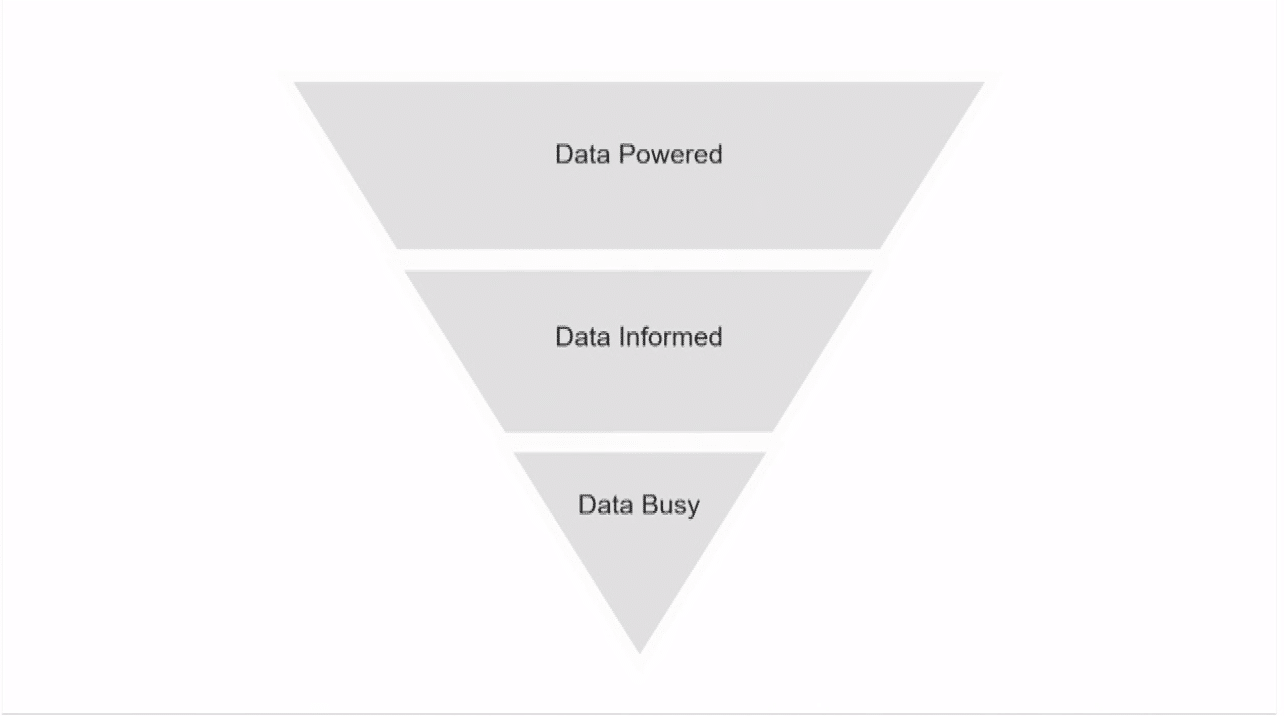
At the “Data Busy” level, a company has implemented data-centric people such as Data Analysts, Data Scientists, or Data Engineers in the organization. However, the analysis time is not quick enough, or there is no return on investment for the Data Scientists.

“At this level, there aren’t any rules in place about the quality of the data, the data is not trusted. Or it represents a bottleneck for the organization,” explains Claire.

At the “Data-Informed” level, the organization has implemented data governance and strategic decisions are increasingly based on the company’s KPIs and metrics rather than on the instincts of top management.

Finally, at the “Data-Powered” level, the highest level of the maturity matrix, data is on the critical line of the organization and becomes a key driver for business growth.

“Above all, data is no longer reserved for a group of data experts but for the entire organization – all employees are in tune with data,” explains the Head of Data Science.

The 6 Steps to Becoming Data-Driven According to Airbnb

Step 1: The Scientific Method

In ‘Data Science’, there is above all ‘Science’, explains Claire. So the first step is to take ownership of the scientific approach in the organization. “The idea is not to build a big R&D team, but rather to put on paper all the hypotheses we operate with and find ways to validate them or not.”

This approach implies testing, testing, and… more testing! And one of these levers is through A/B Testing. The Head of Data Science explains that it was crucial for Airbnb during the COVID-19 crisis to think about different assumptions about the world of today and that of tomorrow to make the right strategic pivots for the company.

One example that highlights the importance of A/B testing at Airbnb is the implementation of a maximum and minimum price filtering system on its booking site. Indeed, Claire explains that user experience feedback was better when travelers could indicate their maximum budget to book a stay. Without this little addition, travelers spent a lot of time on average listings and decided not to book.

Step 2: Strategic Team Alignment

For Claire L., setting up OKRs (Objectives & Key Results) is essential to align the different teams internally. Indeed, the data teams of an organization often tend to focus only on their own data metrics. Yet, it is imperative to put in place common company objectives to truly infuse a data culture in the company: “strategy must come before metrics.”

And the global leader in short-term rental experienced a lack of alignment. In the example below, we can see the negative consequences of this on the Airbnb site’s search experience in 2017. In this illustration, the query “los angeles” was yielding results in multiple categories without really making sense to the user.

Each team here was responsible for a decorrelated KPI. The “experience” team was responsible for company objectives to suggest things to do in the city, while another team was responsible for the cities closest to the search, etc. All were pushing multiple pieces of information to increase their own performance and drive traffic to their section of the website.

Users would get lost and end up not booking anything because the teams weren’t pulling in the same direction.

Step 3: Measuring Uncertainty

For Claire L., “Uncertainty is inherent in running a business and making decisions.” Sometimes the best analysis does not equal the best decision. We need to have organizational discussions, such as: What level of confidence do we need to make decisions? What signals do we need to consider to change decisions?

In the context of OKRs, there is often a temptation to avoid initiatives whose ROI is difficult to measure. However, just because a metric is difficult to measure does not mean that the initiative that depends on it is not the best one. An example that the Head of Data Science gives us is the branding campaigns carried out by Airbnb during the Super Bowl between 2017 and 2021.

“Branding campaigns are the hardest to measure, you can almost never know their ROI. But given our indirect results, building a great branding strategy and moving away from reliance on paid channels like SEM, was perhaps the best marketing strategy to boost organic and direct traffic.”

Step 4: Centralized Governance

Governance, according to Claire L., must be centralized. Indeed, she noticed at Airbnb that as soon as you decentralize the data teams, and they report to the business, you quickly lose the objectivity of the data in the company. She explains: “Data must be considered as a common asset in the organization, and it is essential to make investments centrally and at the highest level of the organization. Data should be managed as a product with the employees as the customers.”

Indeed, Conway’s law also applies to data: “organizations that design systems inevitably tend to produce designs that are copies of their organization’s communication structure.” If applied to data, this law refers to the various departments in the organization creating their own tables, analytics, and features – based on their own definitions – that are not always aligned with those of other departments.

Step 5: The Right Communication

Claire L. shares one of the best decisions Airbnb has made – that of hiring Data Scientists who are not only very good technically, but also good at communicating. Indeed, the company grew very fast in 2017-2018. And to get familiar with how Airbnb works, you sometimes had to read between 15 and 20 analyses for Scientists or take a lot of time to educate yourself on the company’s positioning for design teams – all of which could quickly become costly.

So Airbnb changed its approach to analytics. Instead of making traditional memos that tend to get stale over time and need to be constantly updated, the company started building “living documents.” “We set up “states of knowledge”, aggregations of all the knowledge of a team on a subject – updated according to the frequency of research on a question” Claire details.

The Head of Data Science also explains the importance of communication during the COVID crisis. Since the Airbnb teams in San Francisco were no longer face-to-face, it became essential to work on new communication formats: “We observed a great deal of email and screen fatigue in general. So we looked for more effective ways to communicate, such as via podcast or video formats, so that our employees could get information away from their screens. We needed to simplify and make information available in a simple and visual way so that all employees can appropriate the data.”

Step 6: A More Human-Like Machine Learning

Since its beginnings, Airbnb has used search-matching algorithms between guests and hosts. But it took time for the company to build them in volume – on the one hand, to improve the user experience – and on the other to help cross-functional teams get comfortable discussing modeling decisions.

Claire Lebarz explains that in order to have machine learning algorithms without defects, you have to look at the problem backwards: “Instead of saying that we have to solve a problem through automation and machine learning, we wanted to focus on the opposite: What kind of user experience do we want to create? And then go and inject machine learning where it makes sense to improve those processes.”

The addition of category-based searches on the Airbnb platform illustrates this. Indeed, it was about offering an alternative way to search for a place to stay: by asking the traveler what they would like to do. “Here we’re moving away from our basic model where we propose to enter dates and the place you want to go. Now we can ask you what you want to do or have, like surfing lessons, a nice beach view, or even a pool.”

These algorithms are labor-intensive because they depend on documentation provided by hosts. To avoid having to ask hosts several questions a week, it’s the machine learning that “searches” for this information and pulls it up into the right categories on the site via algorithms.

Conclusion: The 3 Data-Driven Talents According to Airbnb

To ensure a true data culture, hiring the right talent is crucial. According to Claire, here are the three essential data roles of a data-driven enterprise:

  • Analytics Engineers: They are the guarantors of data governance and quality. They position themselves between Data Engineering and Analytics to focus on insights and questions.
  • Machine Learning Ops: This is a new profession that focuses on the operation and evolution of machine learning algorithms.
  • Data Product Managers: They are the ones who instill the way to manage data as a product and professionalize the data approach in the organization. They provide transparency on roadmaps, and new data features and they serve as a liaison with other functions.

“It is critical to bring these three emerging professions into the organization to truly become Data Powered.”


Blog | Data Analytics | | 4 min read

Are You Getting the Most Out of Your Healthcare Data Platform?

Image of the human body digitally representing a healthcare data platform

Healthcare organizations now require insights that are only possible to gain by bringing together diverse and disparate clinical, financial, and operational data from across the organization, as well as outside it. Without access to these insights, improvements in outcomes and operational efficiencies that value-based care models promise to deliver will be harder and more costly to achieve. This is where a healthcare data analytics hub comes into play.

What is a Healthcare Data Analytics Hub?

A healthcare data analytics hub provides a unified, cloud-based platform that supports enrichment, analysis, visualization, and reporting services to both automate and act on healthcare delivery, operations, and administration activities. The goal of the hub is to create standardized, normalized data that can easily be computable and leveraged for business intelligence. What distinguishes it from data lakes or traditional data hubs, is that it provides the tools needed to transform data from disparate sources into actionable insights intended for a range of uses and functional groups.

Cloud computing is quickly making inroads in healthcare, with the strongest demand for this software coming from IT professionals in the healthcare space. As a result, providers and payers have started to take note of this demand and are adopting various cloud technologies. Hybrid and multi-cloud adoption is eliciting the most traction from healthcare organizations as they seek a path forward from traditional legacy applications.

Challenges for Healthcare Data

Because of the intricacies and complexities of the profession itself, healthcare companies are faced with a unique set of needs and challenges, including:

Privacy and Security

Issues such as bad actors and ransomware attacks targeting patient data, with HIPAA compliance mandates, privacy and security enforcement are more manageable.

Data Complexity

Patient matching is one aspect of larger master data management challenges in healthcare. Factoring in healthcare’s many standards, code sets, value sets, and local practices and codes, the process for data integration heightens an already complex process.

Capacity for Change and Interoperability

As organizations adopt and utilize new technologies at their own pace, they need better, faster, and easier ways to operate with both new internal and external systems and data sources.

Data Quality

All data integration projects naturally run into data quality issues, which are inconsistent in the way they adhere to various standards.

Skills and Technology

For many health systems, modern tools are unfamiliar as they have historically used legacy tools for every use case. Even if many systems are modern, there is undoubtedly legacy data and systems that must be considered in the grand scheme of value-based care.

To mitigate these issues, a healthcare data analytics hub deals with data as it arrives. The hub mitigates data complexity and security issues by seamlessly linking data across applications, databases and organizations. It resolves data quality issues by producing clean, computable and optimized data for analytics and various other use cases. It takes data that is incompletely coherent to a particular standard and turns it into a computable format that is acceptable and complies with healthcare standards. Data complexity is resolved by aggregating and summarize data in an optimized way, mitigating the skills and technology gap. Overall, a healthcare data analytics hub helps healthcare organization automate and streamline operations and administrative responsibilities.

Benefits of a Healthcare Data Analytics Hub

A healthcare data analytics hub provides a unified platform that helps automate healthcare data delivery, reduces operational overhead, and provides more reliable automation and data sharing. Other important benefits include:

  1. Innovation. Be prepared for new and changing care and delivery models while building more efficient, effective, and standardized care pathways.
  2. Value. Reduce IT infrastructure, development and integration costs while also investing in high-impact performance improvement programs.
  3. Speed. Accelerate developer productivity, improve optimize workflows for clinical and administrative users, and process financial payments in a timely fashion.
  4. Usability. Reduce clinical burden, improve the patient experience, reduce friction between payers and providers and improve overall care to the public.

Get More Out of Your Data Platform

A healthcare data analytics hub supports you in managing data across various systems, allowing you to drive change throughout your healthcare enterprise by cataloging, modeling and analyzing data with ease. Your ecosystem of payers, providers, and other professionals can gain greater insights and drive better outcomes with a trusted, flexible solution for managing data.


Because we have entered a world where data is your company’s most valuable asset: the quality, security, and health of your data are essential. To guarantee this, you need to ensure its integrity at all times. Would you like to understand the fundamental rules of Data Integrity to set your company on the path to serene and reliable exploitation of data? Follow this guide.

While the notion of integrity is often mentioned when talking about security and data being compromised, it should not be confused with Data Integrity, which is a discipline on its own in the complex and demanding world of data exploitation.

The exact definition of Data Integrity is maintaining and ensuring the accuracy and consistency of data throughout its life cycle.

Ensuring Data Integrity means ensuring that the information stored in a database remains complete, accurate, and reliable. And this, regardless of how long it is stored, how often it is accessed, or how it is processed.

The Different Types of Data Integrity

The concept of Data Integrity is complex because it takes multiple forms and meanings. Beyond an overall approach to Data Integrity, it is important to understand that there are different types of Data Integrity. These different types are not in opposition to each other but rather complement and combine each other to ensure the quality and security of your data assets.

Guaranteeing Data Integrity, in all its dimensions, is not only a matter of compliance but also of optimal use of the available information. There are two main types of Data Integrity: physical integrity on the one hand, and logical integrity on the other.

Physical Integrity

Protecting the physical integrity of data means avoiding exposing it to human error and hardware failure (such as storage server malfunctions, for example).

It also means making sure that the data cannot be distorted by system programmers, for example. In the same way, the physical integrity of the data is called into question when a power failure or a fire affects a database.

Finally, the physical integrity is also compromised when a hacker manages to access the data.

Logical Integrity

Ensuring the logical integrity of your data means making sure that the data remains unchanged under all circumstances. While logical integrity is, like physical integrity, intended to protect data from human manipulation and error, it is exercised in a different way and on four distinct axes:

Entity Integrity

Entity integrity is the principle of associating primary keys with the data collected. These unique values identify all of your data elements. It is an effective guarantee against duplicates, for example, because each piece of data is only listed once.

Referential Integrity

The principle of referential integrity describes the series of processes that ensure that data is stored and used in a uniform and consistent manner. Repository mode is your best assurance that only the appropriate and authorized data changes, additions, or deletions are made. Referential integrity allows you to define rules to eradicate duplicate entries or to verify the accuracy of the data entered in real-time.

Domain Integrity

Domain integrity refers to the set of processes that ensure the accuracy of data attached to a domain. A domain is characterized by a set of values that are considered acceptable and that a column can contain. It can include different rules to define either the format or type of the data or the amount of information that can be entered.

User-Defined Integrity

User-defined integrity involves rules created by the user to meet their needs related to their own usage. By adding a number of specific business rules to Data Integrity measures, it is possible to complement the management of entity integrity, referential integrity, and domain integrity.

Why is it Important to Ensure Data Integrity?

Data integrity is important for two key reasons:

The first concerns data compliance. As the GDPR sets strict rules and provides for severe penalties, ensuring Data Integrity at all times is a major issue.

The second is related to the use of your data. When integrity is preserved, you have the certainty that the information available is reliable and of quality, and, above all, in line with reality!

The Differences Between Data Integrity and Data Security

Data Security is a discipline that brings together all the measures that are deployed to prevent data corruption. It is based on the use of systems, processes, and procedures that restrict unauthorized access to your data.

Data Integrity, on the other hand, addresses all the techniques and solutions that ensure the preservation of the integrity and accuracy of the information throughout its life cycle.

In other words, Data Security is one of the components that contribute to Data Integrity.


Blog | Data Intelligence | | 4 min read

All You Need to Know About Data Observability

Devops Concept With Infinite Loop On Abstract Technology Background

Companies are collecting and processing more data than they did before and much less than they will tomorrow. After infusing a data culture, it is essential to have complete and continuous visibility of your data. Why? To anticipate any problem and any possible degradation of the data. This is the role of Data Observability.

4.95 billion Internet users. 5.31 billion mobile users. 4.62 billion active social network users. The figures in the Digital Report 2022 Global Overview by HootSuite and We Are Social illustrate just how connected the entire world is. In 2021 alone, 79 zettabytes of data were produced and collected, a figure 40 times greater than the volume of data generated in 2010! And according to figures published by Statista, by the end of 2022, the 97 zettabyte threshold would be reached and could be doubled by 2025. This profusion of information is a challenge for a lot of companies.

Collecting, managing, organizing, and exploiting data can quickly give a headache because, as it is manipulated, and moved around, it can be degraded or even rendered unusable. Data Observability is one way to regain control over the reliability, quality, and accessibility of your data.

What is Data Observability?

Data Observability is the discipline of analyzing, understanding, diagnosing, and managing the health of data by leveraging multiple IT tools throughout its lifecycle.

In order to embark on the path of Data Observability, you will need to build a Data Observability platform. This will not only provide you with an accurate and holistic view of your data but also allow you to identify quality and duplication issues in real-time. How can you do this? By relying on continuous telemetry tools.

But don’t think of Data Observability as just a data monitoring mission. It goes beyond that – it also contributes to optimizing the security of your data. Indeed, permanent vigilance on your data flows allows you to guarantee the efficiency of your security devices and acts as a means of early detection of any potential problem.

What are the Benefits of Data Observability?

The first benefit of Data Observability is the ability to anticipate potential degradation in the quality or security of your data. Because the principle of observability is based on continuous, automated monitoring of your data, you will be able to detect any difficulties very early.

From this end-to-end and permanent visibility of your data, you can draw another benefit: that of making your data collection and processing flows more reliable. As data volumes continue to grow and all of your decision-making processes are linked to data, it is essential to ensure the continuity of information processing. Every second of interruption in data management processes can be detrimental to your business.

Data observability not only limits your exposure to the risk of interruption but also allows you to restore flows as quickly as possible in the event of an incident.

The 5 Pillars of Data Observability

Harnessing the full potential of data observability is all about understanding the scope of your platform. This is built around five fundamental pillars:

Pillar #1: Freshness

In particular, a Data Observability platform allows you to verify the freshness of data and thus effectively fight against information obsolescence. The principle: guarantee the relevance of the knowledge derived from the data.

Pillar #2: Distribution

The notion of distribution is essential when it comes to data reliability. The concept is simple: rely on the probable value of data to predict its reliability.

Pillar #3: Volume

To know if your data is complete, you need to anticipate the expected volume. This is what Data Observability offers, which allows you to estimate, for a given sample, the expected nominal volume and compare it with the volume of data available. When the variables match, the data is complete.

Pillar #4: The Schema or Program

Know if your data has been degraded. This is the purpose of the Schema, also called the Program. The principle is to monitor the changes made to any data table and data organization to quickly identify damaged data.

Pillar #5: Lineage

By ensuring metadata collection and rigorous mapping of data sources, it is possible, like a water leak in a faucet, to pinpoint sources and points of interruption in your data handling processes in the shortest time possible and with great accuracy.

Understanding the Difference Between Data Observability and Data Quality

If data observability is one of the elements that allow you to continuously optimize the quality of your data, it differs, however, from Data Quality which prevails over Data Observability. Indeed, in order for observability to be fully utilized, Data Quality must first be assured.

While Data Quality measures the state of a dataset, and more specifically its suitability for an organization’s needs – while Data Observability detects, troubleshoots, and prevents problems that affect data quality and system reliability.


Blog | Data Analytics | | 5 min read

Why is Customer Experience Strategy So Important?

charts and icons to give an idea of a customer experience strategy

Use the Good to Outweigh the Bad

Instead of reacting to negative customer experiences and feedback once damage has already happened, an organization is more successful when it takes a proactive approach. It may seem obvious, but the time and effort it takes to overcome a negative experience is much greater than that of maintaining a positive one.

Consider a study on romantic relationships from the 1970s. Two researchers discovered the difference between happy couples and unhappy couples was the balance between positive and negative interactions during conflict. The study found happy relationships had a ratio of 5:1, meaning happy couples had five or more positive interactions to counter each negative interaction. That same recipe for success translates to other types of relationships too, including relationships with customers.

In the business environment, customers require even more positive interactions for the good to outweigh the bad. For example, when it comes to customer reviews, the positive-to-negative ratio can be as high as 40:1, as explored in this Inc. article. This happens because unhappy customers are far more likely to write a review than happy customers. Add in word-of-mouth, and recency bias – there’s more trouble than meets the eye. Customers have higher expectations of product and service quality now than in previous years, which makes vying for their business even more competitive.

We can also look at this from a Net Promoter Score (NPS) perspective. NPS is a market research metric that asks customers how likely they are to recommend a company, product, or service to a friend. NPS is a valuable way to gather insight into how an organization is currently performing and identifies opportunities for improvement. NPS responses fall into three ranges:

  • The detractor range is 0-6, categorized as unhappy customers who are unlikely to repeat customers or refer a friend.
  • The passive range is 7-8, which includes customers who are satisfied but not excited enough to promote the company or product.
  • The promoter range is 9-10, the most loyal and enthusiastic customers. It takes constant dedicated effort to maintain this high score.

The Negative Impacts of a Poor Customer Experience Strategy

When navigating the customer experience, past performance is not indicative of future performance. We’ve all heard it, and when it comes to your brand, it is 100% true. Customers are constantly evaluating and comparing brands. Brand equity takes years to build but can be destroyed by a single tweet – that’s reflective of the impact of a poor customer experience strategy. It adversely impacts the premium a business can command for its product and services and diminishes customer lifetime value. Brands that score low are less profitable and brands that score high are more profitable. The London School of Economics estimates that a 7% increase in NPS increases revenue by 1%.

That’s not all though. Bad customer care has a ripple effect beyond customer retention and growth; it impacts internal team morale and attrition, increasing stress and deteriorating emotional health among employees. Just as it takes lots of time and effort to overcome a bad customer experience, the same is true for employees. It’s difficult to replace great employees. Happy customers and happy employees go hand in hand.

The Importance of Product Design

The most ever-present way a customer interacts with a company is through the company’s product. It’s one of the forefront factors in how customers judge you. Some argue the product is the brand and experience; others say the experience is the product. I believe the entire customer journey is the experience, and products and services provide valuable decisioning influence.

Product design is important in a customer experience strategy, but it is not a magic bullet that can overcome other poor areas of the experience, particularly bad customer service. Examples include long wait times, no live agent to resolve an issue and having to repeat the same information when transferred to different agents. Before, during and after the product, are experiences that either add to, or detract from the journey. This reminds us to break down functional-based silos and not project those onto customers.

All of this leads us to some key customer experience strategy advice:

  • Make the customer experience so enjoyable that people don’t want to leave you. Think long-term.
  • Stay grounded, honest, respectful, and open to feedback. Learn and pivot quickly.
  • People first. Do what’s best for others.
  • At the root of all design and product goals, deeply understand what problem or solution you are trying to solve. How are you making someone’s life easier?
  • Once you’ve solved this, look at it from different perspectives.
  • Challenge assumptions, and always be mindful of ways to improve.

Further Reading

Check out this resource for more customer experience strategy tips Customer Data Analytics Hub provides details on how to get real-time actionable insights across all your customer experience data silos. There’s also some useful information on a reference architecture to build a unified customer profile. Learn how to educate and empower customers.


Blog | Data Platform | | 4 min read

Why It’s Essential to Embrace Hybrid Data

lights that join the center of the image in a circle to represent hybrid data

If you package and ship data like cartons of sugar – standard-sized, easily stacked, and easily pulled from the shelf – it would be simpler to manage. Unfortunately, it’s not. Because organizations store data in so many different forms and places, extracting the sweet, fine grains of insight from hybrid data is a complex, cumbersome task.

Data is hybrid in every way. The days are long gone when all of an organization’s text reports and databases live comfortably in a data center. Data exists on-premises, in the cloud, at the edge, and in smart devices outside the organization. Hybrid data also comes in different dimensions: structured, unstructured, and semi-structured. It can be raw, cleansed, or exquisitely prepared. It is stored in different forms (text, video, audio) with different time elements (historical, time series, and real-time) and shelf-life requirements (durable and ephemeral).

In short, hybrid data encompasses every facet of data. Using its power can be game-changing for organizations both large and small.

Don’t Ignore Hybrid Data (By the Way, Your Competition Doesn’t)

It is essential to embrace hybrid data, if only just to keep pace with competitors. Data is critical to delivering competitive differentiation to forward-thinking organizations. Hybrid data, and the ability to harness it in all its forms, can deliver sustainable competitive advantage.

Across every industry, time to insight is a key success factor. Gaining insight on shifts in industry trends and consumer preferences faster than the competition can make a material difference in an organization’s ability to compete and win in real-time markets. Your competition uses hybrid data. Your shareholders demand it.

Hybrid Data is Only Limited by Your Imagination

Having access to hybrid data, with its numerous dimensions, provides the ability to envision more use cases.

Many companies want a 360-degree view of their customer, but to fuel this view, you’ll need hybrid data that enables you to correlate social media feeds with customer IDs and activities of website visitors and application users.

Others want to detect fraud in real time by blending transactional data with graph-based relationship data to flag and isolate rogue actors. Digital transformation requires effective use of all the data you have, and quite possibly adding more sources.

Consider how hybrid data changed the game for one financial services institution in the United Kingdom where regulations require it to produce a risk exposure report at the end of each trading day. This business had to cover three billion risk data points across 30 different risk portfolios in one hour. The institution knew that its systems, which ran 30 separate reports, couldn’t meet these reporting requirements. A hybrid data system of record solved this challenge, enabling the institution to run a single report integrating all 30 risk categories in seconds.

Hybrid Data Can Fundamentally Change Your Business

Analyzing the latest data, refreshed from relevant sources, yields timely and accurate insights. With hybrid data in hand, you can gain a true 360-degree view of your customer. You will learn more about true customer behavior by including relevant information you have on purchases, social media sentiment, website clickstream data, customer support data, and more. You can use that multi-dimensional intelligence to drive personalized ads and next-best offers.

Picture a scenario where a travel and tourism brand can micro-target two different consumers based on cross analysis of real-time consumer behavior and third-party data. Rather than serving up the same generic ad, the brand delivers focused relevant offers to each distinct persona. A business offers the 45-year-old father of two who’s been tweeting about fall foliage a family-themed vacation in New England. The 20-year-old college student with museum memberships and Instagram posts about hip-hop receives a getaway offer show casing museum tours and a diverse array of local concert halls.

Organizations need patience to manage the expanding universe of hybrid data. They also need tools. The Actian Data Platform makes it easy for organizations to optimize the value of their data, wherever it lives, and whatever form it is in. Running analytics on data where it resides saves time and resources. The platform provides distinctive capabilities such as blazing fast analytics, real-time data ingestion, enterprise scale and a true hybrid data architecture so you can make decisions in the business moment.

Embracing hybrid data empowers you and takes you from data as a pain point to data as capital to drive growth, innovation, and revenue.

How Can You Embrace Hybrid Data?

Try the Actian Data Platform to explore your hybrid data use cases with a single platform for data analytics, integration, and management.


Blog | Data Analytics | | 4 min read

Big Data and Data Analytics in the Finance Domain

Digital representation of a world made of binary data

Big data is revolutionizing virtually every industry, perhaps none more than financial services. It is giving finance firms the ability to do things they never could before – like roll out new payment systems, deliver data-driven offers and use AI to combat fraud.

Banks, investment firms, stock traders, and others have more data at their disposal than ever before. To generate positive business outcomes, they must master the art of organizing, accessing, and analyzing this vast amount of structured and unstructured data to pull insights out in efficient, timely, and cost-effective ways.

Legacy data management systems are struggling to keep up with the myriad sources and different types of data flowing in at higher velocities. Data platforms operating in the cloud provide a solution to these issues across industries. They also have the power, storage, and scaling capabilities necessary to solve specific data-related challenges that financial services firms face.

Regulatory Requirements

The finance industry, of course, is one of the most tightly regulated of all industries. Many countries require data to stay in their country, which makes it difficult for firms to pull reports and perform analytics in finance across geographical boundaries. Firms wanting to look at how a payment instrument performs in one country vs. another, or on a global basis, face challenges accessing and analyzing that data. Modern data management tools enable them to set up data warehouses country by country or region by region. Analytical tools can study the data in stages, with queries getting rerun against different warehouses, all using one platform.

Data Quality

Data quality is critical in financial services because firms generate reports and perform predictive intelligence based on the data they have. Because data comes from disparate sources, quality is often suspect. There might be some data missing or in a different format. Data management tools can preview the data that is collected, and integration tools can translate data from one format to another. Data platforms can fix data quality issues within systems and integrate with other data quality management solutions.

Data Governance

Because financial services firms also deal in sensitive data, they must maintain fine-grained control as to who has access to specific reports. This is especially true for personally identifiable information (PII). Plus, organizations must adhere to data governance rules, as certain types of data can only be “kept” for certain time frames. Using database management tools, financial companies can comply with timelines on transaction and processing data and create governance rules on access and archival data.

Data Silos

Data silos are a significant problem for financial services companies. They often have credit data, customer data, and marketing data in separate warehouses, governed by separate sets of rules. Data integration tools can connect the sets in one warehouse, where departments can run analytics across forms, functions, and geographies. Data management tools provide the capability to connect to different sources and generate reports in one format.

Data Security

As hackers intensify their efforts and broaden their intrusion tactics, financial services firms must respond with tougher security strategies. It is a challenge because every piece of data that gets brought in or shared must be authenticated for each database it connects with. Organizations need to encrypt data warehouses to ensure that data is secure. Integration tools and analytics software also play a key role in providing access to secure data warehouses.

Moving Forward With a Data Strategy

Financial services firms are no stranger to data. They have been collecting and analyzing big backlogs of information for decades. But today’s data requirements dwarf those from previous decades. For those looking to adopt a big data strategy or refine their current tactics, a methodical approach makes the most sense.

Here are some steps they should take:

  • Interview internal and external stakeholders.
  • Evaluate the current state of systems, processes, and skills.
  • Identify a problem space to focus on.
  • Create a roadmap for transformation.
  • Develop a platform for data collection, organization, and analysis.
  • Utilize a cloud data management platform that aligns with your strategy to accelerate this step.

Financial services firms recognize the value that data can provide. They are developing new and creative ways to pull insights from data to do a better job connecting with customers and driving efficiencies through their own operations. Taking advantage of tools like the Actian Data Platform can provide the strategic advantage they need in today’s competitive environment.