
Ist VectorAI DB die beste Air-Gapped-Alternative zu Qdrant?


Wichtigste Erkenntnisse
- Der Vergleich konzentriert sich darauf, welche Vektordatenbank in Umgebungen mit echtem Air-Gap besser funktioniert.
- Qdrant kann offline ausgeführt werden, doch seine Air-Gap-Optionen erhöhen entweder Kubernetes oder schränken wichtige Produktionswerkzeuge ein.
- VectorAI DB gilt als die einfachere Option, da es als einzelner Docker-Container ohne ausgehende Abhängigkeiten läuft.
- Qdrant spielt seine Stärken besonders dann aus, wenn die Reife des Ökosystems, umfangreichere Filterfunktionen, mehrsprachige SDKs und Aufzeichnung im Produktionsbetrieb Aufzeichnung entscheidender Aufzeichnung .
- Der wichtigste Kompromiss besteht darin, dass man zwischen einer ausgereiften Flexibilität mit höherer Reibung im Luftspalt und Deployment einfacheren, selbst gehosteten Deployment isolierte Umgebungen wählen muss.
Falls Ihre Deployment ausgehende Internetverbindungen untersagt, weisen beide Air-Gap-fähigen Ebenen von Qdrant erhebliche Einschränkungen auf. Cloud Private Cloud Kubernetes ein Enterprise-Vertriebsvertrag Cloud , für den keine Preise veröffentlicht sind. Die Open-Source-Docker-Binärdatei funktioniert zwar offline, verzichtet jedoch auf die Verwaltungstools, automatisierten Backups undDowntime , die Sie in der Produktion benötigen.
Actian VectorAI DB wird als einzelner Docker-Container ausgeliefert, der keine externen Abhängigkeiten aufweist, keine Kubernetes stellt und über integrierte Betriebsfunktionen verfügt.
In diesem Artikel wird genau erläutert, wie sich die einzelnen Produkte in Bezug auf das Thema „Air Gap“ verhalten, in welchen Bereichen Qdrant nach wie vor die bessere Wahl ist und wie die Kompromisse zwischen den beiden Produkten hinsichtlich Leistung, Kosten und Ökosystem aussehen.
Die folgende Tabelle zeigt, wie sich Qdrant und Actian VectorAI DB hinsichtlich der zentralen Entscheidungskriterien für Air-Gapped-Bereitstellungen unterscheiden.
| Fähigkeit | Qdrant | VectorAI-DB |
| Deployment | Cloud, Private Cloud Kubernetes K8s), Open-Source-Software (OSS), Docker | Einzelner Docker-Container |
| Air-Gap-fähig (kein Unternehmensvertrag) | Teilweise (nur OSS, keine Betriebswerkzeuge) | Ja |
| Mindestanforderungen an die Produktionsausstattung | Kubernetes manuelle Docker-Betriebsabläufe | Nur Docker |
| QPS bei 1 Mio. Vektoren | 181.6 QPS | 1,040 QPS |
| p99-Latenz bei 1 Mio. Vektoren | 33,1 ms | 12,7 ms |
| Abruf bei 1 Mio. Vektoren | Höchster Wert (≈0,9988) | Etwas niedriger (≈0,9948) |
| Unterstützte Indextypen | HNSW + Quantisierungsoptionen | HNSW (bei Markteinführung) |
| Mindestkosten für Cloud | Nutzungsbasiert | k. A. (zunächst selbst gehostet) |
| Preismodell | Nutzungsabhängig / für Unternehmen | Lizenzbasiert; geringerer Infrastrukturaufwand |
| SDK-Sprachen | 6+ (Python, JavaScript, Rust, Go, .NET, Java) | Python, JavaScript (Start) |
| Konformitätsbescheinigungen | SOC 2 Typ II, HIPAA | Zum Zeitpunkt der Markteinführung liegen keine Zertifizierungen vor; die Architektur unterstützt Deployment Umgebungen, die den Anforderungen der DSGVO, HIPAA und ISO 27001 entsprechen |
Die Luftspaltreibung mit Qdrant
Qdrant unterstützt drei Deployment . Jede davon erfüllt die Anforderungen an die Luftisolierung auf unterschiedliche Weise, und die genaue Kenntnis der jeweiligen Einschränkungen ist die Voraussetzung für die Wahl der geeigneten Stufe.
Stufe 1: Cloud
Bei „Hybrid Cloud “ wird die Datenebene in Ihrer „ Cluster “ untergebracht, sodass Ihre Vektordaten Ihre Infrastruktur niemals verlassen. Der Haken liegt in der Steuerungsebene. Der „Qdrant Cloud Agent“, der im Lieferumfang von „Hybrid Cloud “ enthalten ist, unterhält eine dauerhafte ausgehende Verbindung zu „grpc.Cloud.qdrant.io“ und „api.Cloud.qdrant.io“ auf Port 443. In einer echten Air-Gap-Umgebung ist diese Konnektivität untersagt, wodurch „Hybrid Cloud “ nicht in Frage kommt.
Stufe 2: Private Cloud
„Private Cloud “ ist die einzige Qdrant-Stufe, die einen echten Air-Gapped-Betrieb ohne Abhängigkeiten nach außen unterstützt. Sie läuft im „ On-Premises “-Modus ohne externe Aufrufe an die Control-Plane. Allerdings erfordert sie eine „ Kubernetes “-Umgebung und einen Enterprise-Vertriebsvertrag. „Private Cloud “ ist kein „ Self-Service “-Produkt und erfordert einen Enterprise-Vertriebsvertrag. Es gibt keine veröffentlichten Preise und keinen Anmeldeweg für eine Testversion oder „ Self-Service “. Für ein Entwicklerteam, das noch in diesem Quartal – und nicht erst nach Abschluss eines Beschaffungszyklus – eine Offline-Vektorsuche benötigt, ist diese Stufe sowohl betrieblich als auch kommerziell nicht zugänglich.
Stufe 3: Open-Source-Vektordatenbanken (Standalone)
Die Docker-basierte Binärdatei läuft offline. Für die Entwicklung und Prototypenerstellung funktioniert sie reibungslos. In der Produktion zeigen sich jedoch konkrete Lücken. Die OSS-Distribution wird ohne Verwaltungs-UI, automatisierte backup oderDowntime ausgeliefert. Für die Replikation müssen Sie eine eigene Failover-Ebene aufbauen und betreiben. Backup das Schreiben und Einplanen von Shell-Skripten, die mit der Snapshot-API von Qdrant interagieren, sowie eine eigene Aufbewahrungsrichtlinie und Übertragungslogik für Air-Gapped-Speicher. Index-Upgrades erfordern geplante Downtime es keinen rollierenden Upgrade-Pfad gibt. Sie betreiben nicht Qdrant, sondern die Engine von Qdrant sowie eine Produktionsbetriebsschicht, die Sie selbst aufbauen müssen.
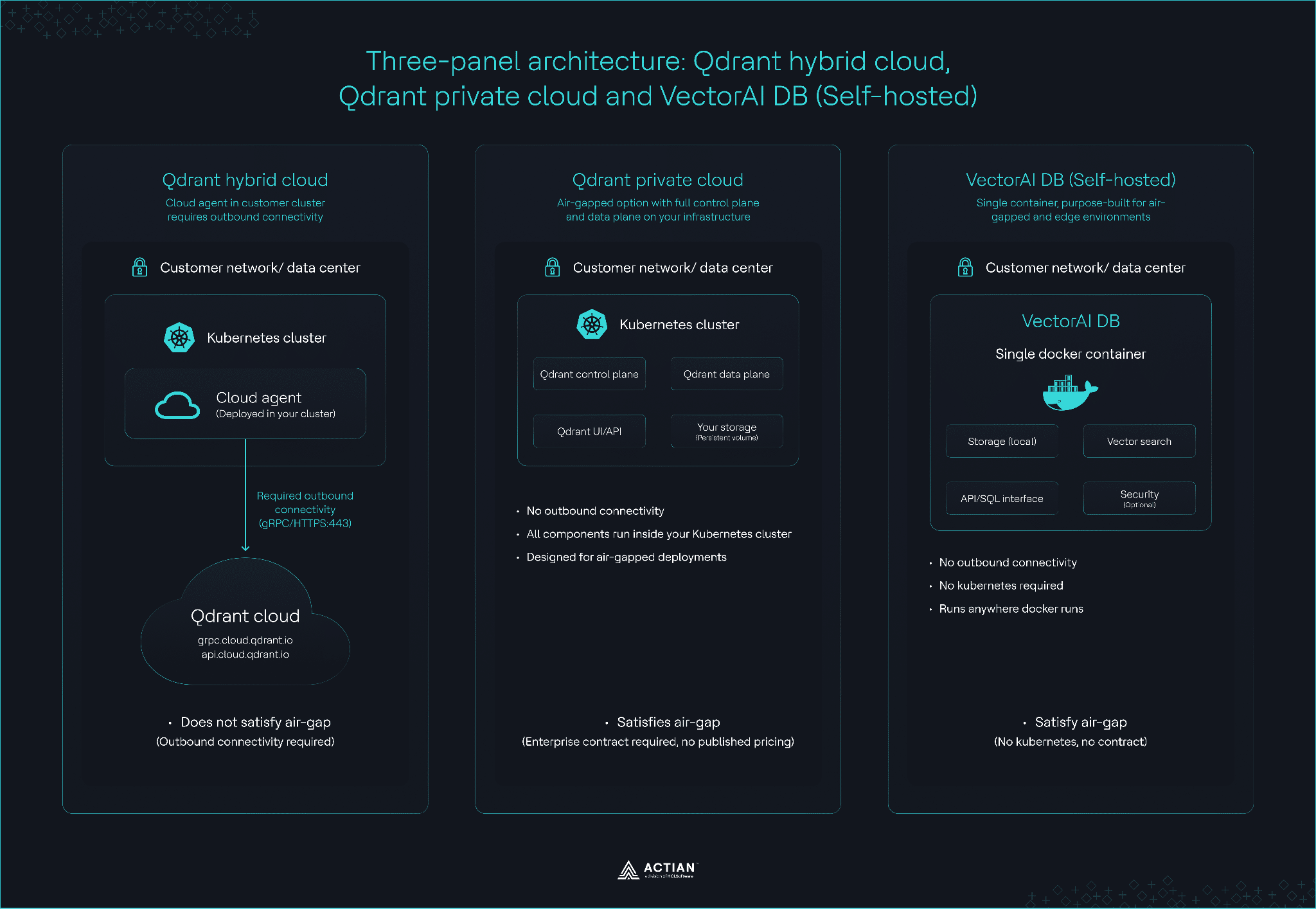
Dreiteiliger Architekturvergleich zwischen Qdrant Hybrid Cloud, Qdrant Private Cloud und VectorAI DB
Leistung bei 1 Million Vektoren
Leistungsvergleiche vom April 2026 zeigen einen deutlichen Unterschied hinsichtlich Durchsatz und Skalierbarkeit – zwei Schlüsselmerkmale. Bei einer Basis von einer Million Vektoren (768 Dimensionen) liegt VectorAI DB bei den Abfragen pro Sekunde (QPS) weiterhin um das 5,7-Fache vor Qdrant.
Beachten Sie, dass bei diesem Benchmark „QdrantLocal“ – der eingebettet – anstelle des vollständigen Qdrant-Standalone-Servers verwendet wurde. QdrantLocal führt die in Qdrant Standalone verfügbaren Hintergrundoptimierer nicht aus, was sich bei anhaltender Auslastung auf den Durchsatz auswirkt. Als groß angelegte Referenz von Drittanbietern verzeichnete der Tiger Data 50M-Vektor-Benchmark für Qdrant v1.13.4 auf einer AWS-Instanz vom Typ r6id.4xlarge 41 QPS bei einer Recall-Rate von 99 Prozent.
Das wichtigere Ergebnis ist die Skalierbarkeit. Bei 10 Millionen Vektoren behielt VectorAI DB 72 % seines ursprünglichen Durchsatzes bei, während Qdrant unter denselben selbst gehosteten Bedingungen auf etwa 12 % seiner Basisleistung zurückfiel. Dieses Verhalten ist bei Air-Gap-Bereitstellungen von Bedeutung, da sich die Betreiber nicht auf Cloud elastische Cloud verlassen können, um Leistungseinbußen auszugleichen.
Qdrant überzeugt weiterhin durch eine hohe Abfragequalität und die ausgereifte Plattformarchitektur, doch der Leistungsabfall bei größeren Indizes führt zu betrieblichen Belastungen für Teams, die eine vollständig getrennte Infrastruktur betreiben.
Die Benchmark-Ergebnisse zeigen, dass VectorAI DB den Durchsatz bei zunehmender Indexgröße effektiver aufrechterhält und so den starken Leistungsabfall vermeidet, der bei einigen HNSW-basierten Implementierungen häufig zu beobachten ist.
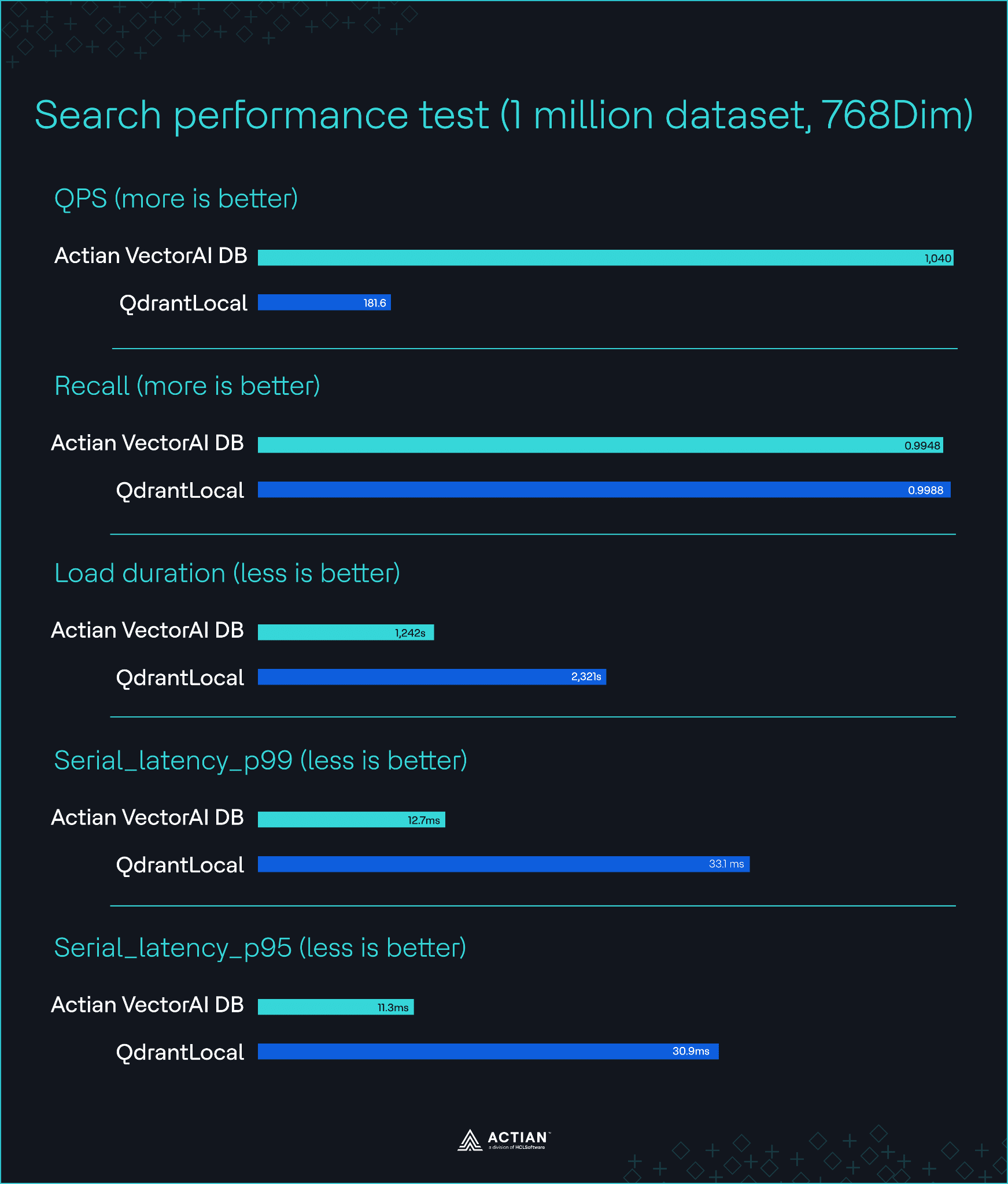
Leistungstest mit VectorAI DB und QdrantLocal bei einer Vektorkapazität von 1 Mio.
Betriebskosten von Qdrant im Vergleich zu VectorAI DB
Qdrant
Qdrant Cloud nutzt ein nutzungsbasiertes Preismodell, das sich nach dem Verbrauch an Rechenleistung, Arbeitsspeicher und Speicherplatz richtet. Die Preise variieren je nach Cluster , Cloud und Region, und Qdrant veröffentlicht keine festen Preise pro Ressource. Mit steigenden Infrastrukturanforderungen skalieren die Kosten entsprechend der Hardware-Nutzung, was die langfristige Budgetplanung für Air-Gapped-Bereitstellungen weniger vorhersehbar macht.
Cloud Private Cloud von Qdrant werden individuell festgelegt und erfordern einen Vertriebszyklus, der den Projektzeitplan um mehrere Wochen verlängert. Die Open-Source-Version ist zwar lizenzrechtlich „kostenlos“, doch die versteckten Kosten liegen in dem Aufwand an „Arbeitsstunden“, der für die Erstellung maßgeschneiderter backup , Überwachungs-Dashboards und Failover-Logik erforderlich ist – all dies ist in der OSS-Binärdatei nicht enthalten.
VectorAI-DB
Actian VectorAI DB bietet ein Einstiegspaket für 417 US-Dollar pro Monat (jährliche Abrechnung) für bis zu eine Million Vektoren, das für kleine KI-Anwendungen konzipiert ist. Die Tarife reichen bis hin zu einer Enterprise-Stufe, die mehr als 10 Millionen Vektoren unterstützt. Für spezielle Einsatzszenarien sind zudem maßgeschneiderte Edge-Tarife verfügbar. Besuchen Sie die Preisseite von Actian VectorAI DB und nutzen Sie den interaktiven Kostenrechner, um den passenden Tarif zu finden.
VectorAI DB wird als selbst gehostete Deployment Cloud oder Kubernetes ausgeliefert.
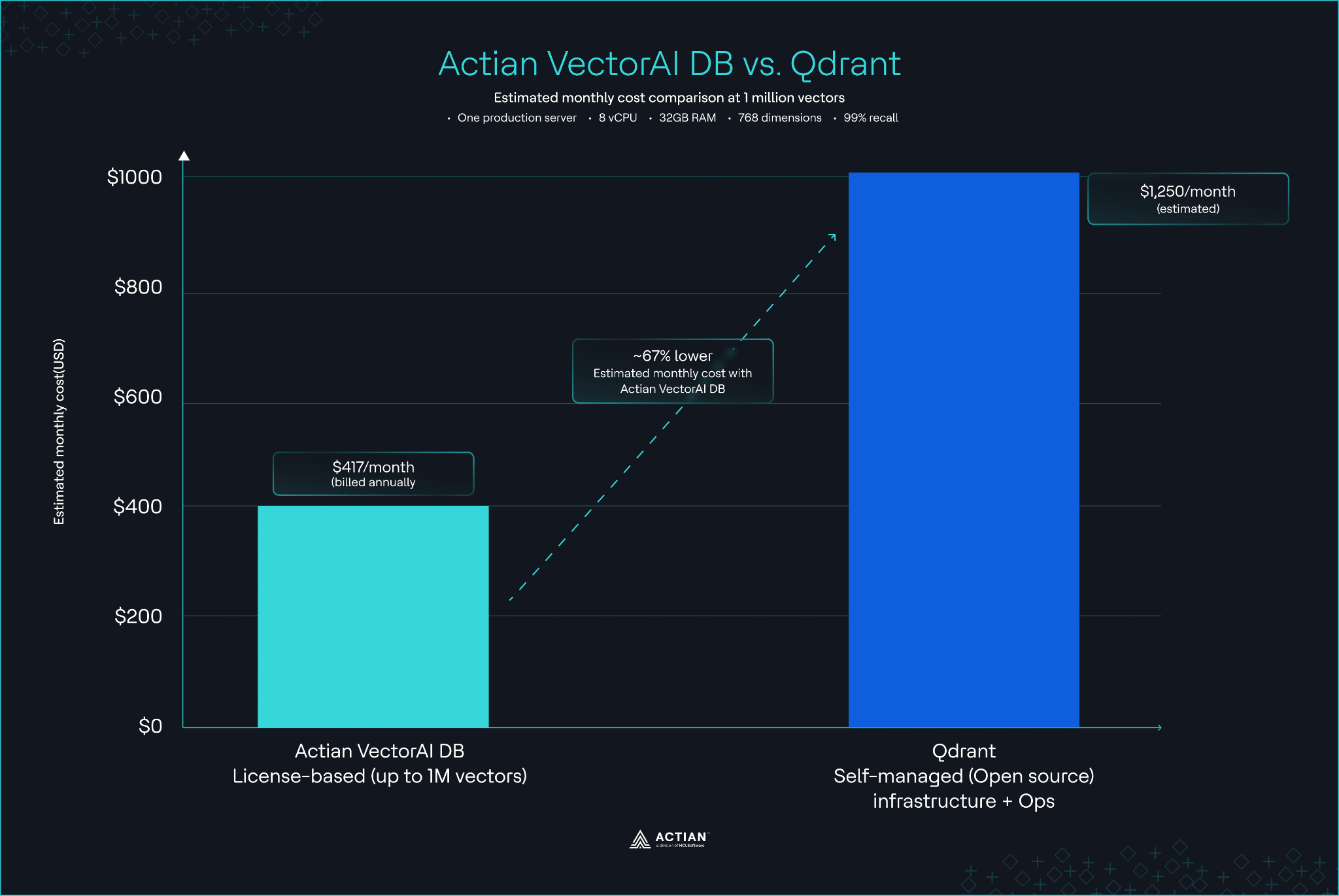
Kostenvergleich zwischen Actian VectorAI DB und Qdrant bei einer Vektorkapazität von 1 Mio.
Wann Qdrant die richtige Wahl ist
VectorAI DB wurde für Umgebungen ohne Internetverbindung entwickelt, ist jedoch nicht für jeden use case die richtige Wahl. Qdrant ist die bessere Wahl, wenn:
- Sie verfügen über eine zuverlässige Internetverbindung: Der Managed Service CloudQdrant Cloud ist ausgereifter als Cloud ursprüngliche Cloud von VectorAI DB.
- Sie benötigen eine erweiterte Quantisierung: Wenn Sie spezifische binäre oder skalare Quantisierungsoptionen benötigen, um mehr als 100 Millionen Vektoren in einen begrenzten Speicherbereich unterzubringen, ist die HNSW-Implementierung von Qdrant flexibler.
- Sie benötigen Unterstützung für mehrere Sprachen: Qdrant unterstützt SDKs in Python, JavaScript, Rust, Go, .NET und Java. Wenn Ihre Technologieplattform nicht auf Python JavaScript basiert, erfordert VectorAI DB einen höheren manuellen Aufwand bei der REST- oder SQL-Integration.
- Sie benötigen eine lange Aufzeichnunghistorie: Qdrant wird bereits produktiv bei Unternehmen wie HubSpot eingesetzt. VectorAI DB ist neuer und verfügt über weniger öffentliche Produktionserfahrung.
- Sie benötigen erweiterte Filterfunktionen: Qdrant bietet umfangreiche Filterausdrücke, die bei der Ähnlichkeitssuche effizient ausgeführt werden und komplexe boolesche Bedingungen über mehrere Felder hinweg unterstützen. RAG-Workloads (Retrieval-Augmented Generation) benötigen diese Art der Filterung, um die Suche nach Datum, Kunden-ID, Dokumentquelle oder Sicherheitsberechtigungen einzuschränken.
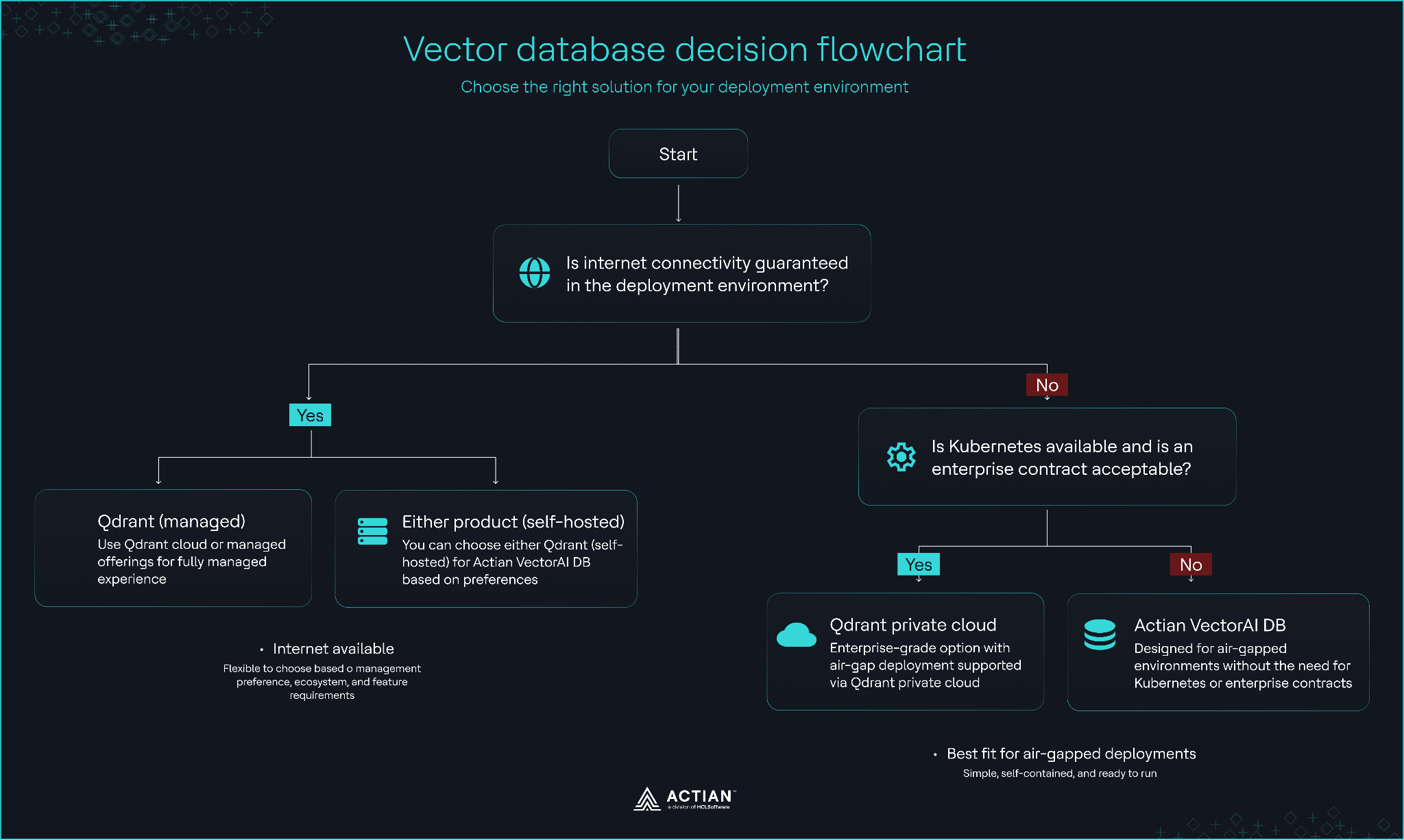
Entscheidungsflussdiagramm
Reifegrad des Ökosystems und der Integration
Die Reifegradlücke zeigt sich in der Integrationslandschaft. Qdrant lässt sich mit fast allen wichtigen Tools im KI-Stack integrieren, von Terraform und Pulumi bis hin zu LangChain, LlamaIndex und Haystack. Darüber hinaus verfügt Qdrant über SOC-2-Typ-II- und HIPAA-Zertifizierungen, die für Cloud von entscheidender Bedeutung sind.
VectorAI DB wurde mit SDKs Python JavaScript sowie nativen gRPC- und REST-APIs eingeführt. Es unterstützt zwar LangChain und LlamaIndex, sein Ökosystem befindet sich jedoch noch im Aufbau. Ein Vorteil von VectorAI DB im Sicherheitskontext besteht darin, dass es standardmäßig Authentifizierung und Verschlüsselung ermöglicht. Im Gegensatz dazu ist die Authentifizierung bei Qdrant in Docker oft standardmäßig deaktiviert, sodass eine manuelle Konfiguration erforderlich ist, um grundlegendeBereitschaft zu erfüllen.
Parallele Initialisierung (Python)
In beiden Beispielen wird eine Client-Verbindung initialisiert und eine gefilterte Vektorsuche durchgeführt, wobei jedoch unterschiedliche Ansätze verfolgt werden. Qdrant nutzt einen stark typisierten Client mit expliziten Filtermodellen und manueller Konfiguration, während Actian VectorAI DB die Initialisierung durch eine minimalistische Schnittstelle und einfache, auf Wörterbüchern basierende Filter optimiert.
Qdrant Standalone
from qdrant_client import QdrantClient
from qdrant_client.models import Filter, FieldCondition, MatchValue

client = QdrantClient(
    url="http://localhost:6333",
    api_key="your_key"  # optional for local
)

results = client.search(
    collection_name="docs",
    query_vector=[0.1, 0.2, 0.3],
    query_filter=Filter(
        must=[
            FieldCondition(
                key="jurisdiction",
                match=MatchValue(value="SG")
            )
        ]
    )
)
Was der Code bewirkt
- Stellt eine Verbindung zu einer Qdrant-Instanz her, die unter localhost:6333 läuft.
- Verwendet einen API-Schlüssel (lokal optional, inCloud erforderlich).
- Führt eine Vektorähnlichkeitssuche durch.
- Wendet einen Payload-Filter an (Gerichtsbarkeit = „SG“).
- Abfragen für eine Sammlung namens „docs“.
VectorAI-DB
from actian_vectorai import VectorAIClient

client = VectorAIClient("http://localhost:50051")

results = client.points.search(
    collection_name="docs",
    vector=[0.1, 0.2, 0.3],
    filters={
        "jurisdiction": "SG"
    }
)
Was der Code bewirkt
- Stellt eine Verbindung zu einer VectorAI-DB-Instanz her (standardmäßiger gRPC-/HTTP-Endpunkt).
- Nutzt die integrierte Sicherheit auf Containerebene (kein expliziter API-Schlüssel erforderlich).
- Führt eine Vektorähnlichkeitssuche durch.
- Wendet einen einfachen, auf einem Wörterbuch basierenden Metadaten an.
- Fragt die „docs“- Sammlung ab.
Ein Vergleich mit anderen Qdrant-Alternativen
Sollten weder Qdrant noch VectorAI DB Ihren Anforderungen entsprechen, ziehen Sie bitte die folgenden Alternativen unter dem Gesichtspunkt der Air-Gap-Fähigkeit in Betracht:
- Pinecone: Ein Marktführer im Bereich Managed Vector Search, jedoch ausschließlich Cloud. Die „Bring Your Own CloudOption (BYOC) erfordert nach wie vor eine ausgehende Verbindung zur Pinecone-Steuerungsebene, wodurch die Lösung für echte Air-Gap-Umgebungen nicht in Frage kommt.
- Milvus: Kann auf Kubernetes selbst gehostet werden. Die Abhängigkeitskette mit mehr als 20 Pods macht die Lösung jedoch betrieblich „schwerfällig“. Für Teams, dieCluster ihre Vektorsuche keinen komplexen Kubernetes Cluster verwalten möchten, ist dies überdimensioniert.
- Weaviate: Unterstützt Docker und Kubernetes. Es stellt einen guten Mittelweg dar, erfordert jedoch, dass der gesamte HNSW-Index im Arbeitsspeicher gehalten wird, was bei ressourcenbeschränkter, isolierter Hardware einschränkend sein kann.
- ChromaDB: Leichtgewichtig und einfach offline zu betreiben. Allerdings fehlen ihm Hochverfügbarkeit und produktionsreife Failover-Mechanismen, weshalb es sich eher für die Prototypenentwicklung als für geschäftskritische Compliance-Systeme eignet.
- Faiss: Eine von Meta entwickelte Bibliothek für die effiziente Ähnlichkeitssuche und das Clustering dichter Vektoren, die häufig eingesetzt wird, wenn hohe Leistung oder GPU-Beschleunigung erforderlich ist.
- Elasticsearch und OpenSearch: Beide verfügen nun über Fähigkeiten, die eine hybride Suche ermöglichen.
Vollständige Vergleichstabelle
In dieser Tabelle wird verglichen, wie führende Vektordatenbanken Deployment für den Offline-Betrieb und Deployment in einer isolierten Umgebung erfüllen.
| Fähigkeit | Qdrant | VectorAI-DB | Pinecone | Milvus | Weaviate | ChromaDB | Faiss | Elasticsearch / OpenSearch |
| Air-Gap-fähig (kein Unternehmensnetzwerk) | Teilweise | Ja | Nein | Ja | Teilweise | Ja | Ja | Ja |
| Deployment | Hybrid/K8s/Docker | Docker | Cloud | K8s | Docker/K8s | Lokal | eingebettet | Verteilter Such Cluster |
| Mindestkonfiguration | Mittel–Hoch | Niedrig | Niedrig | Hoch | Mittel | Niedrig | Niedrig | Hoch |
| Erfordert eine ständige Verbindung nach außen | Teilweise (nur Hybrid) | Nein | Ja | Nein | Nein | Nein | Nein | Nein |
| Open Source | Ja | Nein | Nein | Ja | Ja | Ja | Ja | Ja |
| Mindestkosten | Nur Infrastruktur | Nur Infrastruktur | Nutzungsbasiert | Infrastruktur + Betrieb | Infra | Minimal | Minimal | Infrastruktur + Betrieb |
| Konformitätsbescheinigungen | SOC2, HIPAA | Zum Zeitpunkt der Markteinführung liegen keine Zertifizierungen vor; die Architektur unterstützt Deployment Umgebungen, die den Anforderungen der DSGVO, HIPAA und ISO 27001 entsprechen | SOC2 | Keine | Keine | Keine | Keine | Je nach Deployment unterschiedlich |
| Hauptstärke | Ausgereiftes Vektor-Ökosystem | Die Einfachheit des Luftspalts | Verwaltete Betriebsabläufe | Groß angelegte verteilte Suche | Flexible Hybrid-Wiederherstellung | Leichte lokale Arbeitsabläufe | GPU-beschleunigte Ähnlichkeitssuche | Hybride Suche nach Stichworten und Vektoren |
| Hauptkompromiss | Luftspaltreibung | Kleineres Ökosystem | Erfordert eine Internetverbindung | Operative Komplexität | Speicherintensives HNSW | Werkzeuge für die Kleinserienfertigung | Keine integrierten Funktionen für verteilte Betriebsabläufe | Umfangreiche Infrastrukturmaßnahmen |
Die meisten Alternativen lassen sich theoretisch offline betreiben, bringen jedoch eine höhere Komplexität im Betrieb, fehlende Funktionen oder versteckte Abhängigkeiten mit sich. VectorAI DB hebt sich dadurch ab, dass die Unterstützung für Air-Gap-Betrieb als zentrale Designvorgabe und nicht als nachträglicher Einfall betrachtet wird.
Zum Abschluss
Die Anforderungen an den Luftspalt verändern die Entscheidung grundlegend. Qdrant unterstützt zwar Deployment, zwingt Sie jedoch entweder zur Kubernetes oder zu eingeschränkter Betriebsfähigkeit. VectorAI DB beseitigt diesen Kompromiss, indem es alles in einem einzigen, in sich geschlossenen System ohne externe Abhängigkeiten bündelt.
Wenn Sie bewährte Skalierbarkeit, ein ausgereiftes Ökosystem und verwaltete Optionen benötigen, entscheiden Sie sich für Qdrant. Wenn Sie Deployment echte Deployment minimalem Betriebsaufwand benötigen, ist VectorAI DB die passendere Lösung.
Lesen Sie die Dokumentation zur VectorAI-Datenbank und prüfen Sie, ob deren Einfachheit mit Ihren Deployment vereinbar ist.
Registrieren Sie sich für die Actian VectorAI DB Community Edition und legen Sie noch heute los.

Bleiben Sie in Verbindung
Datenanalysen direkt bei Ihnen.
(z. B. sales@..., support@...)
