
What are Self-Evolving AI Agents?


Key Takeaways
- Self-evolving agents improve over time by modifying prompts, memory, tools, or workflows based on verified experience.
- Unlike static agents, successful changes persist and influence how the agent behaves on future runs.
- Persistent semantic memory lets agents recall similar failures and reuse proven fixes instead of starting from scratch.
- Regenesis, Rewire, and Gradient evolved different parts of their stacks while relying on external correctness signals.
- Actian VectorAI DB provides persistent storage, semantic retrieval, and verified write-back to support durable agent self-improvement.
Self-evolving agents modify part of their own stack, whether that is prompts, memory, tools, or the workflow graph itself, based on experience and feedback, rather than staying fixed after deployment. The agent you have in production right now almost certainly does not work that way. Its prompts are fixed, its tools are hardwired, and when it fails, you read the trace, edit the config, and ship a new version.
That does not mean that self-evolving agents retrain their model after every task. It means something in the agent’s stack can change based on what happened during previous interactions. If you are building agents that stay deployed, the difference is practical: a static agent treats every task as new, while a self-evolving agent carries verified experience forward, reduces manual fixes, and improves reliability over time. That carry-forward lives in the retrieval layer underneath the agent, which is one reason agent workloads are forcing a rethink of vector database architecture and how teams pick a library to build on.
At the Self-Evolving Agents Hackathon, hosted by tokens& in San Francisco in July 2026, three teams demonstrated this pattern in different ways. Regenesis evolved its rules configuration. Rewire evolved its conversation graph. Gradient evolved its taxonomy clusters. The implementations were different, but they shared one requirement: persistent, queryable memory that lets the agent use experience the next time it acts.
This article showcases what actually changes inside the architecture, and how those three builds evolved when they were held to a real correctness signal.
Most AI Agents Do Not Learn From Experience
Most AI agents deployed today have fixed prompts, hardwired tools, and static behavior. When one gets something wrong, a human reads the trace, edits the prompt, and redeploys. The agent itself does not learn from that failure.
Look at what your agent does on a single request today. It observes some input, reasons about it, calls a tool or two, produces an answer, and terminates. Every one of those steps reads from configuration that the agent cannot write to. The prompt is a string constant in your repo. The tool list is a fixed array. The retrieval index is whatever you populated at build time.
That design is deliberate and, for a long time, correct. Constants are predictable, and predictability is what makes an agent safe to put in front of customers.
The cost shows up on the second failure. Because nothing in the agent’s own stack changed after the first one, the same input produces the same wrong output. An agent that fabricates a price on Monday fabricates it again on Tuesday. Every failure resets to zero, and the same mistakes recur across sessions. The only path to improvement runs through a human, a code review, and a deploy. Your organization learns. Your agent does not.
What Makes an Agent Self-Evolving
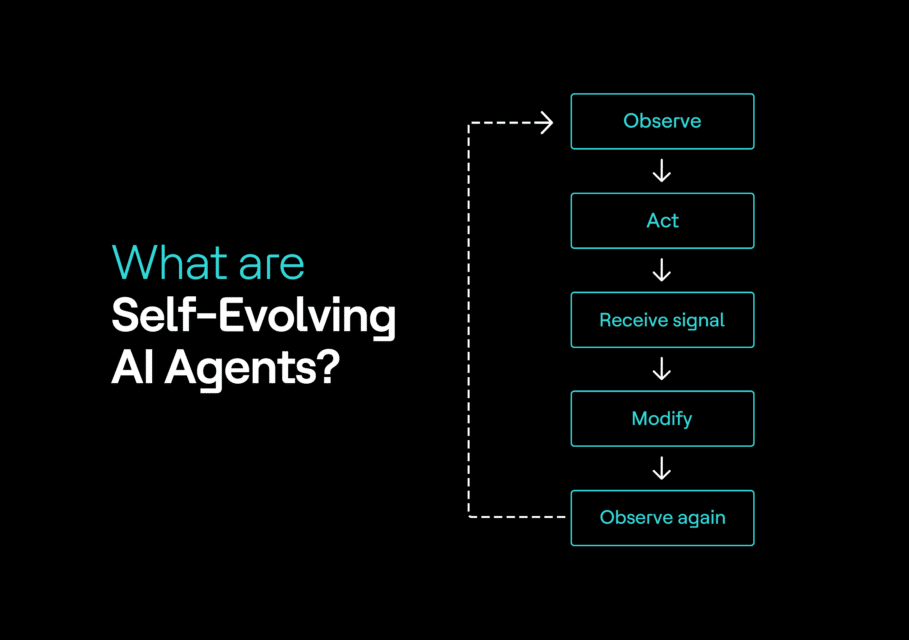
A self-evolving agent runs a closed feedback loop: observe, act, receive a signal, modify. That makes it a continual learning system rather than a fixed one. Some part of its own stack changes based on experience rather than manual intervention.
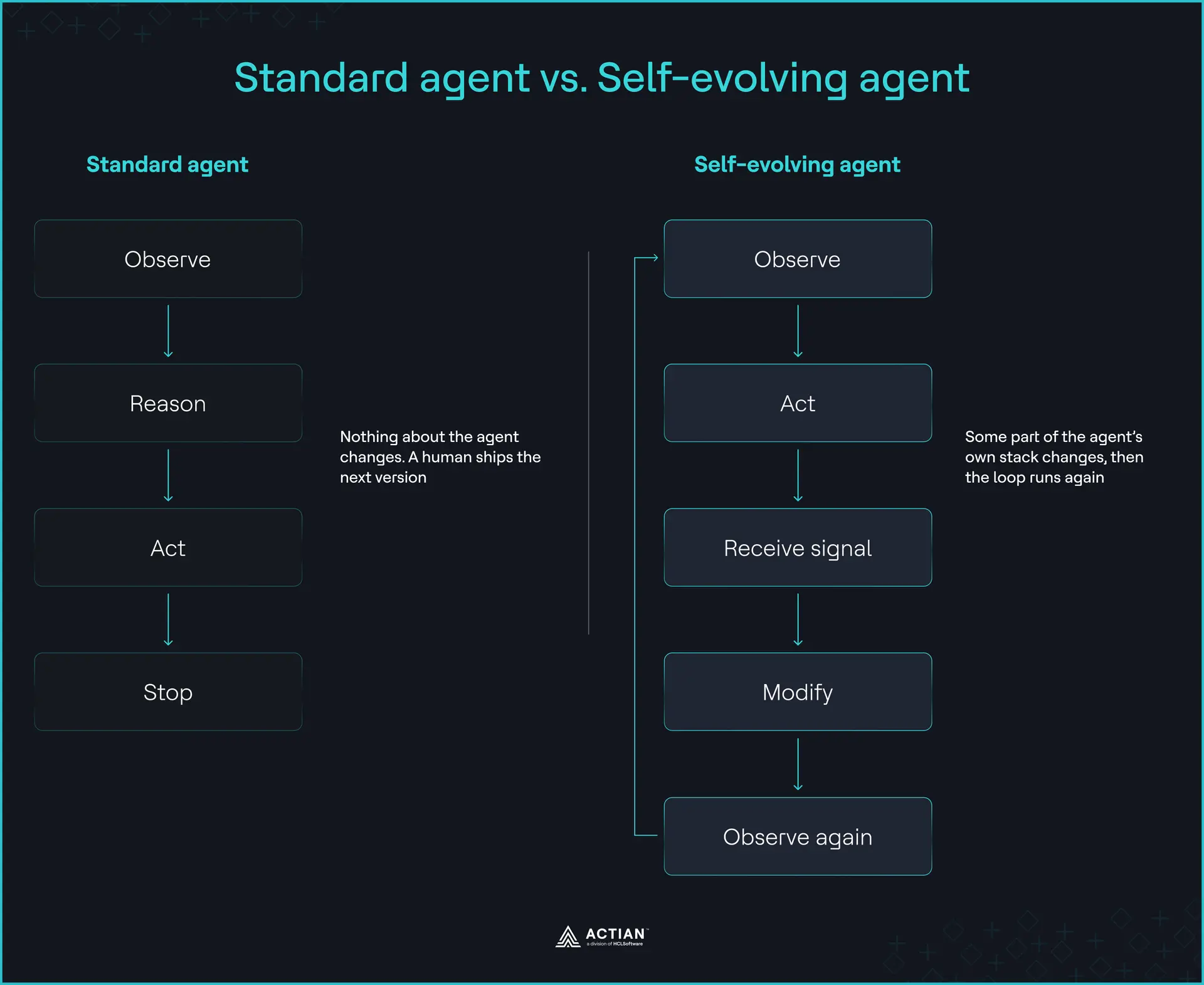
A standard agent terminates after one pass. A self-evolving agent closes the loop back on itself.
The word doing the work is modify. A standard agent modifies its output, which is just inference. A self-evolving agent modifies itself, which means the artifact that produced the output is different on the next run than it was on this one. That is the whole distinction, and it is structural rather than philosophical.
Structurally, it comes down to which parts of your stack are writable within the agent framework. In a standard agent, prompts, decision rules, and agent memory are constants that only a deploy can change. In a self-evolving agent, at least one of those parts is writable. That writable part needs a defined write path, a signal that authorizes the change, and durable storage for the result.
That third requirement is the one teams underestimate. A modification the agent cannot recall on the next run is not evolution; it is a retry. The loop only closes if the change persists somewhere the agent queries before it acts again, so it can adapt to signals from its environment.
The signal matters just as much. An agent that rewrites its own instructions based on nothing but its own confidence will happily converge on being confidently wrong. Every build discussed below is gated on an external correctness oracle as part of its evaluation. That oracle might be a signed-off safety spec, a verified knowledge base, or a human pressing accept or reject.
What Can Evolve, When, and How
Self-evolving agents can change different parts of the stack, at different times, and by different mechanisms. The table below breaks that down into what changes, when it changes, and how the change is applied. First, decide what should be writable. Then decide when that change should happen. Only after that should you choose the mechanism that makes the change stick.
| Axis | Options | Build example |
|---|---|---|
| What to evolve | Model parameters, prompts, memory, tools and skills, workflow graphs | Regenesis evolved a rules config; Rewire evolved a conversation graph; Gradient evolved taxonomy clusters |
| When to evolve | Intra-task (inside a single run) or inter-task (between runs) | Regenesis modifies inside one heal cycle; Gradient updates clusters after each accept or reject |
| How to evolve | Replay-based elimination, memory recall before action, feedback write-back | Rewire killed 27 of 33 candidates by replaying history; Regenesis queries memory before patching; Gradient writes accept/reject back to its clusters |
What to evolve. Five options, ordered roughly by how hard they are to attempt. Model parameters are the hardest because changing them means retraining or fine-tuning. That makes them slow, expensive, and global. Prompts are the most accessible, which is why prompt-optimization frameworks got here first. But a prompt rewrite is still a blunt instrument. Memory is the fastest loop and the most targeted because writing one verified fact changes retrieval without touching anything else. Tools and skills are additive: the agent gains a capability it did not have and can generate or integrate new tools over time. Workflow graphs are structural, mutating nodes and edges rather than text. That is why they matter for agentic and operational workflows.
One example is EvoAgentX, which generates multi-agent workflows from prompts and optimizes them with self-evolving algorithms.
For most teams, memory is the right starting point. It is the only one of the five where a bad write is cheap to reverse.
When to evolve. Intra-task means the agent modifies something inside a single run, before that run finishes. Inter-task means the change lands between runs and shows up on the next one. Inter-task is safer and more common because you get to validate the change before anything downstream depends on it. Intra-task reacts faster and is much easier to get wrong, since a mid-run modification has no clean rollback point.
How to evolve. Three mechanisms cover most of what works in practice. Replay-based elimination is one search strategy: it generates several candidate changes and tests each against historical cases, promoting only a candidate that fixes the new failure without breaking an old one. Memory recall before action has the agent query its own history first, so a known failure resolves from memory instead of being rediscovered. Feedback write-back takes a verified signal and writes it straight back into the retrieval layer, reshaping what the agent surfaces next time.
What Each SwarmHack Build Evolved
All three builds ran on real data against an external correctness oracle, not their own confidence. That makes them useful evidence because they landed on three different points in the framework above and hit the same constraint from three directions.
| Build | What it evolved | How VectorAI DB made it possible |
|---|---|---|
| Regenesis | The rules config, treated as a mutable genome | Stored failure history and enabled memory recall before patching |
| Rewire | The conversation graph inside a live voice runtime | Indexed failures by shape and replayed historical calls against competing fixes |
| Gradient | The taxonomy clusters used for retrieval | Stored accept/reject signals and used them to reshape future retrieval |
Regenesis ran a hospital shift-scheduling app under a closed self-healing loop. The team split the app in two: rules are mutable, and an agent may rewrite them, while invariants are an immutable, signed-off safety spec. An oracle audits the running app against that fixed spec, so the violations it reports are computed rather than scripted. The agent then queries its own memory before patching, and only successful fixes are ever recalled as solutions. A defect class it has seen before resolves straight from memory instead of being rediagnosed.
Rewire attacked a failure mode that retrieval alone cannot fix. Its voice agent fabricated a price the knowledge base contradicted, but the cause wasn’t bad retrieval: the node’s instruction permitted answering without calling the lookup tool at all. Fixing that means editing the instruction, not the index. So the system mutates the conversation graph, replays candidates against historical calls, and promotes only one that fixes the new failure without breaking an old one. Because each surviving patch is stored against the structure of the failure rather than its subject matter, a fix learned on brake pricing later resolved a healthcare copay in a domain sharing almost none of the same vocabulary.
Gradient turned already-classified social-post data into interest plans and evolved its own taxonomy on real accept/reject signals and user feedback. When a user accepts or rejects an item, that signal writes back to the vector store and reshapes the clusters the agent retrieves on the next pass, with categories auto-minted as the taxonomy shifts. The entire stack runs locally, with embeddings through nomic-embed-text-v1.5 and generation through a quantized Qwen3 model. Nothing is retrained. The behavior change comes entirely from the retrieval layer reorganizing itself around verified signals.
Together, these builds point to a pattern that shows up across healthcare, voice agent, and social-post interest planning.
Why Memory is the Enabling Layer
Every build that produced genuine evolution shared one property: the agent queried its own history before it acted, making memory the mechanism for real self-improvement rather than a retry loop. That is what puts specific requirements on your memory layer.
Three properties are non-negotiable for the store you pick. Memory has to persist across sessions, or the agent restarts empty and relearns what it already knew. It has to be queryable by semantic similarity, because the next failure is never byte-identical to the last one. And it has to be writable on verified signals, so that write-back becomes part of ongoing self-evolution rather than a one-off update based on what the agent believed at the time.
A conventional database satisfies the first requirement and fails the second. Exact-match lookup only fires when the new case is identical to the stored one, which is rarely true of agent failures in open-ended learning conditions. Semantic retrieval enables generalization, and Rewire is the clearest demonstration: a patch learned on brake pricing was retrieved for a healthcare copay failure because the two failures were structurally similar, not textually similar. No keyword index finds that.
Retraining is not the alternative most teams think it is. Fine-tuning is slow, expensive, and global, and heavier approaches like reinforcement learning or broad parameter updates are even harder to isolate and painful to reverse. Memory evolution is targeted, fast, and reversible: you write one point, you scope one behavior, and you delete it if it turns out to be wrong.
That is the substrate the three builds ran on, and it is why each one keeps improving across runs. All three used Actian VectorAI DB self-hosted for persistent storage, semantic retrieval over their own history, and write-back gated on a verified signal. All three ran it locally, which for an agent that modifies itself is worth something on its own: the record of what your agent learned and why stays on infrastructure you control.
Start with the memory layer, get the write gate right, and decide which part of the stack the agent can edit. That is what makes self-evolution durable instead of accidental. That order is the shortest path to an agent that is meaningfully different on its hundredth run than it was on its first.
To test the setup, try VectorAI DB Community Edition via Docker.

Stay connected
Data insights delivered to you.
(i.e. sales@..., support@...)
