
Control the data your AI depends on
Where data is stored is only part of the answer. Sovereignty also means controlling access, making technology dependencies visible, enforcing policies by design, and proving what happened.








Why sovereignty matters now
Geopolitical instability, AI-driven cyber threats, and tightening regulation are converging. Together, they turn everyday technology dependencies into business risks.
Enterprise data no longer stays within predictable applications and pipelines. It becomes prompts, embeddings, model context, training data, and inputs to autonomous agents. As AI systems retrieve information dynamically, generate new knowledge, and take action across platforms, organizations need to understand not only where their data resides, but also who or what can access it, how it is used, and which dependencies they can control.

Kill switches
A sanction, export control, or provider decision can cut off access to a service you depend on, sometimes overnight.

Price shocks
When a critical supplier is acquired or re-prices, costs can undermine your business model overnight.

Changing provider terms
Terms of service, data-use rights, and feature availability can change by region, often with little notice. AI services change the fastest.

Regulatory exposure
Laws in a provider’s home country can compel access to the data it holds, wherever that data is stored.
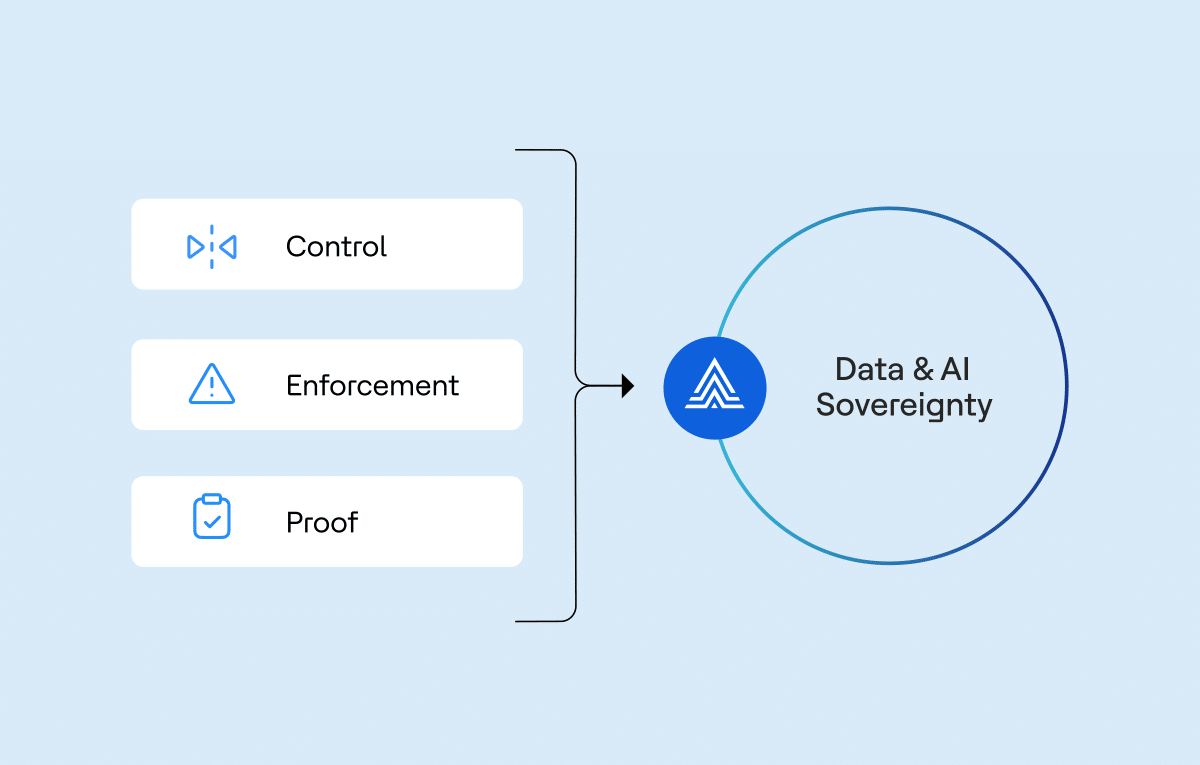
A practical framework for data & AI sovereignty
Sovereignty becomes manageable when you break it into three questions. Use them to decide where you need more control and where an existing dependency is acceptable.
Who decides how data and AI can be used, by whom, from where, and for what? Clear ownership, classification, and jurisdictional and contractual constraints for each dataset, plus defined limits on which data AI models and agents may use.
How are the rules actually applied? Policies must be applied on the access path during runtime: identity, masking, query locality, pipelines, and AI retrieval. Rules that live only in documents stay aspirational.
Can you show what happened? Lineage, audit trails, and observability that let you quickly answer a regulator, customer, or board with evidence. Proof turns a belief into a defensible position.
How Actian helps you operationalize sovereignty

Federate without forced centralization
Connect metadata, business definitions, discovery, and governance across distributed environments while maintaining local ownership. Actian Data Intelligence Platform uses a federated knowledge graph to govern data where it resides, without moving it.

Govern by design
Embed governance into data workflows through active metadata, classification, and policy-aware access. Data products and contracts make the rules explicit, with contracts generated automatically, and Actian Data Observability continuously monitors compliance with them.

Govern AI access
Extend governance to semantic search, retrieval, and AI agents. The Actian MCP Server gives agents governed context instead of raw tables, while Actian VectorAI DB keeps agent memory and retrieval on infrastructure you control.

Preserve deployment choice
Place each workload across cloud, on-premises, and edge based on business requirements, risk, and operational constraints. Actian Analytics Engine runs AI workloads on infrastructure you own, and Actian Zen processes data in real time on edge devices, syncing to the cloud when needed.
From policy to provable control
A policy without evidence is not enough. Actian connects the rules you define to the evidence that auditors, customers, and regulators ask for, across data pipelines and AI access.
What rules apply to this data? |
Where did it come from, and where did it go? |
|---|---|
|
Captured and governed with Metadata Management |
|
Traced with Data Lineage |
|
Built into the Data Intelligence Platform |
|
Monitored with Data Observability |
Compliance depends on your full set of controls, processes, and legal review. Actian provides capabilities that support those efforts. |
Sovereignty is a spectrum. Choose your position per workload.
Every architecture choice sits somewhere between fully managed services and self-hosted infrastructure. Moving toward self-hosted gives you more control and strategic freedom, but it usually adds complexity and cost and can sometimes reduce capability. More control isn’t automatically better. Choose the level each workload needs based on its risks, dependencies, business requirements, and the trade-offs you can accept.
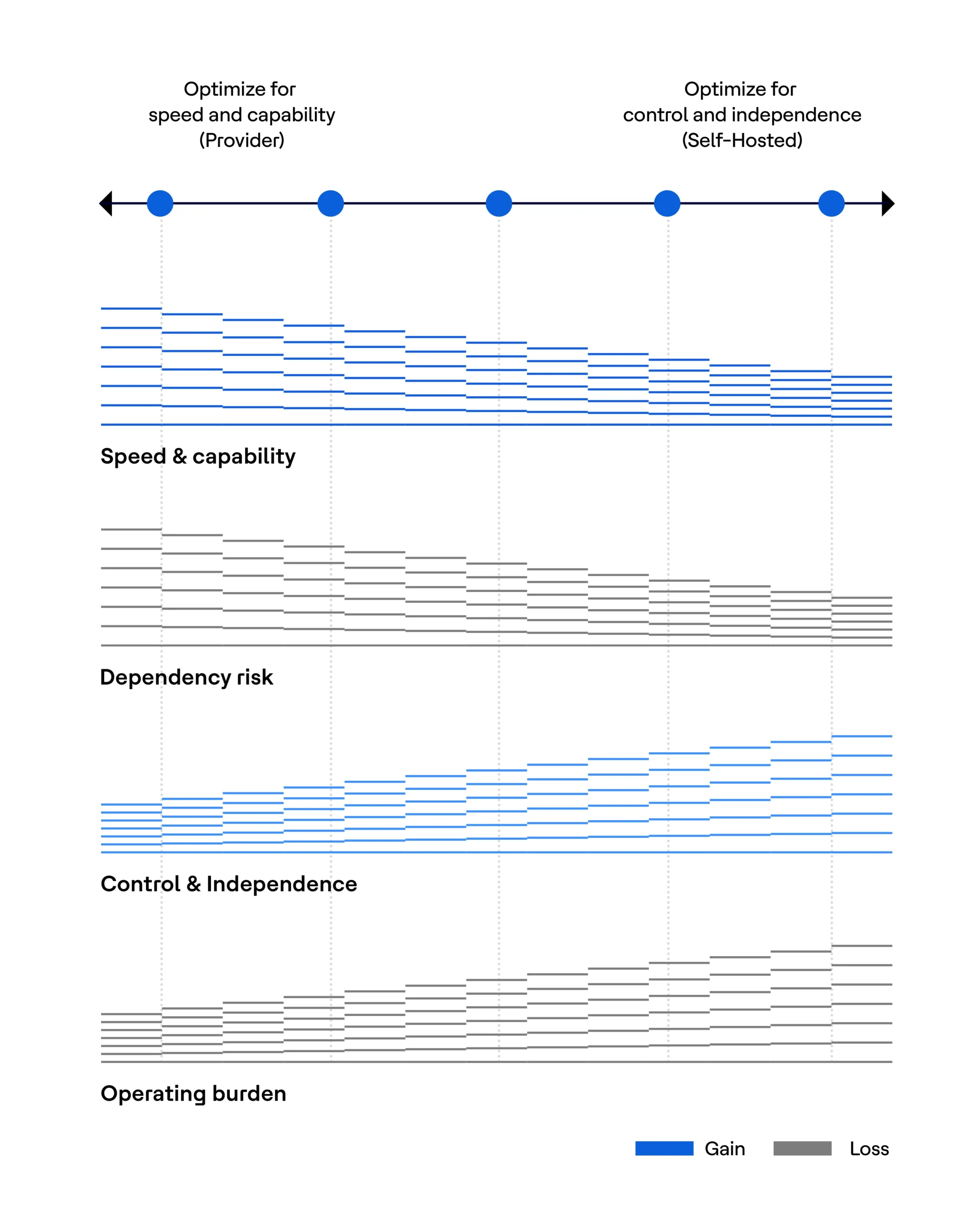
One organization. Different sovereignty requirements.
Different workloads call for different levels of control. An organization might choose to self-host its most critical systems, use a sovereign cloud for certain regulated workloads, and rely on public cloud services elsewhere. The right approach depends on the risks, dependencies, and trade-offs involved.

Some organizations self-host identity systems, core IP, or customer PII so no outside party can switch them off or reach them remotely. Others protect the same data in the cloud with strong encryption and their own key management. Where self-hosting is the right call, Actian VectorAI DB runs retrieval and agent memory on-premises, at the edge, or air-gapped.

A regulated reporting workload might run with a sovereign cloud or domestic provider when local jurisdiction is a priority, but many regulated workloads run well elsewhere. Before deciding, check who operates the control plane, who holds the keys, and who can switch it off. For metadata that can’t sit on shared infrastructure, the Actian Data Intelligence Platform offers a dedicated VPC, isolated from every other customer.
Explore Data Intelligence PlatformNon-critical, non-personal data often fits public cloud services, which offer durability and built-in disaster recovery when the dependency risk is acceptable. Wherever it runs, Actian data products and contracts keep the same rules and quality expectations attached to the data.
Explore Data Product & Contract



FAQ
Data & AI sovereignty is the ability to maintain control over your data, the AI systems that use it, the paths through which it is accessed, and the technology it depends on; enforce that control during operation; and prove it. Location is one input. Who operates the systems, which rules apply, and what AI can reach matter just as much.
No. Data can stay in-region while identity, support access, monitoring, backups, and AI pipelines operate elsewhere. Residency is necessary context; control, enforcement, and proof determine whether you are sovereign in practice.
Sovereignty is not about a technology choice. It is about making dependencies visible, understood, and fallbacks tested. Hybrid sovereignty matches the level of control to each workload’s risk.
AI needs new access paths. Enterprise data becomes prompts, embeddings, retrieved context, and inputs to agents that can act across providers and jurisdictions. Sovereignty now spans three layers: the data, the AI models that use it, and the agents that act on it.
Common drivers include GDPR, the EU AI Act, NIS2, DORA, sector rules such as HIPAA and BCBS 239, and national data localization and sovereign cloud initiatives. Requirements vary by jurisdiction and industry, so confirm what applies to you with your legal and compliance teams.
Actian supports the data and context foundation for sovereignty through databases, active metadata, governance, lineage, observability, governed AI access, and flexible deployment capabilities, as part of a broader enterprise architecture.