
Data and AI Sovereignty
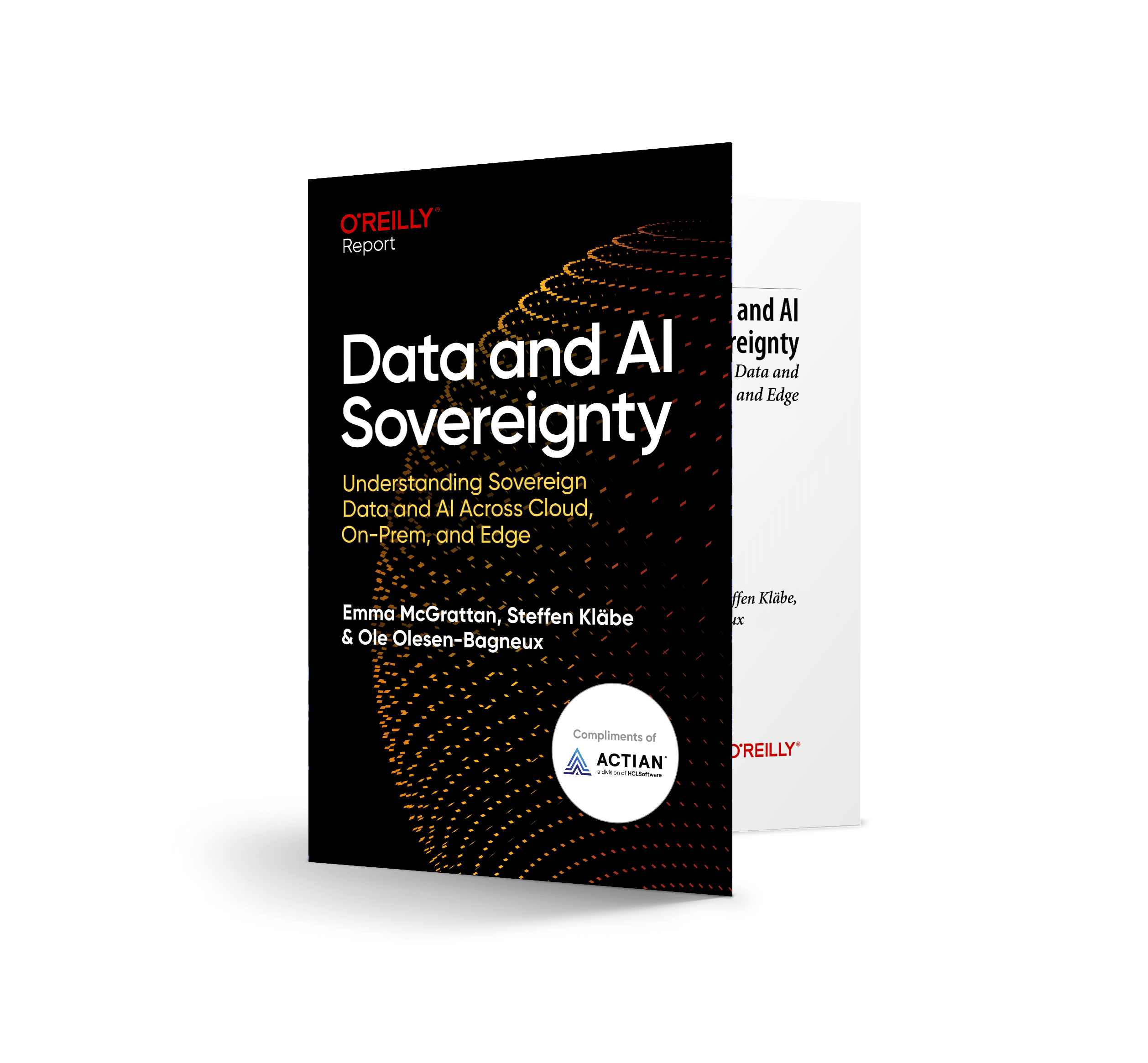
In this exclusive O’Reilly report, Actian CTO Emma McGrattan, Chief Evangelist Ole Olesen-Bagneux, and Chief Researcher Steffen Kläbe explore why Data & AI Sovereignty is becoming a strategic enterprise priority and how organizations can retain meaningful control over their data, AI systems, and critical technology dependencies.
Written for enterprise technology and business leaders, the report provides a practical framework for assessing sovereignty, managing critical dependencies, and balancing control, cost, complexity, capability, and strategic freedom.

Sovereignty is No Longer Just About Where Data is Stored
For decades, enterprises optimized technology architectures for connectivity, scale, efficiency, and access to global technology ecosystems. Those priorities remain important, but organizations must increasingly design for another property: the ability to retain meaningful control when circumstances change.
AI raises the stakes. Enterprise data now becomes prompts, embeddings, model context, training data, and inputs to autonomous systems that may operate across providers and jurisdictions. Understanding where data is stored is no longer enough. Organizations also need to understand who ultimately controls it.
This report provides a framework for making those decisions consciously. It explores how Control, Enforcement, and Proof can help organizations understand their dependencies, determine where they need greater sovereignty, and build resilience without pursuing technological independence.
Get Your Free Copy
Fill out the form below to get instant access to the digital report.
(i.e. sales@..., support@...)

About the Report
Data & AI Sovereignty is often reduced to data residency or the location of infrastructure. But keeping data within a particular country does not necessarily determine who can access it, which laws apply, or whether an organization can continue operating if a critical technology dependency becomes unavailable.
The report approaches sovereignty as a spectrum rather than a binary condition. Using Control, Enforcement, and Proof as its core framework, it helps organizations assess where greater sovereignty is necessary based on data sensitivity, regulatory requirements, operational importance, jurisdictional exposure, and dependency risk.
Rather than advocating complete technological independence, the authors introduce a pragmatic approach to hybrid sovereignty, helping organizations determine where greater control is needed and where existing technology dependencies remain acceptable.
What’s Inside
Preface
Why sovereignty is becoming an enterprise architecture priority.
Chapter 1: Data and AI Sovereignty in a Fragmented World
How geopolitical, regulatory, and AI shifts are reshaping sovereignty.
Chapter 2: The Consequences of Missing Sovereignty
The business and technology risks created by critical dependencies.
Chapter 3: The Levels and Trade-Offs of Sovereignty
How different sovereignty levels balance cost, complexity, capability, and strategic freedom.
Chapter 4: Becoming Sovereign
A practical approach to hybrid sovereignty, metadata-driven governance, risk prioritization, and roadmap development.
What You’ll Learn
✔ Why Data & AI Sovereignty is becoming a strategic enterprise priority.
✔ How sovereignty extends across data, AI, and agentic systems.
✔ How to identify risks and dependencies created by a lack of sovereignty.
✔ How Control, Enforcement, and Proof provide a practical framework for sovereignty.
✔ How to assess different sovereignty levels and their trade-offs.
✔ How to balance sovereignty with cost, complexity, capability, and strategic freedom.
✔ How to apply sovereignty principles to your own enterprise reality.
Who Should Read This Report?
- CTOs, CDOs, CDAIOs, and CPOs.
- Enterprise architects and senior technical leaders.
- CISOs and Data Protection Officers.
- Legal, risk, and governance leaders.
- CEOs and CFOs evaluating strategic technology dependencies and resilience.
About the Authors

Emma McGrattan
CTO, Actian
Emma McGrattan is Chief Technology Officer at Actian, where she leads the technology vision and engineering strategy for the company’s data and AI platforms. She has more than three decades of experience designing and operating mission-critical database and data management systems, spanning the evolution from traditional relational architectures to modern, AI-driven data platforms.
Emma is a recognized industry speaker and practitioner known for her pragmatic approach to emerging technologies. Her work focuses on the architectural foundations required to make AI systems reliable in production, including data quality, governance, metadata, and integration. Rather than emphasizing tools in isolation, she advocates designing data platforms that are resilient, explainable, and fit for enterprise-scale AI workloads.

Ole Olesen-Bagneux
VP, Chief Evangelist, Actian
Ole Olesen-Bagneux holds a PhD in Information Science from the University of Copenhagen, Denmark, where he has also taught courses pivotal to data cataloging and data management. His award-winning scientific work has been published in prestigious journals such as Philosophy and Literature, Knowledge Organization, and The Information Society. He is also the author of Fundamentals of Metadata Management and The Enterprise Data Catalog (both O’Reilly).
He has worked in Data Management and Governance as a leader, architect, and practitioner for over a decade in the life science sector. He has hands-on experience with several data catalogs. Ole is VP, Chief Evangelist at Actian, and lives in Copenhagen, Denmark.

Steffen Kläbe
Chief Researcher, Actian
Steffen Kläbe is Chief Researcher at Actian, where he works on vision and strategy at the intersection of AI and database technology. He holds a PhD in database system design from the University of Ilmenau, Germany. His scientific work has earned him best paper and dissertation awards.
Previously, Steffen worked as a researcher at the University of Ilmenau, Germany, and at Actian Engineering, where he bridged research and engineering. He led engineering projects that applied scientific results to enterprise products, gaining hands-on experience in transforming architectures into production-ready systems.