
Your engineers know what's broken. They don't know what it'll break next.
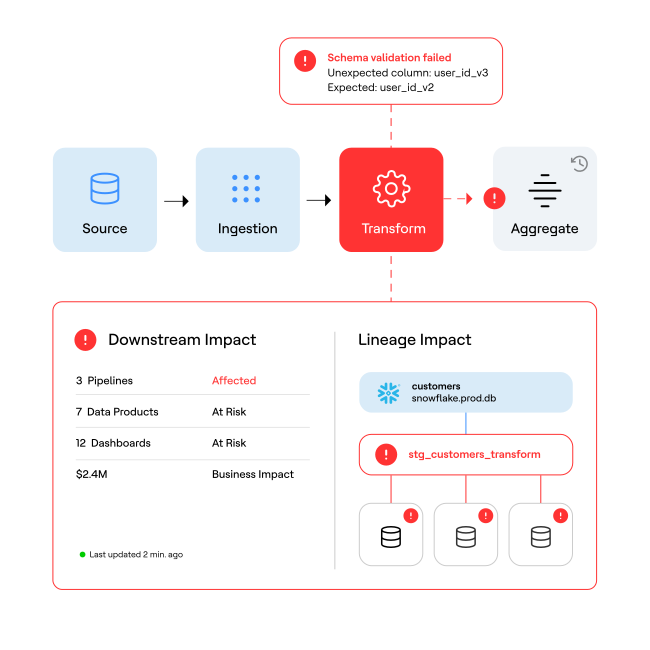
Actian gives data engineers a live view of pipeline health, downstream impact, and the business context to make safe changes fast.


Global science & technology company in healthcare / life science / electronics
Objects cataloged
.
Data products launched
.
Explorer users registered
.
A global science and technology company replaced Informatica across a 10,000 process pipeline. Without rebuilding it.
Our customer is one of the world’s oldest science and technology companies, operating across healthcare, life science, and electronics. Founded in the 17th century. €21B in annual revenue. 63,000 employees across 65 countries.
Their data problem was specific: schema shifts in a fragmented ecosystem spanning Snowflake, Palantir, AWS, and SAP were triggering cascading pipeline failures. 10,000+ data processes. No automated way to trace what broke, why, or what it touched downstream.

The challenge
- Legacy on-premise catalogs kept data siloed with zero cross-department visibility.
- Unexpected schema shifts triggered breaking errors that rippled downstream before anyone caught them.
- No lineage meant engineers were doing forensics after failures, not preventing them.

What Actian did
- Smart Lineage integrated as “Data Central” into their UPTIMIZE ecosystem, automatically tracking every data transformation from collection through storage.
- The Federated Knowledge Graph connected physical datasets to governed business context, so engineers could see what a field means, who owns it, and what depends on it before touching anything.
- Pipeline Observability flowed automated health scores into the catalog, surfacing schema drift and anomalies before downstream consumers saw them.
What a company of this scale achieved
3.4M unique metadata objects ingested across 30,000+ datasets.
1,000 governed data products launched from distributed operational processes.
13,000+ registered Explorer users within months of launch.
Built for how engineers actually work

Semantic context engineers can use
The Federated Knowledge Graph connects physical datasets to governed business logic. Before you change anything, you can see what a field means, who owns it, and what depends on it. Context is there when you need it, not buried in a wiki someone stopped updating.

Metadata that stays current without manual effort
Native connectors harvest and sync metadata continuously across cloud, on-prem, and hybrid environments. Health signals from Observability flow in automatically. Metadata flows back out via open APIs. Your stack stays current automatically.

Downstream impact mapping before something breaks
Smart Lineage traces two things simultaneously: how data transforms as it moves through pipelines and where it came from at the source. Most tools do one. When a schema shifts, Actian maps both, so engineers see exactly which downstream processes are at risk and can trace the problem back to its origin in the same motion.
Recognize any of these?
If your team is dealing with this… |
Actian addresses it with… |
|---|---|
Pipeline failures traced manually after the fact |
Smart Lineage shows you what breaks before you push the change |
Lineage tools that track transformations but lose the source, or trace origins but miss what changed in transit |
Smart Lineage captures transformation lineage and data source lineage together, in a single automated pass |
Engineers spending hours on context-hunting before safe edits |
Federated Knowledge Graph exposes governed business logic at field level |
Metadata documentation that’s always 3 sprints behind |
Native connectors harvest and sync continuously, no manual refresh |
Schema drift that surfaces only after downstream consumers complain |
Observability detects drift and surfaces it before it propagates |
Where data engineering connects to the bigger picture


Ready to Stop Tracing Failures After the Fact?
Talk to a solutions engineer about your pipeline environment. We’ll map where Smart Lineage, Quality, and Observability apply to your specific stack.
Book a Solutions Call
(i.e. sales@..., support@...)
