Blog | Data Intelligence | | 4 min read

5 Essential Features for a Five-Star Data Stewardship Program
Zeenea Studio Screen

You have data – and lots of it. However, it is messy, incomplete, and scattered across several different platforms, databases, and even spreadsheets. On top of this, some of your information is inaccessible or, worse, accessible to the wrong people. And as the go-to data experts of the company, Data Stewards must be able to identify the who, what, when, where, and why of their data to build a reliable stewardship program.

Unfortunately, Data Stewards face a major roadblock to success – the lack of tools to support their role. When dealing with large volumes of data, maintaining data documentation, managing enterprise metadata, and tackling quality & governance issues can be quite challenging.

This is where the Actian Data Intelligence Platform steps in. Our data intelligence platform – and its smart and automated metadata management features – facilitates the lives of Data Stewards. Discover 5 of them in this article.

Feature 1: Universal Connectivity

Automatically extract and inventory metadata from your data sources.

As mentioned above, a lot of enterprise data is spread across many different information sources, making it difficult, even impossible, for Data Stewards to manage and control their data landscape. Actian Data Intelligence Platform provides a next-generation data cataloging solution that centralizes and unifies all enterprise metadata into a single source of truth. Our platform’s wide range of native connectors automatically retrieves and collects metadata through our APIs and scanners.

Feature 2: A Flexible & Adaptable Metamodel

Automate data documentation.

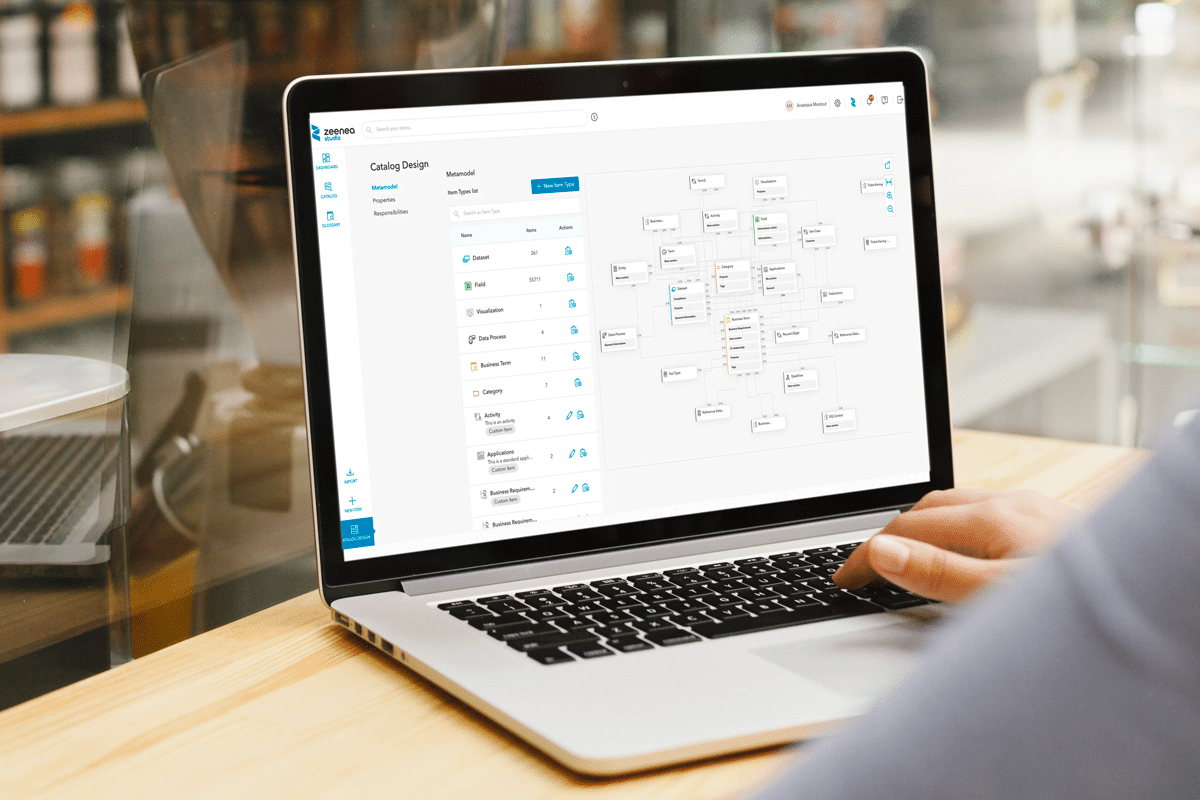
Documenting information can be extremely time-consuming, with sometimes thousands of properties, fields, and other important metadata that need to be implemented for business teams to fully understand and have the necessary context on the data they are consulting. Actian Data Intelligence Platform provides a flexible and adaptable way to build metamodel templates for pre-configured (datasets, fields, data processes, etc) and an unlimited amount of custom objects (procedures, rules, KPIs, regulations, etc).

Import or create your documentation templates by simply dragging & dropping your existing properties along with your tags, and other custom metadata into your templates. Made a mistake in your template? No problem! Add, remove, or modify your properties and sections as you please – your items are automatically updated after you’ve finished editing them.

Feature 3: Automatic Data Lineage

Trace your data transformations.

In order for Data Stewards to build accurate and trustworthy compliance reports, data lineage capabilities are essential. Many software developers offer lineage capabilities, but rare are those who understand it. Via a visual and easy-to-interpret lineage graph, the Actian Data Intelligence Platform offers your users the possibility to navigate through the lifecycle of their data. Click on any item to get an overview of its documentation, relations to other assets, as well as its metadata to obtain a 360° view of your catalog items.

Feature 4: Smart Suggestions

Quickly identify personal data.

With the GDPR, California Consumer Privacy Act, and other regulations regarding the security and privacy of the information of individuals, it can be a hassle to go through each existing set of information to ensure you’ve correctly indicated the data as personal. To always ensure your information is correctly labeled, the Actian Data Intelligence Platform analyzes similarities between existing personal data by identifying and giving suggestions on which fields to tag as “personal data”. Data Stewards can accept, ignore, or delete suggestions directly from their dashboard.

Feature 5: An Effective Permission Sets Model

Ensure the right people are accessing the right data.

For organizations with various types of users accessing their data landscape, it doesn’t make sense to give everyone full access to modify anything and everything. Especially when dealing with sensitive or personal information. For this reason, the Actian Data Intelligence Platform designed an effective permission sets model to allow Data Stewards to increase efficiency for your organization and reduce the risk of errors. Assign read-only, edition, and admin rights in all or different parts of the catalog to not only ensure a secure catalog but also save time when data consumers need to find an asset’s referent.

Ready to Start Your Data Stewardship Program?

If you’re interested in the Actian Data Intelligence Platform’s features for your data documentation & data stewardship needs, contact us for a demo with one of our data experts.


Global data has been rapidly growing for more than a decade, snowballing into massive quantities of data available to businesses today. Data is aggregated everywhere on the Internet – through web searches, social media, work files and text messages – as well as via IoT devices and sensors. This has led to impressive market growth, and according to Statista, the global big data market is forecasted to increase to $103B by 2027, more than double its market size in 2018.

There is no end in sight for the accumulation and growth of big data. So, the question remains, are you prepared to face the future of big data? Let’s look at several key steps you can take to prepare yourself for big data management in the years to come.

Database Server Farms Provide Fast and Simple Data Management

Let’s face it, big data doesn’t all easily fit together in one computer. Setting up a cluster of small computers to handle workloads is complicated to configure and difficult to keep running. It can also introduce problems, such as sharing skew and workload management difficulties, creating a highly fragile and difficult ecosystem. Further, a large, singular dataset and a centralized data warehouse of everything is simply not productive or necessary.

Instead, consider working with a flexible database server farm for an environment that’s easy to set up, manage and change. A homogenous database server farm offers independent servers without cluster complexity, a single database setup and the ability to add or delete servers without affecting others. Vector Analytics Database’s high performance and easy administration without cluster complexities make it a great option for a database server farm. Vector requires little to no tuning, so virtually no individual setup is needed, and it allows users to introduce variations that are typically found in a heterogenous database server farm.

Integration Makes Data Usable and Agile

Data supports decision-making, and data quality impacts an organization’s ability to provide their products and services. Company data must be usable and agile, as well as protected and governed, but managing data becomes more complicated each year as quantities of data grow. Because of this, organizations must harness the power of data integration by collaboratively using people, suppliers, and technologies to make better use of disparate data sources and inform decision-making.

The key steps to follow in the big data preparation process include extracting data from various sources, properly loading data, and transforming data for analysis. Ensure that during this process, you are following data governance standards and keeping security processes in mind. Using big data integration will allow your company to run with high-performing teams sharing information, data, and knowledge to support business decisions and customer service.

A Modern Data Platform Offers High-Quality, Real-Time Data Insights

Businesses are facing another challenge when it comes to managing seemingly infinite amounts of data – their data warehouses are not designed for analyzing big data in real-time. Most data warehouses are designed for what companies needed several years ago, with on-premises infrastructure and fixed capacity and processing optimized for relational database schemas. Today, organizations need scalable cloud infrastructures and on-demand resource scaling. Traditional data warehouses cannot accomplish this with the speed that modern businesses require.

A modern data platform designed for high-efficiency processing can leverage high-performance vectorized data processing and manage big, unruly data. Actian Data Platform helps organizations manage and analyze huge quantities of data quickly and efficiently, giving users real-time insights to make business decisions in the moment. The Actian Data Platform’s unique capabilities outperform traditional data warehouse solutions, delivering significantly higher performance at a much lower cost.

Better Manage Big Data in the New Year

Looking for modern, scalable solutions to help you tackle your big data challenges in the new year? Visit Actian’s product overview page to find solutions to your data management and analytics needs.


Blog | Data Analytics | | 4 min read

A Beginner’s Roadmap for Adopting and Using Cloud Data Analytics

Digital chart with rising and falling lines representing the cloud analytics adoption path

Data managers have their hands full when it comes to their data analytics strategies. Datasets are growing in complexity and are generated at record volumes. Processing, analyzing and putting this data to use is mission critical for businesses to drive revenue and scale in the future.

To help process these new and complex datasets for use in analytics, businesses are turning away from traditional on-premises solutions, eschewing them for cloud-based alternatives instead. Modern-day solutions such as cloud data platforms allow businesses to keep data offsite, while still making it instantly available for use and analysis. These platforms offer businesses more efficient data management strategies and can easily scale alongside the business.

There are several considerations that data leaders need to make before choosing a new analytics solution, to ensure it meets the needs of the business. In this blog, we’ll offer a how-to guide on choosing the right solutions to drive optimal results, no matter the scale or complexity of the data involved.

What to Choose?

Businesses need agility to keep pace with their competitors and technological innovation. Maintaining this agility comes down to having access to mission-critical data and being able to easily analyze and interpret it. Without easy analysis of datasets, businesses would be lost when it comes to recommending next steps to customers or mapping out future revenue projections. This is why selecting the right data analysis solution is so important.

Before adopting a new cloud analytics solution, businesses need to create a data-first culture and clearly outline what they want to get out of their analytic efforts. To move forward with a data strategy, businesses should evaluate the current state of their internal systems, processes, and the skillsets of those working directly with data. Through that analysis, businesses can identify issues that may exist in analytic processes, and where they can streamline them.

Organizations must establish buy-in on adopting new cloud analytics solutions at the top, starting with business stakeholders and C-suite executives. The adoption of a new data analytics solution will help make data analysis more seamless across the enterprise; so, it’s up to leaders to create a company culture that’s focused on collaboration.

Creating this type of culture can come with challenges. Internal issues often hamper data initiatives. A recent report from Foundry found that organizations are struggling in analytics training, data management, data security, data integration and business intelligence. Among shortages in technical talent today, businesses should recognize the need to prioritize up-skilling and training employees in these areas. Once an organization establishes a culture of data-sharing and buy-in on change, they can find the solution best suited to meet their needs and goals.

Opting for the Cloud

Many businesses have opted for cloud analytics to aid them in generating business-critical insights. The flexibility offered with solutions such as the Actian Data Platform, allows businesses to have instant access to the data they need in a single-pane view.

Cloud data platforms provide greater flexibility and efficiency than a typical traditional data warehouse. Cloud service providers automatically deploy software updates and maintain servers, meaning the platform is constantly at its best, most up-to-date state. A scalability advantage lies in the ability to change compute resources based on need, as opposed to paying for an entire physical warehouse, but only using half of it.

Cloud analytics also improves availability for businesses, as the data is stored offsite. In the event of an issue such as a server crash or power outage in a facility, a business can still access data securely and remotely.

Cloud analytics is essential to driving revenue and keeping customers happy. Businesses need to recognize this value and use cloud analytics to drive growth. By taking the right steps evaluate a solution’s ability to meet their needs, businesses can set themselves up for success by picking the right cloud analytics solution.

To learn more about how the Actian Data Platform can help your business level up your cloud analytics game, visit https://www.actian.com/data-platform/


Blog | Data Analytics | | 4 min read

Three Critical Best Practices for Utilizing Customer-Centric Data

Person with a tablet accompanied by digital illustrations related to sales and customer data

Today’s customers have high expectations when it comes to customer experience and making purchasing decisions. Consumers are looking for high-quality shopping experiences, both online and in-store. They expect companies to provide a clear shopping interface, visually appealing websites and storefronts, easy access to customer support, and simple checkout processes when interacting with brands.

You may be wondering, “How can I ensure my company offers all this to meet customers’ standards?” The key to creating a valuable customer experience is to uncover specific consumer preferences through your data. Gaining a complete, 360-degree view of customer data can unlock insights into your clientele that you were previously unaware of, allowing you to create a customer-centric business.

Developing a complete, comprehensive customer profile can be a difficult challenge, as businesses often have difficulty compiling disparate data sources. A single data source may have worked well enough in the past, but today’s customers have diversified the way they go about daily activities, including obtaining goods and services. Companies must reevaluate how they analyze customer data if they want to continue to grow and scale.

Three Best Practices for Using Your Customer Data

Bring Disparate Data Sources Together

On its own, your customer relationship management (CRM) system only offers a narrow view of the data available to you, making it impossible to rely on that system exclusively in order to gain a 360-degree view of the customer. There are numerous data silos in your system that offer the information you need, but you must have the tools in place to aggregate and analyze your siloed data.

The data you need can be found across various internal department systems, including marketing, customer support, and sales, which commonly capture data from various customer touchpoints. Important customer data can also be found across your mobile applications or loyalty programs. Customer activities on these platforms can offer valuable insight into customer preferences and behavior. Finally, data from your social media platforms can also help you better understand your customers, especially how they feel about your company. Make sure to compile findings from social media to better understand customer perception of your company and products.

Create a Customized Experience

Consumers today expect a shopping experience that is tailored to their wants and preferences. Your customer data offers insights into everyone’s unique buying behavior, preferences, and perception of your brand. Building a 360-degree view of your customer data allows you to shape sales channels and marketing campaigns according to their preferences. Furthermore, a unified customer profile allows you to tailor the shopping experience to each customer’s unique taste.

An example of optimizing the customer experience is to use data to send shoppers discounts on items that they’ve viewed while browsing your online store but haven’t yet purchased. Another way to improve sales and customer satisfaction could be to use customer data and market basket analysis to pair products that are frequently purchased together, recommending them once a shopper has added something to their cart. Using data insights makes it possible to offer customized deals, create product bundles, and optimize product placement for the ideal customer experience.

Improve Customer Retention

By gathering your data together into a complete, unified customer profile and creating compelling shopping experiences, organizations will ultimately earn better customer loyalty. Assembling your customer data allows you to develop a more complete view of customer behaviors, sentiment, and buying patterns. You will better understand how shoppers feel about their experience, and you can more easily determine areas of adjustment as needed.

Customer data can provide companies with the insights they need to create better marketing and sales promotions, improve customer service, and improve on customer experiences in-person and online. All of this has a direct impact on the likelihood of purchasers shopping with you in the future, and a data-informed customer strategy will lead to improved retention and a higher sales volume.

Uncover Customer Insights and Grow Your Business

Actian’s Customer Data Analytics Hub offers strategic capabilities for organizations looking to design a better customer profile and an experience that is uniquely tailored to each shopper. Learn more about how Actian’s Customer Data Analytics Hub can help you unify your customer data by unlocking silos, giving you the insights to grow your business.


Blog | Data Intelligence | | 4 min read

Implementing a Data Culture – BARC Data Culture Survey 23

Multiethnic Business Team Meeting In Office

In last year’s BARC Data Culture Survey 22, “data access” was selected as the most relevant aspect of BARC’s ‘Data Culture Framework’. Therefore, this year, BARC examined companies’ current status, experiences, and plans about their efforts to create a positive data culture with a special emphasis on ‘data access’.

The study was based on the findings of a worldwide online survey conducted in July and August 2022. The survey was promoted within the BARC panel and via websites and newsletter distribution lists. A total of 384 people took part, representing various roles, industries, and company sizes.

In this article, discover the achievements & priorities regarding implementing data culture from BARC’s Data Culture Survey 23.

The Benefits & Expectations of Data Culture are Promising

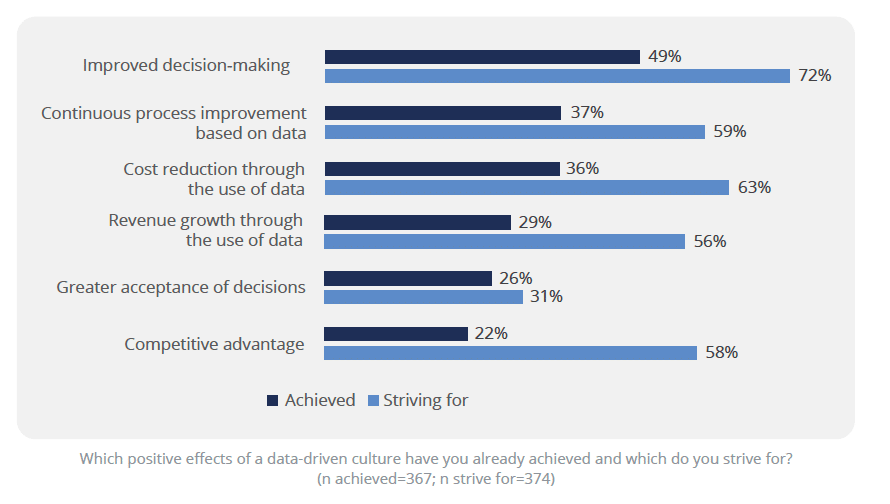
One of the major benefits of data culture was improved decision-making, which, according to BARC, almost half of the participants achieved. As seen in the graph below, the benefit with the smallest deviation between expectation and achievement is ‘greater acceptance of decisions’. For just under a third, this is a desirable goal, and nearly all achieve it.

Best-in-class* companies prove that improving their data culture pays off. The benefits are significantly more frequent than the laggards, with the differences between them being greatest when it comes to achieving competitive advantage and revenue growth through the use of data.

BARC also mentions that in Europe, more than 50% of participants expect greater benefits by reducing data silos and a distributed understanding of data than those from the USA & APAC! However, actual benefit achievement is noticeably higher in the USA & APAC, most likely because there is a higher adoption rate of new technologies (e.g. more widespread use of data products).

The Initiatives Companies are Improving Data Culture Initiatives

40% of participants are not planning any initiatives in data literacy.

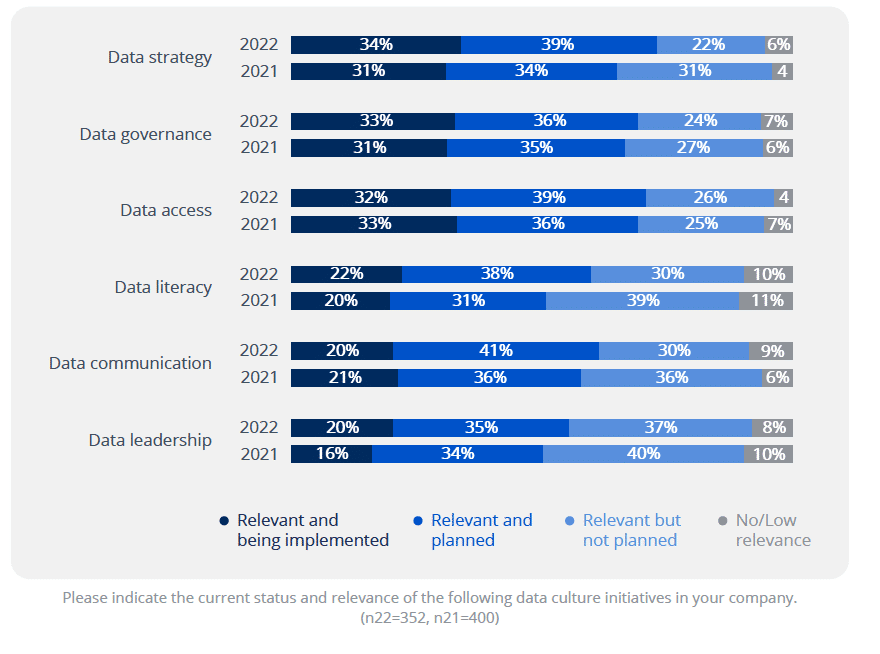
Overall, compared to 2021, the importance of data initiatives has increased in each of the 6 aspects of the BARC Data Culture Framework: Data strategy, Data Governance, Data access, Data literacy, Data communication, and Data leadership.

The most significant and the most implemented initiative impacting data culture was Data strategy, with 94% of respondents considering it to be relevant & 73 percent having already launched or planning to launch the initiative.

Closely related to data strategy is the data governance initiative. Governance is seen as an instrument for establishing a secure, consistent, and reliable data ecosystem that meets corporate & legal requirements. Indeed a third of respondents have already implemented governance initiatives and a further 36% have it planned.

Data leadership is also considered relevant in 92 percent of companies. However, only 20 percent have anything in place and 35 percent have implementations planned.

Data leadership is dependent on the generation of leaders. BARC states in their survey “Strategies for Driving Adoption and Usage with BI and Analytics”, that a new generation of data-driven leaders was cited as the strongest driver of BI and analytics tool adoption and usage.

An interesting note from CxOs: 81% of those surveyed claim that data literacy initiatives have already been implemented or are planned, and the corresponding figure for data communication is 78 percent. However, employees in operational functions and data and analytics leaders and experts report less widespread activity – there is work to be done to convince top management that competence and communication are still nowhere near as far advanced as they think!

Data access initiatives have the highest relevance overall at 96% having already been implemented! Data literacy and data communication trail way behind, each with around 40 percent of participants not planning any initiatives in these areas.

The Obstacles to Overcome for Data Culture Implementation

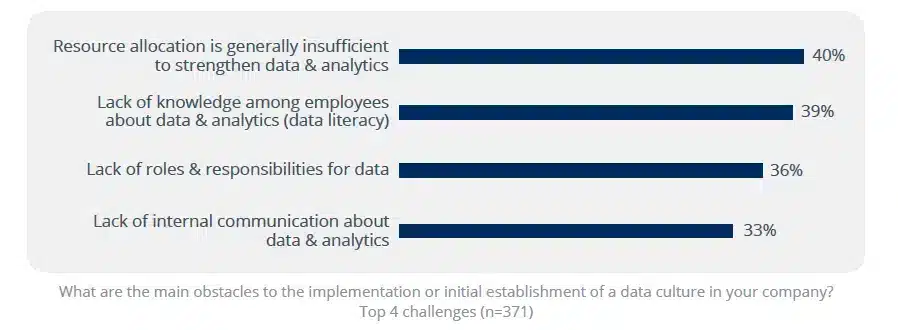
According to BARC, the top barriers to implementing data culture are the lack of resources, lack of knowledge, organization, and communication. They have consistently been the biggest challenges for data and analytics leaders for a long time. A particular concern is that many are prioritizing initiatives to improve data culture that do not directly address the biggest problems.

For instance, the lack of data literacy is the second most frequent challenge but tackling it is not a high priority for participating companies. Unlike data strategy, data governance, and data access, data literacy is one of the initiatives where a lot is planned but relatively little is done.

In fact, the prevailing opinion is that the purchase of specific data technology or software solves data problems. BARC states that this is not the case. For example, a data catalog without any organization (roles, responsibilities, processes) and active use by data consumers and producers will never be able to deliver the benefits it is designed for.

This also includes data leadership and communication: from the beginning, the goal should be to bring everyone along, empower them, and set an example of data-driven action. This requires creating the necessary space, starting with the development of a data strategy.


Blog | Data Analytics | | 4 min read

Do You Have Big, Fast, Useless, or Ugly Data? Here’s What to Do.

Man with a tablet in his hands on which digitally illustrated data appears to exemplify unstructured data

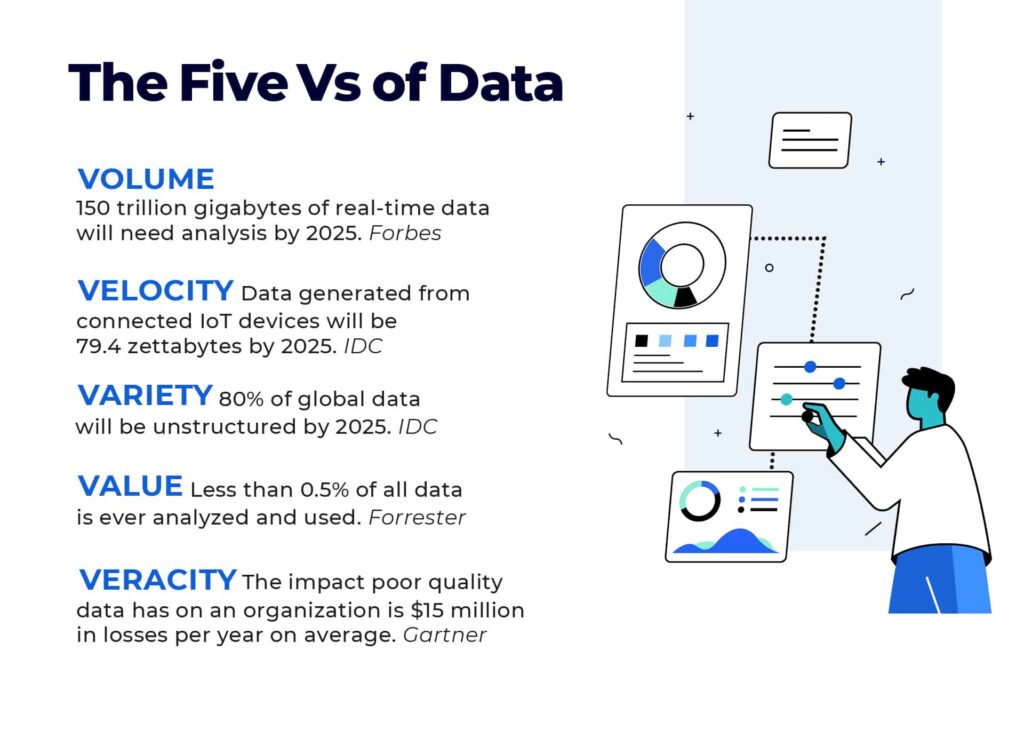
It has been more than 20 years since Meta Group (acquired by Gartner) introduced the 3Vs of data, Volume, Velocity and Variety. Gartner later expanded the 3Vs to 5Vs by adding Value and Veracity. To this day, these remain important considerations in data analytics. However, their size and complexity continue to increase. Here’s a look at where we are today and some pointers for how to keep up.

Illustrated infographic about the 5 Vs of data

Volume

The volume of data refers to the size of data that needs to be analyzed and processed. Data is getting bigger. IDC predicts that the global data volume will expand to 175 zettabytes by 2025. Over half of this, 90 zettabytes, will come from Internet of Things (IoT) devices. Moreover, Forbes predicts that 150 trillion gigabytes of real-time data will need analysis by 2025.

Pointers:

  • Look for solutions that can scale with data volumes.
  • Make sure that you can reuse data pipelines and share data across use cases.
  • Choose real-time analytics that can meet your key performance indicators and service level agreements.
  • Evaluate the solution’s ability to offer consistent management, governance, and compliance.

Velocity

Velocity refers to the speed with which data is generated. Data is getting faster, especially with the increased analysis of real-time data streams to tackle diverse use cases such as IoT sensor data analytics, fraud detection, online advertising, cybersecurity, log analytics, stock trading and much more. IDC estimates data generated from connected IoT devices will be 79.4 zettabytes by 2025, growing from 13.6 ZB in 2019.

Pointers:

  • Preprocess data at the edge to reduce the cost and effort of moving and storing data.
  • Test high speed data load capabilities of your data analytics so you can quickly access operational and streamed data.

Variety

Variety refers to the number of types of data and includes structured, semi-structured or unstructured data. Data required for analytics is getting more jumbled. Unstructured data, content that does not conform to a specific, pre-defined data model, is rapidly surging. IDC forecasts that 80% of global data will be unstructured by 2025. About 90% of unstructured data has been created in the last two years. Organizations analyze just .5% of unstructured data today, but this will certainly increase soon. Semi-structured data such as JSON, XML, and HTML formats is also dramatically growing due to growth of the web.

Pointers:

  • Assess the solution’s ability to make data accessible regardless of structure or format.
  • Look for the flexibility to create custom connectors and extend integrations.

Value

Value refers to whether data is positively impacting a company’s business outcomes. Unfortunately, data is often useless. The reason is simple; data doesn’t meet the needs of users. Forrester finds that less than 0.5% of all data is ever analyzed and used. It also estimates that if the typical Fortune 1000 business was able to increase data accessibility by 10%, it would generate more than $65 million in additional net income.

Pointers:

  • Get to know what data your users really need.
  • Prioritize data that will help users meet their goals.
  • Understand issues that may prevent users from getting insights they need.
  • Present data in a manner that is timely and in the right context.

Veracity

Veracity refers to the quality and credibility of data. Data can be ugly and decisions made on it cost you money. According to Gartner, the financial impact poor quality data has on an organization is around $15 million in losses per year on average.

Pointers:

  • Ensure your data quality is adaptable and scalable.
  • Include a level of automation that can help filter out quality data and better integrate it across the enterprise.
  • Take a collaborative approach to data quality across the enterprise to increase knowledge sharing and transparency regarding how data is stored and used.

Blog | Data Security | | 4 min read

Six Data Privacy Trends in Data Analytics to Watch in 2023

Hands on a laptop keyboard with a digitally illustrated shield exemplifying data privacy trends

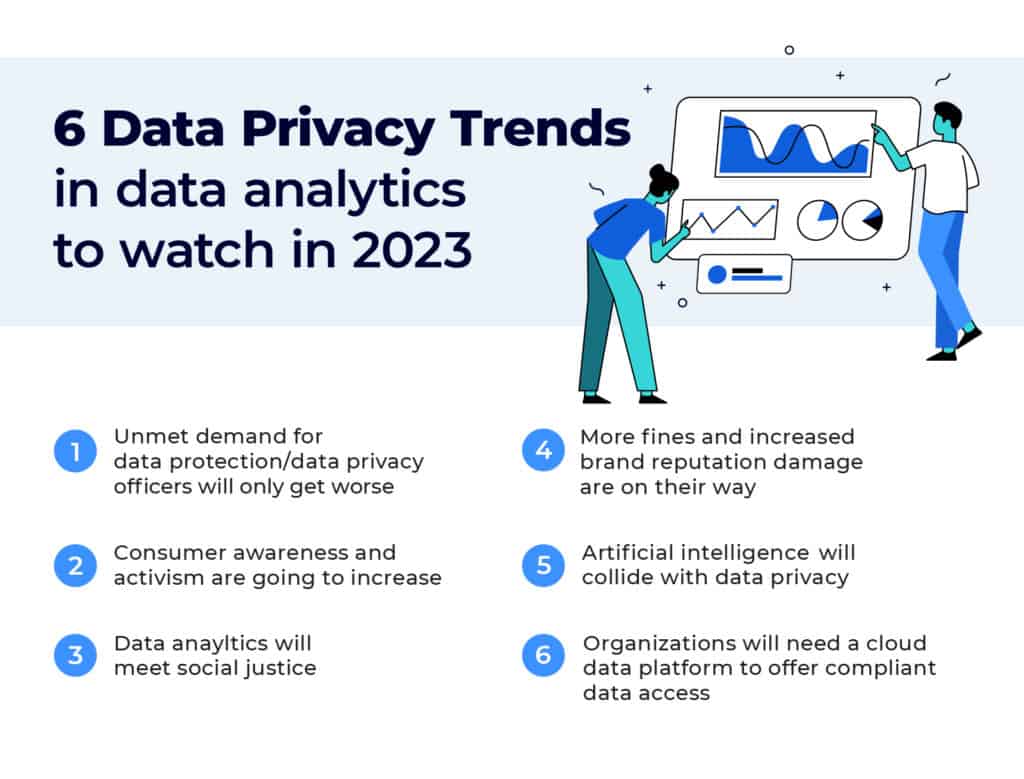
Just like climate change, data privacy is a topic that’s grown from warm to hot and is moving into an extreme heat wave. This fast-moving issue inspired me to get out my crystal ball to predict top trends for 2023. Here are six data privacy trends, that lie ahead next year in the world of data analytics.

6 data privacy trends in data analytics to watch

1. Unmet Demand for Data Protection/Data Privacy Officers Will Only Get Worse

For many businesses, it’s no longer sufficient for someone in their legal, finance or IT teams to take on the data privacy challenge as an added responsibility. Understanding and monitoring compliance with the deluge of new privacy laws and keeping up with relevant data and analytics trends is a full-time job. Plus, the data protection officer is a mandatory role for all companies that collect or process EU citizens’ personal data, under Article 37 of the General Data Protection Regulation (GDPR) if:

  • A public authority or body conducts processing.
  • Core activities of the controller or the processor consist of processing operations which require regular and systematic monitoring of data subjects on a large scale; or
  • Core activities of the controller or the processor consist of processing on a large scale of special categories of data or personal data relating to criminal convictions and offences.

2. Consumer Awareness and Activism Are Going to Increase

Consumers are already concerned about the way companies are using their data. The Cisco 2021 Consumer Privacy Survey found that 32% of consumers have terminated relationships with online and traditional companies over data privacy concerns. At the same time, consumer awareness of privacy and data protection rules is low. DataProtect reports that just 3% of Americans say they understand how the current laws regulating online privacy in America work.

Don’t expect low awareness to continue as consumers read more about data and analytics trends such as new compliance laws and reported violations. At the least, data privacy advocacy groups will increase their watchdog activities on behalf of consumers.

3. Data Analytics Will Meet Social Justice

Over the last few years, awareness of systemic injustices in our society has also increased, and this includes knowledge of how advanced analytics can result in inequitable outcomes. For example, a bank may deny a person of color a mortgage, even if the credit rating and financial profile are the same as someone the bank accepted for a mortgage for a similar property. Businesses will need to take greater care when aggregating data and modeling analytics to ensure there isn’t systematic bias against a demographic. Otherwise, the organization can be held liable.

4. More Fines and Increased Brand Reputation Damage Are on Their Way

Fines for compliance violations are already increasing, with GDPR fines skyrocketing by 600% to €1.1 billion in 2021. Alongside increased consumer awareness and activism, it’s only natural that more fines will follow.

Also, keep in mind that data privacy is a brand reputation issue, not just a compliance issue. It’s going to become even harder for companies to bounce back and repair the damage to their brand as consumers become more aware of a business’ legal obligations to protect their privacy.

5. Artificial Intelligence (AI) Will Collide with Data Privacy

AI drives sensitive data analytics in search algorithms, recommendation engines, AdTech networks, and more. Just because compliance regulations don’t explicitly mention AI, it doesn’t mean that compliance provisions aren’t relevant to AI. For this reason, I’m predicting a greater need to consider data privacy in AI design including building, training and deploying machine learning models.

6. Organizations Will Need a Cloud Data Platform to Offer Compliant Data Access

I would like to end with what I envision as a greater requirement for cloud data platform adoption for data analytics. The right solution can help break down data silos that introduce greater non-compliance risks since you don’t have full visibility. The right solution can help drive equitable outcomes and ensure that users only see the data they should. A cloud data platform can also help configure data quality rules to ensure data is accurate, consistent, and complete, as more laws require that organizations clean up their bad data. For example, Article 16 of the GDPR requires companies to rectify inaccurate personal information and complete missing personal data without undue delay.


Blog | Data Security | | 5 min read

Data Privacy: Five Tips to Help Your Cloud Data Platform Keep Up

Digitally modeled shield to exemplify cloud data privacy

Gartner estimates that 65% of the world’s population will have its personal information covered under modern privacy regulations by 2023, up from 10% in 2020. General Data Protection Regulation (GDPR) opened the floodgates with its introduction in 2018. Since then, countries across the globe have enacted their own laws. The United States is growing increasingly complex as individual states such as California, Colorado, Connecticut, Utah, Virginia, and Wisconsin have each passed their own privacy bills and more states have pending legislation in the works. Plus, there’s industry compliance to worry about such as Payment Card Industry (PCI) DSS and Health Insurance Portability and Accountability Act (HIPAA).

In a fragmented privacy compliance environment, organizations are scrambling to make sure they comply with all the different rules and regulations. There’s no getting around the need to understand constantly evolving data privacy legislation and to develop appropriate policies. To deal with the tremendous scope of the work involved and the regulatory requirements for this role, many organizations are hiring a dedicated Data Privacy Officer/Data Protection Officer.

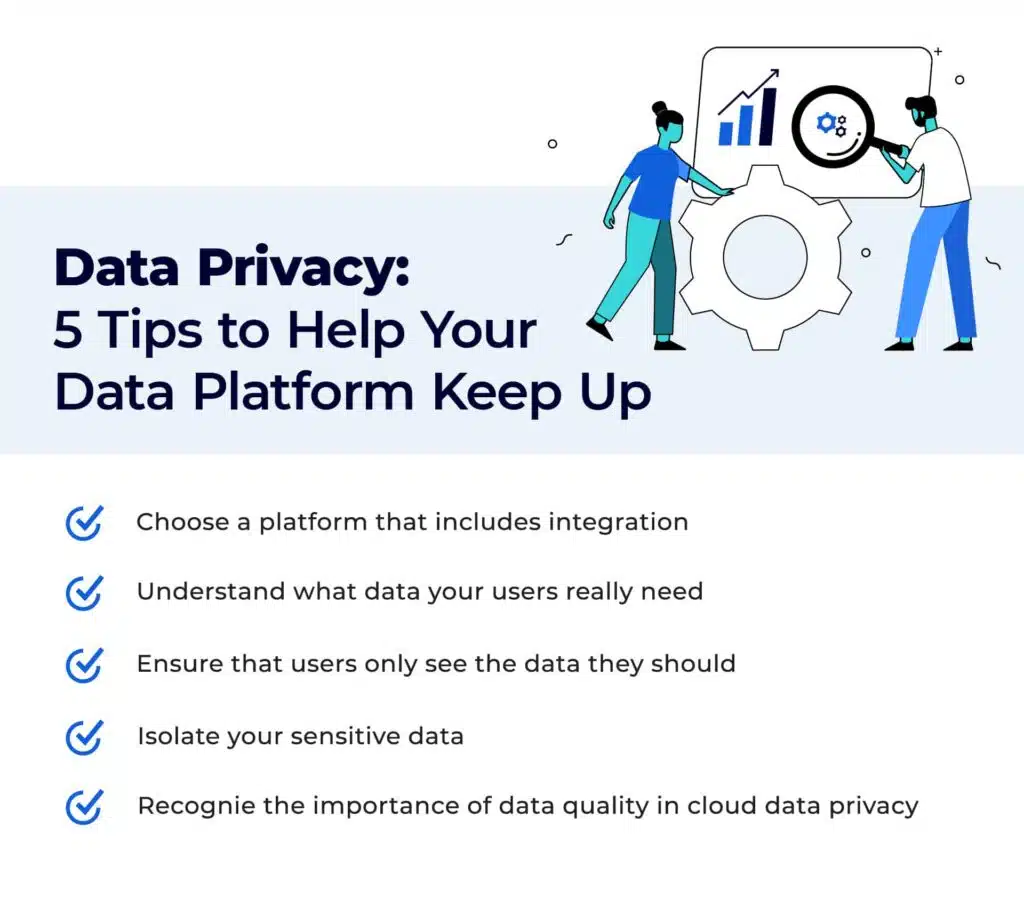
Implementing a compliant cloud data platform is also hard, particularly as organizations strive to make data available to anyone in their organization who can use it to gain valuable insights that produce better business outcomes. These five tips can make cloud data privacy easier:

1. Choose a Platform That Includes Integration

Data silos add to data compliance complexity and introduce more non-compliance risks. With built-in data integration, businesses can quickly create and reuse pipelines to ingest and transform data from any source, providing a way to break down silos and to avoid the need to build them in the future. With integration as part of a single solution, businesses will be able to migrate data more quickly into the platform and to reflect changes in source systems sooner.

Further, integrating data to get a 360-degree view of the customer will help you better understand what sensitive information you’re collecting data, where you’re sourcing it from and how and where you are using it.

2. Understand What Data Your Users Really Need

Collecting too much data also increases risk exposure because there’s more data to protect. Delivering data that users need rather than a kitchen sink approach not only improves decision-making, but also enhances cloud data privacy. If simply asked “what data do you need?”, the answer is often “everything,” but this rarely is the right answer. Getting to know one’s users and understand what specific data they really require to do their jobs is a better approach.

3. Ensure That Users Only See the Data They Should

What can a business’ users see? The answer should not be “everything,” nor should it be “nothing.” Business users need visibility to some data to do their jobs, but identities shouldn’t be exposed unless necessary.

Cloud data platforms need to provide fine-grained techniques such as column-level de-identification and dynamic data masking to prevent inappropriate access to personally identifiable information (PII), sensitive personal information, and commercially sensitive data, while still allowing visibility to data attributes the worker needs. Column level de-identification protects sensitive fields at rest while dynamic data masking applies protection on read depending on the role of the user. Businesses will also need role-based policies that you can quickly update so that they can flexibly enforce the wide range of data access requirements across users.

4. Isolate Your Sensitive Data

Many privacy laws require that businesses protect their data from various Internet threats. There are lots of security measures to consider when protecting any data, but protecting sensitive data requires advanced capabilities such as those mentioned above as well as the ability to restrict physical access. Using a platform evaluation check list, businesses should be sure to include support for isolation capabilities such as:

  • On-premises support in addition to the cloud so that sensitive data can remain in the data center.
  • The ability to limit the data warehouse to specific IP ranges.
  • Separate data warehouse tenants.
  • Use of a cloud service’s virtual private cloud (VPC) to isolate a private network.
  • Platform access control for metadata, provisioning, management, and monitoring.

5. Recognize the Importance of Data Quality in Cloud Data Privacy

Data leaders widely recognize the importance of high-quality data to enable accurate decision-making but think of it less often as a compliance issue. Some data privacy regulations specifically call for improving quality. For instance, GDPR requires businesses to correct inaccurate or incomplete personal data. Make sure your Cloud Data Platform lets you easily configure data quality rules to ensure data is accurate, consistent, and complete.

Final Thoughts

Non-compliance is costly and can cause considerable damage to your brand reputation. For GDPR alone, data protection authorities have handed out $1.2 billion in fines since Jan. 28, 2021. To avoid becoming part of the mounting penalties, and then part of the next day’s news cycle, always remember to keep compliance in mind when evaluating your cloud data platform and how it meets cloud data privacy data requirements.


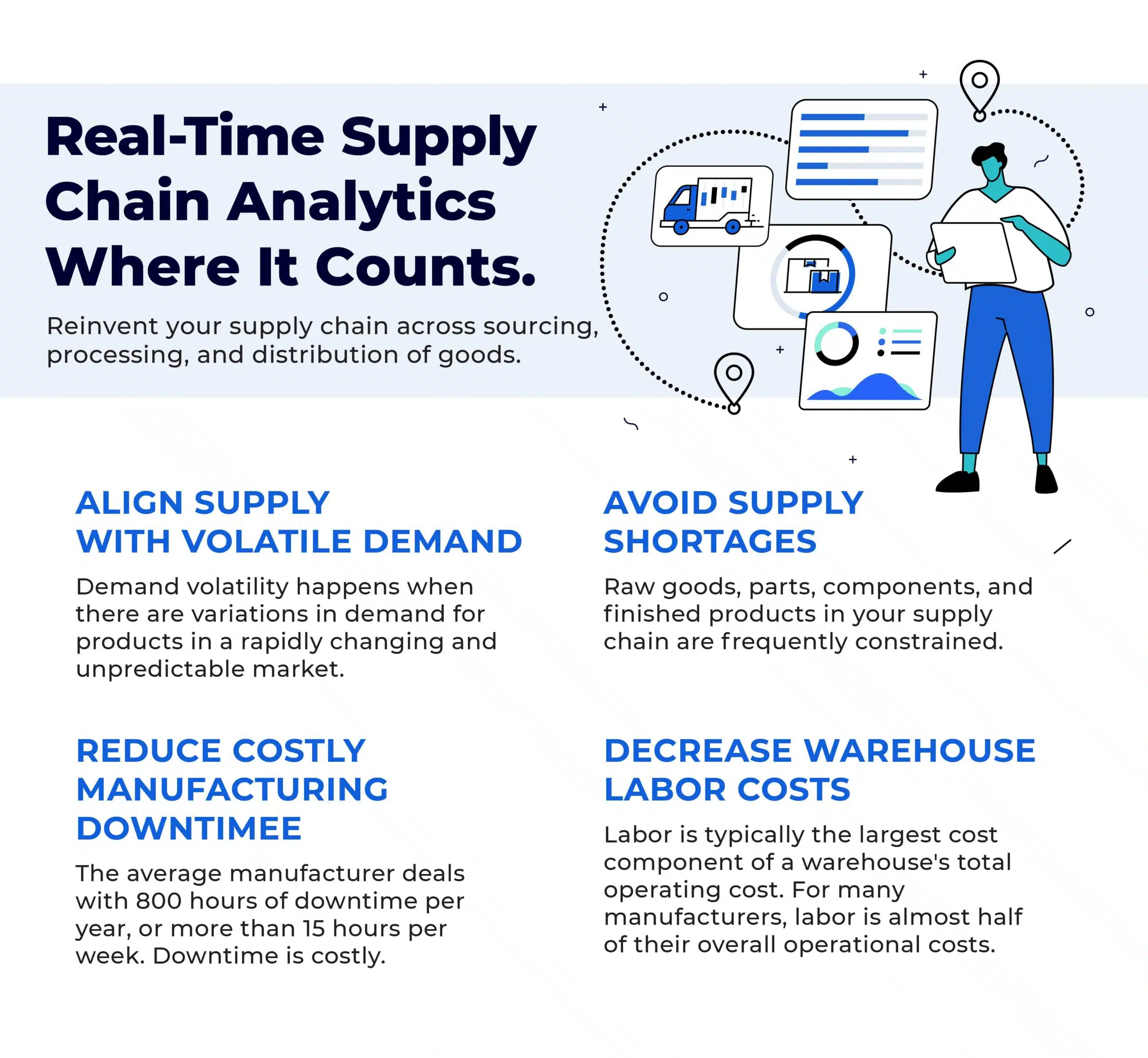
There are many areas where real-time data analytics helps businesses increase revenue and operate more efficiently. Manufacturers, for instance, can use real-time supply chain analytics to reinvent their supply chain across sourcing, processing, and distribution of goods, so they can adjust to changing conditions quickly and effectively. Manufacturers can get the visibility they need at any moment, in time to deal with some of their hardest supply chain challenges more effectively – including demand volatility, supply shortages, manufacturing downtime and high warehouse labor costs.

Demand Volatility

Demand volatility happens when there are variations in demand for products in a rapidly changing and unpredictable market. Many factors contribute to demand volatility. Examples include the changing customer preferences and behavior, competitive business maneuvers, upstream supply fluctuations, and your own product and price adjustments.

But how can you effectively align supply with demand when demand is volatile? Forecasts based on what happened in the past are inherently inaccurate in this type of environment. Accessing insights from real-time customer behavior and streamed point-of-sale data can help you understand demand as it’s happening more meaningfully. When used effectively, these insights can provide opportunities to:

  • Source new or reallocate existing production components.
  • Adjust production levels, shortening lead times and cycles.
  • Ensure adequate inventory is available in the right quantity, at the right place, at the right time.
  • Create or refine promotions to increase customer demand.

Supply Shortages

We have seen how the COVID-19 pandemic has posed significant challenges for supply chain dynamics and the kinds of business disruptions that it brought on across industries. Beyond the pandemic, the war between Russia and Ukraine and geopolitical concerns in East Asia have led to manufacturers reassessing where their suppliers and manufacturing facilities are located. To counter supply chain shocks, businesses rely on data analytics to help them determine what events are happening in their supply chain.

Can your data analytics help you determine which raw goods, parts, components, and finished products in your supply chain are constrained? Would you be able to determine the reasons why? If so, you may be able to leverage opportunities to buy missing production inputs from an alternative supplier or to resolve a transportation bottleneck by using another shipper. These are just two illustrations of how your business can use data analytics to resolve such challenges. Manufacturers should base decisions not only on whether sales margins will still be positive after adjusting sourcing and transportation, but also on the potential negative impact on the customer experience that supply chain constraints can cause.

Manufacturing Downtime

Downtime in manufacturing and labor costs in warehouses rank among one of the top reasons why there are operational inefficiencies. The average manufacturer deals with 800 hours of downtime per year – or more than 15 hours per week. Downtime is costly. For an automotive manufacturer, they can lose up to $22,000 per minute of downtime. As an increasing number of manufacturers incorporate more Internet of Things (IoT) devices on their plant floors, they also have many opportunities to analyze data from them in real time using advanced analytics and machine learning techniques. Manufacturers would be able to identify and resolve potential problems with production-line equipment before they happen and spot bottlenecks and quality assurance issues faster.

High Warehouse Labor Costs

Labor is typically the largest cost component of a warehouse’s total operating cost. For many manufacturers, labor is almost half of their overall operational costs.

Do you have the latest insights into changing demand so that you can dynamically scale your warehouse workforce based on business needs? Traditional demand forecasting helps manufacturers understand demand and product movement on a weekly, monthly, and yearly basis. However, manufacturers need to move faster if they want maximum efficiency. For example, real-time insights into demand can lead to faster production scheduling adjustments to either avoid or shorten the time of stockouts and to reduce unnecessary labor costs such as overtime.

Real-time supply chain analytics is a must-have for proactive, ambitious companies – not a nice-to-have. For manufacturers, whose success relies on the efficiency of their sourcing, processing, and distribution – real-time supply chain analytics should be a part of their business best practices. The bottom line is that real-time supply chain analytics will help manufacturers increase their revenue targets and metrics for business success.


Blog | Data Intelligence | | 4 min read

The Most Common Data Quality Issues and How to Solve Them

Quality Management With Qa (assurance), Qc (control) And Improvement. Standardisation And Certification Concept. Compliance To Regulations And Standards. Manager Or Auditor Working On Computer.

To stand out from your competitors, innovate, and offer personalized products and services, collecting data is essential. However, managing data isn’t a walk in the park: small problems can affect their quality every day. Incomplete or inaccurate data, security problems, hidden data, duplicates, inconsistencies, and data inaccuracies can cause data quality issues.

Here is an overview of the most common data quality-related issues and some best practices to use to curb them for good.

The Risks Associated With Poor Data Quality

As it’s been said over and over again, when it comes to data, the real issue is not the quantity of data but its quality. Data Quality Management (DQM) is a demanding discipline that relies on the endless questioning of data processes and constant surveillance of the very nature of the information that constitutes your data assets. Poor data quality can directly translate into lower revenues and higher operational costs, potentially resulting in financial losses for your company.

When data quality is degraded, analyses, projections, forecasts, and even decisions can be distorted. The greater the volume of degraded data, the greater the gap between reality and one’s understanding of reality. Ensuring data quality starts with a good understanding of the errors that can affect it.

The Most Common Data Quality Issues

Ensuring data quality is a key topic for any company that bases its development strategy on data. To carry out targeted actions, you need to prioritize tasks and not spread yourself too thin. Data Quality Management consists of identifying all the erroneous information that could distort your decision-making. This erroneous data can be classified into four categories.

Duplicate Data

When data is duplicated, it means that the same information is present multiple times in the same database or file. Data duplication is hence one of the most harmful issues because it is often difficult to detect. Beyond 5% of duplicated data, it is considered that the quality of the data starts to be degraded. For example, CRM tools often generate duplicate data, because their users sometimes add contacts without checking their presence in the database.

Hidden Data

On a daily basis, your business generates an increasing amount of data. Very often, you only leverage a limited portion of the available information. The rest of the data produced by your business gets scattered and diluted in data silos. It then remains permanently untapped. For example, a customer’s purchase history is not always available to customer service teams. Yet, this information would allow them to better identify the customer’s profile and therefore, provide more relevant answers to their specific requests, or even upsell or cross-sell by making adapted suggestions.

Inconsistent Data

Are John Smith and Jon Smith really two different customers? Inconsistent data significantly affects data quality. It can also be created by another well-known phenomenon: redundancy. This phenomenon occurs when you work with multiple sources (including third-party data) in addition to your own data. Discrepancies in data formats, units, or even spelling must be tracked in a data quality approach.

Inaccurate Data

It may seem obvious, but inaccurate data is probably one of the worst issues that can undermine data quality. When customer data is inaccurate, any personalized experience will not be relevant. For example, if your data inventory is inaccurate, supply difficulties or storage costs can skyrocket. Whether it’s incorrect contact information or missing or empty fields, you need to do everything you can to eradicate inaccurate data.

How to Solve Data Quality Problems

While common sense often presides over good data quality management, they are not enough to ensure it.

To meet these challenges and solve your data quality issues, you’ll need a Data Quality Management tool. But in order to choose the right solution, you will need to start by mapping your data assets in order to identify and evaluate their actual quality. Deploying a Data Quality Management solution, data governance, training, and raising awareness of your teams to good data management…are all essential pillars to limit data quality-related issues.


Blog | Data Integration | | 4 min read

Make Your Marketing Campaigns More Successful This New Year

Man in a suit drawing a red upward-curving arrow as an example of success

The key to a successful marketing campaign is to reach customers at the right place, at the right time, with the right message. Traditional market segmentation used in campaigns aggregates prospective buyers into groups with common needs. Marketers hope that customers in the same segment will respond similarly to a marketing promotion. But will they?

Not according to McKinsey & Company’s research that found that 71% of consumers expect companies to deliver personalized interactions. In addition to this, 76% answered that they get frustrated when this doesn’t happen. McKinsey & Company also reports that companies that excel at personalization generate 40% more revenue from those activities than average players.

Segmentation introduces more challenges than just insufficient personalization. Segmentation, even micro-segmentation, is an increasingly flawed campaign tactic since a customer with constantly changing shopping behavior quickly falls into a different segment than the ones initially identified for a promotion. This situation is made more complex because marketers can’t adjust campaigns quickly enough to keep up with customer and market changes throughout a campaign’s duration.

A more effective campaign optimization approach is to use data integration to build a 360-degree customer profile that enables the creation of individual-level messaging and relevant offers delivered in the best channel to reach the customer at exactly the right time. This data integration combined with real-time data analytics will help you sense and respond to campaign performance changes in real-time.

360-Degree Customer View

If you don’t understand who your customers are, your campaign promotions will not be able to target them effectively and you’ll lose opportunities to your competitors. The impact on your business can be tremendous; 66% of consumers say encountering content that isn’t personalized would stop them from making a purchase. Yet, many marketing departments lack access to the comprehensive data they need to create a 360-degree customer view, relying on limited historical data that has been extracted from their sales and CRM systems.

A 360-degree view requires access to real-time customer engagement data across all touchpoints, including your call center, your website, emails, social media, and more. In addition to this first-party data that you’re collecting directly from your customers, zero-party data collection is becoming more important. Forrester coined the term zero-party data and defines it as data that a customer intentionally and proactively shares with a brand. This includes data such as personal information, contact preferences, and purchase intentions.

Customer data should also come from external data sources (second-party data from partners and third-party data from aggregators). Examples include credit history, demographics and market data to create a broader picture of the customer that helps produce better-performing campaigns.

Real-Time Campaign Performance Analytics

Once you execute your campaign, you will benefit from measuring its performance in real-time. Operational analytics of sales data tied to marketing promotions can identify when you should adjust your campaign. You’ll have to build, test, and deploy campaigns in rapid succession to quickly adapt to constant changes in the market and customer behavior. Quick action will help you drive more revenue and optimize your marketing spend with greater accuracy.

How to Improve Your Campaign Performance

To fully optimize campaigns, you’ll need a cloud data platform with two important characteristics. The platform should include data integration to make it easier to create an accurate, complete, and timely 360-degree customer profile. Since data sources for creating a 360-degree customer view are so diverse, the integration should handle structured, semi-structured and unstructured formats. Also, the platform must provide real-time data analytics so that you can make fast campaign optimization decisions based on how your campaign is performing.

Actian Data Platform provides all these capabilities, making it easy to connect, manage and analyze customer data and campaign performance.


An impactful customer experience (CX) requires accurate and relevant data that’s easy to access, manage, and use. For businesses today, this data is the lifeblood for knowing more about customers to optimize CX. However, many organizations are saddled with data management challenges that reveal roadblocks to this data, resulting in an inaccurate and incomplete picture of the wider data set. This has a cascading impact for business teams to interpret data, which can lead to uninformed and less optimal business decisions.

The data management issue isn’t due to the lack of data. Rather, data silos, shadow IT, and aging legacy infrastructure (among other hurdles) all hold a business back from using data effectively to grow and scale. To make matters worse, traditional data management solutions require specialized IT resources and labor-intensive data preparation, which slows down processing. These data challenges also make data inaccessible to non-technical business users, such as sales, marketing, and customer success teams, who need to be more empowered through democratized, easy access to data.

Delivering exceptional CX requires businesses to remember who’s up front and center for them: their customers. This keeps the focus on finding ways to clear their data hurdles and identify useful and repeatable efforts that drive down as many of the hurdles as possible. We’ll further examine challenges, explore ways to clear them, and share best practices to help ensure organizations have the right data available to paint a 360-degree view of their customers.

Data Management Risks to CX

The amount of data businesses can access is no longer a challenge – the gap lies in the quality of that data, the level of access to it, and gaining a clear understanding of how it fits into broader business goals. A recent study found that nearly eight in 10 data management decision-makers believe cataloging issues (such as knowing where data lives and who the owners are) are among the top challenges in the data ecosystem.

This lack of knowledge and poor management of who owns the data and how to access it leads to two major issues: data silos and shadow IT. Silos around data collection limit data sharing. For example, a sales department may have collected data for a customer’s previous sales history. This data would be valuable to a CX team to resolve a customer issue, but the sales department doesn’t share its data with other departments.

Teams unable to access silos can turn to other systems or applications to help plug in missing information. In the example above, the CX team may use unapproved third-party applications or services to source information to resolve the customer’s issue. Without the knowledge of IT, this scenario can turn into a sprawl of unapproved resources for collecting and using data, further deepening the silo conundrum.

Who is at the receiving end of poorly managed data accessibility? Customers. Consumers are demanding a more personalized and unified CX, with a recent study finding that over 75% of consumers are frustrated when their experiences aren’t personalized. If silos or other issues stall customer teams from accessing critical data, it’s hard to create an experience that’s relevant to a customer’s buying journey.

Tackling this issue head-on means assessing if your systems are set up to simplify and automate data integration and provide access to that data across the enterprise. Many traditional data management solutions are laborious and ineffective from a time and money standpoint. To be truly effective, solutions should unify core technologies and function as a one-stop center for all things data.

Modernizing CX Through Unified Systems

It’s evident that customer demands reflect the backdrop of today’s fast-paced society. Any delay can impact the business, making it less proactive in understanding and addressing customer needs in the most meaningful way. To be successful, companies need access to solutions built with data integration and ease-of-use at their core. Actian Data Platform makes data easy, enabling businesses to simplify how people connect, manage, and analyze their data.

Actian Data Platform is purpose-built for the future of data-driven businesses. It reduces complexity and risks associated with digital transformation. The Actian platform enables businesses to streamline data processing, getting data into the hands of those who need it in the most flexible and easy way.

With the Actian platform, data is accessible from on-premises, cloud, or hybrid environments. This gives CX teams unparalleled access to business-critical customer data, allowing them to make decisions quicker and create a more engaging experience for customers. Additionally, the Actian platform makes data-driven projects even easier with the ability to have any – or all – of the platform’s capabilities managed or co-managed.

Transforming your data management strategies to improve CX can be tricky, but it’s imperative for organizations to be fully equipped to deliver the best for their customers. See how the Actian Data Platform can modernize your data management strategy.