Data Quality | The Enterprise Guide to Data Quality

Data quality is the degree to which data is accurate, complete, consistent, timely, valid, and unique enough to be fit for its intended purpose. In practice, that means a dataset can only be called high quality if it reliably supports the decision, process, analysis, or AI model that depends on it.
Data quality is not a nice-to-have technical attribute. It affects revenue reporting, customer experience, compliance, operational efficiency, and whether teams trust the data they use every day. If the data behind a dashboard, machine learning workflow, or regulatory submission is wrong, incomplete, stale, or duplicated, the output will be unreliable too.
What is data quality?
Data quality is a measure of how well data meets defined standards for a specific use case. Those standards usually include six core dimensions: accuracy, completeness, consistency, timeliness, validity, and uniqueness.
The key phrase is fit for purpose. Data that is good enough for one use may fail another. Customer records precise enough for billing may not be complete enough for churn prediction. Financial data suitable for internal reporting may not meet the traceability and accuracy requirements of external regulatory reporting.
That is why organizations define quality thresholds by domain, dataset, and business process rather than assuming one universal standard applies everywhere.
Why data quality matters
Data quality matters because every decision made from data depends on the reliability of that data. When quality drops, analytics, operations, governance, and AI all become less trustworthy.
Better decisions
Forecasts, performance reports, and strategic plans are only as good as the source data behind them. Inaccurate sales pipeline values distort revenue forecasts. Stale inventory data can trigger fulfillment errors. Inconsistent definitions across departments lead executives to see conflicting numbers for the same business metric.
Regulatory and audit readiness
Compliance depends on trustworthy records. Accuracy, completeness, and lineage all matter when organizations must demonstrate that data used in reporting or customer record handling is reliable. Quality failures can create audit issues, reporting errors, and regulatory exposure.
AI and analytics you can trust
AI systems inherit the strengths and weaknesses of their training and input data. If the data is incomplete, outdated, or mislabeled, models learn the wrong patterns and produce unreliable outputs. High-quality data is a prerequisite for trustworthy analytics and AI-ready information.
Lower operational friction
Poor data quality creates hidden work. Engineers troubleshoot broken pipelines, analysts recheck reports, and business teams manually correct records or reconcile conflicting systems. Even when the issue is not visible to leadership, the cost appears in delays, rework, and lost confidence.
The six dimensions of data quality
The most widely used answer to “what are the dimensions of data quality?” is six core dimensions. Some frameworks add others such as integrity or reliability, but these six are the standard foundation.
|
Dimension |
What it means |
Example of poor data quality |
|---|---|---|
|
Accuracy |
Data correctly represents the real-world object, event, or value it describes. |
A customer address still shows a location the customer left two years ago. |
|
Completeness |
All required fields and records are present and usable. |
Thousands of customer records are missing email addresses or account status values. |
|
Consistency |
The same data has the same meaning and format across systems. |
“Active customer” means 90 days in one system and 180 days in another. |
|
Timeliness |
Data is current and available when needed. |
Yesterday’s inventory data is used to process today’s orders. |
|
Validity |
Data conforms to the required format, type, range, and business rules. |
A date field contains a value that does not match any accepted date format. |
|
Uniqueness |
Each real-world entity is represented once, without unnecessary duplicates. |
The same customer appears multiple times with slight spelling differences. |
Organizations sometimes ask about the “5 elements,” “7 C’s,” or “7 dimensions” of data quality. Those are alternative frameworks, but most enterprise data programs still center on the six dimensions above because they are measurable, widely understood, and practical for governance and operations.
Data quality example
A simple data quality example is a customer table used for billing, marketing, and support. If one customer appears three times, one record has an outdated address, and another is missing an email address, the dataset has uniqueness, accuracy, and completeness problems.
Those issues produce real consequences:
- Billing statements may go to the wrong address.
- Marketing may send duplicate campaign messages.
- Support agents may not see a complete view of the customer relationship.
- Analytics teams may overcount active customers.
A data quality program would detect those issues through profiling, validation, and matching rules, then fix root causes at data entry, integration, and synchronization points.
What causes poor data quality?
Poor data quality is usually caused by process gaps, system complexity, and weak controls rather than by a single bad dataset. Common causes include manual entry errors, missing validation rules, inconsistent business definitions, duplicate records, broken integrations, and data that arrives too late for the use case.
Typical root causes include:
- Manual data entry with no format or value checks.
- Different systems using different definitions for the same business term.
- Incomplete ingestion pipelines and mapping errors during data ingestion.
- Schema changes that break downstream transformations and rules.
- Lack of deduplication and identity matching.
- Weak ownership and accountability for fixing recurring issues.
- Missing business context in the business glossary or technical metadata.
Quality problems rarely stay isolated. One inaccurate source system can spread defects across reporting, analytics, and AI pipelines if controls are not in place early enough.
How data quality is measured
Data quality is measured by testing datasets against defined rules, thresholds, and expected patterns. The most common methods are profiling, validation, scoring, and continuous monitoring.
Data profiling
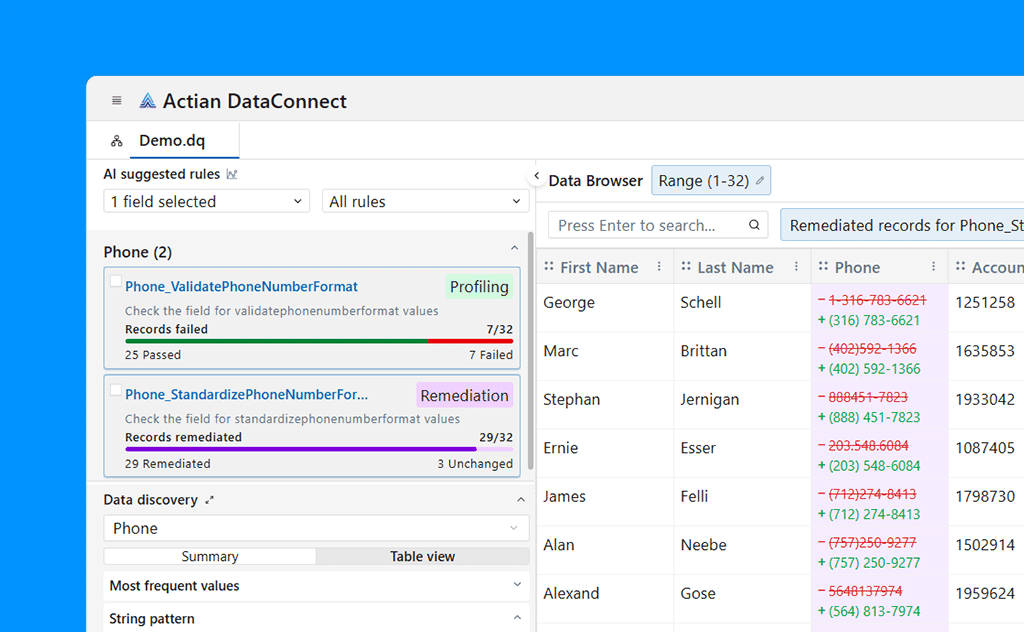
Data profiling examines the actual contents of a dataset to understand null rates, distinct values, patterns, outliers, distributions, and duplicate rates. Profiling establishes a baseline and helps teams find issues before defining remediation steps.
Validation rules
Validation rules specify what acceptable data looks like. These rules may test required fields, allowed ranges, accepted formats, referential integrity, or cross-field logic. For example, a rule might require every active customer account to have a valid region, owner, and last activity date.
Quality scores
A data quality score is a numerical summary of how well a dataset passes its checks. For example, a dataset that passes 96 out of 100 required tests may receive a 96% score. Scores help teams compare assets, track trends over time, and decide whether a dataset is ready for production use.
Continuous monitoring
Continuous monitoring watches quality metrics over time and alerts teams when thresholds are breached. This is especially important in modern pipelines where changes in volume, schema, or source behavior can quickly degrade downstream trust.
In practice, quality measurement works best when connected to metadata management, business definitions, usage history, and lineage. That context helps users understand not only whether a dataset passed a check, but why the result matters and who should act on it.
Data quality dimensions vs. related concepts
Data quality is closely related to several other data disciplines, but it is not the same thing as any of them.
|
Concept |
How it differs from data quality |
|---|---|
|
Data quality management |
Data quality is the condition of the data. Data quality management is the ongoing program used to measure, improve, and govern that condition. |
|
Data governance |
Data governance defines policies, ownership, standards, and accountability. Data quality applies those standards to real datasets. |
|
Data observability monitors the health and behavior of data pipelines and datasets. Data quality focuses on whether the data itself is fit for use. |
|
|
Data cleansing fixes existing issues. Data quality includes prevention, measurement, monitoring, and root-cause improvement, not just cleanup. |
|
|
Data accuracy |
Accuracy is one dimension of data quality, not the whole concept. A dataset can be accurate but still incomplete, stale, or duplicated. |
What good data quality looks like in practice
Good data quality means users can find, understand, and trust data without repeating the same manual checks every time. It is visible, measurable, and tied to business context.
In a mature environment:
- A data analyst can compare datasets based on certification status, freshness, and quality score before using them.
- A data engineer can assess downstream impact before changing a schema because dependencies and data lineage are visible.
- A steward or owner can trace recurring defects back to the source system and assign accountability for remediation.
- Business users can interpret metrics consistently because business terms, rules, and metadata are connected.
This is where a modern data intelligence approach matters. Trusted, AI-ready data depends on more than isolated rules. It depends on connecting technical metadata, business definitions, ownership, usage, and lineage across distributed systems so quality issues can be understood in context and resolved at the source.
Best practices for improving data quality
Improving data quality requires a repeatable framework, not a one-time cleanup project. The most effective programs combine governance, automation, and accountability.
- Define quality by use case. Set thresholds by domain and business need rather than relying on generic standards.
- Assign ownership. Clarify who owns the data, who stewards it, and who fixes recurring issues.
- Standardize definitions. Align business terms, rules, and field meanings across systems.
- Validate early. Catch issues at entry, ingestion, and transformation points instead of waiting for reports to fail.
- Monitor continuously. Track quality over time and alert teams when conditions change.
- Connect context. Link quality metrics to metadata, lineage, and downstream usage so teams know the impact of defects.
FAQ
Data quality means how well data meets the standards required for its intended use. In most organizations, that means the data is accurate, complete, consistent, timely, valid, and unique enough to support reliable decisions and operations.
Some sources describe five elements of data quality, but there is no single universal five-part model. The most widely used enterprise framework includes six dimensions: accuracy, completeness, consistency, timeliness, validity, and uniqueness.
Many teams use six core dimensions and add a seventh such as integrity, reliability, or conformity. The exact list varies by framework, but the standard foundation remains accuracy, completeness, consistency, timeliness, validity, and uniqueness.
The “7 C’s” is an alternative way some organizations describe data quality attributes, but it is not the dominant enterprise model. Most practitioners still organize data quality work around measurable dimensions such as accuracy, completeness, consistency, timeliness, validity, and uniqueness.
A data quality score is a numeric summary of how well a dataset passes its defined checks. It helps teams compare assets, monitor trends, and decide whether data is ready for reporting, analytics, or AI use.
Data quality affects AI directly because models learn from the data they are given. Inaccurate, incomplete, inconsistent, or stale data leads to weak training signals, unreliable predictions, and outputs that are harder to trust or defend.
Responsibility for data quality is shared. Data owners are accountable for business outcomes, data stewards manage day-to-day quality processes, and technical teams implement the controls, pipelines, and monitoring that enforce standards.
Data accuracy is one part of data quality. Accuracy asks whether a value is correct, while data quality evaluates a broader set of characteristics including completeness, consistency, timeliness, validity, and uniqueness.