
Not all AI analytics answers give you the same control
AI analytics tools can all turn a business question into an answer. The differences become clearer when you look at how they govern the analysis, how much work it takes to maintain that governance, and how much control you retain over deployment and model choice.

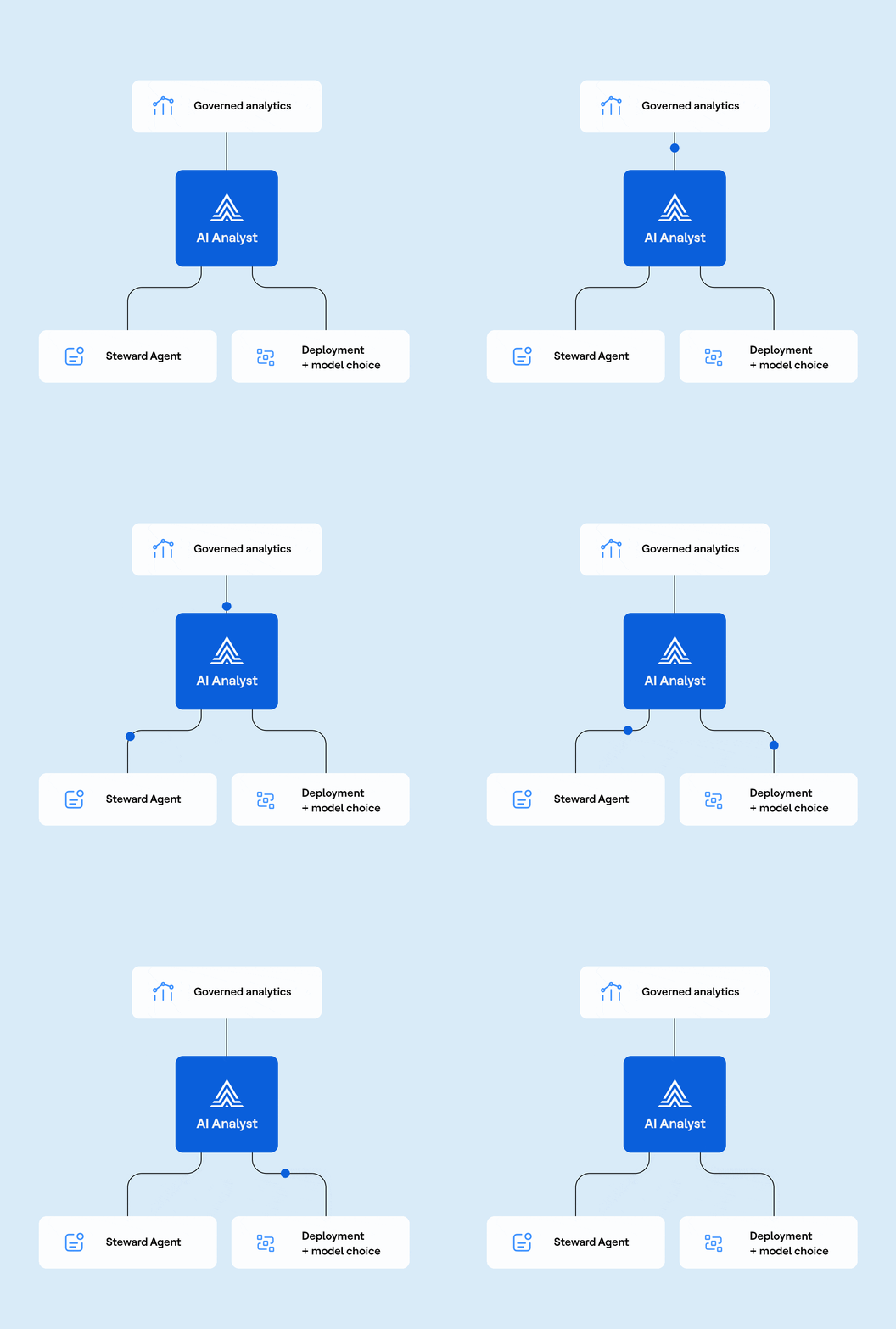

Same question. Three different paths to an answer.
See how each platform turns a business question into SQL, and where governed context shapes the path.
The agent expresses the analysis through the governed semantic layer as SemQL, Actian’s semantic query language. A semantic query describes what to analyze using governed business concepts, such as metrics, dimensions, relationships, and filters, instead of generating the database logic itself. AI Analyst then compiles that semantic query into native SQL for execution.
Semantic context guides SQL generation. Genie uses modeled and inferred business context from its knowledge store, including semantic definitions, relationships, and SQL expressions. The LLM uses that context to generate SQL for execution.
Routing Mode attempts semantic SQL first, then falls back to standard SQL on physical tables when needed. Snowflake reports that semantic SQL is produced for about 10% of queries in aggregate, depending on semantic-view coverage.

A semantic layer only works if you can build one
Snowflake and Databricks provide tools to create, refine, and optimize the semantic context their AI uses, including inferred context.
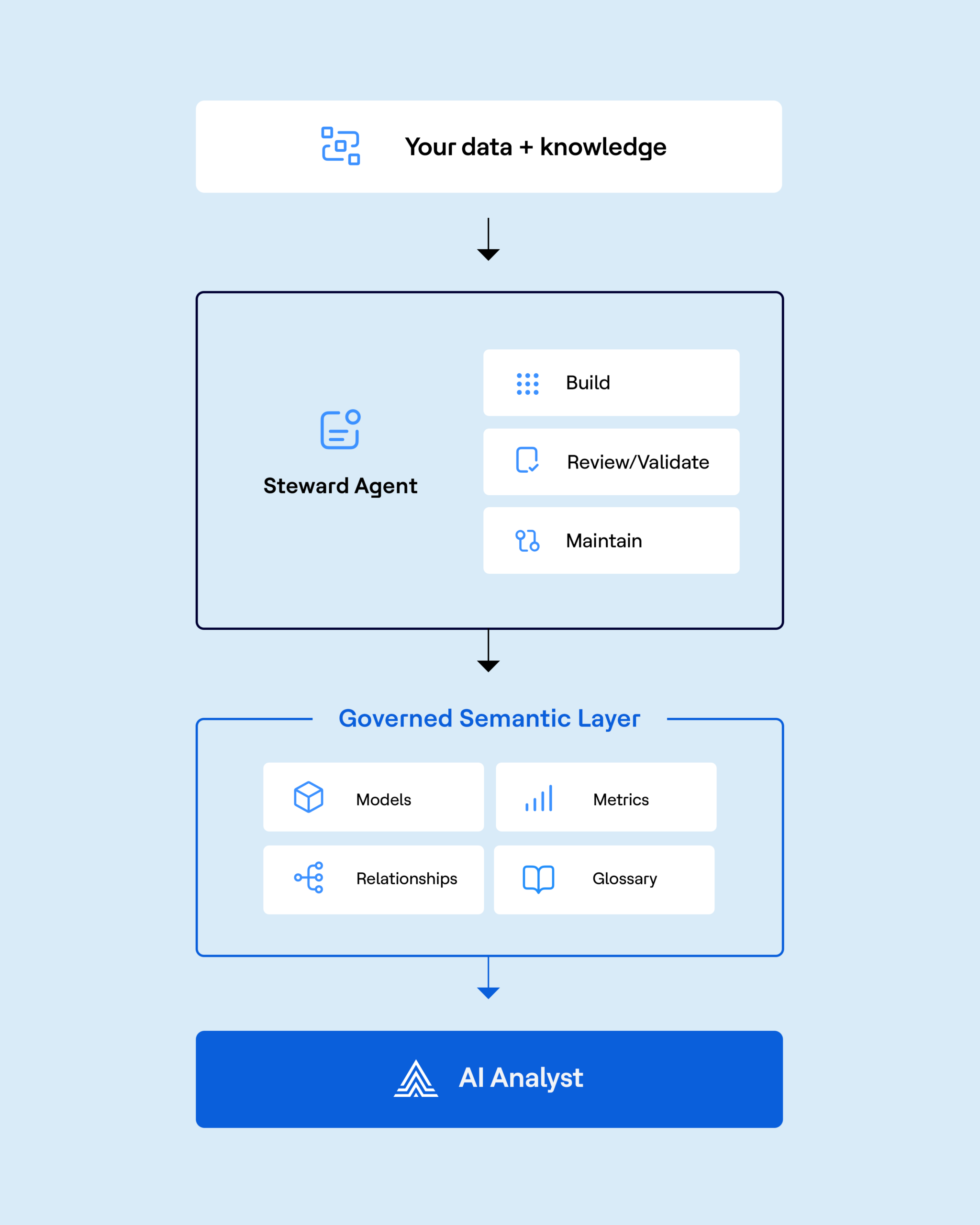
AI Analyst takes a different approach. The Steward Agent helps build and maintain an explicitly defined semantic foundation rather than relying on inferred business logic.
Business definitions often live across tables, documentation, and your data team’s institutional knowledge. Steward analyzes those sources to propose models, metrics, relationships, and glossary terms for your team to review and validate.
Once approved, those definitions become governed business logic that AI Analyst applies consistently. As definitions change, Steward surfaces potential impacts before updates create inconsistencies elsewhere.
AI analytics that adapt to your architecture
Snowflake Cortex and Databricks Genie extend the ecosystems they’re built into. AI Analyst takes a different approach, giving you flexibility over where the analytics layer runs and which LLM sits behind it.


Questions for any AI analytics vendor
The differences that matter aren’t always visible in a demo. Use these questions to understand what the platform requires from your data team and how much control you retain after deployment.
Ask the vendor |
What to understand |
|---|---|
How does governed business context carry through to execution? |
Whether governed definitions constrain how the query is constructed or serve as context the LLM uses when generating it. |
Who builds and maintains the semantic layer? |
What your data team must do to create metrics and relationships, validate them, manage changes, and keep definitions current. |
Where can the platform be deployed? |
Whether the analytics application can run within your environment or remains a vendor-hosted service, even with private connectivity. |
Can you choose the LLM? |
Whether you can use your organization’s preferred supported model or are limited to the models available through the analytics platform. |
What does adopting the platform require you to change? |
Whether you need to move data, adopt vendor-specific infrastructure, replace existing analytics investments, or restructure current workflows. |
Can you inspect how an answer was produced? |
Whether you can trace the definitions, relationships, filters, calculations, and query logic used to produce the result. |
