Data quality management (DQM) is the ongoing practice of measuring, monitoring, remediating, and improving data quality across an organization’s data estate so that data remains accurate, complete, consistent, timely, valid, and unique for its intended uses.
The distinction between data quality and DQM is important. Data quality is a state — how well data meets defined standards at a given point in time. Data quality management is the program — the processes, roles, tools, and governance structures that maintain and improve that state over time.
Organizations that measure data quality once and fix what they find have done data cleansing. Organizations that build ongoing monitoring, stewardship accountability, and continuous improvement into their data operations have built data quality management. Actian Data Observability and the Actian Data Intelligence Platform are built for the latter, providing continuous monitoring, automated stewardship workflows, and governance integration across cloud and on-premises environments.
Data Quality vs. Data Quality Management
| Data Quality | Data Quality Management | |
|---|---|---|
| What it is | The state of data: how well it meets defined standards at a point in time | The program: the processes, roles, tools, and governance that maintain and improve that state |
| Primary question | How accurate, complete, and consistent is this data right now? | How do we ensure data meets quality standards consistently over time? |
| Time horizon | Point in time | Ongoing and continuous |
| Outputs | Quality scores, profiling results, validation outcomes | Quality improvement trends, certified datasets, stewardship workflows, governance records |
| Who is responsible | Measured by data engineers and stewards | Managed by a program with defined ownership, processes, and metrics |
| Relationship | DQM produces data quality as its outcome | Data quality is what DQM measures and improves |
The most common failure in enterprise data programs is treating quality as a one-time fix rather than an ongoing management discipline. A data cleansing project that improves quality scores by 30% followed by no ongoing management produces data that degrades back to its previous state within months as new records accumulate, pipelines change, and source systems evolve.
What Data Quality Management Covers
A complete DQM program covers seven disciplines.
Data profiling
Automated scanning of data assets to assess current quality characteristics: null rates, value distributions, format patterns, duplicate rates, and referential integrity. Profiling establishes the baseline for every data domain, identifies where quality gaps exist, and produces the evidence that stewards and owners need to prioritize remediation.
Profiling should run continuously, not just at program launch. Quality characteristics change as data volumes grow, source systems change, and pipelines are modified.
Data validation
Business rules that define what valid data looks like for each field: acceptable value ranges, required formats, referential constraints, and cross-field dependencies. Validation rules run at the point of data entry and ingestion to prevent invalid values from entering the system, and they run continuously on stored data to detect values that no longer conform to current standards.
Effective validation requires collaboration between data engineers (who implement the rules technically) and data stewards and domain owners (who define what valid means for each business field). Technical validation without business context produces rules that pass the wrong data. Business requirements without technical implementation produce standards that are never enforced.
Data cleansing and remediation
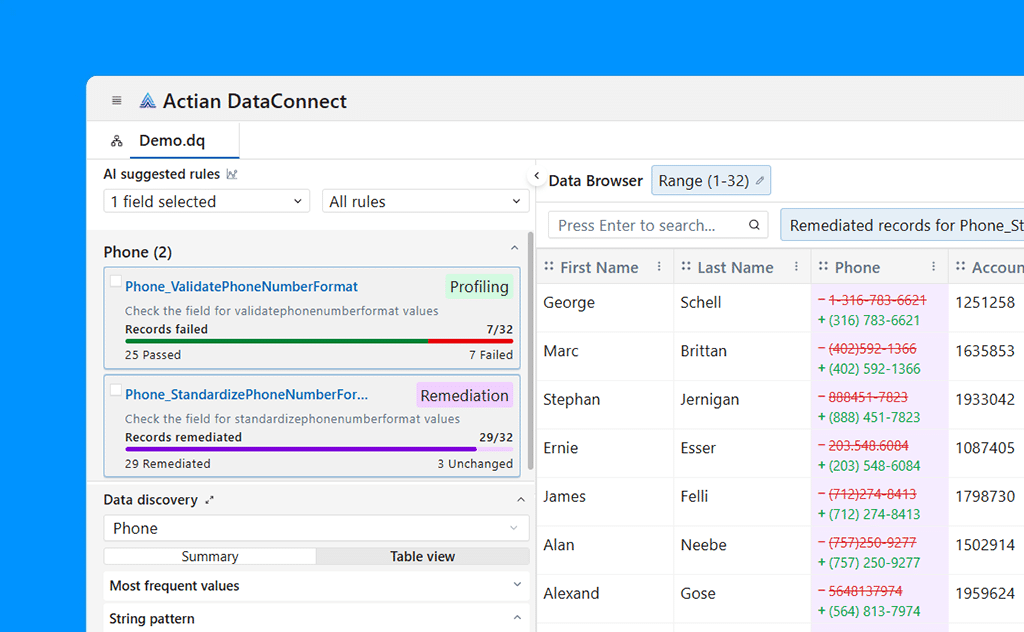
The process of correcting, standardizing, and enriching data that fails quality checks. Cleansing can be automated for high-volume, correctable patterns — reformatting phone numbers to a standard format, correcting postal codes against an authoritative database, merging duplicate records above a confidence threshold — and manual for ambiguous cases that require human judgment.
The most important principle in data cleansing is source-level remediation over downstream fixing. Fixing data in a downstream warehouse while the source system continues to produce the same errors generates indefinite maintenance burden. Every cleansing investment should include an assessment of whether the root cause can be addressed at the source.
Quality monitoring and alerting
Continuous monitoring of quality scores across all data assets with automated alerts when scores fall below defined thresholds or when anomalies appear. Quality monitoring detects problems before they affect production reports, operational systems, or AI training pipelines.
Effective monitoring connects to stewardship workflows rather than just to a monitoring dashboard. An alert that fires and lands in a queue that nobody owns does not improve quality. An alert that fires, creates a stewardship ticket assigned to the responsible steward, tracks resolution time against an SLA, and escalates if unresolved — that is quality management.
Data certification
The formal process of marking a data asset as approved for use after it has met defined quality thresholds and been reviewed by a data steward. Certification translates quality measurement into user confidence: a certified dataset visible in the data catalog tells users the data is trustworthy without requiring them to validate it independently.
Certification is the point where quality management delivers its most direct business value. When analysts and data scientists can find certified datasets in the catalog and use them without escalation or independent validation, the time and effort invested in quality management pays back directly.
Stewardship and ownership
Data quality management requires human accountability at two levels: data owners who define quality standards and hold ultimate accountability for their domain’s data health, and data stewards who execute quality management operationally — monitoring scores, resolving incidents, maintaining glossary terms, and certifying assets.
Without assigned data stewardship, quality management programs decay. Engineers can build monitoring infrastructure, but they cannot define what accurate means for a business field or certify whether a dataset is appropriate for a specific business use. Those decisions require domain expertise and business accountability.
Quality reporting and governance
Aggregation of quality metrics into governance reporting that gives leadership visibility into data quality health across the organization. Quality reports cover coverage rate (percentage of assets with active quality monitoring), quality score trends by domain, mean time to resolve quality incidents, and certification rates.
Governance reporting is what makes DQM a sustainable program rather than a project. When quality metrics are reported to leadership regularly and quality failures have visible accountability, the organizational culture around data quality improves over time.
The Data Quality Management Lifecycle
DQM operates as a continuous cycle rather than a linear process.
1. Discover: Inventory the data assets in scope. Connect profiling tools to every priority source and run an initial scan to assess current quality across the six dimensions: accuracy, completeness, consistency, timeliness, validity, and uniqueness. Identify the domains with the highest quality gaps and the highest business risk.
2. Define standards: Work with data owners and stewards to define the quality thresholds that apply to each priority domain: acceptable null rates, required completeness percentages, format validation rules, freshness SLAs, and uniqueness requirements. Document these standards in the data catalog as the official quality policy for each domain.
3. Validate and cleanse: Implement validation rules that enforce defined standards at ingestion and run continuously on stored data. Run cleansing processes on existing data that fails current standards. Prioritize source-level remediation over downstream cleansing where possible.
4. Monitor: Deploy continuous quality monitoring with automated alerts connected to stewardship workflows. Set monitoring thresholds at the domain level based on the standards defined in step 2. Track quality score trends over time.
5. Remediate: Resolve quality incidents through the stewardship workflow: investigate the root cause, implement the fix at the source wherever possible, verify resolution through the monitoring system, and close the incident with documentation of what was done. Track remediation SLAs to measure stewardship program health.
6. Certify: Review assets that meet defined quality thresholds and apply certification status. Publish certified assets in the data catalog with quality evidence visible to users. Review and renew certification on a defined cadence.
7. Report and improve: Generate quality governance reports for leadership review. Identify persistent quality failures and address their root causes. Update quality standards as business requirements evolve. Track quality improvement trends over time. A DQM program that cannot show quality improvement over 12 months is not managing quality — it is documenting it.
DQM and Master Data Management
Data quality management and master data management (MDM) are closely related but distinct disciplines.
Master data management maintains a single authoritative record — a golden record — for key business entities: customers, products, suppliers, employees. It resolves duplicates, enforces consistency, and governs how the authoritative version is maintained and distributed across systems.
Data quality management measures and improves the quality of all data assets across the estate, including master data but also transactional data, operational data, reference data, and analytical data.
MDM depends on DQM: a master data program that does not measure and monitor the quality of its golden records produces authoritative records of unknown quality. DQM depends on MDM: a quality program that does not address the entity resolution and consistency problems that MDM solves will continue to fail on duplicate and inconsistency dimensions regardless of how many validation rules are deployed.
In practice, mature organizations run DQM and MDM as complementary programs with shared governance: the same data owners and stewards are accountable for quality in MDM domains, quality standards apply to master data as they do to all other data, and MDM golden records are certified through the same DQM certification process as other data assets.
DQM and Data Governance
Data quality management is one of the operational disciplines within a data governance program.
Governance defines the quality standards — the thresholds, dimensions, and certification criteria that apply to each domain. DQM executes those standards through profiling, validation, monitoring, and remediation.
| Governance defines | DQM executes |
|---|---|
| Quality thresholds per domain | Continuous monitoring against those thresholds |
| Stewardship accountability | Operational quality issue resolution |
| Certification criteria | Certification applied to qualifying assets |
| Compliance requirements | Quality evidence maintained for audit purposes |
| Data ownership | Owner accountability for domain quality health |
A governance program without DQM execution produces quality policies that are never measured. A DQM program without governance produces quality metrics that nobody acts on because accountability structures are absent.
Tools That Support Data Quality Management
DQM requires tooling across six categories. These are functional categories, not vendor recommendations.
Data profiling and monitoring platforms: Tools that connect to data sources, scan for quality characteristics automatically, compute quality scores, and generate alerts when scores fall below thresholds or anomalies appear. Modern platforms include automated anomaly detection that identifies unusual patterns without requiring manual rule definition for every possible failure mode.
Data catalogs with quality integration: A data catalog that surfaces quality scores, certification status, and validation history alongside asset definitions and lineage gives users the context they need to evaluate data before using it. Quality integrated into the catalog is more accessible than quality buried in a separate monitoring dashboard.
Data observability platforms: Observability tools monitor data pipelines end to end for freshness, volume, schema changes, and distribution anomalies. They complement profiling tools by detecting pipeline-level quality issues — a pipeline that stopped loading, a schema change that broke a downstream dependency — rather than only dataset-level quality metrics.
Validation and testing frameworks: Frameworks that allow data engineers to write and run quality tests as code, integrated into CI/CD pipelines and orchestration platforms. Quality tests that run as part of pipeline execution catch issues at the point of transformation rather than after data has reached production.
Entity resolution and MDM platforms: Tools that identify and merge duplicate records, maintain golden records for key entities, and distribute authoritative versions to connected systems. Required for any DQM program that needs to address the uniqueness and consistency dimensions at scale.
Stewardship workflow management: Tools that manage the human side of DQM: routing quality incidents to the right steward, tracking resolution against SLAs, logging certification decisions, and generating the audit trails that governance and compliance require.
To choose software for your environment, see Choosing Data Quality Software for Hybrid Environments and Live Pipelines.
Building a Data Quality Management Program
Start with a quality assessment
Before deploying tools or defining policies, run a current-state quality assessment across priority domains. Profile every priority dataset against the six quality dimensions and establish baseline scores. Identify the domains with the largest quality gaps and the highest business risk — these are the starting point for the program.
Define quality standards by domain
Work with data owners and stewards to define acceptable thresholds for each quality dimension in each priority domain. A financial transactions domain may require 99.9% accuracy and 100% completeness on required fields. A marketing contact domain may tolerate higher null rates on optional fields. Thresholds defined by domain make quality measurable and certifiable.
Assign stewardship
Identify data owners and stewards for each priority domain before deploying monitoring. Quality monitoring without assigned accountability produces alerts that nobody acts on. The stewardship structure is the foundation of the program; the tooling makes it scalable.
Deploy monitoring and connect to workflows
Deploy continuous quality monitoring for priority domains. Connect monitoring alerts to stewardship workflows rather than just to a monitoring dashboard. Define SLAs for incident response and track compliance. Escalate persistent violations to data owners.
Implement validation at ingestion
Implement validation rules at the point of data entry and pipeline ingestion for priority domains. Prevent invalid, incomplete, and duplicate data from entering the system rather than fixing it after the fact. Source-level prevention produces compounding returns as the program matures.
Certify priority assets
Work through the priority asset list and certify datasets that meet defined quality thresholds. Publish certified status in the data catalog. Set a review cadence for certification renewal — typically quarterly for high-risk domains.
Measure and report
Define the DQM program KPI dashboard: catalog coverage rate, quality score trends by domain, mean time to resolve incidents, certification rate, and stewardship SLA compliance. Report these to governance leadership monthly. Demonstrate improvement over time.
FAQ
Data quality management is the ongoing practice of measuring, monitoring, remediating, and improving data quality across an organization’s data estate. It encompasses the processes, roles, tools, and governance structures that keep data accurate, complete, consistent, timely, valid, and unique for its intended uses over time — not just at a single point in time.
Data quality is the state of data at a point in time — how well it meets defined standards. Data quality management is the program that maintains and improves that state over time through profiling, validation, monitoring, stewardship, and governance. Cleansing data once is not data quality management. Building the continuous program that keeps data clean is.
Data profiling to establish baselines, validation rules to enforce standards, cleansing and remediation to fix existing issues at the source, continuous monitoring with stewardship-connected alerting, data certification to translate quality measurement into user confidence, stewardship and ownership assignments, and governance reporting that tracks quality improvement over time.
MDM maintains a single authoritative golden record for key business entities — customers, products, suppliers — and governs its distribution across systems. DQM measures and improves the quality of all data assets across the estate, including master data. MDM addresses the uniqueness and consistency dimensions of quality for key entities. DQM covers all six quality dimensions for all data assets. Mature organizations run both as complementary programs.
The main tool categories are: data profiling and monitoring platforms, data catalogs with quality score integration, data observability platforms, validation and testing frameworks that run quality checks as code in pipelines, entity resolution and MDM platforms for duplicate management, and stewardship workflow tools that manage the human side of quality incident resolution and certification.
Through six metrics tracked over time: catalog coverage rate (percentage of assets with active quality monitoring), quality score trends by domain (are scores improving?), mean time to resolve quality incidents, certification rate (percentage of priority assets with current certification), stewardship SLA compliance (are incidents resolved within defined timeframes?), and reduction in data quality incident frequency year over year.
ROI comes from four sources: reduced engineering rework from fewer pipeline failures caused by quality issues, fewer bad business decisions from unreliable data, lower compliance penalty exposure, and faster audit preparation. Gartner research from 2020 puts the average cost of poor data quality at $12.9 million per year. A DQM program that reduces the frequency and severity of quality failures by 50 percent delivers substantial ROI even at significant program investment. Most organizations achieve positive ROI within 12 to 18 months of a functioning DQM program.
AI models inherit every quality problem in their training data. DQM ensures that training datasets are profiled, validated, and certified before they enter AI pipelines; that quality evidence is maintained for model reproducibility and regulatory audit; and that production data feeding deployed models is continuously monitored so data drift is detected before it degrades model performance.