

Why Enterprises are Looking Beyond Cloud-Only AI


Key Takeaways
- Enterprise AI deployment is becoming more workload-specific as sensitive data and business-critical processes create new control requirements.
- 55% of respondents cite growing sensitivity of internally used data as a reason for considering AI deployment outside the cloud.
- 49% point to increased use of AI in core or mission-critical processes as another reason to consider non-cloud deployment.
- Deployment decisions increasingly depend on security, sovereignty, auditability, resilience, provider dependency, and required levels of control.
- The shift is not away from cloud, but toward choosing the environment that best fits the requirements of each AI workload.
Insights from the 2026 BARC x Actian global research study
Enterprise AI is becoming more deeply embedded in the business. AI systems increasingly work with sensitive data, support critical processes, and operate under stricter governance and control requirements. Where those workloads run therefore matters more than it did during experimentation.
Cloud remains foundational to enterprise AI, offering fast access to infrastructure, models, managed services, and the flexibility to innovate quickly. But as organizations move from experimentation to production, cloud is no longer an automatic choice for every workload.
The short answer: organizations are looking beyond cloud-only AI because production workloads can introduce requirements for control, security, sovereignty, auditability, performance, and proximity to data that vary by workload.
Actian partnered with BARC, a leading analyst firm for data and analytics, to examine how organizations are deploying AI across cloud, on-premises, and edge environments, and what is influencing those decisions.
Based on insights from 329 respondents across industries and regions, the research shows that deployment decisions are closely tied to the characteristics of individual AI workloads.
BARC × Actian Global Research Report (2026)
Sensitive Data Changes the Equation
As AI systems consume more enterprise data and context, organizations need to think carefully about how that information is handled, where it is processed, and who can access it.
In the BARC x Actian research, 55% of respondents cite the growing sensitivity of internally used data as a reason for considering AI deployment outside the cloud.
The issue isn’t simply where data is stored. AI workloads can involve proprietary business information, customer data, intellectual property, operational data, and other sensitive context.
Different workloads can therefore require different levels of control, making deployment location part of the broader architecture decision rather than simply an infrastructure choice.
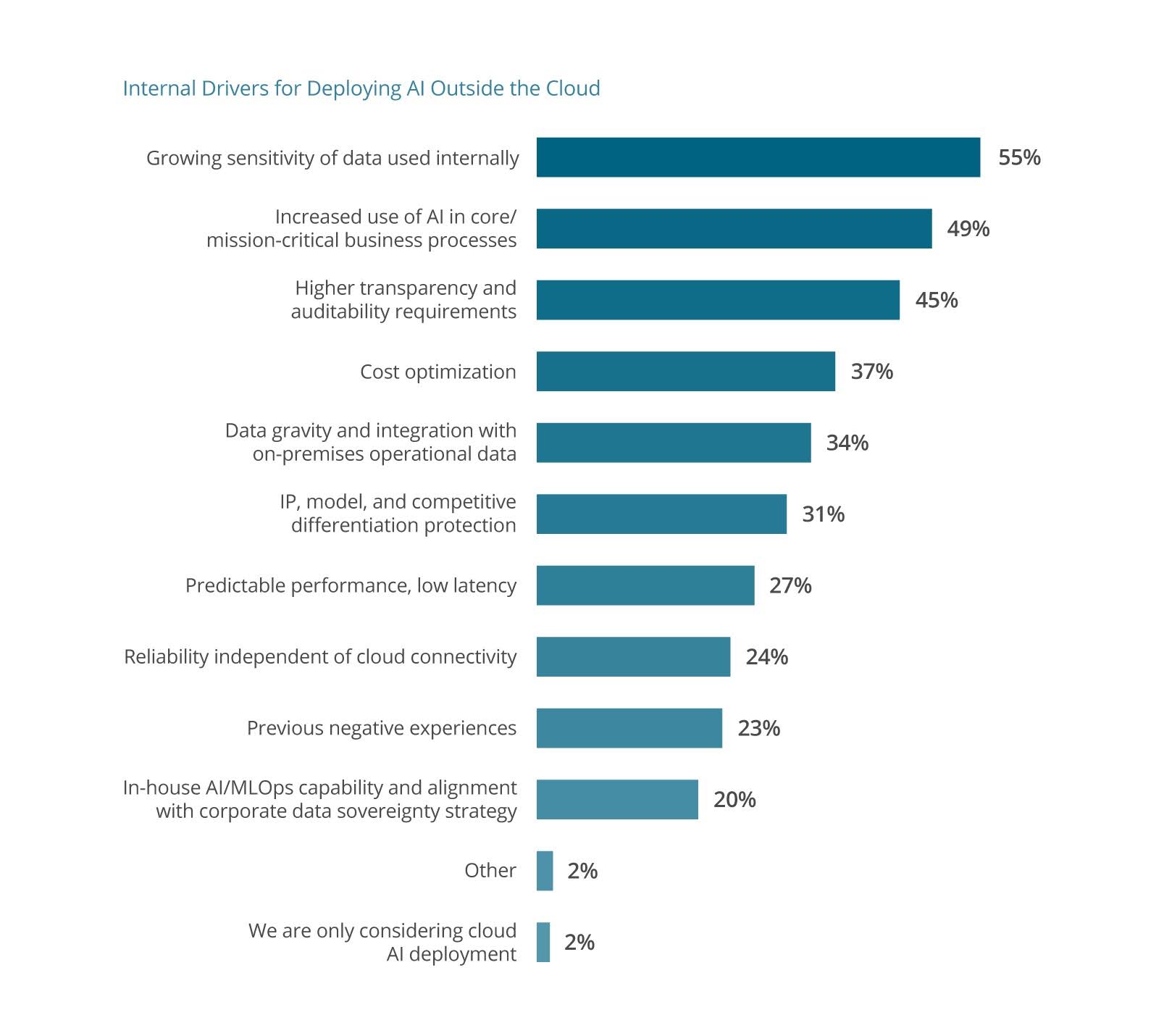
55% cite growing sensitivity of internally used data as a reason for considering AI deployment outside the cloud. © BARC 2026
AI is Moving into Business-Critical Processes
Data sensitivity is only part of the shift. AI is also moving into more critical parts of the business. 49% of respondents cite the increased use of AI in core or mission-critical processes as a reason for considering deployment outside the cloud.
An experimental AI application and an AI system supporting a critical operational process don’t necessarily have the same requirements; once AI supports critical operations, availability, resilience, transparency, governance, and control matter as much as access to infrastructure and innovation.
That doesn’t automatically point to one deployment environment. The right choice still depends on the workload.
Control is About More Than Data Location
The pressure isn’t only coming from inside the enterprise. Cybersecurity concerns, customer and partner requirements, and growing dependence on specific cloud and technology providers also influence deployment decisions. For business-critical AI, that puts greater emphasis on environment control, access to sensitive data, and dependencies on particular providers and jurisdictions.
The decision to look beyond cloud-only AI is also broader than moving workloads on-premises.
Organizations can choose from public cloud, sovereign or regional cloud services, private and on-premises infrastructure, edge environments, and combinations of these approaches.
This makes Data & AI Sovereignty an architecture consideration rather than simply a question of geography. Where data and workloads run matters, but so do access, jurisdiction, provider dependency, policy enforcement, and the level of control an organization needs to retain.
The right balance will vary by workload.
From Cloud-First to Workload-Specific
None of these pressures means enterprises are abandoning the cloud. Cloud continues to provide the speed, flexibility, access to innovation, and scale that make it well suited to many AI workloads. What is changing is the assumption that those advantages should determine where every workload runs.
As AI becomes more embedded in the enterprise, organizations need to consider the sensitivity of the data involved, the criticality of the process, governance and sovereignty requirements, and the level of control each workload demands. The shift, then, isn’t away from the cloud. It’s toward deployment decisions that reflect the requirements of each AI workload.
The full research explores the wider range of internal and external factors influencing these decisions, the benefits and challenges organizations are experiencing across deployment environments, and how enterprise AI architectures are evolving as a result.
Download the Full Research Report
This article introduces key insights from the BARC x Actian global research study.
The full report, Where Enterprise AI Runs: Deliberate Workload Placement Across Cloud, On-Premises, and Edge, explores how organizations deploy AI across cloud, on-premises, edge, and hybrid environments, and what drives those decisions.
Based on a global study of 329 respondents across industries, company sizes, and regions, the report examines the benefits and challenges organizations are experiencing, the factors influencing workload placement, and what emerging deployment patterns mean for the future of enterprise AI.
Download the full report to explore the findings and learn how organizations are approaching the next phase of enterprise AI architecture.
Download Full Report
Stay connected
Data insights delivered to you.
(i.e. sales@..., support@...)
