

The Real Cost of Enterprise AI: Why Workload Placement Matters


Key Takeaways
- There is no universally cheaper environment for enterprise AI because cost depends on workload characteristics, operations, and control requirements.
- BARC frames AI economics around both consumption costs and the cost of maintaining greater control over infrastructure and data.
- 37% of organizations deploying AI outside the cloud report cost optimization and better predictability as a realized benefit.
- At the same time, 31% of cloud-only organizations say on-premises or edge TCO does not justify the investment.
- The real cost of AI includes infrastructure, skills, security, tooling, and operational requirements, making workload-specific evaluation essential.
Insights from the 2026 BARC x Actian global research study
AI infrastructure costs are often framed as a simple comparison: is it cheaper to rent computing capacity in the cloud or own the infrastructure yourself? The reality is more complicated.
Cloud gives organizations flexible access to infrastructure without the upfront investment and operational responsibility of running it themselves. On-premises and other non-cloud environments introduce their own costs, from hardware to specialist skills and ongoing operations. But the economics can change as AI workloads move into sustained production.
The short answer: there is no universally cheaper environment for enterprise AI. Cost depends on the workload, how infrastructure is used, the operational resources required to support it, and the level of control the organization needs.
Actian partnered with BARC, a leading analyst firm for data and analytics, to examine how organizations are deploying AI across cloud, on-premises, and edge environments, and what is influencing those decisions.
Based on insights from 329 respondents across industries and regions, the research shows why AI infrastructure economics can’t be reduced to a simple cloud-versus-on-premises calculation.
BARC × Actian Global Research Report (2026)
AI Infrastructure Has More Than One Cost Equation
Most infrastructure cost comparisons start with consumption: computing resources, operations, maintenance, and the cost of keeping AI available. But production AI can add another dimension: the cost of control.
Running AI outside the cloud can require additional skills, hardware, tooling, and operational resources. At the same time, organizations may decide that greater control over sensitive or business-critical workloads has value in itself.
BARC describes these as two dimensions of AI architecture economics: consumption economics, or the cost of running AI, and control economics, or the cost of controlling it.
Both matter when calculating the real cost of running enterprise AI.
The Research Shows Both Sides of the Cost Debate
The BARC x Actian research illustrates why there isn’t a universal answer. Among organizations already deploying AI outside the cloud, 37% report cost optimization and better cost predictability as a realized gain. At the same time, 31% of cloud-only organizations say the total cost of ownership of on-premises or edge infrastructure does not justify the investment.
Those findings aren’t contradictory. Different workloads, operating models, and existing capabilities can lead organizations to very different conclusions about cost. Non-cloud deployment may improve cost predictability or economics in some cases, while for others the infrastructure and operational investment outweighs those benefits.
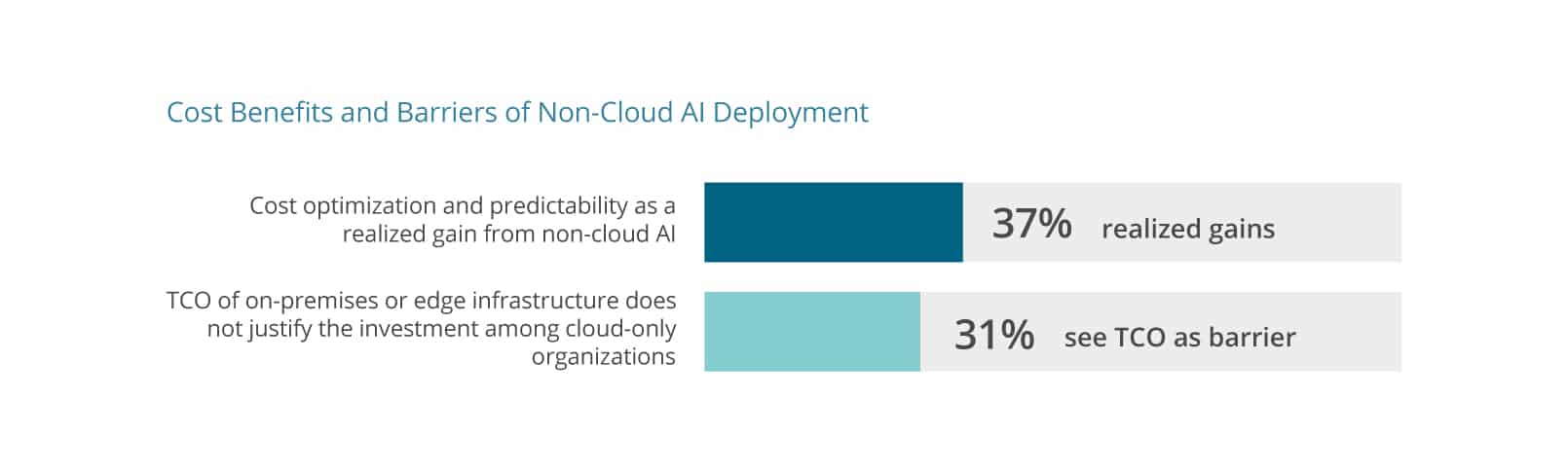
37% of organizations deploying AI outside the cloud report cost optimization and predictability as a realized gain, while 31% of cloud-only organizations cite TCO as a barrier to on-premises or edge deployment. © BARC 2026
Infrastructure is Only Part of the Cost
The infrastructure bill is only part of the equation. Deploying AI outside the cloud can also require specialist skills and investment in hardware, data pipelines, security, and tooling. The BARC x Actian research shows organizations already face challenges across these areas, adding to total cost beyond computing capacity itself.
These operational requirements also help explain why two organizations can look at similar AI workloads and reach different conclusions about the economics of where to run them.
Existing infrastructure, internal expertise, workload characteristics, and operational requirements all shape the calculation.
AI Economics Change With the Workload
A workload used intermittently doesn’t necessarily have the same cost profile as one running continuously in production. An organization with established infrastructure and specialist skills may also evaluate non-cloud deployment differently from one that would need to build those capabilities from scratch.
Cost is also rarely the only consideration. Data sensitivity, business criticality, sovereignty, provider dependency, and performance can all influence where an AI workload should run.
No single environment is most cost-effective for enterprise AI. The answer depends on the workload and the full cost of operating it, not infrastructure pricing alone.
The full research examines the cost benefits and barriers organizations report, the operational challenges of deploying AI outside the cloud, and how economics fit into the broader shift toward more deliberate AI workload placement.
Download the Full Research Report
This article introduces key insights from the BARC x Actian global research study.
The full report, Where Enterprise AI Runs: Deliberate Workload Placement Across Cloud, On-Premises, and Edge, explores how organizations deploy AI across cloud, on-premises, edge, and hybrid environments, and what drives those decisions.
Based on a global study of 329 respondents across industries, company sizes, and regions, the report examines the benefits and challenges organizations are experiencing, the factors influencing workload placement, and what emerging deployment patterns mean for the future of enterprise AI.
Download the full report to explore the findings and learn how organizations are approaching the next phase of enterprise AI architecture.
Download Full Report
Stay connected
Data insights delivered to you.
(i.e. sales@..., support@...)
