

How to Start Metadata Management: A 6-Week Milestone Approach


Key Takeaways
- Metadata management must deliver value quickly to gain adoption.
- Start with a focused milestone tied to a specific business problem.
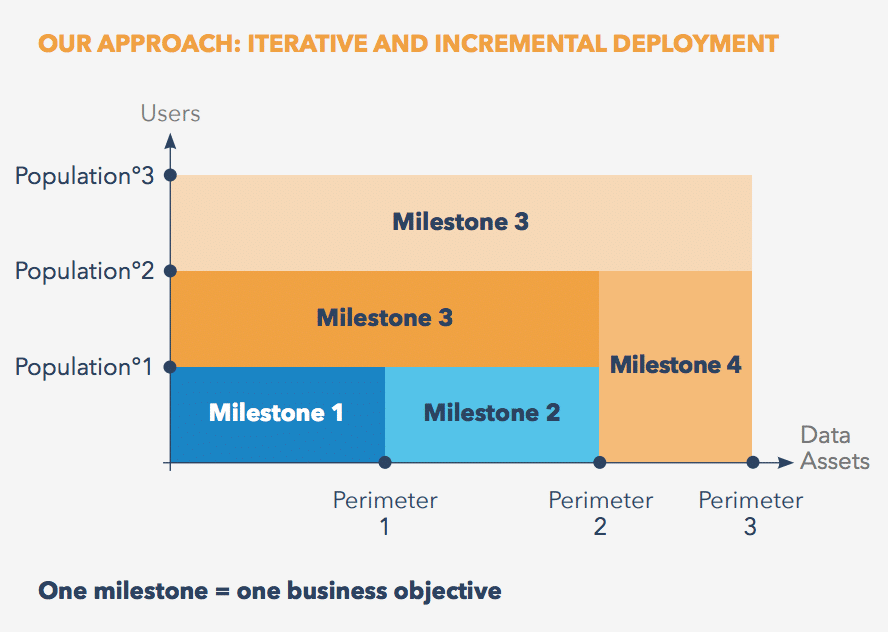
- Limit the scope to the data that matters for that problem and to users who are engaged.
- Use short, iterative cycles. Six weeks is the default, within a window of 4 weeks to 3 months.
- Continuous assessment and iteration drive long-term success.
Metadata management is the discipline of collecting, organizing, and maintaining the information that describes your data, so people can find it, understand it, and trust it. It is necessary for enterprises that want to strengthen innovation or regulatory compliance initiatives for their data assets.
Many organizations are still working out their approach. As a result, metadata is often managed alongside data in a partitioned and siloed way, which prevents the full, enterprise-wide potential of the discipline.
To win support in your organization, you need to show that metadata management delivers value from the outset. A strong data catalog makes this possible in a very short timeframe, in most cases within a matter of a few weeks.
This article describes an approach supported by a solution like the Actian Data Intelligence Platform: connected, agile, and agnostic about the technologies used in enterprises.
How Do You Start Metadata Management? Step by Step
- Assess your starting point (optional). Run a data governance maturity workshop to define where your organization stands today.
- Set a milestone. Define the problem to solve, the data involved, the users who will take part, and the time you have.
- Launch the first milestone. Run the onboarding phase and aim to finish a first iteration in about six weeks.
- Review and iterate. Check the tangible benefits delivered, then start the next milestone.
How Do You Set a Milestone?
For each milestone, identify four elements:
- The problem. Increasing and sharing knowledge must solve a problem. It can be compliance for a scheduled audit, or centralizing and standardizing a piece of information to satisfy a group of collaborators in a difficult situation.
- The data. Focus your effort on the data directly related to the problem. A data set that is too large lengthens the timeframe and delays the point at which you can measure value.
- The data users. On the first iteration, which may be longer than any other, the mobilized users must be able to free up enough time and must be motivated to put metadata management in place. They become your first ambassadors.
- The time. Complete the iteration within a reasonably short period. Across an enterprise, we recommend a timeframe between 4 weeks and 3 months at most, depending on the bandwidth of the people in charge. The duration also helps you judge whether a problem is the right size, should be subdivided, or should be set aside.
Optional first step: assess your governance maturity. Sometimes, before the first milestone is identified, an organization runs a preliminary exercise on its data governance maturity. We suggest doing this through workshops in which the company uses our maturity matrix to define its position. The exercise is most useful when repeated regularly, for example every year, because it gives you a global assessment of the benefits of your governance program.
How Do You Launch the First Milestone?
The onboarding phase supported by our metadata management tool follows the chronological sequence shown above. The goal is to anchor the launch in a value-producing reflex. Each iteration must bring the company tangible benefits that address your issues.
The first iteration includes elements that appear much less in later iterations, in particular the technical work of implementing the solution.
We suggest iterations of six weeks by default. The duration is somewhat arbitrary, but it matches the time generally needed to produce significant value without disrupting the activity of the people involved. Keep in mind that mobilized collaborators rarely have full time to dedicate to the subject.
Set a Milestone
For each milestone, you will be asked to identify several elements:
- What are the Problems: Increasing and sharing knowledge must solve a problem. It can be of various types: compliance for a scheduled audit, centralization and uniformity of a particular piece of information to satisfy a group of collaborators in a difficult situation, for example.
- What data: It is important to focus efforts on data directly related to the identified problem. Trying to deal with too large a data set will lengthen the time frame and ultimately extend the time at which the achievement of the objective, and therefore the production of value, could be measured.
- Who are my data users: On the first iteration, which may be longer than any other, the mobilized users will be structured. They must be able to free up enough time to invest themselves in achieving the objective, but they must also have the motivation to set up metadata management in place. These users will be your first ambassadors moving forward.
- What time do I have: This iteration must be completed within a reasonably short period of time. On an enterprise-wide basis, we recommend a timeframe between 4 weeks to 3 months maximum, depending on the bandwidth of the people in charge of the subject. This duration should also help to qualify whether a particular problem is appropriate or should be subdivided, or simply discarded.
Sometimes, even before the first milestone is identified, a preliminary introspective exercise on the enterprise’s data governance maturity is carried out.
We suggest this through workshops during which the company, with the help of our maturity matrix, will be able to define its positioning. This type of exercise is of particular interest when it is carried out regularly (e.g. every year). It allows a global assessment of the benefits of deploying your governance program.
Launch the First Milestone
Typically, the chronological sequence for the onboarding phase supported by our metadata management tool is the following:
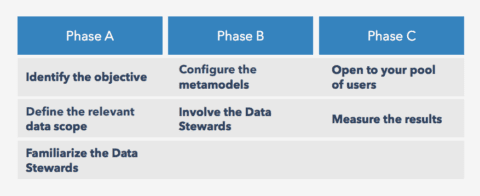
Our desire is to anchor the launch in a value-producing reflex. Each iteration must bring the company tangible benefits that address your issues. This first iteration includes elements that will not appear anymore, or at least much less, in the following iterations, in particular the technical aspects related to the implementation of the solution.
We suggest by default iterations of 6 weeks. This duration, which is fairly arbitrary, corresponds relatively well to the time generally required to produce significant value while not disrupting too much the activity of the people involved. Indeed, it is necessary to keep in mind that it is rare that the mobilized collaborators have full time to deal with the subject.

Stay connected
Data insights delivered to you.
(i.e. sales@..., support@...)
