Implementing a data warehouse is a big investment for most companies, and the decisions you make now will impact both your IT costs and the business value you are able to create for many years.

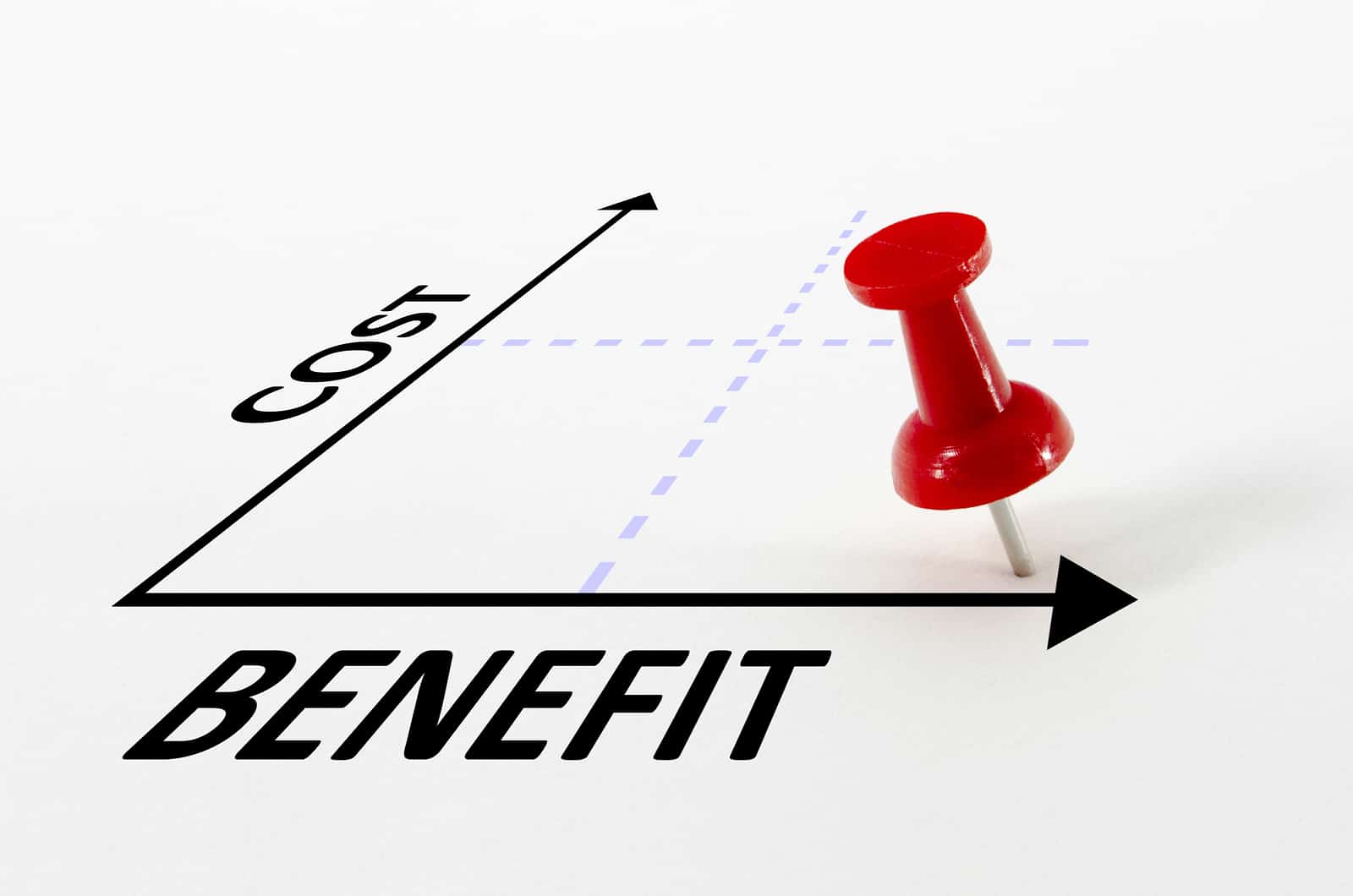
This concise data warehouse cost/benefit guide will help you understand what to expect, so you can make informed decisions about what solution is best for your company. There are many options available in the marketplace, from on-premises installed solutions that run in your company’s data center to hosted cloud services and Data Warehouse-as-a-Service (DWaaS). The solution you select will determine what costs you incur and what benefits you can realize.

Data Warehouse Cost

Your data warehouse is the centralized repository for your company’s data assets. Data from all of your IT systems will be copied into the warehouse where it can be aggregated, sorted, stored, analyzed, and curated into the reports and insights that decision makers and operational staff need, so your business runs smoothly.

The large volume of data created as a result of your day-to-day business operations means your data warehouse is likely to be your largest single IT system (and, perhaps, your most valuable one too). A combination of size, deployment option (on-premises or cloud), and the sophistication of analytics tools that come with the warehouse will drive the cost of your data warehouse. You should plan for these main cost categories:

Setup – These are the costs to acquire and configure the data warehouse solution. If your solution will run on-premises, then setup costs may include, for example, data center hardware, purchase/licensing of solutions and staff or consultants to configure the solution and establish connections with each of your source IT systems. If you are choosing a cloud data warehouse, then you may be able to avoid many of the up-front infrastructure costs, but you are likely to still need staff or contractors to configure the cloud service to integrate into your IT environment.

Data Migration – If you are replacing an existing data warehouse or consolidating data from your current databases, then you will need to migrate data from the old systems into the new warehouse. The migration itself isn’t difficult, but this is often when you discover data quality issues that must be addressed. Both the amount of data you are moving and the amount of remediation that is required to achieve an acceptable level of quality drive data cleanup and migration costs.

Compute and Storage Capacity – If your solution will run on-premises, then you must determine how much storage and compute capacity you will need in advance, so you can allocate your infrastructure investments appropriately. If you are using a cloud data warehouse or Data Warehouse-as-a-Service, then your compute and storage capacity will likely be a combination of a baseline subscription fee, Performance SLAs and the amount of resources your company uses. You should expect these costs to increase during the future (for both on-premises and cloud) as a function of your data volume.

Administration – Data warehouses (whether on-premises or hosted in the cloud) require active administration to: ensure data feeds are processing as expected, monitor analytics batch jobs for errors and manage user access to data. Most solutions include administration tools to assist in these tasks, but you will still need a person to be responsible for overseeing the continuous operations of your data warehouse.

Data Hygiene and Maintenance – This is one of the most overlooked costs of a data warehouse. The value of your company’s realized business insights is directly dependent on the quality of data with which you are working. To maximize your potential value, continuous data maintenance is needed. This includes purging old records, reconciling conflicts among data feeds, refining the data model, validating data for completeness and accuracy, and ensuring data is properly categorized and tagged, so users can find it easily.

In addition to these cost categories, you should also expect costs related to onboarding new data sources, supporting changes to source systems, implementing advanced analytics capabilities, such as AI, and training your user community how to use the data warehouse effectively.

Operational Benefits

The costs outlined above may seem overwhelming and lead you to question whether implementing a data warehouse (or upgrading your current one is a good idea). It is important to consider the value and benefits it will provide your company when assessing the investment choices, as different deployment options yield different levels of benefits. Expect your data warehouse solution to benefit from the following attributes:

Performance – The main reason you are implementing a data warehouse is because you must manage large amounts of data and run resource-intensive queries, but you don’t want the transactional source systems that your company is using for day-to-day business to perform slowly. The data warehouse provides a dedicated environment designed for these resource-intensive activities. Large-scale infrastructure in your data center powers your on-premises solutions, while cloud data warehouses use an elastic-demand model, drawing from a pool of resources to support your storage and processing needs.

Scalability – Your company’s data assets will continue to increase as a result of normal business operations and the impact of digital transformation initiatives on your operations. A data warehouse is one of the best available tools for managing data growth by enabling archival, aggregation and analysis of data from many different data sources. Data warehouses (particularly new cloud-based solutions) are built on highly scalable architectures and infrastructure platforms to enable full-featured data warehouse capabilities to be deployed at a small scale, and then expanded as the company’s needs increase.

Cost Benefits – Cloud-based data warehoused, in particular, provide companies with a number of cost benefits related to IT expense management. Cloud service providers benefit from immense economies of scale and buying power, which means they are able to acquire and manage the underlying hardware your data warehouse uses at much less cost than you could purchase it yourself. The service provider also manages the depreciation of hardware assets, simplifying your company’s ITAM activities. The biggest benefit of cloud-based data warehouses is the avoidance of underutilized capacity with a demand/utilization-based billing model in which your company pays only for the resources you consume rather than paying for much more expensive hardware up front and it sitting idle some of the time.

Resiliency – Data warehouses, both on-premises and in the cloud, provide a layer of resiliency to your company data by maintaining a complete copy of your operational data separate from the source systems. In case of a data breach, hardware failure or disaster scenario, your data is still available. Cloud-based data warehouses have additional resiliency features, including service provider-managed maintenance and security patching and script-based deployment that can be leveraged during a disaster recovery scenario.

Strategic Benefits

Most of the operational benefits of a data warehouse are related to your IT department cost structure, technology assets and overhead required to administer the system. More importantly, data warehouses provide a set of strategic benefits to your company that (although they are difficult to quantify) are very important to consider.

  1. The Cost of Poor Decisions – Your data warehouse is a decision-support system intended to help your company leaders and operational staff make informed business decisions. Without the data it provides, you are at a greater risk of making potentially catastrophic decisions based on false assumptions.
  2. The Speed of Insights – Even without a data warehouse, your company likely has all the data building blocks needed to understand what is occurring within your organization. The data warehouse provides a way to mine, refine and harvest actionable insights faster – increasing the amount of time available to realize the benefits from those insights in both exploiting opportunities and mitigating risk.
  3. Capability to Change in the Future – Your business and IT environment is continuously changing, with new solutions replacing legacy systems, cloud service providers and business processes due to re-organization. A data warehouse provides your company with the capability to isolate your data from the impacts of these changes, maintaining a consistent record of your business, regardless of what people and tools are being used.

The investment in a data warehouse is one of your company’s most important IT decisions. Whether you choose an on-premises solution or a new cloud data warehouse offering, such as Actian Data Platform, your company will benefit from the impacts of this decision for many years. Understanding the costs and benefits related to this decision is essential when making an informed investment that aligns with your company’s data management goals. Learn about the benefits of deploying your own Data Warehouse in the cloud by downloading the Whitepaper here.


Almost every company is embarking on some sort of digital transformation initiative – reshaping the relationships between employees and business processes and the technology that supports them. At the heart of any digitally transformed operation is data – data about your company’s operations, data about your customers and suppliers and data about your environment.

What makes digital transformation so powerful is that it optimizes the way people interact with data by using technology to integrate different data sources in support of processes and decision-making. A successful digital transformation initiative begins with data integration.

The Role of Data Before Digital Transformation

Before digital transformation, there was a clear delineation between the activities people performed in support of business processes and the technological processes and systems that supported them. Data was created in the physical world and recorded in the digital world. The interfaces where these worlds intersected (forms, screens, Web pages, etc.) were very specific in their designs to capture data from one world and transmit it to the other. While this worked okay to enable people to use technology in support of business processes, it also served to reinforce the separation. In that environment, the flow of data both between people and machines and across the organization became the ultimate constraint to productivity and process performance.

Digital Transformation Changes Everything

The main concept behind digital transformation is removing the preconceived notions of barriers between people and technology being necessary and, instead, re-imagining an environment where humans and technology freely interact in support of business processes. With digital transformation, there are no business processes and IT processes, just processes. The structured interfaces (forms, screens, Web pages, etc.) between the physical world and digital world are replaced with a new set of capabilities enabling users to interact freely with data in an immersive manner. Within this new environment, data silos that were built for functional IT systems where data is stored are replaced with enterprise data, which policies and role-based access controls manage.

Why Integration is Important for Digital Transformation

Data integration is an essential part of your digital transformation journey. Integration is the tool to help you eliminate the silos and re-factor user interfaces. Without doing this, you won’t be able to achieve your company’s vision of modernized technology-embedded processes. By addressing integration at the start of your digital-transformation initiative, you will be able to create a new/modern data platform upon which to build your new processes. Because you are integrating instead of consolidating source systems, your legacy and new processes can co-exist through the transformation process.

Integration and Business Agility

Once your digital-transformation initiative is complete, the focus of your organization will shift from transformation to achieving business agility to sustain continuous evolution and the re-invention of your processes. Data integration helps you achieve agility by decoupling your processes from individual IT systems, applications or components. New systems can be added to your environment and old ones can be removed freely, but your enterprise data can remain stable and secure. Business agility also refers to making on-the-spot business decisions that are informed by real-time information insights. Data integration enables your operations staff and company leaders to see what is occurring across the company, monitor for changes and identify areas rapidly that require immediate attention.

Digital transformation is an ambitious goal for any company – moving beyond the constraints of the past and reimagining an environment where people, processes, data and technology interact freely in support of your company’s goals. Data integration is an important part of taking the vision of digital transformation and making it a reality. Actian DataConnect can help by giving you the tools you need to connect anything, anytime and anywhere. To learn more, visit DataConnect.


Blog | Data Intelligence | | 2 min read

Iterative Governance – Agile Data Governance Attribute (5/5)

iterative governance

The weak maturity of data governance projects necessitates the implementation of good practices and feedback loops to constantly monitor and verify the validity of management rules on your data asset.

The following articles explain the characteristics of data governance labeled as agile:

1. Be as close as possible to your enterprise’s operational reality.
2. Adapt to your enterprise’s context and not the other way around.
3. Accurately reflect your data assets.
4. Unify and involve your collaborators.
5. Respond to changes quickly.

The implementation of data governance must not take the form of a five-year plan where deliverables hardly see the day. It must avoid the Big Bang effect and adopt an approach influenced by “agile” methods used in the software development sector.

The enterprise must adopt an iterative approach to the implementation of data governance.

This approach rests on the concept of validity verification, experimentation, and iterative design.

We think that a data governance project must start by curating data assets in a cross-functional way. By adopting the Pareto principle, collect, document, and manage the 20% of data that will generate 80% of business value within your organization.

By gradually increasing its reach across your different data segments, by redefining the roles and responsibilities within your organization, and the rules of data management, you will begin to seek a satisfying governance.

This flexibility also encourages the emergence of a strong data culture within your organization.


Blog | Data Intelligence | | 2 min read

Collaborative Governance – Agile Data Governance Attribute (4/5)

collaborative governance

The weak maturity of data governance projects necessitates the implementation of good practices and feedback loops to constantly monitor and verify the validity of management rules on your data asset.

The following articles explain the characteristics of a data governance labeled as agile in order to:

1. Be as close as possible to your enterprise’s operational reality.
2. Adapt to your enterprise’s context and not the other way around.
3. Accurately reflect your data assets.
4. Unify and involve your collaborators.
5. Respond to changes quickly.

The consistent practice of having a single person or a single group arbitrate data governance has become obsolete.

Data governance must not be IT’s guarded territory.

Data circulates in the hierarchy from senior managers to entry-level employees in all departments. Information on how data should be managed and what rules to follow can come from anywhere.

To create a democracy of data, where all the employees can access the enterprise’s data on a large scale, like what Facebook has done, signifies that employees don’t have to wait to execute projects that can add value.

This also signifies that data problems are more likely to be discovered and corrected. This is all the more important in an environment where 85% of organizations’ information is redundant, obsolete, and trivial, and 41% of all the stored data has not been touched for the past 3 years.

We believe that the sustainability of data governance must include the creation of communities around the different areas of activity related to data within your organization. This approach aims to put individuals and their interactions in front of processes and tools.

As a shared asset, it will be necessary to define ownership rules and areas of responsibility around an enterprise’s data. In a number of organizations, the responsible parties have official roles to play such as data owners, data stewards, or data custodians. If the formal designation of responsibilities remains essential, we think that it is important to involve as many people as possible in the implementation of data governance, capable of contributing to the knowledge, control and management of data. Otherwise known as: Everyone is a Data Steward.


Blog | Data Intelligence | | 2 min read

Automated Governance – Agile Data Governance Attribute (3/5)

automated data governance

The weak maturity of data governance projects necessitates the implementation of good practices and feedback loops to constantly monitor and verify the validity of management rules on your data asset.

The following articles explain the characteristics of a data governance labeled as agile in order to:

1. Be as close as possible to your enterprise’s operational reality.
2. Adapt to your enterprise’s context and not the other way around.
3. Accurately reflect your data assets.
4. Unify and involve your collaborators.
5. Respond to changes quickly.

Implementing data governance must begin by referencing, indexing, and evaluating your organization’s data assets. Building such an artifact by only using human intelligence is rarely successful, given the resource constraints. Therefore, it is necessary to maximize automated processes regarding the extraction and collection of information related to the data in your organization.

With the help of artificial intelligence algorithms or machine learning, it becomes possible to interpret, contextualize, and give more meaning to your data assets.

With the help of artificial intelligence algorithms or machine learning, it becomes possible to interpret, contextualize, and deduce a more precise meaning from your data asset. This automation allows your data managers to avoid the blank paper syndrome and, freeing them from tedious and repetitive tasks, increases the support from as many people as possible for your initiative to implement data governance within your company.

Finally, this automation became a necessity in the new era where the volume and the variety of systems exploded. The maintenance and updating of this information repository are crucial to reflect the reality of your IS data. With the help of incremental analysis, which frequently and automatically processes your data, you will gain a high-value metadata repository added for your data consumers.


Blog | Data Intelligence | | 2 min read

Non-Intrusive Governance – Agile Data Governance Attribute (2/5)

non intrusive governance

The weak maturity of data governance projects necessitates the implementation of good practices and feedback loops to constantly monitor and verify the validity of management rules on your data asset.

The following articles explain the characteristics of data governance labeled as agile:

1. Be as close as possible to your enterprise’s operational reality.
2. Adapt to your enterprise’s context and not the other way around.
3. Accurately reflect your data assets.
4. Unify and involve your collaborators.
5. Respond to changes quickly.

Enterprises consider that the classic approaches to Enterprise Data Management (EDM) require all parties involved to adopt a certain number of tools and procedures that can burden the processes of data discovery, thus becoming an obstacle to innovation. In a world where the variety as well as the volume of data is exploding, where new tools for data storage and processing ceaselessly pop up, a much more reasonable approach exists.

It is a means to give freedom to your collaborators to use tools more adaptable to their uses, whether it is to generate or to access datasets, of course, according to their authorized level.

This approach aims to centralize the knowledge that your collaborators have acquired from their datasets in a “data catalog.” The objective is to collect and aggregate the metadata of your created or updated datasets from your tools and storage systems. It is from these platforms, unrelated to operations, that data governance can be executed without interfering with the daily work of your collaborators.

This non-intrusive method of addressing data governance calls for the enterprise to move forward little by little. Experiment with and adjust your management rules on data and its metadata gradually so that you can establish a curation of your data assets.


Blog | Data Intelligence | | 2 min read

Bottom-Up Governance – Agile Data Governance Attribute (1/5)

bottom up governance

The weak maturity of data governance projects necessitates the implementation of good practices and feedback loops to constantly monitor and verify the validity of management rules on your data asset.

The following articles explain the characteristics of a data governance labeled as agile to:

1. Be as close as possible to your enterprise’s operational reality.
2. Adapt to your enterprise’s context and not the other way around.
3. Accurately reflect your data assets.
4. Unify and involve your collaborators.
5. Respond to changes quickly.

The implementation of data governance must avoid pitfalls, all too often seen in the past via a top-down approach.

This type of descending approach wants objectives and instructions to be set by management and then implemented.

This project leadership, like software development in recent years, has proven to be too hierarchical and bureaucratic, uncorrelated to the realities on the ground and, therefore, the data held by the company.

We recommend a bottom-up approach in the field, in the operational sense, to progressively consolidate a synthesis and to maintain a data governance management that corresponds to the real context of your enterprise.

We define bottom-up data governance as:

  • A democratic approach rather than a hierarchical one.
  • A willingness to solve problems created fluidly rather than by imposing more structure.
  • A “bureaucracy” reduced to a minimum to facilitate its implementation and its maintenance (a prevailing work principle at Spotify called, “Minimum Viable Bureaucracy”).
  • An active collaboration amongst stakeholders in favor of ownership and the collection of information on the organization’s data.
  • An autonomy of collaborators in the choice of tools and the manner in which they organize themselves.

Blog | Actian Life | | 2 min read

Whimsical…Lotus?

Ladies of Actian at painting night

Ladies of Actian, Palo Alto get together for a Paint Nite

When I received the offer to join the Actian family as the People Programs Manager back in April, I was elated! Through my interviews, one thing that really stood out to me was the friendly, inviting culture – which would make my new role even more exciting. As with any big change, it is not to say I didn’t have the typical jitters associated with joining a new company: will I fit in, will the role be what I expect, will my ideas be well received, etc.

Within the first few days of joining, I had the pleasure of meeting Helena Marsikova. She informed me that she, along with a few others, had organized a Paint Nite for the ladies at the Palo Alto office. I was told it was not an ‘official’ company event, but they wanted to get some time to connect outside of work to get to know one another and invited me to join in on the fun. I am so thrilled that she did!

Last Thursday, a group of about a dozen, met up after work in Downtown San Jose for dinner, drinks, painting of a ‘Whimsical Lotus’, and laughs – LOTS OF THEM (based on the outcome of our paintings, you can likely guess why)!

When we got settled in front of our canvases, the instructor jumped in with an overview. He threw in witty banter and set the tone for the evening. We chatted amongst ourselves and joked about our future careers as artists we had as the progress of many of our paintings were a surprising outcome to say the least. After a couple hours of painting, we gathered to see the masterpieces we had all created – it was a blast!

Coming in to help build upon the culture here through employee programs, it was so wonderful to see that we already have such an engaged workforce – both personally and professionally. We all got to know each other a bit better and many were able to build upon the existing relationships they have had built throughout there time here.

I look forward to continuing to build connections, partner, and grow alongside such an amazing, talented, passionate group of women!