
Qu'est-ce que gestion des données? Un guide pratique pour les équipes chargées des données d'aujourd'hui



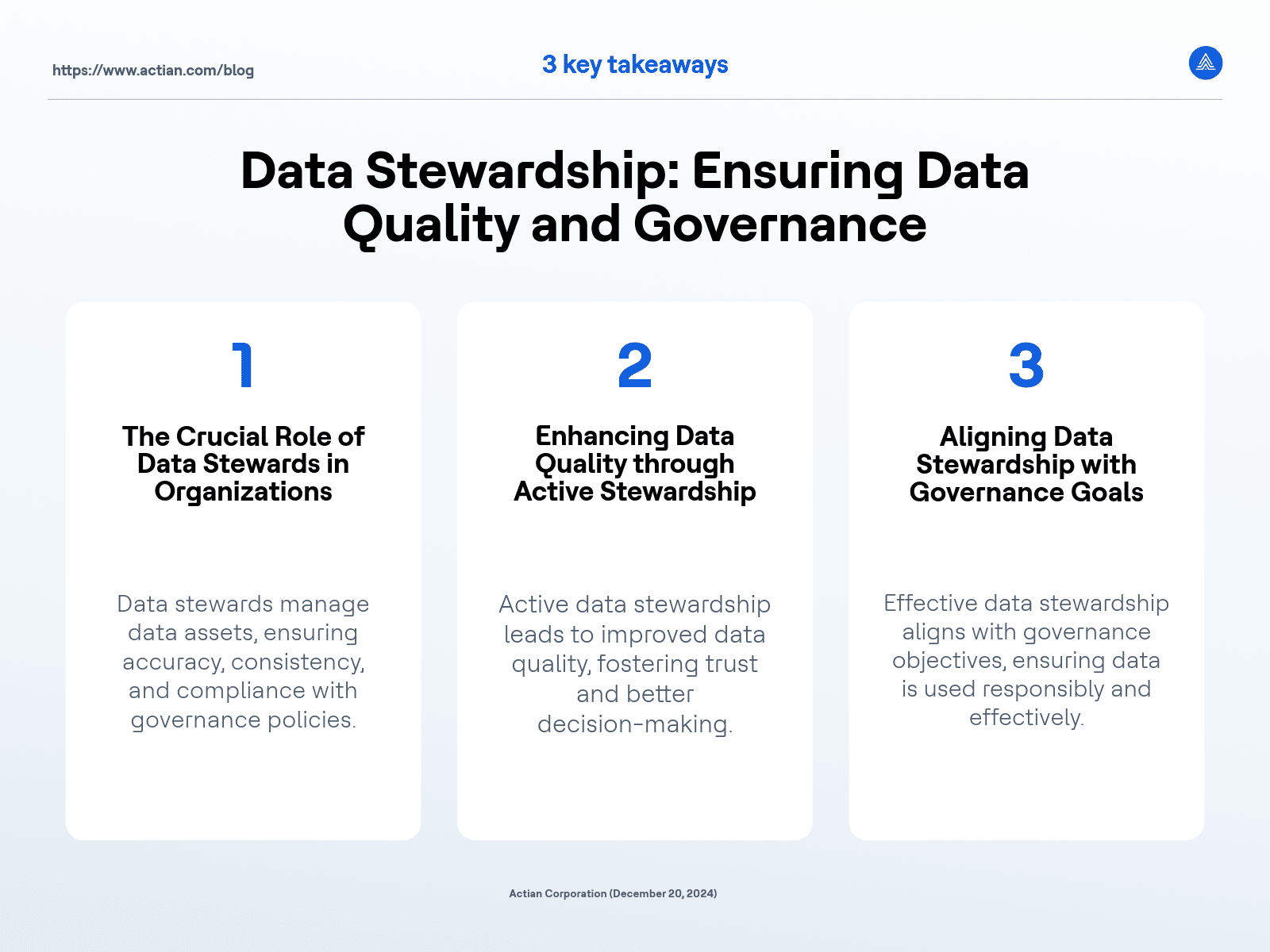
Points clés à retenir
- gestion des données l'ensemble des personnes, des processus et des outils qui permettent de rendre les données accessibles, fiables et exploitables.
- Son objectif va au-delà de gouvernance: il favorise la fiabilité de l'IA, la conformité, la qualité des données et leur utilisation efficace dans tous les domaines.
- Un programme de gestion responsable efficace commence par la définition des domaines, des responsables, des gestionnaires et d'un modèle opérationnel, puis par le référencement des données, la traçabilité de leur provenance et la mise en place de politiques claires.
- Une bonne gestion repose également sur l'automatisation des contrôles qualité, de la surveillance et des mesures correctives, tout en conservant une intervention humaine pour les cas exceptionnels et les décisions qui requièrent un jugement.
- Le succès doit être évalué à l'aide d'indicateurs clés de performance (KPI) clairs, tels que la couverture de la propriété, la couverture de la traçabilité, la qualité des données, la rapidité de détection et le délai de résolution des incidents.
Introduction
gestion des données désigne l'ensemble des personnes, des pratiques et des outils qui permettent de rendre les données accessibles, fiables et exploitables. Aujourd'hui, la gestion des données n'est pas seulement une gouvernance : c'est le pilier opérationnel de la fiabilité de l'IA, de la conformité réglementaire (par exemple, le RGPD, la loi HIPAA, les nouvelles réglementations sur l'IA) et des architectures de données décentralisées. Ce guide transforme la question « qu'est-ce que gestion des donnéesen un programme concret que vous pouvez mettre en œuvre dans tous les domaines, avec des résultats mesurables.
Le coût de l'inaction
Une gestion inadéquate entraîne un ralentissement des analyses, une dérive des modèles, des risques de non-conformité, une duplication des efforts et la perte d'opportunités commerciales. Parmi les causes d'échec courantes, on peut citer le manque de clarté quant à la responsabilité, les corrections manuelles des données et le cloisonnement des outils qui masquent la traçabilité et la provenance des données. Une gestion efficace réduit ces risques et accélère la création de valeur à partir des données et de l'IA.
gestion des données en 5 étapes
Ce cadre permet de traduire les orientations stratégiques en opérations reproductibles. Utilisez-le comme une liste de contrôle pour mettre en place ou développer des pratiques de gestion responsable.
Étape 1 : Définir les domaines, les responsables et le modèle opérationnel
- Mettre en correspondance les domaines de données critiques avec les secteurs d'activité (ventes, produits, risques, clinique, etc.).
- Désigner des responsables des données (chargés de rendre compte) et des gestionnaires de données de domaine (responsables).
- Choisissez un modèle d'exploitation : centralisé, fédéré (Embarqué) ou hybride. Les modèles fédérés sont particulièrement adaptés aux data mesh .
Étape 2 : Répertorier, classer et recenser la lignée
- Publier un catalogue de données un glossaire métier pour tous les actifs critiques.
- Suivre automatiquement le parcours des données depuis leurs sources jusqu'aux utilisateurs, en passant par les différentes étapes de transformation.
- Classer les données en fonction de leur niveau de sensibilité, du champ d'application réglementaire et des restrictions d'utilisation de l'IA.
Étape 3 : Définir les politiques, les normes et les accords de gestion
- Traduire gouvernance en normes concrètes : dénomination, seuils de qualité, durée de conservation, règles d'accès.
- Élaborer des accords de gestion qui définissent les accords de niveau de service (SLA), les procédures d'escalade et les processus de validation entre les équipes.
Étape 4 : Automatiser le contrôle qualité, la surveillance et la correction
- Automatisez la création de profils, les contrôles de validité des données, la détection des dérives de schéma et anomalie .
- Transmettez les incidents aux responsables ou aux administrateurs en mettant en place des procédures de résolution claires et des correctifs versionnés.
- Impliquez les humains dans les processus de classification et de gestion des exceptions.
Étape 5 : Évaluer, itérer et partager les résultats
- Suivre les indicateurs clés de performance, présenter les tendances à la direction et adapter les priorités aux besoins de l'entreprise.
- Utilisez des tableaux de bord pour mettre en évidence la valeur ajoutée (gain de temps, incidents évités, taux de conformité).
- Institutionnaliser apprentissage les audits périodiques.
Exemple de matrice RACI pour la gestion responsable
- Responsable : Responsable des données du domaine (tri des problèmes, gestion métadonnées)
- Responsable : Propriétaire des données (décisions commerciales, validations)
- Intervenants : Ingénieurs de données, Conformité, Sécurité
- Destinataires : Utilisateurs de données, équipes d'analyse/ML, responsables de projet
Gestion responsable basée sur l'IA
Grâce à l'IA et à l'automatisation, les responsables passent des tâches de nettoyage manuel à la supervision et à la gestion des risques :
- métadonnées automatisée métadonnées et la classification sémantique permettent de réduire le balisage manuel.
- L'extraction de la généalogie et les graphiques de dépendances améliorent la traçabilité des modèles et des rapports.
- anomalie signale les incidents de données potentiels ; les administrateurs les valident et y remédient.
- Les processus impliquant une intervention humaine garantissent que les suggestions générées automatiquement sont vérifiées au regard des règles et du contexte.
Matrice des rôles et des profils
- Responsable des données (entreprise) : définit les objectifs, autorise les accès et établit les indicateurs de performance.
- Responsable des données métier (fonctionnel) : est en charge métadonnées, des règles de qualité et des mesures correctives.
- Responsable technique / Gestionnaire des données (informatique/ingénierie) : met en place des pipelines et veille au respect des contrôles d'accès.
- Ingénieur de données : met en place des transformations, assure le traçabilité des données et la surveillance.
- Responsable de la conformité et de la protection des données : définit les contrôles réglementaires et les pratiques d'audit.
- Analyste / Ingénieur en apprentissage automatique : traite les données, signale les problèmes, valide la traçabilité des modèles.
Indicateurs clés de performance et objectifs quantifiables
Suivez un petit ensemble d'indicateurs pertinents :
- Pourcentage de jeux de données critiques jeux de données un responsable et un administrateur ont été attribués.
- C'est le moment de découvrir un jeu de données recherche → exploitable).
- Pourcentage de jeux de données une traçabilité de bout en bout.
- Indice de qualité des données (cohérence, exhaustivité, exactitude) et tendance.
- Durée moyenne de résolution des incidents liés aux données.
- Pourcentage de modèles de production dont la provenance des données est traçable.
Les pièges courants et comment les éviter
- Piège : Approche axée sur les outils — Évitez d'acheter des outils avant d'avoir défini les processus et les rôles.
- Piège : Goulot d'étranglement centralisé — Embarquer dans les domaines pour évoluer.
- Piège : Absence de soutien de la direction — Trouver un responsable au sein de la direction pour donner la priorité au travail de gestion responsable.
- Piège : Indicateurs peu clairs — Définissez les indicateurs clés de performance (KPI) avant de procéder à la mesure ; reliez-les aux résultats commerciaux.
- Piège : Manque d'incitations — Intégrer les responsabilités en matière de gestion dans les objectifs de performance et les critères d'acceptation des projets.
Exemples d'utilisation dans l'industrie
Santé
Des dossiers médicaux électroniques (DME) précis, la traçabilité des données pour les essais cliniques et la classification automatisée des informations médicales protégées (PHI) pour la conformité à la loi HIPAA.
Services financiers
Des dossiers clients cohérents pour la vérification de l'identité des clients (KYC), une traçabilité pour les déclarations réglementaires et des données fiables pour les modèles de crédit.
Télécommunications
Profils clients unifiés, contrôles de qualité de la télémétrie réseau et rapports de conformité concernant les données des abonnés.
Fabrication et Chaîne d'approvisionnement
Traçabilité des pièces et des fournisseurs, données pour les modèles de maintenance prédictive et rapports ESG sur les émissions.
Rapports ESG et de développement durable
La gestion responsable garantit la traçabilité et la vérifiabilité jeux de données les inventaires carbone et les déclarations des fournisseurs.
Mise en œuvre à grande échelle : les personnes, les processus et la plateforme
Les programmes efficaces combinent :
- gouvernance et des accords de gestion responsable.
- Un catalogue, un système automatisé de traçabilité, des outils observabilité et de contrôle qualité.
- apprentissage, guides pratiques et audits réguliers.
- Une intégration claire entre gouvernance et la mise en œuvre des mesures de la plateforme (contrôles d'accès, masquage, conservation).
Actian soutient la gestion des données Meilleures pratiques
Actian propose une suite complète de gestion des données qui support optimisent gestion des données au sein des organisations. La plateforme Actian Analytics AI offre une base solide pour la mise en œuvre d’une gestion des données grâce à ses diverses fonctionnalités et capacités. Ses outils d’intégration de données, notamment DataConnect, aident les organisations à maintenir des données de haute qualité en fournissant des capacités ETL (Extraction, Transformation, Chargement) robustes et des contrôles de qualité. Les entreprises peuvent utiliser la plateforme Actian Data Intelligence pour normaliser le stockage et l’utilisation des données conformément aux gouvernance des données, ce qui favorise la démocratisation des données tout en rendant gestion des données et plus compréhensible pour les parties prenantes.
Les solutions d'Actian s'intègrent parfaitementframeworks gouvernance des données, aidant ainsi les organisations à harmoniser leur gestion des données avec gouvernance plus larges. À mesure que les organisations se développent et évoluent, La plateforme de données Actian conçue pour s'adapter à l'augmentation des volumes de données et utilisateur , offrant support continu support gestion des données . Plus d'aide pour la création de gestion des données , consultez l'article de blog «L'importance de la gestion des données entre entreprises».
Points clés à retenir

Restez connecté
Des informations tirées des données, à votre service.
(par exemple : sales@..., support)
