The gap between conversational analytics and traditional business intelligence isn’t just about technology. It’s about time. In a traditional BI setup, getting an answer means finding the right dashboard, hoping it was built for the question you’re actually asking, and submitting a request to the data team when it wasn’t. That process can take days.
Conversational analytics changes that. You ask a question in plain language (in Slack, Teams, or a web interface) and get an answer in seconds, with visibility into how it was calculated. But the real differentiator isn’t speed. It’s trust. And that’s where most conversational tools fall short. They generate answers without a governed foundation behind them.
How Traditional Business Intelligence Works
Traditional BI follows a structured workflow: data teams prepare data, build dashboards, and business users consume predefined reports. It works well for stable, repeatable metrics like revenue or pipeline performance, where questions are known in advance.
The limitation is flexibility. Dashboards only answer the questions they were built for. Every new question requires BI team involvement, which creates bottlenecks, slows time-to-insight, and leads to inconsistent metrics as teams build their own versions.
What is Conversational Analytics?
Conversational analytics lets you ask questions of your data in plain language and get immediate answers. No dashboards, no SQL, and no waiting for a report. The system interprets your question, runs the query, and returns results in seconds.
What makes it powerful is context. Follow-up questions like “break that down by region” or “compare to last quarter” build on the previous answer, so you’re not starting over each time.
This makes it especially useful for real-world decision-making where questions evolve. Instead of being limited to predefined dashboards, you can investigate unexpected trends, analyze across departments, and explore multiple data sources in one continuous workflow.
It’s built for moments like:
- A sales leader investigating a sudden drop in close rates.
- A supply chain team analyzing inventory, lead times, and regional demand together.
- A finance team answering questions that existing dashboards don’t cover.
- Business users exploring data without relying on BI for every follow-up.
The Governance Gap in Conversational Analytics vs. Traditional Business Intelligence
Most conversational analytics tools rely on text-to-SQL. They translate a question into a query and return an answer. The problem is what’s missing: shared definitions.
In many organizations, metrics like revenue or customer count vary across dashboards and teams. When conversational tools generate answers directly from raw data, they scale this inconsistency. The result is fast answers, but not always the right ones.
The issue isn’t speed. It’s trust. If users can’t see how a number was calculated or whether the correct logic was applied, confidence breaks down. This is the core challenge in conversational analytics vs traditional business intelligence. Traditional BI enforces consistency but lacks flexibility. Ungoverned conversational analytics offers flexibility but sacrifices accuracy.
How Governed Conversational Analytics Solves the Trust Problem
Governed conversational analytics solves this by grounding every question and answer in a shared semantic layer. This layer defines your business’s metrics, relationships, and logic before any query runs.
By combining natural language flexibility with consistent definitions, every question returns the same answer across users, teams, and time. Metrics are defined once and applied consistently, eliminating conflicting numbers and reducing the need for manual validation.
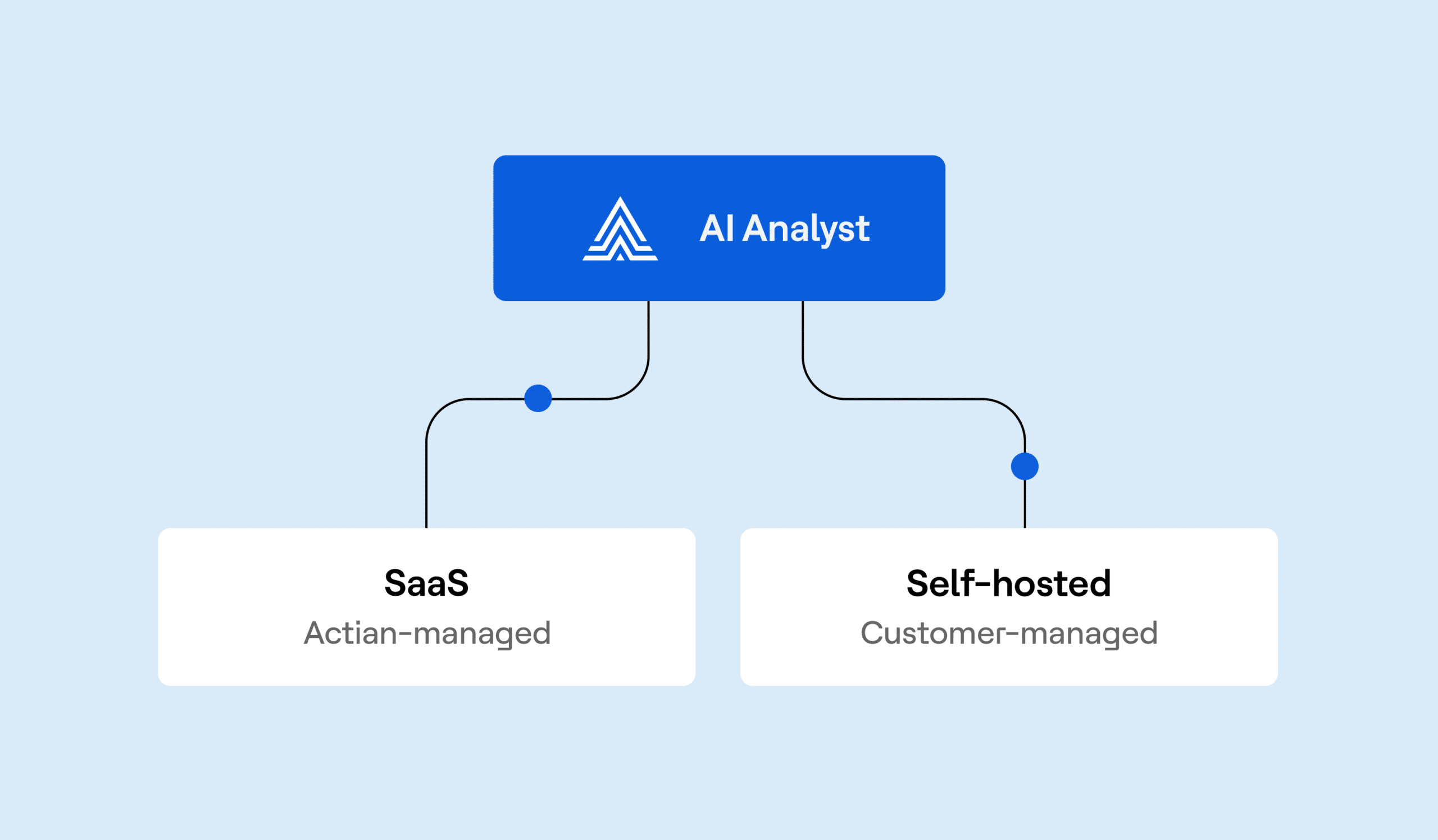
This is the approach behind Actian AI Analyst. Instead of relying on probabilistic query generation, it grounds every answer in governed semantics. Users can ask questions in plain language and trust that results are accurate, explainable, and aligned with how the business defines its data.
Conversational Analytics vs. Traditional Business Intelligence: What Actually Works
Traditional BI gives you consistency, but only for predefined questions. Most conversational analytics tools give you flexibility, but not always accuracy.
Actian AI Analyst is designed to deliver both.
When a user asks about revenue, churn, or customer count, the answer reflects how the business has defined those metrics, not a best guess from the AI. Definitions are established before questions are asked, so results stay consistent regardless of who asks, how it’s phrased, or where it’s asked.
This is the real shift in conversational analytics vs traditional business intelligence. It’s not just faster answers. It’s answers you can trust at scale.
Three core components make this possible:
- Model your business
The Steward Agent creates and maintains governed models, metrics, glossary terms, and data relationships. Business logic is defined once and applied consistently across every query. - Ask anything
Users interact in plain language through Slack, Teams, or web. Context carries forward, so follow-up questions build on prior answers instead of starting over. - Trust every answer
Every result includes visibility into joins, filters, and calculations. Users can see exactly how an answer was produced, while access controls protect sensitive data.
When Traditional BI Still Makes Sense
Traditional BI isn’t going away. It works well for structured, recurring reporting like financial summaries, regulatory reporting, and executive dashboards with stable KPIs.
The limitation is scope. Dashboards handle predictable questions, but struggle with the ad hoc, in-the-moment questions that come up in daily decision-making.
The strongest analytics approach doesn’t replace BI; it complements it. Use BI for standardized reporting and conversational analytics for exploration and follow-up questions. Both should run on the same governed foundation, so metrics stay consistent everywhere.
What to Look for in a Conversational Analytics Solution
If you’re evaluating conversational analytics for enterprise use, start with governance. Look for:
- A semantic layer that defines metrics before questions are asked.
- Explainability into joins, filters, and calculation logic.
- Multi-turn context that carries conversations forward.
- Access controls enforced at the data layer.
- Clear stewardship workflows for maintaining definitions over time.
- Integration with tools like Slack, Teams, or your existing workflows.
Tools that skip the semantic layer may look fast in a demo. In practice, they recreate the same inconsistency issues as fragmented dashboards, just with AI-generated answers that appear more authoritative.
The Bottom Line
Traditional BI was built for a world where questions could be anticipated in advance. That’s no longer how most teams operate.
Today’s questions move faster, span more data, and change constantly. Answering them requires more than dashboards. It requires a system that can adapt in real time without sacrificing accuracy.
That’s the difference in conversational analytics vs traditional business intelligence. BI handles structured reporting. Governed conversational analytics handles everything else. The shift isn’t about replacing BI. It’s about extending it with a model that delivers both speed and trust.
See it in Action
Try Actian AI Analyst in your own environment and see how conversational analytics works with your data. Ask questions in plain language, explore how governed metrics are applied, and validate every result with full transparency.
Book a demo to see how you can scale access to trusted insights without adding complexity or relying on manual workflows.