
Weaviate Alternatives: Is VectorAI DB the Best Choice for Edge Devices?


Key Takeaways
- The comparison focuses on whether a vector database can support production workloads on edge hardware or in disconnected environments.
- Weaviate is stronger for cloud-native applications that need hybrid search, mature integrations, and managed infrastructure.
- Its in-memory HNSW design and experimental embedded mode make it less suitable for constrained or offline production deployments.
- VectorAI DB is positioned for edge use with persistent storage, offline operation, and automatic synchronization when connectivity returns.
- The main tradeoff is Weaviate’s ecosystem maturity versus VectorAI DB’s production-ready edge and disconnected deployment model.
At one million vectors and 768 dimensions, Weaviate’s HNSW index requires about 6GB of RAM, consuming most or all of the memory available on standard edge hardware. The official documentation labels its embedded mode experimental, and the instance shuts down when the client process ends. There is no production-grade, offline-first, sync-when-connected deployment path in Weaviate today.
Weaviate is built for the cloud, and its architecture reflects that. It has been in production for seven years, supports hybrid search with both vector and BM25 keyword queries, includes built-in embedding, and holds SOC 2 certification. It also ships with a fully managed cloud service.
Actian VectorAI DB takes a different architectural approach. It runs on constrained hardware, operates in disconnected environments, and syncs automatically when connectivity returns.
This article gives you a detailed comparison of both databases on memory use, query speed, performance, and indexing at a production scale to help you choose the right vector database for your deployment.
Weaviate vs. VectorAI DB at a Glance
| Capability | Weaviate | VectorAI DB |
| Deployment model | Cloud-native, self-hosted via Docker/Kubernetes | Edge-first, self-hosted via Docker |
| Edge/offline capable (production) | No | Yes |
| Sync-when-connected architecture | No | Yes |
| Embedded mode status | Experimental | Production-grade |
| Min RAM at 1M vectors (768 dims) | ~6GB (index in memory) | 8GB (recommended system RAM) |
| Index stored in memory | Yes | No |
| Index types (production-ready) | HNSW | HNSW |
| Cloud minimum cost | $45/month (Flex plan) | N/A, self-hosted only |
| Self-hosted cost | Free (infrastructure ~$20 to $1,000/month) | Free (Community Edition, up to 5K vectors) |
| SDK languages | Python, TypeScript, JavaScript, Go, Java, C# | Python, TypeScript, JavaScript, Go, Java, C# |
| Compliance certifications | SOC 2, HIPAA on AWS | Compliance-ready for HIPAA, GDPR, ISO 27001, SOC 2 Type II |
Why Weaviate Struggles at the Edge
Memory is where Weaviate’s edge viability breaks down. The HNSW index, which powers Weaviate’s approximate nearest neighbor search across high-dimensional data, sits entirely in RAM at runtime. No configuration option moves it to disk in a production-ready way today.
At four bytes per float32 value, the memory requirement at 768 dimensions breaks down as follows:
- 500K vectors: ~1.5GB raw, ~3GB with overhead.
- 1M vectors: ~3GB raw, ~6GB with overhead.
On edge hardware where 4GB to 8GB of total memory is the standard envelope, those numbers leave very little room for anything else running on the device. Manufacturing RAG pipelines on edge hardware hit that memory ceiling first.
Community reports reflect the same pattern. A Weaviate forum post from December 2025 documents out-of-memory errors at 500K records with default settings. Aggressive quantization can reduce memory usage, but it comes at the cost of recall accuracy, which undermines the core purpose of running vector search.
Weaviate does offer an embedded mode that runs as a Python library rather than a dedicated server. A vector database that cannot persist independently of the calling process has no place in production edge deployment.
Weaviate v1.36 introduced HFresh, a disk-based vector index that addresses in-memory constraints. The v1.36 release notes label it a technical preview and explicitly state that Weaviate does not recommend it for production. The v1.37 and v1.38 release notes are worth monitoring to see if HFresh moves out of preview. The absence of a production-ready disk-based index adds another constraint on top of the memory ceiling for HIPAA-compliant on-premises deployments.
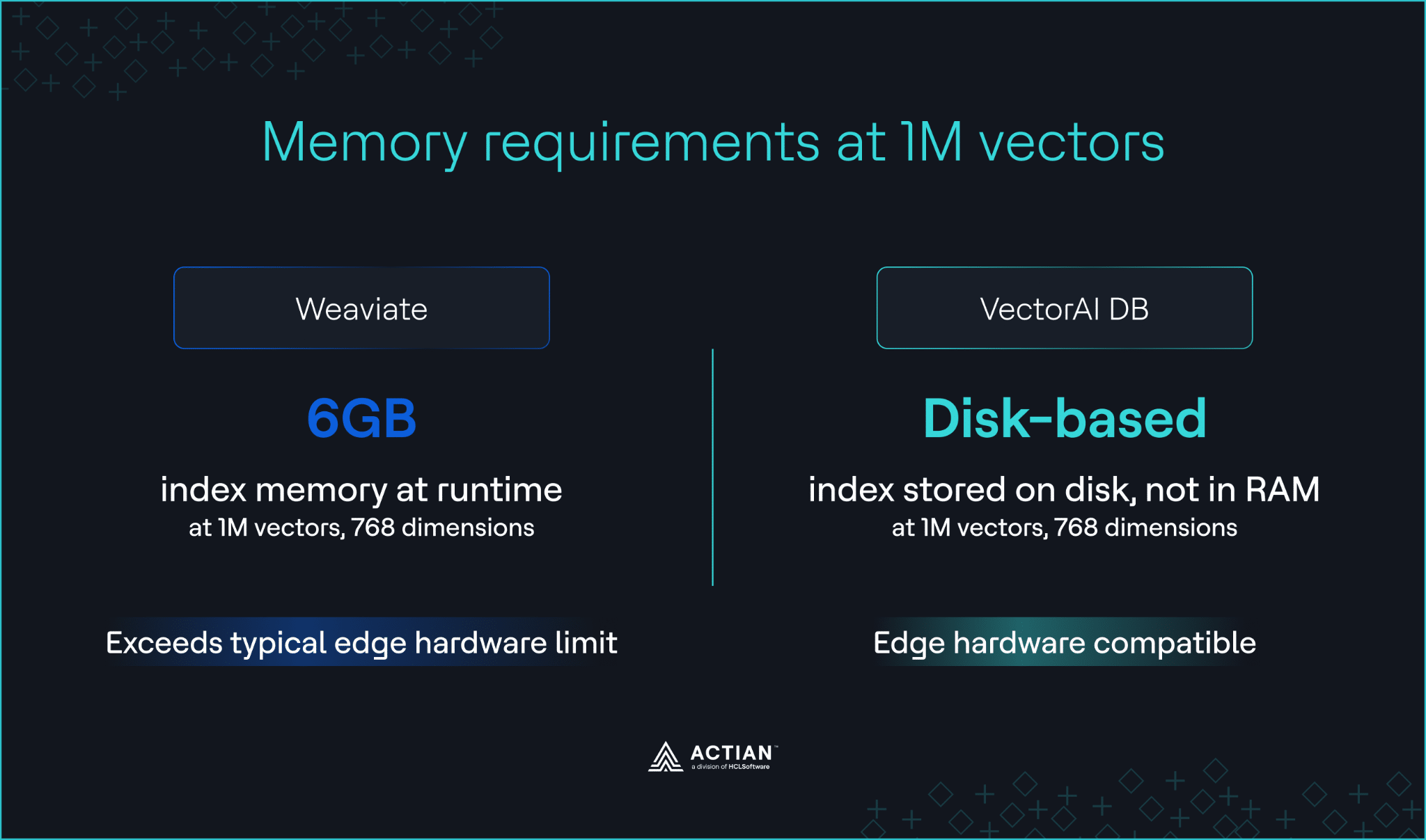
Memory requirements at 1M vectors compared between Weaviate and VectorAI DB
Performance at 1 Million Vectors
VectorAI DB recorded 1,040 queries per second at one million vectors and 768 dimensions, with no vendor-specific tuning applied. Higher QPS capacity directly translates to more concurrent queries the database can handle before latency starts to climb.
On latency, VectorAI DB posted a p99 of 12.7ms and a p95 of 11.3ms. The narrow gap between p95 and p99 indicates consistent performance under load rather than occasional spikes that drive tail latency higher. VectorAI DB achieved a recall of 99.48% on the approximate nearest neighbor search task, meaning the database returned the correct nearest neighbors in nearly every query, well within the range of production vector search workloads. Load duration covered the full ingestion and indexing of one million vectors in 1,242 seconds, a strong indicator of vector database performance at production scale.
Weaviate delivers competitive latency at the same scale. ANN-Benchmarks results show a p50 of 8ms and a p95 of 22ms at one million vectors. A comparable QPS figure for Weaviate was not available from the same test conditions.
Cost at Production Scale
The global vector database market is projected to surge from $2.2 billion in 2024 to $10.6 billion by 2032, indicating a growing demand for cost-effective solutions in this space. Weaviate’s cloud pricing starts at $45 per month for the Flex plan, which uses shared infrastructure and offers a 99.5% SLA. The Premium plan starts at $400 per month for dedicated infrastructure and a 99.95% SLA. Both plans carry usage-based charges on top of the base rate for vector dimensions, storage, and backups.
For a typical edge workload with 500,000 vectors and 1,536 dimensions, Weaviate Cloud costs between $45 and $80 per month. This covers moderate query volume and standard storage. Larger datasets or higher query volumes push costs beyond that range.
Self-hosting Weaviate is free as open-source software, but the infrastructure costs are not. A small Docker setup costs about $20 per month. A production Kubernetes deployment ranges from $200 to $1,000 per month, depending on node count, memory allocation, and storage configuration. Horizontal scaling across multiple nodes drives those infrastructure costs higher. The breakeven point between Weaviate Cloud and self-hosted infrastructure sits around five million vectors, beyond which the managed cloud service typically costs more than a comparable self-hosted setup.
VectorAI DB’s starting plan is the Community Edition, a small free tier that supports up to 5K vectors and runs on local development machines. The Starter plan covers 1M vectors at $417 per month, billed annually, suited for smaller servers and VMs. The Growth plan scales to 5M vectors at $1,250 per month, billed annually. An Edge edition is available for embedded devices and air-gapped systems at custom pricing. All paid plans include a 30-day free trial.
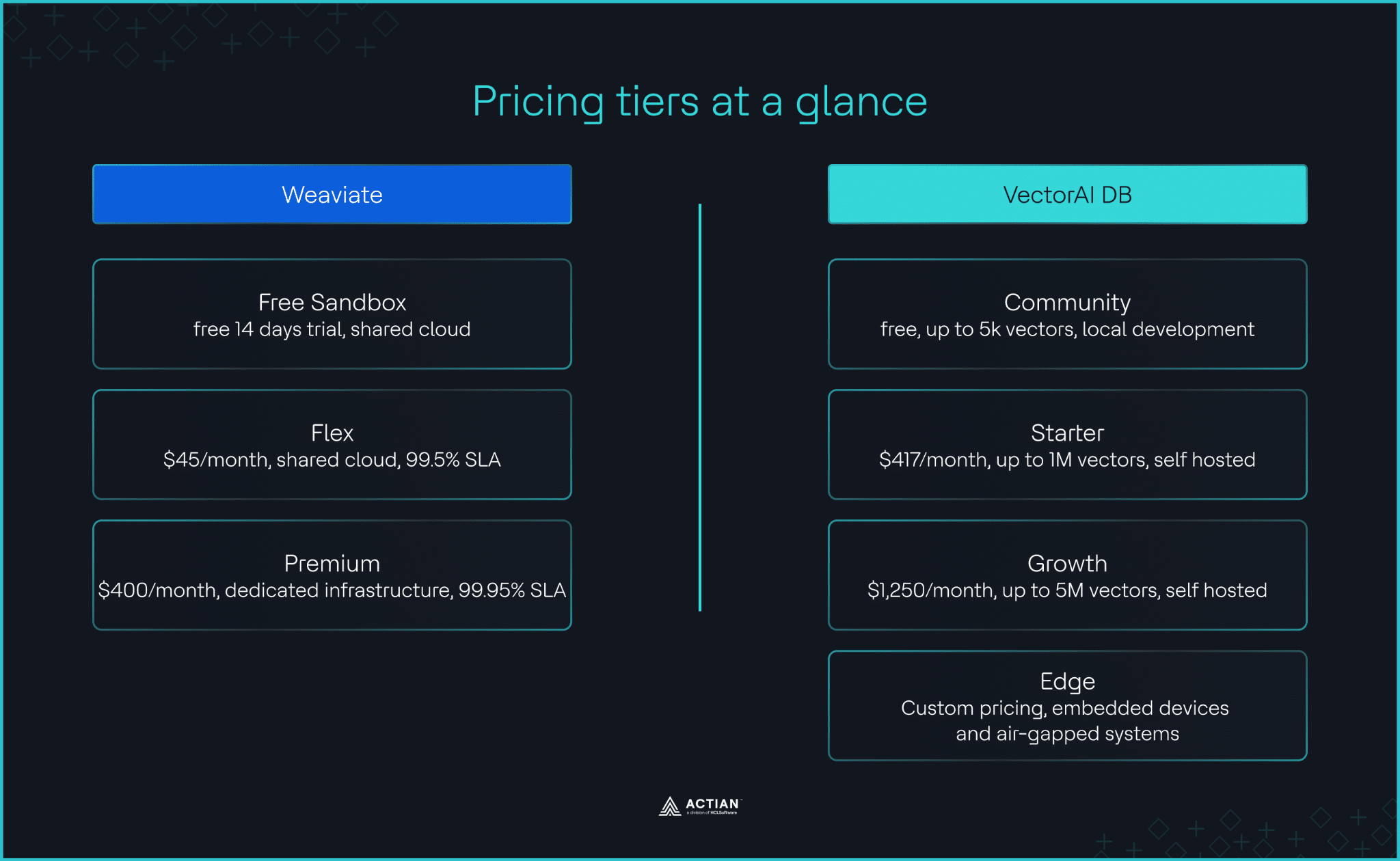
Pricing tiers at a glance for Weaviate and VectorAI DB
The hidden costs of vector database pricing are worth understanding before committing to either model. Egress fees, backup storage, and dimension-based charges add meaningfully to the base plan cost at scale. Modeling the full operational costs before committing to a cloud offering matters more than the base plan number alone.
When Weaviate is the Right Choice
Weaviate is the stronger choice when the deployment environment has reliable internet connectivity and sufficient memory, and when the workload benefits from hybrid search. Its native ability to combine vector similarity and BM25 keyword search in a single query positions it well for semantic search, retrieval-augmented generation pipelines, and natural language processing applications where keyword context matters alongside semantic meaning.
The built-in vectorization modules for OpenAI, Cohere, Hugging Face, and over 600 transformer models remove the need to manage a separate embedding model pipeline. Weaviate Agents add natural-language querying over your own data and transformation capabilities to reshape vector data at scale. Data science workflows that handle large volumes of unstructured data benefit from a meaningful reduction in operational overhead. These are key features that set Weaviate apart for cloud-native workloads.
Weaviate holds SOC 2 Type II, HIPAA on AWS, and ISO 27001 certifications, giving it a maturity advantage that VectorAI DB does not yet have. Its ecosystem maturity and seven-year production track record make it one of the best vector databases for cloud-native workloads. This advantage is important in large enterprise deployments with strict compliance and multi-tenant requirements.
HFresh, the disk-based vector index Weaviate introduced as a technical preview in v1.36, is worth watching ahead of the v1.37 and v1.38 releases. If it reaches production-ready status, it would address the in-memory constraint that currently limits Weaviate’s edge viability.
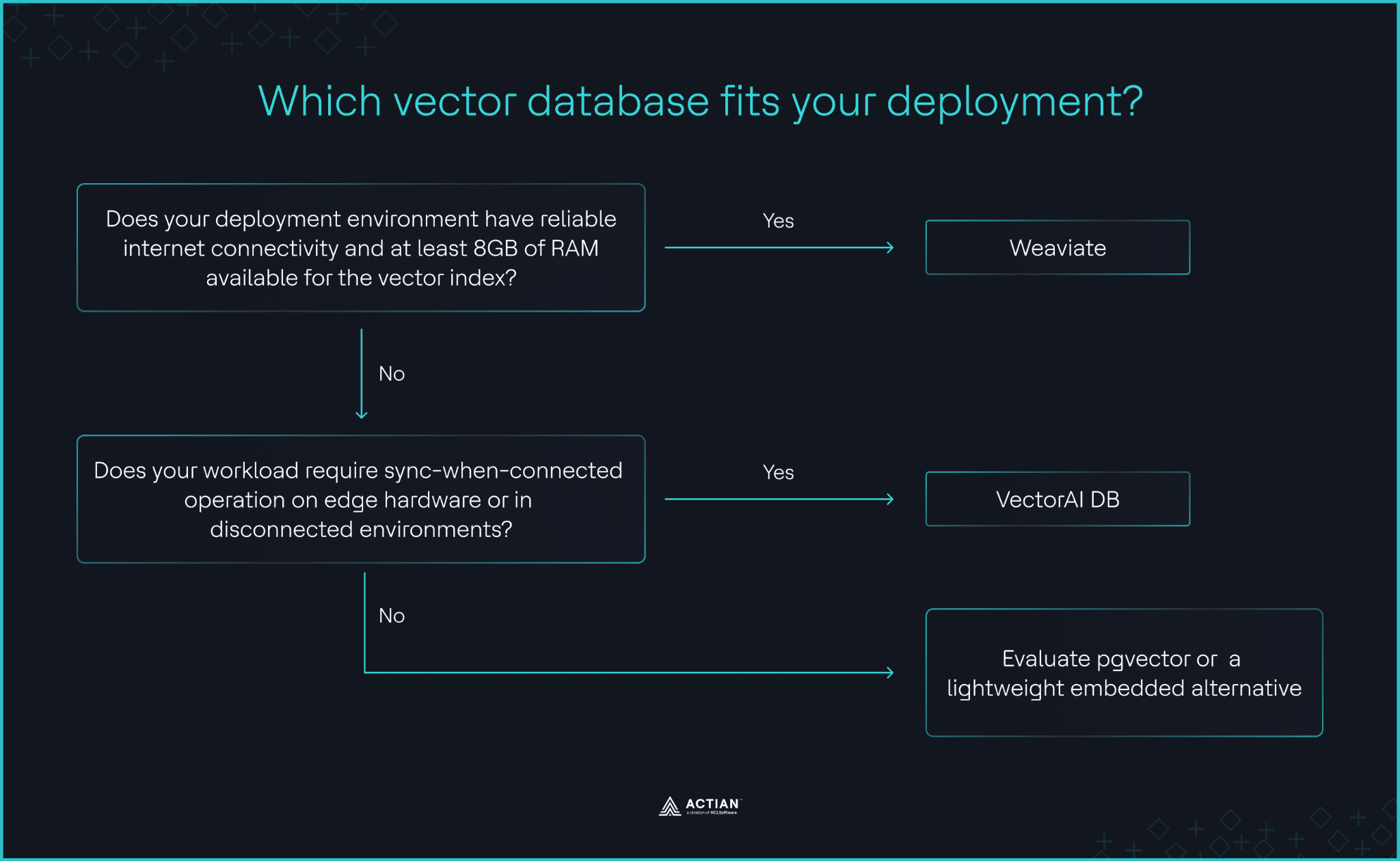
Decision flowchart
Ecosystem and Integration Maturity
Weaviate ships with Python, TypeScript, JavaScript, Go, Java, and C#, as well as REST, gRPC, and GraphQL APIs. Framework integrations include LangChain, LlamaIndex, Haystack, Mem0, and CrewAI, making it well-suited for machine learning pipelines that require vector search at a production scale. Weaviate’s ecosystem is among the most mature in the open-source vector database category for recommendation engines, multimodal search, and complex retrieval-augmented generation pipelines.
VectorAI DB comes with Python and JavaScript SDKs, REST and gRPC APIs, and works with LangChain, LlamaIndex, Hugging Face, OpenAI, Cohere, and Anthropic models. The simple API connects via gRPC on port 50051 and supports cosine similarity, Euclidean distance, and dot product distance metrics out of the box. The filter DSL provides a type-safe, fluent interface for building complex metadata and payload filtering queries without resorting to raw query syntax. Persistent storage ships as the default backend, meaning vector data survives container restarts without additional configuration, a meaningful difference for edge deployments where local development and production environments need to behave consistently.
There is a clear gap in ecosystem maturity. Weaviate’s AI features, multimodal input, and agent tools result from years of development that VectorAI DB has yet to match. This gap matters most for cloud-native workloads that depend on the full Weaviate stack. On constrained hardware with an integration path into LangChain or LlamaIndex, VectorAI DB covers what matters most at launch.
The following Python snippets show how each database initializes and runs a vector search query. The Weaviate example uses hybrid search, combining vector search and BM25 keyword search in a single request. VectorAI DB currently supports only vector search.
Weaviate: Hybrid search
import weaviate

client = weaviate.connect_to_local()

collection = client.collections.use("documents")

query_vector = [0.1] * 768

response = collection.query.hybrid(
    query="edge deployment vector search",
    vector=query_vector,
    alpha=0.5,
    limit=5,
)

for result in response.objects:
    print(result.properties)

client.close()
VectorAI DB: Vector search
from actian_vectorai import VectorAIClient, VectorParams, Distance

with VectorAIClient("localhost:50051") as client:
    info = client.health_check()

    results = client.points.search(
        "my_collection",
        vector=[0.1] * 768,
        limit=5,
    )
    for r in results:
        print(f"ID: {r.id}, Score: {r.score}")
In terms of pure ecosystem depth and AI application support, Weaviate has a clear lead. Where edge deployment, memory constraints, or offline operation are the deciding factors, VectorAI DB covers the integration surface area that matters most at launch.
How Other Weaviate Alternatives Compare
Here is how the five most commonly evaluated Weaviate alternatives handle edge deployment and constrained memory hardware.
Pinecone is a fully managed vector database widely used for production AI applications at scale. The BYOC option keeps vector data within a cloud VPC, but the control plane still requires outbound connectivity, making it unsuitable for disconnected or offline environments. The starter plan starts at $50 per month, and there is no self-hosted version.
Milvus is an open-source vector database designed for large-scale deployments, offering features such as GPU-accelerated search and multiple index types, including HNSW, IVF, and DiskANN, in distributed deployments. The full Milvus Distributed stack uses more resources than most edge devices can provide, and Milvus Lite is not production-ready.
Qdrant is an open-source vector database that emphasizes performance and filtering capabilities, making it suitable for applications that require both semantic search and structured filtering. It is self-hostable as a single binary, making it more edge-viable than Weaviate or Milvus. Its Private Cloud air-gapped tier requires enterprise pricing, and Qdrant Edge is still in private beta, with offline production deployments not yet generally available.
ChromaDB is an open-source embedding database focused on developer experience, allowing for rapid prototyping and local development of vector search applications. It runs in embedded mode with no server dependencies, but lacks built-in replication or failover, so it does not qualify as a production edge database.
pgvector adds vector search to PostgreSQL, making it a natural fit for relational database environments that need similarity search without managing separate infrastructure. Running it on edge hardware adds the full PostgreSQL overhead to an already constrained memory envelope, making it a poor fit unless Postgres is already in the stack.
| Capability | Weaviate | VectorAI DB | Pinecone | Milvus | Qdrant | ChromaDB | pgvector |
| Edge/embedded capable (production) | No | Yes | No | No | No | No | No |
| Min RAM at 1M vectors (768 dims) | High (~6GB index) | Moderate (8GB system RAM) | N/A | High | Low | Low | Moderate |
| Deployment model | Cloud/self-hosted | Edge/self-hosted | Cloud only | Cloud/self-hosted | Cloud/self-hosted | Embedded/self-hosted | Self-hosted |
| Sync-when-connected | No | Yes | No | No | No | No | No |
| Open source | Yes | No | No | Yes | Yes | Yes | Yes |
| Minimum cloud cost | $45/month | N/A (self-hosted) | $50/month | Free tier | Free tier | Free tier | Free tier |
| Hybrid search (native) | Yes | No | Yes | Yes | Yes | No | Partial |
Wrapping Up
Weaviate is a proven vector database with a strong ecosystem, native hybrid search, and a managed cloud service that scales infrastructure. Cloud-native semantic search, retrieval-augmented generation pipelines, and AI applications on reliable infrastructure are where Weaviate performs at its best.
The memory constraint is significant. Weaviate’s HNSW index needs about 6GB of RAM for one million vectors at 768 dimensions. On edge hardware with 4GB to 8GB of memory, this leaves little room for other processes. Combined with an experimental embedded mode and no production-ready offline deployment, Weaviate is not the right tool for edge or disconnected environments.
VectorAI DB fills this gap. With persistent storage as the default backend, a production-ready deployment model, a sync-when-connected architecture, and an index that does not load entirely into RAM the way Weaviate’s does, it is the right choice for vector search on constrained hardware without guaranteed connectivity. The Community Edition is free and runs on your hardware today.
Start building with VectorAI DB for free.
Start for Free
Stay connected
Data insights delivered to you.
(i.e. sales@..., support@...)
