Summary

  • Data observability platforms monitor and optimize data pipelines.
  • Provide proactive anomaly detection, lineage, and root cause analysis.
  • Improve data quality, reliability, and decision-making confidence.
  • Integrate across data stacks without accessing raw data.
  • Enable faster issue resolution and reduced data downtime.

A data observability platform is a comprehensive solution designed to monitor, troubleshoot, and optimize data pipelines and systems. Much like how application performance monitoring (APM) tools oversee software health, a data observability platform ensures the health of data itself, giving organizations confidence in the quality of their data.

How Data Observability Platforms Differ From Traditional Monitoring Tools

Traditional data monitoring tools are often limited in scope. They might check for basic metrics like latency or uptime, but they don’t offer a comprehensive view of the entire data ecosystem. In contrast, a data observability platform provides deep visibility into the state of data across the pipeline, covering ingestion, transformation, storage, and delivery.

Data observability platforms are proactive, not reactive. They don’t just send alerts when something breaks. They identify anomalies, trace the root cause of issues, and even predict potential failures using AI and historical patterns. This holistic, automated approach makes them vastly more effective than legacy tools.

The Importance of Data Observability

Let’s take a brief look at some of the reasons why these platforms are so crucial for organizations in the modern landscape.

Enhancing Data Quality and Reliability

High-quality data is essential for analytics, machine learning, and daily business operations. Data observability platforms continuously monitor for:

  • Schema changes
  • Null values
  • Outliers
  • Broken pipelines

This helps ensure that any deviations from expected behavior are detected early, before data moves downstream. The platforms safeguard data integrity and help teams maintain reliable data environments.

Supporting Data-Driven Decision Making

Organizations increasingly rely on data to drive strategic decisions. If the data feeding into dashboards or machine learning models is flawed, the results can lead to costly mistakes and cause mistrust in data. With a data observability platform in place, teams gain confidence in the data they use, which directly supports smarter, faster decision-making. In turn, the organization can expect better outcomes based on those decisions and predictions.

Key Features of Data Observability Platforms

Every data observability platform will have its own proprietary capabilities and add-ons. However, there are some general features that organizations can expect to find with any good data observability platform.

Real-Time Monitoring and Alerts

Real-time insights are a hallmark of any modern data observability platform. These systems provide instant alerts when anomalies are detected, enabling teams to respond before the issue cascades downstream. This capability reduces data downtime and minimizes disruption to business processes.

Data Lineage and Impact Analysis

Understanding where data comes from, how it’s transformed, and where it’s consumed is critical. Data observability platforms offer data lineage visualization, allowing teams to trace the origin and flow of data across the system. When issues arise, they can quickly identify which datasets or dashboards are affected.

Integration With the Existing Data Infrastructure

No two organizations have identical data stacks. A good data observability platform integrates seamlessly with other infrastructure elements, minimizing friction during deployment. This typically includes integration with:

  • Popular extract, load, and transform (ELT) tools.
  • Cloud data warehouses.
  • Business intelligence (BI) tools.
  • Data lakes.

System integration ensures that data observability becomes an extension of the organization’s existing data ecosystem, not a siloed solution.

How Data Observability Platforms Work

Each data observability platform will have its own specific processes. However, they all perform a range of functions that can be generalized. Below are steps that typical platforms take regardless of their additional bells and whistles.

Data Collection and Analysis

The platform begins by collecting metadata, logs, metrics, and query histories from various sources in the data stack. This non-invasive approach means the platform doesn’t require direct access to raw data. It then applies machine learning algorithms and heuristic models to analyze patterns, detect anomalies, and predict potential failures.

Identifying and Resolving Data Issues

Once an issue is detected, the platform performs root cause analysis to help teams understand what went wrong and where. Whether it’s a broken transformation job, a schema mismatch, or unexpected values, users can take immediate corrective action, often directly from the platform interface.

Benefits of Data Observability Platforms

Organizations that use data observability platforms experience a wide range of benefits. These platforms help companies maintain good data governance practices, make better business decisions, and reduce the time it takes to fix or resolve any data quality issues that may arise.

Improved Operational Efficiency

By automating the detection and resolution of data issues, teams can spend less time firefighting and more time on value-added tasks. This leads to faster delivery cycles, better resource allocation, and increased productivity across data engineering, analytics, and operations teams.

Reduced Data Downtime

Data downtime, which occurs when data is missing, delayed, or incorrect, can paralyze decision-making. Data observability platforms dramatically reduce downtime by proactively catching and resolving issues quickly, often before business users are even aware of a problem.

Enhanced Collaboration Across Teams

Observability platforms often include shared dashboards, alert capabilities, and audit trails, promoting transparency across data teams. This fosters a culture of collaboration and accountability, enabling engineering, analytics, and business stakeholders to work together more effectively.

Choosing the Right Data Observability Platform

Selecting the right platform depends on several factors:

  • Scalability: Can it handle the organization’s volume and velocity of data?
  • Ease of integration: Does it fit within the organization’s existing architecture?
  • Customizability: Does the platform allow users to tailor alerts, thresholds, and metrics?
  • User interface: Is it intuitive for both technical and non-technical users?
  • Support and community: Is there a strong network of users and resources?

Look for vendors that offer hands-on demos, free trials, and reference customers in similar industries to guide the buying decision.

What to Expect With Data Observability Solutions Going Forward

Data observability is a growing market, with many companies starting to work on solutions and tools like comprehensive platforms. Below, we’ve provided a brief list of what to expect in coming years as the need for better, faster, more accurate data observability platforms becomes more pressing.

Possible Future Innovations

The field of data observability is evolving rapidly. Some emerging trends include:

  • Automated remediation: Platforms that not only detect problems but fix them autonomously.
  • Expanded coverage: Observability expanding beyond data pipelines to include governance, compliance, and usage metrics.
  • Unified observability: Consolidating monitoring across data, applications, and infrastructure into a single pane of glass.

More AI and ML to Offset Manual Workloads

AI and machine learning are at the core of next-gen observability platforms. These technologies enable the platform to learn from historical incidents, detect complex anomalies, and forecast potential failures with greater accuracy than manual rules or thresholds ever could. As these models mature, observability will become more predictive than reactive, fundamentally transforming how organizations manage data quality.

Data Observability Platform FAQs

Get the answers to some of the most frequently asked questions about data observability platforms:

Is data observability the same as data quality monitoring?

Not exactly. Data quality monitoring is a component of data observability. While data quality focuses on the condition of the data itself, such as accuracy and completeness, observability also covers pipeline health, infrastructure, lineage, and user impact.

Do I need a separate team to manage a data observability platform?

Not necessarily. Many modern platforms are built to be self-service, with interfaces accessible to data engineers, analysts, and business users. When choosing a data observability platform, factor in issues like its user interface, streamlined design, and whether it has a community of support to provide tips or troubleshooting.

Can a data observability platform integrate with a cloud data warehouse?

Yes, leading platforms offer native integrations with cloud data warehouses, ETL tools, orchestration frameworks, and BI tools. Always confirm compatibility during the evaluation process.

How long does it take to implement a data observability platform?

Depending on the complexity of the data environment, implementation can take anywhere from a few days to several weeks. Most vendors provide onboarding support and customer success teams to guide the rollout. Some vendors, like Actian, offer personalized demonstrations to help acclimatize users to the platform’s many features.

Take a Tour of Actian Data Observability

Actian Data Observability offers enterprise-grade observability with real-time monitoring, lineage tracking, and insights powered by machine learning. It can identify and fix data issues before they impact apps, AI models, or other use cases.

Take a self-guided tour today and discover how Actian Data Observability can help organizations ensure data trust and build reliable AI-ready data products with full visibility and confidence.


Summary

  • Data governance ensures data is secure, consistent, and compliant.
  • Non-compliance risks fines, breaches, and reputational damage.
  • Challenges include silos, complexity, and lack of visibility.
  • Actian automates monitoring, policy enforcement, and reporting.
  • Metadata tracking and lineage enable scalable compliance.

Companies generate vast amounts of data. This data has tremendous value, but it also comes with significant responsibility. Ensuring that data is properly governed, protected, and compliant with regulations is essential for maintaining trust, avoiding costly fines, and supporting business operations. Data governance plays a critical role in ensuring data is handled securely, appropriately, and under various legal and regulatory requirements.

In this article, we will explore the importance of maintaining compliance in data governance, the challenges that organizations face in ensuring compliance, and how the Actian Data Intelligence Platform helps organizations meet regulatory requirements through automated compliance monitoring and metadata tracking.

What is Data Governance?

Data governance refers to the practices, policies, and procedures that ensure that data is managed consistently, securely, and in a way that supports organizational objectives. It encompasses various aspects, including data quality, data security, data privacy, and compliance with laws and regulations.

Data governance aims to ensure that data is used responsibly, that it is trustworthy, and that its usage aligns with both internal and external standards. A strong data governance framework is critical not only for operational efficiency but also for ensuring that organizations adhere to regulatory requirements and best practices in data management.

Why is Compliance Important in Data Governance?

Compliance in data governance refers to adhering to legal, industry-specific, and internal standards that govern the collection, storage, use, and sharing of data. Failing to maintain compliance can have significant consequences for an organization, including:

  1. Legal and Financial Penalties: Non-compliance with regulations such as GDPR, HIPAA, or CCPA can result in hefty fines. For instance, the GDPR imposes penalties of up to 4% of an organization’s global annual revenue for violations, making compliance a high-stakes issue.
  2. Reputational Damage: Data breaches or non-compliance with data privacy laws can severely damage an organization’s reputation. Loss of consumer trust can lead to diminished brand value, customer churn, and difficulty acquiring new customers.
  3. Operational Risks: If an organization fails to ensure compliance, it can face disruptions in operations, including audits, penalties, and a loss of access to critical data or systems. Additionally, non-compliance can result in data being misused or mismanaged, compromising the quality of decisions based on that data.
  4. Risk to Data Security: Compliance regulations often require the implementation of strict data security measures. Failure to comply can leave data vulnerable to cyberattacks, which can lead to data breaches, identity theft, and financial loss.
  5. Audits and Reporting: Many regulatory frameworks require regular audits to ensure that an organization complies with data governance practices. Without a robust compliance program, audits can become stressful and challenging, leading to increased costs and operational inefficiencies.

Common Regulatory Frameworks in Data Governance

Several regulations govern how organizations must handle data. Some of the most well-known ones include:

  • General Data Protection Regulation (GDPR): The GDPR is a comprehensive data protection regulation in the European Union that governs how personal data should be collected, processed, stored, and protected. It requires organizations to implement strict data privacy practices, with heavy penalties for non-compliance.
  • Health Insurance Portability and Accountability Act (HIPAA): HIPAA is a U.S. regulation that governs the security and privacy of health data. Healthcare organizations must ensure that patient data is protected and that only authorized individuals have access to this sensitive information.
  • California Consumer Privacy Act (CCPA): The CCPA is a state-level data privacy law in California that gives consumers greater control over their personal data. It requires businesses to disclose data collection practices and allow consumers to opt-out of the sale of their data.
  • Payment Card Industry Data Security Standard (PCI DSS): PCI DSS sets standards for securing payment card data. Organizations that handle payment information must comply with these standards to prevent fraud and protect consumers’ financial data.

The Challenges of Ensuring Data Governance Compliance

Maintaining compliance in data governance is challenging for several reasons:

  1. Complex Regulations: Regulatory frameworks are often complex and subject to frequent updates. Staying up to date with changes in data protection laws can be difficult, especially for multinational organizations that must comply with multiple regulations across various jurisdictions.
  2. Data Silos: In many organizations, data is stored in different systems, databases, and platforms. This fragmentation makes it difficult to track data and ensure data compliance, as there is often no centralized way to monitor or manage data usage across various departments or tools.
  3. Volume of Data: As organizations grow, the volume of data they handle also increases. Managing compliance becomes increasingly difficult as data proliferates, making it harder to track where data is stored, who has access to it, and how it is used.
  4. Manual Compliance Processes: Many organizations rely on manual processes to manage compliance, such as manually tracking data access and usage or conducting audits. These manual efforts are prone to error, time-consuming, and difficult to scale.
  5. Lack of Visibility: Without proper tools to monitor and track data usage, organizations may struggle to get an accurate picture of their compliance posture. Without visibility, it’s challenging to identify and rectify potential compliance issues before they become major problems.

How Actian Helps Ensure Compliance Through Automated Monitoring and Metadata Tracking

The Actian Data Intelligence Platform helps organizations meet regulatory requirements by offering tools for automated compliance monitoring and metadata tracking. These features allow organizations to ensure that data governance processes are not only consistent but also fully compliant with regulatory standards.

1. Automated Compliance Monitoring

One of the most significant challenges organizations face in maintaining compliance is the manual effort required to track data usage, access, and compliance with regulations. Actian’s platform automates much of this process, reducing the risk of human error and improving efficiency.

  • Continuous Monitoring: The Actian Data Intelligence Platform enables continuous monitoring of data to ensure that all data events are tracked and documented. By automatically recording when and how data is accessed, the platform provides real-time insights into data usage, helping organizations stay on top of regulatory requirements without the need for manual oversight.
  • Policy Enforcement: It helps organizations define and enforce data governance policies, such as access controls, data usage policies, and data retention rules. This ensures that the organization remains compliant with regulations such as GDPR or HIPAA, as well as internal governance standards.
  • Automated Alerts and Reports: The platform also generates automated alerts and compliance reports whenever it detects potential violations or risks. This proactive approach enables organizations to identify compliance issues before they escalate, allowing for timely corrective actions.

2. Metadata Tracking and Management

Metadata plays a critical role in ensuring that data governance processes are compliant. It provides essential context about the data, including where it is stored, how it is used, and who has access to it. The Actian Data Intelligence Platform helps organizations manage and track metadata effectively, making it easier to meet regulatory requirements.

  • Comprehensive Metadata Catalog: Actian’s platform offers a comprehensive metadata catalog that provides a centralized repository for all data-related information. This catalog includes data lineage, access controls, data definitions, and data classifications, which are essential for understanding how data flows through the organization and ensuring that it is used appropriately.
  • Data Lineage: The platform’s data lineage capabilities allow organizations to track the movement and transformation of data across systems and departments. By understanding the full lifecycle of data, organizations can ensure that it complies with legal and regulatory requirements, such as data retention and deletion policies.
  • Access Control Tracking: The Actian Data Intelligence Platform tracks who has access to specific datasets, providing visibility into how data is shared and used across the organization. This is essential for compliance with regulations like GDPR, which requires organizations to restrict access to sensitive data based on role and necessity.
  • Audit Trails: The platform automatically generates audit trails, ensuring that organizations have a complete record of data access and usage. These audit trails are essential for demonstrating compliance during audits or investigations.

3. Centralized Data Governance Framework

The Actian Data Intelligence Platform provides a centralized platform for managing data governance processes, including compliance. This unified framework enables organizations to maintain a consistent approach to data governance across all departments and systems, facilitating compliance with regulatory requirements.

  • Cross-Department Collaboration: Actian’s platform facilitates collaboration between data owners, data stewards, and IT teams, ensuring that everyone is aligned with compliance goals. By bringing all stakeholders together, the platform enables more effective governance and risk management.
  • Standardization of Practices: The platform helps organizations standardize data governance practices, ensuring consistency in how data is handled and governed. This standardization facilitates adherence to regulations and ensures compliance across the organization.

Actian Data Intelligence Platform Can Help Organizations Enforce Governance Policies and Remain Compliant

Maintaining compliance in data governance is critical for organizations to avoid legal penalties, protect data security, and ensure that data is used responsibly. With the increasing complexity of regulations, manual processes, and fragmented data systems, ensuring compliance can be a significant challenge.

Actian Data Intelligence Platform helps organizations navigate these challenges through automated compliance monitoring, metadata tracking, and a centralized governance framework. By leveraging the platform’s advanced features, organizations can streamline compliance efforts, improve operational efficiency, and maintain a secure and compliant data environment. This allows organizations to focus on deriving value from their data while safeguarding against the risks associated with non-compliance.

Take a tour of the Actian Data Intelligence Platform’s capabilities to see how it can transform your company’s governance framework.


Summary

  • High-quality data requires accuracy, completeness, and consistency.
  • Poor data leads to errors, inefficiency, and lost trust.
  • Key steps: assess data, enforce governance, and validate inputs.
  • Ongoing monitoring and culture sustain long-term data quality.
  • Tools like Actian automate quality, observability, and governance.

Every organization, whether a business or a non-profit, relies on accurate and reliable data to make critical strategic decisions. Whether it’s improving customer experience, streamlining operations, or driving revenue, high-quality data plays a pivotal role.

However, achieving and maintaining top-notch data quality remains a significant challenge for many. In this guide, we explore how to improve data quality by understanding its fundamentals, addressing common challenges, and adopting strategic steps and tools for sustainable data excellence.

Understanding Data Quality

First, let’s break down what data quality means. Typically, data experts use five pillars or sets of attributes to evaluate the quality of a dataset.

Defining Data Quality

Various attributes, when taken together, constitute a dataset’s given quality, such as accuracy, completeness, consistency, timeliness, and relevance. High-quality data should accurately represent the real-world construct it describes, be free of errors and duplications, and be suitable for its intended purpose.

Here’s a brief breakdown of the dimensions that define data quality:

  • Accuracy: The degree to which data reflects the real-world entities or values it represents.
  • Completeness: The presence of all required data fields and entries.
  • Consistency: Uniformity of data across multiple datasets or platforms.
  • Timeliness: Data being up-to-date and available when needed.
  • Validity: A measure of whether the data conforms to syntax and format rules.

The Importance of High-Quality Data

The consequences of poor data quality can be far-reaching. Inaccurate or incomplete data can lead to flawed business decisions, reduced operational efficiency, and loss of customer trust. Conversely, high-quality data enhances analytical capabilities, ensures regulatory compliance, and fuels innovation.

Some key benefits of high data quality include:

  • Improved Decision-Making: Clean and reliable data supports accurate forecasting and business planning.
  • Operational Efficiency: Reduces time and resources spent on correcting data issues.
  • Customer Satisfaction: Personalized and timely customer interactions are only possible with reliable data.
  • Regulatory Compliance: Accurate data helps meet industry regulations and standards, reducing legal risk.

Common Data Quality Challenges

Maintaining high-quality data is often easier said than done. Organizations face a range of obstacles that can compromise data quality, particularly as the volume, variety, and velocity of data increase. These challenges are frequently interconnected. Failing to address one can negatively impact the others. Understanding these common pitfalls is the first step toward building more resilient data management practices.

Identifying Data Errors

Data errors are among the most common issues affecting quality. These can include typographical errors, missing fields, duplicate records, and incorrect formatting. Errors often arise from manual data entry, system inoperability, or integration from disparate sources.

Common types of data errors include:

  • Input Mistakes: Human errors during manual entry.
  • Duplicate Records: Multiple entries for the same entity.
  • Outdated Information: Stale or no longer valid data points.
  • Inconsistent Formats: Varying data formats across departments or systems.

Detecting these issues early is critical to maintaining data quality. Regular audits and automated error detection tools can help catch problems before they escalate.

Overcoming Data Silos

Data silos occur when information is isolated in separate departments or systems, making it difficult to get a unified view. Silos hinder collaboration, reduce transparency, and often lead to inconsistent or redundant data.

Organizations facing siloed data often experience:

  • Redundant Data Storage: Duplicate datasets that waste storage and cause version confusion.
  • Lack of Accessibility: Teams struggle to access or share data across functions.
  • Inconsistent Data Definitions: Different interpretations of the same data field.

Breaking down silos requires integration strategies and centralized data management systems that promote data sharing and standardization across the organization.

Steps to Enhance Data Quality

Improving data quality requires a structured, proactive approach. It’s not enough to react to data problems as they occur—organizations must build systematic processes and policies that prevent issues before they arise. This means implementing a comprehensive data observability system in tandem with data quality measures.

Below are three foundational steps that can help any organization elevate the integrity, usability, and reliability of its data assets.

Conducting a Data Quality Assessment

A data quality assessment is the foundation for any improvement initiative. It involves evaluating existing datasets against quality dimensions and identifying areas for improvement.

Steps in a data quality assessment include:

  1. Inventory of Data Assets: Catalog data sources and flows across systems.
  2. Define Quality Metrics: Establish criteria for evaluating accuracy, completeness, etc.
  3. Data Profiling: Analyze data for anomalies, patterns, and outliers.
  4. Gap Analysis: Compare current state to desired quality benchmarks.

The assessment reveals root causes of poor data and guides remediation efforts. It’s important to note that assessing data quality should be an ongoing effort.

Establishing Data Governance Frameworks

Data governance refers to the policies, procedures, and standards used to manage data across its lifecycle. A strong governance framework defines roles, responsibilities, and accountability for data quality.

Key components of data governance include:

  • Data Ownership: Assigning responsibility for data assets to individuals or teams.
  • Standardization: Creating consistent definitions, formats, and taxonomies.
  • Policy Enforcement: Enabling compliance through rules and guidelines.
  • Training and Awareness: Educating staff on data quality principles.

Effective data governance ensures that data quality is not an afterthought, rather data should be handled with governance by design – as a built-in process.

Implementing Data Validation Techniques

Data validation involves verifying that data is accurate, clean, and useful before it’s stored or used. These techniques can be applied during data entry, data migration, or integration.

Examples of data validation techniques:

  • Format Checks: Ensuring fields match expected formats (e.g., dates, email addresses).
  • Range Checks: Validating values fall within acceptable boundaries.
  • Lookup Validation: Cross-checking values against known reference tables.
  • Duplicate Detection: Identifying and eliminating duplicate entries.

Automating validation rules helps reduce manual errors and increases confidence in data reliability.

Strategies for Maintaining Data Quality

Improving data quality is only half the battle—maintaining it over time is where many organizations fall short. As businesses grow, data sources expand, and new technologies are introduced, the risk of data degradation and poor data quality increases.

Long-term success requires an ongoing commitment to monitoring, collaboration, and investment in the right tools and processes. Below are three key strategies that can help organizations sustain high data quality over time. For more, check out our post on the top 9 ways to maintain data quality.

Regular Data Quality Reviews

Ongoing data quality monitoring is essential for sustaining improvements. Regular reviews involve analyzing data over time to detect new issues and evaluate the effectiveness of remediation efforts.

Best practices for regular reviews include:

  • Scheduled Audits: Monthly or quarterly evaluations of data sets.
  • Key Performance Indicators (KPIs): Tracking metrics such as error rate, data completeness, and user complaints.
  • Reporting Dashboards: Visual tools to monitor quality trends in real time.

These reviews allow organizations to proactively identify emerging problems and respond swiftly.

Promoting a Data-Driven Culture

Improving data quality is not just a technical challenge—it’s a cultural one. Organizations must instill the importance of data integrity throughout their workforce to ensure everyone values and contributes to data quality.

Ways to foster a data-driven culture:

  • Executive Buy-In: Leadership must champion data initiatives.
  • Employee Training: Offer training on data entry best practices and quality standards.
  • Recognition and Accountability: Reward teams for maintaining clean data and hold them accountable for errors.
  • Cross-Functional Collaboration: Encourage departments to work together on data-related initiatives.

A data-aware culture ensures that quality becomes an ongoing priority across all levels of the organization.

Utilizing Data Quality Tools

Modern data quality tools provide powerful features to automate, monitor, and enhance data quality. These platforms can significantly reduce the manual workload and ensure consistent standards.

Popular types of data quality tools include:

  • Data Profiling Tools: Analyze datasets to identify errors, gaps, and anomalies.
  • Data Cleansing Software: Automate the process of correcting or removing inaccurate data.
  • Master Data Management (MDM): Create a unified view of key business entities by reconciling duplicates and discrepancies.
  • Data Observability Platforms: Monitor, detect, and alert on data quality, reliability, and pipeline health issues across the data stack in real time
  • ETL (Extract, Transform, Load) Tools: Integrate and transform data from multiple sources with built-in quality checks.

Selecting the right tools depends on your organization’s size, industry, and specific data challenges.

Actian Helps Businesses Improve and Maintain Data Quality

With the Actian Data Intelligence Platform, organizations can organize and govern their data, share it between departments, perform data discovery, and more. Its federated knowledge graph technology offers advanced metadata management and helps with everything from quick data retrieval to regulation compliance.

Ready to see the difference Actian makes? Schedule a personalized demo today.


Summary

  • Metadata tools organize and manage data context across systems.
  • Improve discovery, lineage, governance, and compliance.
  • Enhance data quality and enable faster insights.
  • Break down silos to support collaboration and decision-making.
  • Actian automates metadata management for scalable data intelligence.

Efficiently managing the onslaught of today’s unprecedented volume of data across various systems, departments, and business units and ensuring it is accessible, secure, and trustworthy requires robust metadata management. Metadata, often referred to as “data about data,” provides the context, structure, and meaning of data. Without it, organizations struggle to understand, utilize, and secure their data assets.

In this article, we’ll explore what metadata management tools are, why they are important, and how organizations can benefit from them to streamline data discovery, improve decision-making, and ensure compliance.

What are Metadata Management Tools?

Metadata management tools are software applications designed to help organizations collect, organize, and manage metadata throughout their lifecycle. These tools provide a centralized platform for storing and accessing metadata, enabling users to track data lineage, quality, definitions, and relationships across various systems. Metadata management tools also support data governance processes by providing insights into how data is used, who is accessing it, and how it is transformed across the data pipeline.

Metadata can come in several forms:

  • Descriptive Metadata: Information about the content and context of data, such as file names, data types, and descriptions.
  • Structural Metadata: Information about the format, organization, and relationships of data, such as schemas and tables.
  • Administrative Metadata: Information about the management of data, including access rights, ownership, and creation dates.
  • Technical Metadata: Information on data systems, databases, and technology stacks used to store and process data.

Effective metadata management allows organizations to gain visibility into their data assets, which is critical for ensuring compliance, improving data quality, and enhancing business intelligence.

Why are Metadata Management Tools Important?

The importance of metadata management tools can be highlighted by the following benefits.

Improved Data Discovery and Accessibility

Data can become siloed, fragmented, and difficult to access without proper metadata management. Metadata management tools provide a catalog of data assets, making it easier for users to discover, search, and retrieve data across various platforms. With comprehensive metadata, users can quickly understand the context, meaning, and relevance of data, allowing them to make better decisions faster.

Data Lineage and Traceability

Data lineage is the ability to track the flow and transformation of data as it moves through various systems. Metadata management tools enable organizations to visualize data lineage, providing clarity on where data originates, how it is transformed, and where it is used. This capability is essential for understanding data quality, impact analysis, and troubleshooting.

Enhanced Data Governance and Compliance

Effective metadata management supports data governance initiatives by allowing organizations to define and enforce data usage, privacy, and access policies. Many industries face strict regulatory requirements related to data security and privacy (e.g., GDPR, HIPAA). Metadata management tools can help organizations track data access, ensure compliance, and mitigate risks of data misuse or breaches.

Improved Data Quality

Metadata management tools can help identify data quality issues early in the process by tracking the source and transformation of data. This proactive monitoring enables organizations to detect and correct inconsistencies, inaccuracies, and redundancies in their data, ensuring higher-quality datasets for decision-making.

Facilitating Collaboration

Metadata management tools help break down data silos by creating a shared view of data across departments and teams. When metadata is easily accessible, it fosters collaboration among data scientists, business analysts, IT teams, and other stakeholders, leading to more informed and effective decision-making.

Faster Insights

Metadata management tools can significantly reduce the time required to analyze and generate insights by providing a clear understanding of the data landscape. Users can quickly find and use the data they need, resulting in faster reporting, analysis, and decision-making.

Key Features of Metadata Management Tools

The most effective metadata management tools offer a variety of features that make managing and utilizing metadata easier for organizations. These features include:

Metadata Repository

A central repository for storing all metadata, ensuring that metadata is organized and easily accessible to all stakeholders. This repository allows users to search, retrieve, and manage metadata across multiple systems.

Data Lineage Visualization

A graphic representation of data lineage shows how data flows and is transformed across different systems, applications, and processes. This feature helps users understand the relationships between different data assets and how they impact one another.

Metadata Search and Discovery

Advanced search capabilities that allow users to quickly find metadata based on specific criteria, such as data type, source, or tags. Users can search through a catalog of data assets to identify the relevant data needed for analysis.

Data Governance and Policy Management

Tools to define and enforce data governance policies, such as access control, data security, and privacy regulations. These tools help organizations manage data permissions and ensure compliance with industry regulations.

Automated Metadata Collection

Automated tools that collect metadata from various data sources and systems, reducing the manual effort required for metadata management. Automation ensures that metadata is consistently updated and accurate.

Integration With Data Tools and Platforms

Metadata management tools that integrate with other data management platforms, business intelligence (BI) tools, and data warehousing systems to create a unified data environment. This integration ensures that metadata remains up to date across all systems.

Collaboration and Annotation

Collaboration features that allow users to add notes, comments, or documentation to metadata records. This encourages teamwork and knowledge-sharing, making it easier to understand and manage data across the organization.

Manage Your Organization’s Metadata With Actian

Metadata management is a critical component of effective data governance. With the rise of data-driven decision-making, organizations must be able to understand, track, and manage their data assets to ensure they are being used effectively and securely. Metadata management tools help organizations streamline data discovery, improve data quality, ensure compliance, and enhance collaboration. By investing in the right metadata management tool, organizations can better manage their data landscape and unlock the full potential of their data for improved business outcomes.

Through next-generation features, the Actian Data Intelligence Platform ensures that data teams spend less time searching for information and more time getting value from their data. Our platform collects, inventories, and shares metadata throughout the organization and across all data sources.

Request a demo to see how it can transform your organization’s data management systems.


Blog | Data Observability | | 4 min read

AI-Ready Data: Inside Actian’s Data Observability Solution

actian data observability solution

Summary

  • Actian Data Observability Agents provide active defense by validating data continuously as it enters the lakehouse.
  • The Model Context Protocol (MCP) server allows AI agents to verify data quality in real-time before taking action.
  • Autonomous remediation explains root causes in plain language and coordinates fixes without manual investigation.
  • The solution enables “autonomous-ready” data that supports agentic AI workflows with high-quality, context-rich inputs.

The hard truth about AI projects: 60% will fail by 2026 (Gartner) – but not because of algorithms.

While 95% of companies are already using AI and 99% plan to adopt it, most are stuck in pilot programs that can’t scale. The culprit? Data foundations that simply aren’t ready for enterprise AI deployment. 

In our recent webinar, Actian’s CTO, Emma McGrattan, and Senior Sales Engineer, Scarlett Whedbee, revealed how leading organizations are breaking through this barrier with a game-changing approach to data observability.

The $100 Problem Hidden in Your Data Pipelines

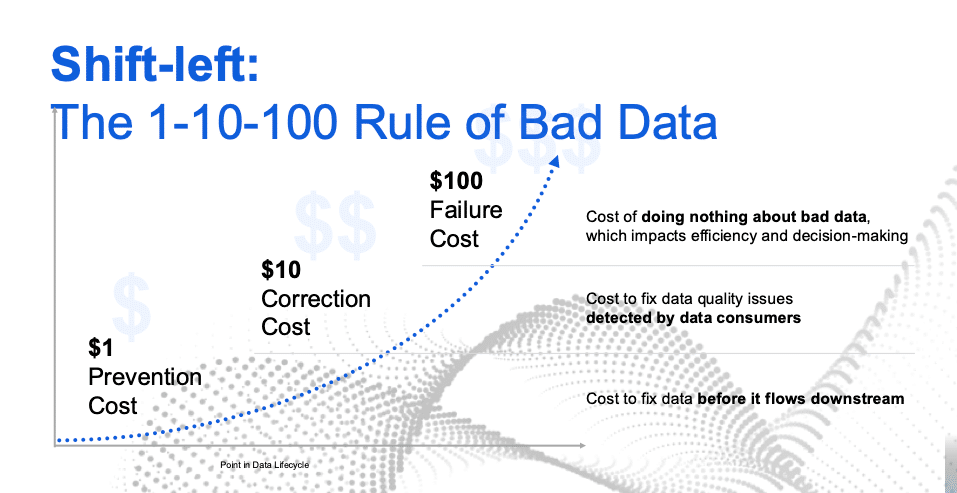
Picture this: A simple typo in a customer account number during onboarding. Caught immediately? That’s a $1 fix. Discovered when invoices start bouncing? Now that’s a $10 problem involving finance investigations and re-issued bills. But if it reaches regulatory reporting? Welcome to the $100 nightmare of penalties, audits, and reputational damage.

This is the “1-10-100 rule” – and it’s exactly why shifting left in data observability matters more than ever in the AI era.

shift-left 1-10-100 rule of bad data

Why Traditional Data Quality isn’t Enough for AI

According to the MIT Technology Review, while 76% of organizations have deployed AI in 1-3 use cases, 50% expect full enterprise AI deployment within just 2 years. Yet Gartner predicts that 60% of AI projects fail – not due to algorithmic limitations, but because of inadequate data foundations.

The difference between AI success and failure isn’t about having the most sophisticated models. It’s about ensuring your data is complete, consistent, unbiased, and governed from day 1.

Meet Actian’s Data Observability: Your AI Data Foundation

Actian’s solution goes beyond traditional monitoring in each of the 5 pillars of data observability:

  • Freshness: Real-time pipeline health monitoring.
  • Data Quality: Completeness, accuracy, and validity checks.
  • Volume: Anomaly detection for unexpected data spikes or drops.
  • Schema: Structural change tracking across your ecosystem.
  • Lineage: End-to-end data traceability for impact analysis.

What Makes Actian Different: 4 Game-Changing Advantages

Open Architecture for Modern Data Stacks

Our cloud-agnostic deployment means Actian works with your existing infrastructure – from raw JSON files to curated enterprise tables.

No Sampling = No Blind Spots

While others sample your data (potentially missing critical issues), Actian performs full table scans. In healthcare trials or financial reporting, missing even one anomalous record could be catastrophic.

Predictable, Budget-Friendly Costs

Purpose-built architecture delivers cost predictability that scales with your environment – crucial as AI initiatives expand enterprise-wide.

Security-First Design

SOC2 Type II compliant, deployed within your VPC, with end-to-end encryption. Your data never leaves your environment, we analyze the metadata, not the data itself.

See it in Action: Key Demo Highlights

During the live demo, Scarlett showcased how Actian customers gain:

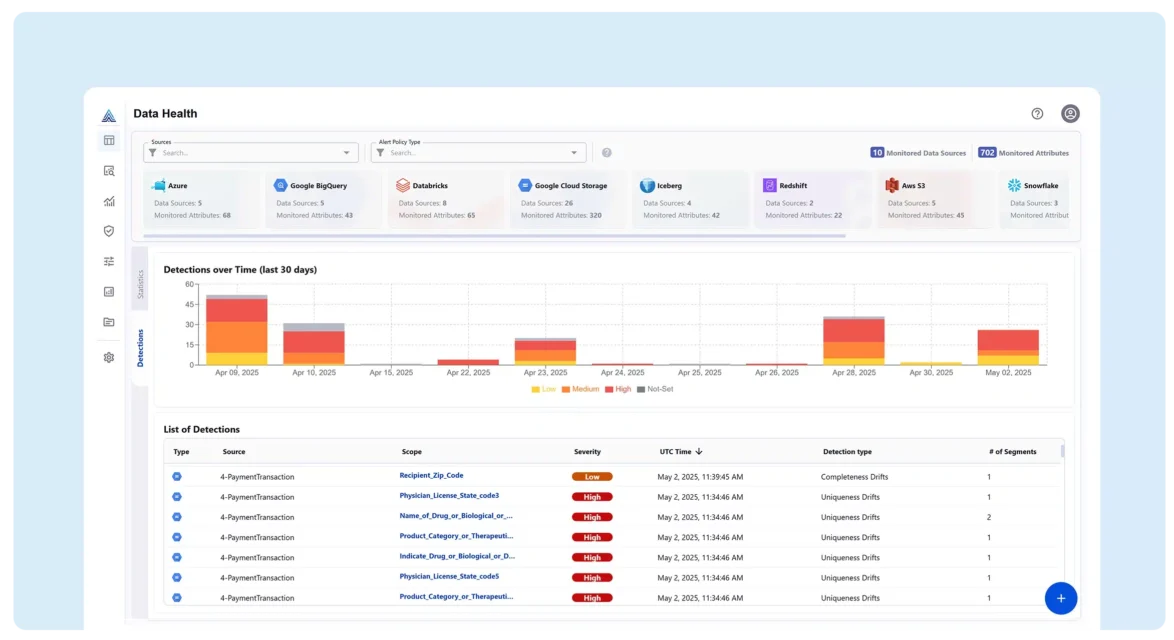
  • 10,000-foot pipeline visibility through unified data health dashboards.
  • ML-powered anomaly detection with 16 out-of-the-box monitors.
  • Automated alerting via Slack, Jira, and other collaboration tools.
  • Root cause analysis tools that pinpoint exactly which records need attention.
  • Data binning capabilities that separate good data from problematic records in real-time.
  • Spark-powered full table scanning that processes millions of metrics without impacting production systems, delivering 100% visibility with zero performance overhead.

From Reactive Fire-Fighting to Proactive Data Trust

Traditional approaches leave teams spending 25-40% of their time putting out data fires. Actian flips this model by:

  • Validating data at the source before issues cascade downstream.
  • Providing real-time context when problems occur.
  • Enabling immediate remediation through integrated workflows.
  • Building confidence in data that scales with your AI ambitions.

The Bottom Line: AI-Ready Data isn’t Optional

With enterprise AI deployment timelines compressing from years to months, 2025 is the year to establish bulletproof data foundations. The organizations that get this right won’t just avoid the 60% failure rate – they’ll gain sustainable competitive advantages through trustworthy, scalable AI implementations.

Ready to Transform Your Data into Your AI Advantage?

Actian Data Observability bridges the gap between AI ambitions and AI success. Whether you’re a data engineer seeking pipeline reliability, an analyst needing trusted insights, or a business leader planning enterprise AI rollout, Actian provides the foundation for data you can trust.

Want to see how this works in your specific environment? Our team is ready to show you exactly how Data Observability can accelerate your AI initiatives while eliminating the costly surprises that derail most projects.


Watch the full webinar recording on our website or contact our team to schedule a personalized demo.


Blog | Awards | | 5 min read

Actian Recognized as ‘Exemplary’ for Data Intelligence

ISG_BG_Actian_Data_Intelligence_Exmplerary_blog

Summary

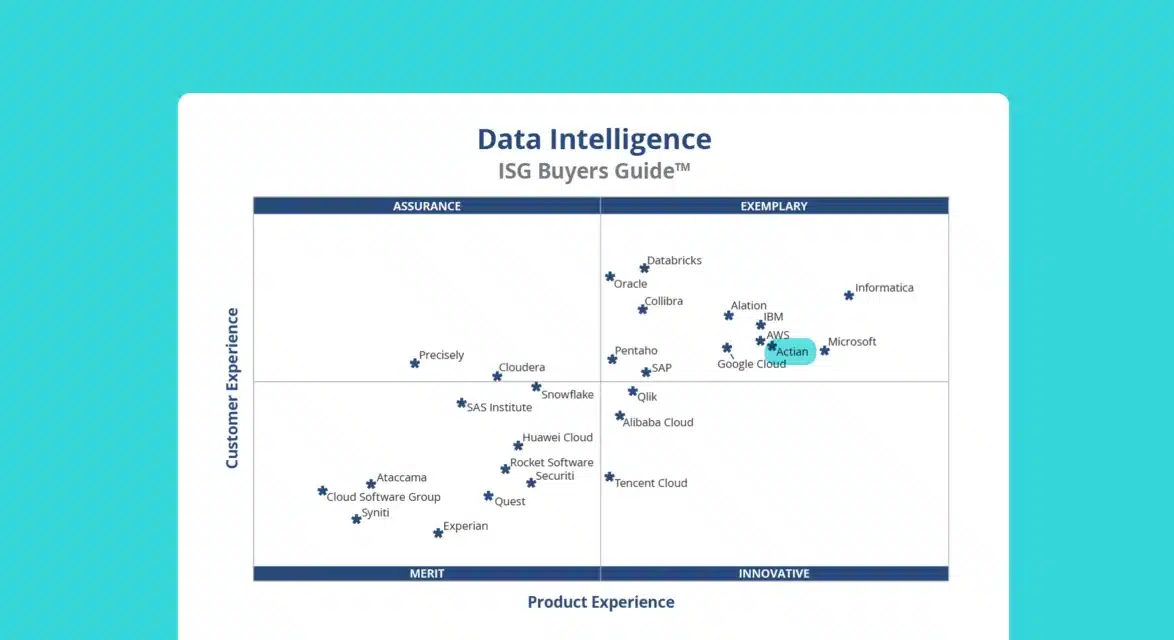
  • Actian named “Exemplary” in ISG 2025 Data Intelligence Buyers Guide.
  • Leader in product experience, capability, and manageability.
  • Strong in governance, metadata, lineage, and data quality.
  • Knowledge graph and catalog enhance data context and trust.
  • Validated by customers with a clear, future-ready roadmap.

“Actian performed best in Product Experience with an A- grade, notably receiving an A in Manageability due to breadth and depth of capability for technology administration.”

–ISG 2025 Data Intelligence Buyers Guide


The newly released ISG 2025 Data Intelligence Buyers Guide names Actian as “Exemplary” and designates us as a “Leader” in multiple categories.

In addition to recognition in the Data Intelligence Buyers Guide, Actian was also named Exemplary in the newly released ISG 2025 Data Governance Buyers Guide. ISG awarded Actian an A- overall and named us a Leader in Manageability, underscoring our platform’s technology administration, privacy, and security. Download the Data Governance Buyers Guide here.

Together, these results emphasize Actian’s ability to deliver governance by design, embedding compliance, stewardship, and oversight directly into the platform, while enabling flexibility and scalability.

This recognition highlights Actian’s ability to balance intuitive technical functionality with flexible data governance and management. These are key considerations for executives, buyers, and decision-makers evaluating enterprise data intelligence platforms.


Actian Data Intelligence Platform Performance Snapshot

Evaluation Area ISG Grade Key Strengths
Product A-   (Leader) Strong technical depth and breadth
Capability A (Leader) Comprehensive coverage across data discovery, lineage, metadata, and quality
Manageability A (Leader) High marks for administration and operational efficiency
Customer Experience B++ Balanced performance with strengths in roadmap and validation
Validation A- Clear roadmap, credible case studies, strong references


ISG’s evaluation shows that Actian has built an innovative data intelligence platform that scales across technical requirements while delivering credible validation from customers. Scalability and customer validation are important indicators of long-term stability and direction.

Why Product Experience is Critical

ISG weighted Product Experience at 80% of its overall evaluation, underscoring the importance of usability, capability, reliability, adaptability, and manageability in daily operations.

Actian’s platform stands out in several ways:

  • ISG highlights Actian’s breadth and depth of technology administrative capabilities. Enterprises can expect efficient configuration, governance, and monitoring, minimizing overhead while strengthening reliability and compliance.
  • Actian is named a Leader for its coverage across metadata management, data lineage, data quality profiling, and data discovery, ensuring support for both operational and analytical needs.
  • Balanced strengths. Actian’s profile reflects a well-rounded solution designed to meet user requirements.

For executives and technology buyers, this shows that Actian aligns with enterprise-scale expectations while remaining accessible and efficient to use.

Customer Experience: Validation and Roadmap

Customer Experience accounted for 20% of ISG’s evaluation. Actian earned strong marks in this area for:

  • Roadmap confidence. ISG cites Actian’s credible product roadmap, giving buyers assurance that today’s investment will align with future requirements.
  • Case studies and references. Documented customer experiences strengthen adoption decisions by showcasing measurable, real-world outcomes.

Taken together, these results demonstrate that Actian not only delivers technologically, but also provides a clear vision of how the platform will evolve.

Knowledge Graph and Data Catalog Capabilities

Modern data intelligence depends on knowledge graphs and data catalogs to connect disparate data, provide context, and build trust. ISG highlights the growing importance of these features across the marketplace.

Through 2027, data catalog providers will evolve their products to support data intelligence by prioritizing the delivery of knowledge graph and data product platform capabilities, as well as the use of AI, according to ISG.

Actian integrates a knowledge graph and catalog:

  • Knowledge graph. Actian’s knowledge graph maps relationships among data assets, pipelines, reports, and business processes. This helps organizations understand dependencies, uncover hidden connections, and accelerate discovery. By surfacing these relationships, enterprises gain better visibility into how data moves across their ecosystem and how it underpins analytics and AI initiatives.
  • Data catalog. With data catalog functionality layered over technical and business metadata, Actian ensures both IT professionals and business analysts can search, interpret, and trust the data they find. Natural-language discovery, semantic enrichment, and governance controls make data more accessible without compromising oversight.

Together, these capabilities act as the “connective tissue” between data production and consumption, supporting self-service data access while upholding governance and compliance.

Key Strengths and Capabilities

ISG forecasts that by 2027, more than three in five enterprises will adopt technologies to support the delivery of data as a product.

Actian is well positioned here. Our data contracts provide a governed framework for creating and sharing trusted, ready-to-use data products across the enterprise. Combined with our data observability and catalog features, this ensures data products are reliable, traceable, and AI-ready.

Additional strengths of the Actian Data Intelligence Platform include:

  • Exemplary classification. Actian ranks among the top-tier providers evaluated by ISG.
  • Manageability leadership. Simplifies complexity for IT and business users with intuitive administrative controls.
  • Capability depth. Comprehensive functionality across discovery, lineage, quality, and governance.
  • Knowledge graph and data catalog. Advanced capabilities to connect, contextualize, and democratize data.

Strategic Considerations for Buyers

For organizations selecting a data intelligence platform, ISG advises weighing both Product Experience and Customer Experience against enterprise priorities.

Actian is particularly well suited for organizations that value:

  • Operational efficiency. Strong manageability reduces administrative and compliance burdens.
  • Governance and compliance. High capability scores demonstrate strengths in metadata, lineage, and quality management.
  • Roadmap confidence. Validation and customer references provide assurance of continued relevance.
  • Enhanced visibility. Knowledge graph and catalog functionality deliver transparency and accessibility across domains.

Key Takeaways When Buying a Data Intelligence Platform

Actian has consistently earned recognition across multiple ISG market reports, including the Buyers Guide for Data Intelligence 2024, Buyers Guide for Data Platforms, and Buyers Guide for Data Products.

The 2025 ISG Data Intelligence Buyers Guide underscores Actian’s position as an Exemplary provider. We are noted as a Leader in Product Experience, Manageability, and Capability, and have strong validation from customers and references.

Executives, buyers, and decision-makers can explore Actian’s full performance in the latest ISG Data Intelligence Buyers Guide to see how we compare across evaluated providers.

Get Report
Blog | Data Governance | | 6 min read

Master Data Governance: A Key to Ensuring Data Quality and Integrity

woman mastering data governance

Summary

  • Master Data Governance ensures accurate, consistent core business data.
  • Establishes a single source of truth across systems and teams.
  • Key elements include stewardship, quality, security, and lifecycle management.
  • Improves compliance, efficiency, and data-driven decision-making.
  • Helps eliminate silos and enhance cross-functional collaboration.

Organizations across a variety of industries rely heavily on data to make informed decisions, drive innovation, and streamline operations. However, with the vast amounts of data being generated and utilized, ensuring its accuracy, consistency, and reliability is a critical challenge. Master Data Governance (MDG) plays a pivotal role in ensuring that an organization’s most critical data, referred to as master data, remains accurate, trustworthy, and compliant with regulatory standards.

What is Master Data?

Master data refers to the core, foundational data that is critical for business operations across an organization. It includes key entities such as:

  • Customers: Information such as names, addresses, contact details, and other related information.
  • Products: Product specifications, pricing, and classifications.
  • Suppliers: Contact details, product offerings, and performance records.
  • Employees: Personal details, employment history, and payroll information.
  • Locations: Physical locations, warehouses, and regional offices.

These key data elements are shared across various business processes, applications, and systems. Ensuring that master data is accurate, consistent, and up to date is vital because it affects every department, from sales to supply chain management, finance, and marketing.

What is Master Data Governance?

Master Data Governance (MDG) refers to the set of practices, processes, policies, and technologies used to manage an organization’s master data. The goal of MDG is to ensure that master data is correctly formatted, accurate, and in line with organizational standards and regulatory requirements. It involves establishing a framework to oversee the creation, maintenance, and distribution of master data across the organization.

MDG enables an organization to have a single, authoritative source of truth for its most important data, reducing duplication, minimizing errors, and improving decision-making. By implementing robust governance processes, businesses can create a well-defined structure for managing data throughout its lifecycle, from creation and validation to maintenance and archiving.

Key Components of Master Data Governance

Let’s take a look at some of the key components of data governance.

Data Stewardship and Ownership

Data stewardship refers to assigning specific individuals or teams responsible for overseeing the accuracy and integrity of master data. Data stewards ensure that data is governed in compliance with organizational policies and standards and resolve any data issues that arise. This role is crucial because it assigns accountability for ensuring the quality and consistency of the data across its lifecycle.

Data Standards and Policies

Clear data standards and policies define how master data should be created, formatted, and maintained. They ensure that data is consistent across departments and systems and adheres to the business’s specific requirements. These policies govern data naming conventions, data validation rules, data classification, and other related aspects.

Data Quality Management

Data quality management is a key aspect of MDG. It involves regular monitoring, profiling, cleansing, and validating master data to ensure accuracy and consistency. The processes include identifying duplicate records, correcting erroneous data, and ensuring data completeness. Focusing on data quality helps mitigate the risks associated with poor data, such as incorrect decision-making and operational inefficiencies.

Data Integration and Consistency

As master data is often spread across multiple systems and departments, it is essential to integrate these data sources into a central repository or system of record. Effective data integration ensures a single, authoritative version of the truth accessible across the organization. This helps eliminate discrepancies and ensures all business processes work with the same, accurate data.

Data Security and Compliance

As organizations handle more sensitive data, compliance with regulatory standards (such as GDPR, CCPA, and industry-specific requirements) becomes a major concern. Master Data Governance includes defining policies and procedures to protect data from unauthorized access and ensuring that the organization complies with applicable laws and regulations. This may involve setting access controls, data encryption, and audit trails to maintain data integrity and protect sensitive information.

Master Data Lifecycle Management

Master data undergoes various stages during its lifecycle, from creation and storage to archiving or deletion. Effective lifecycle management ensures that data is appropriately maintained and that obsolete or outdated data is archived or removed in accordance with organizational policies. This ensures that data remains relevant and is not cluttered with outdated or irrelevant records.

Change Management

Managing changes to master data is critical. When updates, modifications, or additions are made to master data, they must be carefully controlled and monitored. MDG includes a structured approach to managing changes, ensuring they are documented, approved, and integrated into systems smoothly without disrupting business operations.

Benefits of Master Data Governance

Some of the benefits of master data governance include:

  • Improved Data Quality: MDG ensures that master data remains accurate, complete, and consistent. With improved data quality, organizations can trust the information they use in decision-making, reducing errors and inconsistencies that could have significant operational consequences.
  • Operational Efficiency: When data is properly governed and integrated across systems, employees can access the same authoritative source of truth. This leads to fewer manual interventions, faster decision-making, and reduced duplication of effort, ultimately improving operational efficiency.
  • Regulatory Compliance: With MDG, businesses can establish a framework to ensure they are in compliance with data privacy laws and industry regulations. This reduces the risk of non-compliance penalties and protects the organization’s reputation.
  • Better Decision-Making: Having reliable, high-quality master data is a foundation for data-driven decision-making. By leveraging accurate and consistent data, organizations can make better strategic, operational, and financial decisions.
  • Collaboration Across Departments: Effective MDG breaks down silos between departments by ensuring that everyone in the organization is working with the same high-quality data. This improves cross-departmental collaboration, coordination, and overall alignment within the organization.

Challenges of Master Data Governance

Master data governance also has its challenges, including:

  • Data Silos: In many organizations, master data is stored across multiple systems, making it difficult to consolidate and ensure consistency. Overcoming data silos requires effective integration and alignment of various systems and applications.
  • Complexity of Data: Master data often spans multiple domains and departments. Managing such complex data across different formats, systems, and geographical locations can be challenging, particularly when dealing with legacy systems or a lack of standardization.
  • Change Management: As organizations grow and evolve, so do their data governance needs. Ensuring that the MDG framework adapts to these changes without disrupting ongoing operations can be difficult.
  • Resource Allocation: Successful implementation and ongoing management of MDG require dedicated resources, both in terms of personnel and technology. Organizations must invest in training, tools, and technologies to manage master data governance effectively.

Ensure Accurate and Organized Master Data With Actian

Master Data Governance is essential for any organization that seeks to improve its data quality, maintain regulatory compliance, and drive informed business decisions. By establishing clear policies, ensuring data accuracy, and fostering collaboration across departments, MDG helps businesses optimize their operations and achieve long-term success. Organizations that can effectively manage and govern their master data will be better positioned to respond to challenges and seize opportunities.

Take an online tour of the Actian Data Intelligence Platform to see how it can help transform an organization’s master data governance strategies.


Blog | Data Management | | 5 min read

From Silos to Strategy: How France Travail Powers its Infrastructure

How France Travail Powers Its Infrastructure

Summary

  • France Travail transformed data governance to improve public services.
  • Actian enabled unified discovery across 20,000+ datasets.
  • Embedded governance ensured trusted, compliant, AI-ready data.
  • Boosted adoption with 77% satisfaction and active user growth.
  • Shows governance is key to trust, innovation, and decision-making.

When governments manage data well, the impact reaches far beyond their own walls by helping public organization stakeholders and citizens. For example, accurate statistics drive policy decisions, trusted KPIs support accountability, and transparent, citizen-facing services shape how people interact with government institutions.

That’s why France Travail, France’s national employment agency, undertook one of the most ambitious data transformations in the public sector. Its impressive results earned recognition as a Constellation Research SuperNova Awards™ finalist in the Data to Decisions category for 2025.

The agency’s story is about more than modernizing IT. It’s about how strong data governance and data discovery became mission-critical to building public trust, delivering reliable services, and powering an infrastructure that affects millions of lives. The success story also holds important lessons for private-sector leaders looking to unlock similar value from their data.

The High Stakes of Public Data

France Travail supports more than five million job seekers and approximately 60,000 employees across every region of France. It connects job seekers with employers and training providers through AI-powered services, statistical analysis, and digital innovation platforms.

In addition, France Travail offers tailored support to individuals through financial aid, professional development, and training. The organization also provides employment statistics and offers other mission-critical services that influence national economic policy.

The challenge was that the organization’s work was constrained by fragmented knowledge, IT-owned documentation, and a lack of organization-wide data literacy. These issues severely impacted AI teams that were developing sensitive algorithmic solutions and also affected lead teams producing critical employment statistics.

The risks were not at an abstract level. Flawed or inaccessible data can slow down critical projects, compromise trust in employment statistics, and affect citizens who rely on accurate information for their livelihoods.

Embedding Governance and Discovery at the Foundational Level

To break through data silos, France Travail optimized the Actian Data Intelligence Platform as its enterprise-scale governance and data discovery solution. The goal wasn’t simply to centralize information, but to create a culture of data confidence and usage across a highly distributed workforce.

France Travail took an approach that included:

  • Unified data discovery. Making 20,000 datasets with 30,000 glossary definitions, along with 500 business data concepts, cataloged and accessible across 30 connected platforms. This ensured every team could find the right information quickly.
  • Governance by design. Embedding data lineage, documentation, and compliance tracking into workflows so every algorithm, statistic, and report is built on accountable, auditable data.
  • Human-centered adoption. Using internal demos, continuous promotion, and local ambassadors to build momentum and ensure employees understand how to use the Actian platform effectively.

This combination of flexible, easy-to-use technology and a detailed strategy allowed data scientists, policy leaders, and business teams to make decisions with confidence.

Delivering Measurable Outcomes

With the Actian Data Intelligence Platform in place, France Travail experienced transformative results. Tangible outcomes included:

  • 60,000 potential users with 1,000 active weekly users engage in data discovery.
  • 77% satisfaction across departments and regions, from technical teams to government advisors.
  • 500 business concepts catalogued to establish a common language for employment reporting.
  • AI teams are empowered to develop sensitive algorithms responsibly, while lead teams produce accurate, transparent KPIs for national statistics.

One France Travail management control department user summed up the impact by saying, “The application is intuitive and speeds up daily tasks significantly.” That intuitive experience proved to be critical in overcoming employee resistance, helping staff leverage the platform and ensure it wasn’t just adopted but also embraced by teams.

Why Governance Builds Public Trust

At the heart of this transformation is a principle that resonates in both the public and private sectors, which is that building trust in data is non-negotiable. When an organization reports national unemployment rates, manages financial aid, or launches AI-powered matching services, the credibility of those efforts depends on the integrity of the underlying data.

By embedding governance into the fabric of its operations, France Travail ensures that every dataset fueling a decision is complete, accurate, and compliant with strict governmental standards. The outcome isn’t only faster reporting or more efficient projects, but also instills confidence among citizens, employees, and policymakers.

What Businesses can Learn From France Travail

While France Travail’s scale and mission are unique, its data journey offers lessons that apply broadly. Organizations in any sector can follow a similar approach to:

  • Democratize data access responsibly. France Travail turned 60,000 potential users into empowered data explorers by balancing accessibility with strict compliance controls. Enterprises can do the same, ensuring that data decentralization doesn’t come at the expense of oversight.
  • Drive adoption with intention. Technology alone isn’t enough to reach data goals. Internal demos, ambassador networks, and a focus on literacy helped France Travail embed data use into daily workflows. Other organizations can replicate this approach.
  • Make platforms intuitive. From data scientists to advisors, platform satisfaction improved because the Actian solution is easy to use. In business contexts, usability often determines whether a governance initiative succeeds or stalls.
  • Connect governance to outcomes. By linking trusted data to mission-critical KPIs, France Travail showed how governance isn’t a check-the-box exercise but instead a foundation for meaningful impact.

A Blueprint for Modernization

France Travail’s recognition as a 2025 Constellation Research SuperNova Award finalist (the winner will be announced in October 2025) underscores the importance of data intelligence in the modern era. Governments around the world face similar challenges of scale, compliance, and citizen trust. Businesses face parallel pressures to drive innovation while ensuring accountability.

The common thread is clear that organizations can no longer treat data governance and discovery as back-office functions. They must be viewed as strategic imperatives that determine whether AI initiatives succeed, KPIs can be trusted, and services meet the expectations of the people they serve.

France Travail’s transformation shows that when silos give way to strategy, data becomes more than an asset. It becomes part of an infrastructure that’s capable of powering both economic policy and everyday experiences. It’s a lesson that every organization, public or private, can put into practice.


Summary

  • Data governance ensures data quality, security, and compliance.
  • Key elements include strategy, roles, policies, and tools.
  • Executive support and stakeholder alignment are critical.
  • Ongoing monitoring and improvement sustain success.
  • Actian enables scalable, trusted, and compliant data governance.

Managing data effectively is essential for businesses of all sizes. Data governance plays a pivotal role in this process by ensuring data integrity, security, and accessibility. A well-implemented data governance program can increase organizational efficiency, reduce risks, and help unlock the full potential of a company’s data. However, creating a successful data governance program can be complex and requires strategic planning, the right tools, and a dedicated team.

What is Data Governance?

Data governance refers to the practices, policies, and procedures that ensure data within an organization is accurate, accessible, secure, and used responsibly. It sets the foundation for how data is collected, stored, shared, and used. At its core, data governance focuses on ensuring that data is of high quality, compliant with regulations, and protected against misuse.

A comprehensive data governance framework includes several key components, such as data ownership, data stewardship, data quality, privacy policies, and regulatory compliance. The goal is to align data management practices with business objectives and regulatory requirements, making data both a strategic asset and a compliant resource.

Why is Data Governance Important?

Key reasons why data governance is important include:

  • Data Quality: Good data governance ensures that the data being used for decision-making and various use cases is accurate, consistent, and reliable. Without governance, organizations may end up with inconsistent, incomplete, or incorrect data.
  • Compliance: With organizations needing to meet increasingly stringent data protection laws such as GDPR and CCPA, having a strong data governance program in place is critical for regulatory compliance. It ensures that data is managed in ways that meet legal and ethical standards.
  • Risk Management: Proper governance helps reduce risks related to data breaches, unauthorized access, and improper use of sensitive information. This can help avoid costly penalties and reputational damage.
  • Operational Efficiency: When data is well-governed, it becomes more accessible, transparent, and usable for employees, resulting in better decision-making and increased productivity across the business.

Key Elements of a Successful Data Governance Program

To create an effective data governance program, organizations must address seven fundamental elements:

1. Creating a Clear Vision and Strategy

The first step in implementing a data governance program is defining a clear vision and strategy. This should align with the overall business goals of the organization. Determine the purpose of the program, the business benefits the organization wants to achieve, and the scope of the data governance initiative.

Key questions to address include:

  • What are the specific data-related challenges that need to be addressed?
  • What are the desired outcomes, such as improved data quality, compliance, or enhanced decision-making?
  • Which departments will be affected, and how will governance policies impact daily operations?

2. Ensuring Executive Sponsorship and Stakeholder Involvement

A successful data governance program requires strong support from senior leadership. Without executive buy-in, data governance initiatives are likely to fail. Leaders should actively support the program, allocate necessary resources, and ensure its alignment with the company’s overall strategy.

Additionally, involving key stakeholders from across departments, such as IT, legal, finance, and operations, ensures that governance policies reflect the needs and priorities of all parts of the organization. A collaborative approach will also foster a sense of shared ownership and responsibility.

3. Establishing a Data Governance Council

Forming a data governance council or committee is critical to oversee and manage the program’s implementation and ongoing sustainability. This group should consist of senior leaders and stakeholders from various departments who are responsible for making decisions on data management policies, standards, and practices.

The council’s role includes:

  • Setting strategic priorities for data governance.
  • Defining roles and responsibilities for data management.
  • Approving data governance policies and procedures.
  • Ensuring compliance with internal and external regulations.
  • Resolving conflicts related to data management.

4. Defining Roles and Responsibilities

For data governance to be successful, it’s important to define clear roles and responsibilities. These roles help ensure accountability and proper oversight of data management activities.

Common roles include:

  • Data Stewards: Individuals responsible for the quality and integrity of specific datasets. Data stewards maintain data accuracy and ensure that data governance policies are followed.
  • Data Owners: Senior executives or department heads who have ultimate accountability for the data’s usage and compliance within their area.
  • Data Custodians: Typically IT professionals, these custodians are responsible for the technical management and security of the data.
  • Data Governance Managers: Professionals tasked with overseeing and coordinating the governance program across the organization.

5. Developing Data Policies and Standards

Creating and implementing data governance policies is at the heart of the program. These policies should define how data is acquired, managed, used, and disposed of within the organization. The policies should address key areas such as:

  • Data Quality: Define data accuracy, completeness, consistency, and timeliness standards.
  • Data Security and Privacy: Set guidelines for protecting sensitive data and ensuring privacy regulations such as GDPR are followed.
  • Data Classification: Create a classification system for different types of data, categorizing types based on sensitivity and usage requirements.
  • Data Access and Usage: Establish rules for who can access data, under what conditions, and for what purposes.
  • Data Lifecycle Management: Implement procedures for managing data from creation to disposal, including data archiving and deletion policies.

6. Implementing Technology and Tools

Technology plays a critical role in the success of data governance programs. Various data governance tools are available that help automate and streamline key processes such as data cataloging, quality monitoring, access control, and auditing.

Tools to consider include:

  • Data Cataloging Tools: These help organizations manage metadata and provide an organized view of all data assets.
  • Data Quality Tools: These tools assess and improve the quality of data by identifying errors, inconsistencies, and duplicates.
  • Data Security Tools: These protect sensitive data and ensure compliance with privacy regulations through encryption, access controls, and data masking.

Choosing the right tools depends on the organization’s data governance objectives and its existing IT infrastructure.

7. Enabling Ongoing Monitoring and Continuous Improvement

Data governance is not a one-time project. It requires continuous monitoring and adaptation to ensure effectiveness. Regular audits should be conducted to evaluate the adherence to data governance policies, assess data quality, and identify areas for improvement.

Key activities include:

  • Monitoring data usage and compliance with governance policies.
  • Identifying potential risks or gaps in data protection.
  • Continuously reviewing and updating policies to address new regulations or emerging best practices.

By iterating and improving the data governance framework over time, organizations can maintain high standards of data quality and compliance.

Challenges to Watch Out For

While implementing a data governance program is essential, organizations may encounter several challenges along the way. They include:

  • Resistance to Change: Employees and departments may be reluctant to adopt new governance policies and learn new tools.
  • Data Silos: Data can be spread across different systems or departments, making it difficult to enforce uniform governance practices.
  • Complexity of Regulations: Compliance with evolving regulations such as GDPR, HIPAA, and CCPA can be complex and time-consuming.

To overcome these challenges, clear communication, proper training, and a well-defined implementation plan are critical.

Implement a Successful Data Governance Program

A well-executed data governance program is crucial for any organization seeking to harness the power of its data while ensuring security, compliance, and quality. By defining a clear strategy, securing leadership support, establishing roles, developing comprehensive policies, and leveraging the right tools, organizations can implement a data governance framework that not only protects data but also drives business value. Remember, data governance is an ongoing process that requires commitment, monitoring, and continuous improvement to be truly effective.

The Actian Data Intelligence Platform provides a solution that enables data teams to find, understand, and create a common language around data. The platform contributes to and supports an active and agile data governance program that delivers trusted, compliant, and secure information across the organization.

Take a quick tour of the platform online or request a personalized demonstration today.


Summary

  • GDPR and CCPA require strict data privacy, governance, and transparency.
  • Non-compliance risks fines, legal action, and loss of trust.
  • Key challenges include data discovery, mapping, and rights management.
  • Actian automates cataloging, classification, lineage, and monitoring.
  • Enables efficient, scalable compliance and stronger data governance.

Personal information has become a valuable asset over the last several decades, leading to the establishment of stringent data privacy regulations like the General Data Protection Regulation (GDPR) and the California Consumer Privacy Act (CCPA). These laws aim to protect individuals’ privacy rights by regulating how organizations collect, store, and process personal data. Compliance with such regulations is not only a legal obligation but also a critical factor in maintaining customer trust and avoiding substantial penalties.

To navigate these complex requirements efficiently, organizations can leverage advanced tools like the Actian Data Intelligence Platform, which integrates metadata management and data governance practices to automate compliance processes.

Here’s what you should know about data privacy regulations and how the platform can help.

Understanding Data Privacy Regulations

Data privacy regulations establish guidelines and requirements for organizations that collect, store, process, and share personal information. The main goal is to ensure transparency, accountability, and control for individuals over their data.

Let’s explore two of the most prominent regulations, GDPR and CCPA.

General Data Protection Regulation (GDPR)

The GDPR, which came into effect in May 2018, is one of the most comprehensive data privacy laws globally. It applies to any organization that processes the personal data of European Union (EU) citizens, regardless of where the company is based. Key requirements under GDPR include:

  • Lawful Processing: Organizations must have a valid legal basis for collecting and processing personal data. Reasons for data collection must be disclosed and users must consent to data collection.
  • Data Subject Rights: Individuals have the right to access, rectify, erase, and restrict the processing of their data.
  • Data Portability: Users can request to receive their data in a structured, commonly used format.
  • Breach Notification: Companies must notify authorities of data breaches within 72 hours.
  • Accountability and Governance: Organizations must implement proper security measures and maintain detailed records of data processing activities.

Failure to comply with GDPR can lead to fines of up to €20 million or 4% of annual global turnover, whichever is higher. These fines apply to companies that violate GDPR rules, regardless of the geographical location.

California Consumer Privacy Act (CCPA)

The CCPA, which went into effect in January 2020, is a comprehensive privacy law that gives California residents more control over their personal data. Some of its key provisions include:

  • Right to Know: Consumers can request to know what personal data is collected and how it is used.
  • Right to Delete: Individuals can ask businesses to delete their personal information.
  • Right to Opt-Out: Users have the right to opt out of having their data sold to third parties.
  • Non-Discrimination: Organizations cannot discriminate against consumers who exercise their privacy rights.

Businesses that fail to comply with CCPA may face fines and legal consequences, including private lawsuits for data breaches.

The Importance of Complying With Data Privacy Regulations

Beyond legal requirements, compliance with data privacy laws carries significant business benefits:

  1. Building Customer Trust: Consumers are more likely to do business with organizations that prioritize data protection.
  2. Avoiding Legal Penalties: Non-compliance can lead to substantial fines and lawsuits.
  3. Enhancing Operational Efficiency: A well-structured data governance framework improves internal data management and security.
  4. Gaining Competitive Advantage: Companies that demonstrate strong data privacy practices can differentiate themselves in the market.

Challenges in Achieving Compliance

Despite its importance, compliance with GDPR, CCPA, and other data regulations presents numerous challenges:

Data Discovery and Mapping

Organizations must identify and document all personal data they collect and hold, including its source, storage location, and usage. This can be a complex and time-consuming task, especially for large enterprises.

Data Subject Rights Management

Responding to user requests for data access, modification, or deletion requires efficient processes and systems.

Continuous Monitoring and Reporting

Regulations mandate continuous monitoring of data processing activities to ensure compliance, requiring robust tracking and reporting tools.

How the Actian Data Intelligence Platform Helps Organizations Automate Compliance

Actian’s data intelligence platform is designed to help organizations address these challenges by integrating metadata management and data governance practices.

Here are the key ways the Actian Data Intelligence Platform supports compliance automation:

1. Automated Data Discovery and Cataloging

The platform automatically scans and catalogs data assets across an organization, creating a centralized metadata repository. This allows companies to easily identify and classify personal data, streamlining compliance efforts.

2. Personal Data Identification and Classification

The platform employs intelligent algorithms to detect and categorize personal data within datasets. By tagging data assets that contain personal information, organizations can better manage and protect sensitive data.

3. Data Lineage and Impact Analysis

The platform provides detailed data lineage capabilities, allowing organizations to trace the flow of data from its origin to its current state. This transparency helps businesses understand how personal data is processed and ensures compliance with regulations.

4. Data Subject Rights Management

With a clear inventory of personal data, organizations can efficiently respond to data subject requests. The Actian Data Intelligence Platform supports tracking and managing these requests to ensure timely and accurate responses.

5. Policy Enforcement and Monitoring

The platform enables the definition and enforcement of data governance policies, ensuring that data handling practices align with regulatory requirements. Continuous monitoring capabilities alert organizations to potential compliance issues, allowing for proactive remediation.

6. Audit Trails and Reporting

The platform maintains comprehensive audit logs of data access and processing activities. These logs are essential for demonstrating compliance during audits and for internal reporting purposes.

Automate Data Compliance With the Actian Data Intelligence Platform

Compliance with data privacy regulations like GDPR and CCPA is essential for organizations to protect individual privacy rights, maintain customer trust, and avoid significant penalties. However, achieving and sustaining compliance can be challenging without the right tools.

Actian’s data intelligence platform addresses these challenges by automating data discovery, classification, lineage tracking, and policy enforcement. By integrating metadata management and data governance practices, the platform empowers organizations to navigate complex data privacy compliance efficiently and effectively.

Ready to see how the Actian Data Intelligence Platform can automate data compliance for your organization? Request a personalized demo today.


Summary

  • Effective data triage involves categorizing incidents based on their severity and impact on downstream business users.
  • Data observability tools speed up triage by identifying whether an issue originates in the code, the infrastructure, or the data itself.
  • Automated lineage helps teams quickly assess which datasets and reports are affected by a specific failure.
  • Prioritizing high-impact “gold” datasets during triage ensures that critical business operations are restored first.

A single data incident can lead to broken dashboards, inaccurate analyses, or flawed decisions, which in turn can critically endanger an organization’s ability to thrive. Whether caused by schema changes, integration failures, or human error, data incidents must be addressed quickly and effectively.

Triage is the process of assessing and prioritizing incidents based on severity and impact, and it is a crucial first step in managing data quality disruptions. This article outlines a systematic approach to triaging data incidents and introduces tools and best practices to ensure an organization’s data systems remain reliable and resilient.

Understanding Data Incidents

Data incidents are events that disrupt the normal flow, quality, or accessibility of data. These can range from missing or corrupted records to delayed data ingestion or faulty transformations. Left unresolved, such issues compromise downstream processes, analytics, machine learning models, and ultimately, business decisions.

Common Causes of Data Incidents

Data incidents often stem from a variety of sources, including:

  • ETL/ELT Pipeline Failures: Issues in data extraction or transformation logic can lead to incomplete or inaccurate data.
  • Source System Changes: Schema modifications or API updates are often the cause of integration pipeline disruptions.
  • Human Error: Manual data entry problems, configuration mistakes, or miscommunication can lead to inconsistent datasets.
  • Infrastructure Issues: Network failures, database outages, or storage constraints can cause delays or data corruption.
  • Software Bugs or Logic Flaws: Flawed code in data processing scripts can propagate incorrect data silently.

Recognizing these root causes helps organizations prepare for and respond to incidents more effectively.

Types of Data Quality Issues

Data quality issues manifest in multiple ways, including:

  • Missing Data: Entire rows or fields are absent.
  • Duplicate Entries: Redundant records inflate data volumes and distort results.
  • Outliers or Anomalies: Values that deviate significantly from expected norms.
  • Schema Drift: Untracked changes to table structure or data types.
  • Delayed Arrival: Latency in ingestion affects freshness and timeliness.

Early detection of these signals (through monitoring tools, data validation checks, and user reports) enables faster triage and resolution.

The Importance of Data Triage

Just as medical teams prioritize patients based on urgency, data teams must evaluate incidents to allocate resources efficiently. Data triage ensures that the most business-critical problems receive immediate attention.

Minimizing Business Impact

Without proper triage, teams may spend time addressing low-priority issues while severe ones remain unattended. For instance, an unnoticed delay in customer order data could result in shipment errors or poor customer service. Triage helps focus efforts where they matter most, reducing downtime and avoiding reputational damage.

Enhancing Data Reliability

Triage lays the groundwork for a resilient data ecosystem. By classifying and tracking incident types and frequencies, organizations can uncover systemic weaknesses and build more fault-tolerant pipelines. Over time, this leads to more accurate analytics, dependable reporting, and greater trust in data.

Steps to Triage Data Incidents

Triage is not a single action but a structured workflow. Here’s a simplified three-step process:

Step 1: Detection and Logging

The process starts with detecting a data incident. This can happen through automated alerts, dashboard anomalies, or stakeholder reports. Once detected, organizations should take the following actions.

  • Log the incident with key metadata: time, source, data domain, and symptoms.
  • Categorize by severity: High (e.g., customer data breach), Medium (delayed reporting), Low (minor formatting errors).
  • Notify the relevant stakeholders: data engineers, analysts, or data stewards.

Accurate logging helps build a knowledge base of incidents and their solutions, speeding up future investigations.

Step 2: Impact Assessment and Prioritization

Next, determine the business impact of the incident:

  • What systems or teams are affected?
  • Is the issue recurring or isolated?
  • Are critical KPIs or SLAs at risk?

Prioritize incidents based on urgency and scope. For example, an incident affecting real-time fraud detection should take precedence over a broken weekly email report. This step often involves a preliminary root cause analysis to determine whether the incident is caused by a transformation error, integration failure, or an issue with the external data source.

Step 3: Containment and Escalation

Once prioritized, initiate containment to prevent further spread. This might involve halting data processing, isolating affected pipelines, or reverting to backup datasets. If the issue is complex or spans multiple teams, escalate to senior engineers or incident response teams. Communication is key. Provide regular updates to stakeholders until the incident has been resolved.

After containment, document the information learned and update processes to prevent similar data issues from occurring.

Implementing Effective Data Management Solutions

A strong data management foundation streamlines triage and reduces the frequency of incidents.

Leveraging Automation Tools

Manual incident detection is inefficient and prone to delays. Modern observability platforms like the Actian Data Intelligence Platform, Monte Carlo, Bigeye, or open-source tools like Great Expectations can:

  • Monitor pipelines and data quality in real time.
  • Detect anomalies automatically.
  • Generate alerts and route them to the appropriate teams.

Automation shortens detection time and ensures consistent handling across incidents.

Establishing Clear Data Governance Policies

Governance frameworks provide clarity on ownership, accountability, and standards. Well-defined data ownership helps answer questions like:

  • Who owns this dataset?
  • Who should be alerted?
  • What’s the escalation path?

Data contracts, lineage tracking, and documentation also play a critical role in triage by reducing ambiguity during high-pressure situations. These steps, respectively, outline the proper procedures to follow, the transformations or alterations that occurred during the triage process, and how the incident was resolved.

Best Practices for Continuous Improvement

Beyond tools and processes, a culture of learning and adaptation enhances long-term data incident response.

Regular Training and Awareness Programs

Data teams, engineers, and dataset users alike should be trained on:

  • How to detect and report incidents.
  • Understanding the triage workflow, including the roles involved in creation and remediation.
  • Common causes and prevention techniques.

Workshops, simulations, and post-mortems help build collective resilience and reduce dependency on a few individuals.

Continuous Monitoring and Feedback Loops

Triage is part of a larger lifecycle that includes post-incident reviews. After each incident:

  • Conduct a root cause analysis (RCA).
  • Update monitoring rules and alert thresholds.
  • Capture metrics such as Mean Time to Detect (MTTD) and Mean Time to Resolve (MTTR).

Integrating these insights into ongoing development cycles ensures systems get smarter and more robust over time.

Protect Data With Actian’s Data Solutions

Actian offers enterprise-grade solutions to prevent, detect, and respond to data incidents with agility and precision. With its high-performance data integration, real-time analytics, and hybrid cloud capabilities, Actian helps organizations maintain clean, timely, and trustworthy data.

Key features that support triage include the following.

  • Real-Time Data Validation: Catch anomalies before they impact dashboards or models.
  • Data Lineage and Auditing: Trace the root causes of incidents with ease.
  • Scalable Integration Tools: Handle changes in data sources without breaking pipelines.
  • Hybrid Deployment Options: Maintain observability across on-prem and cloud systems.

By incorporating Actian into their data ecosystems, organizations equip teams with the tools to detect issues early, triage efficiently, and recover with confidence.


Summary

  • Data observability provides a holistic view of data health by monitoring its quality and movement across the entire lifecycle.
  • The five pillars—freshness, distribution, volume, schema, and lineage—ensure data is accurate, timely, and consistent.
  • It shifts data management from reactive troubleshooting to proactive detection, identifying issues before they affect users.
  • While monitoring simply alerts on known metrics, observability uses root cause analysis and lineage to explain why errors occur.

As data ecosystems become more complex, ensuring data health, quality, and visibility has never been more critical. Data observability gives organizations comprehensive insights into the quality and movement of their data across systems.

By borrowing principles from software observability, data observability enables data teams to detect, diagnose, and resolve data issues quickly, ensuring trust in business intelligence, analytics, and decision-making.

Understanding Data Observability

Data observability refers to an organization’s ability to fully understand the health and behavior of its data across the entire data stack. It involves continuous monitoring, alerting, and analysis to ensure data is accurate, complete, timely, and consistent. Unlike traditional data quality efforts, which often rely on reactive processes and manual checks, data observability provides automated, scalable, and proactive methods to surface and resolve issues before they impact downstream users.

The scope of data observability extends from raw data ingestion through transformation and storage, all the way to the data’s presentation in dashboards or analytical models. It aims to bridge silos in data engineering, analytics, and operations, creating a holistic view of the data lifecycle.

The 5 Pillars of Data Observability

Data observability consists of five foundational pillars:

  1. Freshness: Ensures that data is up to date and arrives when expected, helping stakeholders trust their dashboards and analytics.
  2. Distribution: This pillar refers to the shape and structure of data. Organizations need to detect anomalies in volume, null values, or unexpected patterns. Essentially, any deviation from expected distributions should be tracked and examined to see whether the root cause is a data quality issue.
  3. Volume: Tracks the completeness of data tables as well as the sheer amount of data being generated. Monitoring volume and completeness can help alert teams when the amount of data ingested exceeds or fails to meet expected thresholds.
  4. Schema: This facet of data observability tracks changes in a dataset’s structure, such as added or missing fields, to prevent downstream issues. Changes in schema can result in inaccurate data or even data loss.
  5. Lineage: Lineage tracking maps the flow of data across systems, offering visibility into dependencies, transformations, and root causes during incidents. This way, users can tell where the incident happened along the dataset’s journey from its origin to its endpoint.

Together, these components provide an ecosystem where data health is visible, measurable, and actionable.

The 5 Pillars of Data Observability in Action

Let’s break down each of the five pillars to see how they work in specific use cases.

Freshness and Timeliness

Freshness refers to how up to date your data is compared to its source. In many business applications, real-time or near-real-time data is critical. Any delay can lead to outdated insights or missed opportunities. Data observability tools track data latency across pipelines and flag when data is stale or delayed.

This is especially important in use cases like fraud detection, stock trading, and inventory management, where even small delays can lead to significant consequences. For example, failing to keep a company’s inventory data up to date can result in empty shelves or a failure to catch instances of theft or embezzlement.

Data Volume and Flow

Observing the volume of data helps teams detect irregularities such as unexpected spikes or drops, which could indicate upstream errors or bottlenecks. For example, a sudden drop in daily transaction records might signal a failed API call or broken ETL job.

Tracking data flow ensures that data is moving smoothly across ingestion, processing, and storage stages, helping maintain the continuity and completeness of datasets.

Schema and Structure

Data schema defines the structure of datasets, which includes the names, types, and organization of fields. Changes in schema, such as a new column added or a data type changed, can break downstream applications or models.

Data observability tools monitor schema drift and structural changes to prevent errors and maintain compatibility across systems. Early detection of schema issues helps avoid runtime failures and data corruption.

Data Lineage and Traceability

Understanding where data comes from and how it changes over time is crucial. Data lineage provides this traceability, enabling users to track data back to its origin and understand every transformation it undergoes.

With complete lineage visibility, teams can quickly assess the impact of changes, debug problems, and ensure regulatory compliance with GDPR, HIPAA, and other regulations. Data lineage also fosters accountability and improves data governance practices.

The Importance of Data Observability in Enterprise Management

Businesses and organizations need to implement data observability processes for a variety of reasons. The importance of having insights into poor data quality or incomplete datasets cannot be overstated. Below are key ways in which data observability has become a necessary facet of healthy enterprise data management.

Enhancing Data Quality and Reliability

Modern enterprises handle data from a variety of diverse sources, including CRMs, ERP systems, and external APIs. The sheer volume and complexity make traditional data quality checks insufficient. Data observability helps correct this by continuously assessing data for anomalies, missing values, duplicates, schema changes, and other quality issues. This enhances trust in enterprise reports, dashboards, machine learning models, and ultimately, business decisions.

By implementing data observability, organizations ensure that their teams work with clean, accurate data and are able to efficiently trace issues back to their root causes. This translates into improved customer experiences, more accurate forecasting, and reduced compliance risk.

Facilitating Proactive Issue Resolution

One of the most valuable aspects of data observability is its proactive nature. Instead of reacting to broken dashboards or missing fields, data teams can identify and address problems before they escalate. For example, if a key metric suddenly drops due to a pipeline failure, an observability system can detect the anomaly, pinpoint the source, and notify relevant stakeholders immediately.

This shift from reactive firefighting to proactive monitoring saves time and resources while improving the efficiency of data teams.

Data Observability vs. Data Monitoring

While data monitoring is a component of data observability, the two are not the same. Monitoring typically involves setting up alerts based on predefined thresholds or metrics. It’s reactive and limited in scope.

Data observability, on the other hand, provides a more holistic view. It combines monitoring with root cause analysis, data lineage, anomaly detection, and system-wide visibility. Observability tools don’t just tell you when something is wrong. Instead, they help data teams understand why it’s wrong and either mitigate the problem or tell teams how to fix it.

Data Observability vs. Data Quality Assurance

Data quality assurance (DQA) involves processes and rules to ensure data meets specific standards. It usually includes manual checks, test scripts, or validation rules applied during data preparation or after ingestion.

Data observability complements and enhances DQA by automating detection across more dimensions and at a much broader scale. Instead of relying solely on predefined tests, observability systems use machine learning and anomaly detection to uncover previously unknown issues, offering more dynamic and proactive data management.

Actian Provides In-Depth Data Observability

As enterprises increasingly rely on data to power strategic decisions, customer experiences, and operational efficiency, the need for robust data observability becomes paramount. It not only empowers data teams to ensure the reliability of their data assets but also builds confidence across the organization in data-driven initiatives.

Actian Data Observability offers real-time monitoring, anomaly detection, and intelligent alerts. It enables organizations to gain deep visibility into the health, quality, and movement of their data. It supports the five pillars of observability, ensuring teams can proactively address issues before they disrupt operations. Take the product tour.