
Toutes les nouveautés que nous avons lancées en juin pour préparer les données d'entreprise à l'IA


Points clés à retenir
- Les initiatives en matière d'IA échouent lorsque les données sous-jacentes ne sont pas documentées, non validées,
non gérées ou inaccessibles. - Les dernières versions des produits d'Actian visent à relever les défis liés à l'
des données àgouvernance, à observabilité, à l'analyse conversationnelle, à la recherche vectorielle et à la connectivité de l'
de l'IA . - Parmi les nouvelles fonctionnalités figurent la gestion pilotée par l’IA , gouvernance
des contrôles, une approche plus opérationnelle de l’analyse, une amélioration de la qualité des données
et de leur suivi, la recherche vectorielle privée à l’échelle de production, ainsi qu’une connectivité aux bases de données
prête pour les agents. - Ces nouvelles versions contribuent à créer des données fiables, gérées et prêtes pour l'IA, tout en
réduisant les tâches manuelles et en améliorant l'efficacité. - Il en résulte une base solide permettant de développer les initiatives en matière d’IA tout en offrant
des analyses plus précises, gouvernance meilleure gouvernance et des résultats commerciaux fiables.
La plupart des initiatives d'IA en entreprise n'échouent pas parce que les modèles sont erronés. Elles échouent parce que les données qui alimentent ces modèles ne sont ni documentées, ni validées, ni régies, ni accessibles.
Chaque mise à jour de cette version vise à résoudre l'un de ces problèmes. Qu'il s'agisse de gouvernance, de qualité des données, d'analyse conversationnelle, de recherche vectorielle ou de connectivité aux bases de données agentiques, voici les nouveautés disponibles à partir du 3 juin.
Plateforme Actian Data Intelligence:gouvernance évolutive
Les catalogues de données échouent pour une raison bien banale : leur mise à jour nécessite un travail manuel, et le travail manuel n'est pas évolutif. Les définitions deviennent obsolètes. La responsabilité de leur gestion se dilue. Les systèmes d'IA qui exploitent votre couche sémantique commencent à produire des résultats erronés, car le contexte qu'ils interprètent date de plusieurs mois.
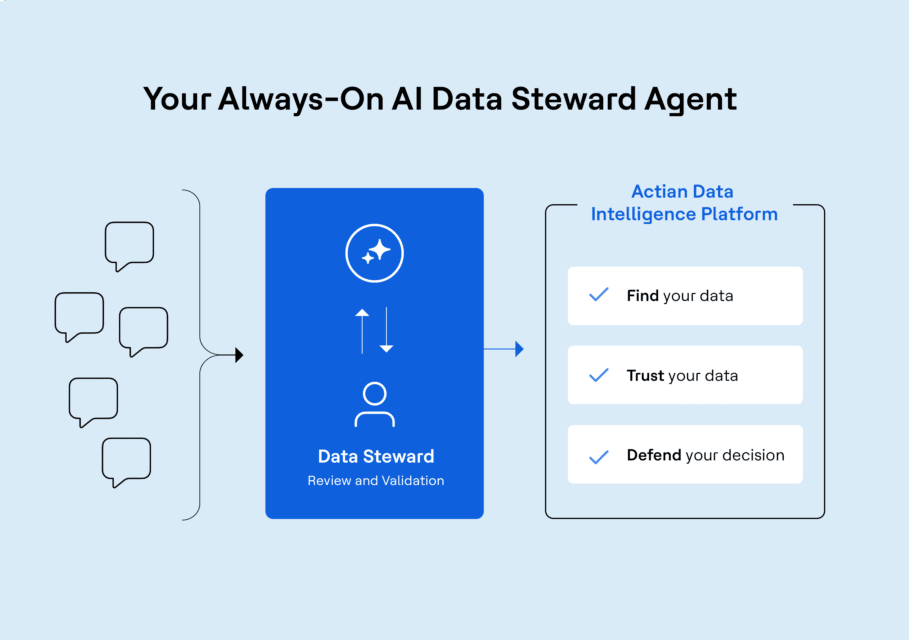
Le agent Data Steward gère les tâches courantes liées à la gestion des catalogues directement au sein de la plateforme Actian Data Intelligence. Il génère de la documentation, attribue une propriété aux ressources orphelines, recommande des balises et des classifications, et signale les définitions incomplètes à l’aide du langage naturel. Les gestionnaires de données passent ainsi de l’exécution des tâches à leur vérification. Pour les équipes chargées de gérer des catalogues à l’échelle de l’entreprise, cela représente une toute autre mission.
Politiques relatives au cycle de vie des éléments : Seules les définitions approuvées sont mises à la disposition des utilisateurs et des agents. Les responsables des données définissent des étapes personnalisables (brouillon, révision, approuvé) et établissent des règles de visibilité à chaque étape dans Explorer, les API, MCP Server et les extensions de navigateur. Les utilisateurs ne voient que les définitions approuvées et fiables. Les contenus contestés restent à l’état de brouillon. Pour les entreprises soumises à une réglementation – parmi lesquelles Forvis Mazars, Natixis et Merck –, ce contrôle de la visibilité est la gouvernance qu’elles réclamaient.
Analyste en IA:Insight sans goulot d'étranglement
Les tableaux de bord sont très utiles pour répondre aux questions que vous saviez déjà poser. Ils ne vous signalent pas qu'un changement est intervenu avant que vous ne le remarquiez, et ils ne présentent pas cette information sous une forme synthétique à l'intention du dirigeant qui en a besoin à 8 h du matin.
Rapports transforment l'analyse conversationnelle en résultats structurés et réutilisables : récits, graphiques et tableaux reliés à des données en temps réel et contrôlées. Le résumé hebdomadaire du merchandising, le rapport sur la santé des clients, l'analyse du portefeuille : tous ces éléments sont générés directement par le workflow d'analyse workflow , sans avoir à être recréés manuellement par la suite.
Analyses programmées surveille en continu les données d’entreprise réglementées, évalue les changements en tenant compte du contexte et met en évidence les anomalies significatives ainsi que les changements opérationnels via Slack, Teams ou des synthèses destinées à la direction. La différence par rapport aux alertes basées sur des seuils : le jugement. AI Analyst détermine si un changement mérite réellement d’être signalé, et pas seulement s’il a dépassé une valeur prédéfinie. Les équipes BI n’ont plus à répondre à des demandes de surveillance récurrentes. Les dirigeants reçoivent une synthèse, et non un tableau de bord.
Il en résulte une approche plus opérationnelle de l'analyse, dans laquelle la surveillance, l'analyse et le reporting de direction se poursuivent automatiquement au lieu de repartir de zéro chaque semaine.
observabilité des données Actian: Une qualité que vous pouvez démontrer
Affirmer à une partie prenante données sont « propres » est très différent de lui présenter un enregistrement indiquant « conforme » ou « non conforme » enregistrement chaque règle, pour chaque élément, sur n'importe quelle période qu'elle choisit. Dans un cas, il s'agit d'une affirmation. Dans l'autre, d'une preuve.
La page de rapport DQ offre aux équipes chargées de la qualité des données une vue centralisée et filtrable des résultats au niveau des règles pour l'ensemble de leurs moniteurs personnalisés. Plus besoin de parcourir les ressources une par une ni d'attendre une exportation manuelle. Les résultats sont exportés vers S3, GCS, Azure Blob et au format CSV pour une utilisation en aval par les outils de BI.
Contrôles de qualité des données SQL Éliminez le principal obstacle à la migration en matière de qualité des données d’entreprise : la réécriture des règles existantes dans une syntaxe propriétaire. Le langage SQL ANSI standard fonctionne. La règle DBT que votre équipe a créée l’année dernière peut être transférée observabilité dans Actian Data observabilité , où elle s’exécute sous forme de requête « pushdown » requête le système source natif.jeu de données sont prises en charge, ce qui signifie que les contrôles de clés étrangères, l’intégrité référentielle et la logique métier multi-tables s’exécutent tous dans une seule requête.
Replay Scan gère les données arrivant en retard, un problème que la plupart des outils ignorent. Lorsque des enregistrements sont traités après la fermeture de la fenêtre d’analyse, les moniteurs standard ne les détectent pas. Replay Scan permet aux ingénieurs d’appliquer rétroactivement des moniteurs à jusqu’à 20 périodes d’analyse précédentes, sans qu’il soit nécessaire de repenser la conception du pipeline. Mettez à jour une règle, cliquez sur « Enregistrer et relancer », et consultez immédiatement les résultats par rapport aux données historiques. Les nouveaux moniteurs disposent également d’une base de référence pertinente dès le premier jour.
Base de données Actian VectorAI:Recherche vectorielle privéeà l'échelle de la production
Les entreprises détenant des données sensibles sont confrontées à un véritable dilemme avec la plupart des bases de données vectorielles : soit elles envoient leurs données vers un service cloud multi-locataires, soit elles acceptent que les solutions locales ne puissent pas évoluer.
La télémétrie basée sur Prometheus comble observabilité pour les équipes utilisant VectorAI DB sur site. Les administrateurs de bases de données (DBA) et les ingénieurs SRE bénéficient d’une visibilité en temps réel sur l’état du moteur, requête vectorielles, le comportement du cache et les temps d’attente d’E/S grâce aux workflows Prometheus et Grafana existants. Normes ouvertes, absence de pile de surveillance propriétaire, visibilité totale dans les environnements isolés où les données ne peuvent pas quitter le réseau.
Des tests de performance internes réalisés sur charge de travail de plus de 20 millions de vecteurs et de 768 dimensions charge de travail les excellentes performances de VectorAI DB sur un seul serveur, sans partitionnement ni évolutivité horizontale. Pour les entreprises qui exploitent des systèmes RAG à grande échelle sur des données sensibles, cela se traduit par une IA en production offrant performances, observabilité et déploiement dans un environnement privé.
Serveur MCP pour les bases de données Actian: Toutesles bases de données Actian sont compatibles avec les agents
Les entreprises qui ne parviennent pas à connecter leurs bases de données existantes à l'écosystème agentique verront leurs investissements dans l'IA en rester au stade de la démonstration.
Actian MCP Server 1.0 est désormais disponible pour Ingres, HCL Informix®, Zen, NoSQL et Analytics Engine. Il offre une requête en lecture seule, un schéma en tant que contexte via les définitions de tables et le DDL, une authentification conforme à OAuth, ainsi déploiement conteneurisé déploiement Docker Hub. Les agents IA se connectent à vos bases de données sans risque de modification accidentelle, sans nécessiter requête nouveaux requête et sans travail d'intégration personnalisé pour chaque système. Il fonctionne avec n’importe quel client compatible MCP, notamment Claude, Cursor, Copilot et les agents personnalisés.
Le caractère « lecture seule » de l’architecture de la version 1.0 est intentionnel. Les équipes peuvent ainsi tester des workflows de base de données assistés par l’IA sur des systèmes de production avant que les opérations d’écriture et la validation par l’humain ne soient intégrées dans la version 1.1. Les limites intégrées sur les ensembles de résultats empêchent les requêtes incontrôlées de saturer les fenêtres de contexte des agents, une mesure de sécurité essentielle lorsque l’on connecte pour la première fois une base de données en production à un agent autonome.
Toutes ces fonctionnalités seront disponibles à partir du 3 juin. Découvrez-les en direct lors d'un prochain événement Actian, ou contactez votre responsable de compte si vous êtes déjà client. Si vous découvrez Actian, le Centre de démonstration est le moyen le plus rapide de les découvrir en contexte.
Informix est une marque déposée d'IBM Corporation dans au moins une juridiction et est utilisée sous licence.

Restez connecté
Des informations tirées des données, à votre service.
(par exemple : sales@..., support)
