Many companies have accurate, up-to-date dashboards that almost never get opened. Gartner research finds that 80% of dashboards go unused after 90 days. Even the ones people keep coming back to tend to stop at the same point: they report the numbers but leave someone else to work out what’s behind them. That gap is what AI is now being asked to fill.
Can AI Replace Static Dashboards?
AI isn’t likely to replace dashboards entirely, because they’re still the fastest way to see how the business is performing at a glance. What AI changes is what happens after someone looks at one. Instead of digging through exports to explain a chart, people can ask what changed and get an answer they can act on, something a fixed set of charts was never designed to do.
The Real Gap: Dashboards Show What Happened, Not What to Do Next
Because dashboards are built around metrics someone defined in advance, they’re good at tracking known numbers but struggle with the question that comes next. If revenue drops in one region, the dashboard will show the dip. Finding out why usually means exporting data, building a new view, or filing a request with the data team, then waiting for a reply. Across every team, those requests pile up quickly: McKinsey research finds that data teams lose 60% of their time to repetitive requests like these.
You can usually tell when dashboards have reached this limit, because the same patterns start showing up:
- People ask before they act. They open a dashboard, then message an analyst to ask what a number means.
- Every question becomes a request. New questions turn into new dashboard builds instead of answers.
- The numbers don’t match. Two dashboards show different figures for the same metric.
- Decisions wait. Teams hold off until the next refresh or the next report.
In most of these cases, the dashboards themselves are working fine; the harder problem is getting from a number to a decision. As Mariana Hebborn, Global Head of HR AI and Data Governance, puts it, “Data earns its place when it changes a decision, not when it fills a dashboard.”
For more on where dashboards stop short, see why business intelligence dashboards can’t answer business questions.
Why Governance Decides Whether This Works
Whether AI’s answers can be trusted depends on the governance behind them. When AI queries raw tables directly, it has to guess what each metric means: which revenue figure to use, which date field matters, or what counts as an “active customer.” Ask the same question two different ways, and you may get two different numbers delivered with equal confidence. Actian CTO Emma McGrattan calls this “automated confusion” in her whitepaper, AI isn’t the Problem. Your Data Model Is.
A semantic layer prevents this by giving AI a shared set of business definitions to work from: your metrics, how they relate to each other, and the terms your teams use. Because those definitions are set once and applied every time, a question always returns one number that can be traced back to its source.
| Ungoverned AI (Queries Raw Data) | Governed AI (Uses a Semantic Layer) | |
| How metrics are defined | Guessed at query time | Defined once, in advance |
| Consistency | Answers shift with how the question is phrased | Same question, same answer |
| Traceability | No way to check how a number was produced | Joins, filters, and calculations are visible |
| Who can safely use it | Analysts who can spot a wrong answer | Business users across the company |
| What happens at scale | Wrong answers spread faster | Trusted answers reach more people |
Actian VP Ole Olesen-Bagneux sums up the tension: “probabilistic AI cannot replace the deterministic outputs.” Business reporting needs an identical calculation every time, which is exactly what a governed layer provides.
What Governed AI Looks Like Day to Day
With that layer in place, the way people work with data changes in four noticeable ways:
- Ask instead of dig. People ask questions in plain language and get answers built on agreed definitions.
- Spot changes early. Anomaly detection flags unusual movements before anyone goes looking for them.
- Get the right next step. Role-based views give a regional manager and a CFO the action that fits each job.
- Skip the wait. Answers draw on current data instead of the last scheduled refresh.
You can read more about why AI analytics needs a semantic layer.
Four Ways to Make AI Analytics Pay Off
Governed AI makes this possible, but getting value from it depends on how your teams work around it:
- Pair every metric with a next step. A number on its own still leaves people guessing, so attach a recommended action or a threshold alert to each insight AI surfaces.
- Let the semantic layer answer the “why.” Send routine follow-up questions to governed AI instead of the analyst queue, so analysts can focus on work that needs their judgment.
- Write business knowledge down where AI can use it. When definitions like “active customer” live in the semantic layer instead of one person’s head, they stay put when that person leaves.
- Measure outcomes, not views. The clearest sign AI analytics is working is how often an insight it surfaced led someone to act differently.
What You Need in Place Before Making the Switch
Before you move people from dashboards to AI, two things need to be ready: your data and infrastructure, and your privacy and security controls.
Data and Infrastructure
Because AI is only as reliable as the data it reads, this is the place to start:
- Clean, integrated data access. AI needs consistent access to the data it will query.
- Shared sources. AI should read from the same pipelines and warehouses your reports use, so both tell the same story.
- A maintained semantic layer. Definitions change as the business changes, so a layer that’s set up once and left alone will drift out of date.
Privacy and Security
When AI can query live data, people can ask for far more than any dashboard ever showed them, so access controls have to extend into the AI layer itself. Each person and each AI agent should see only the data and metrics they’re cleared to see.
For more on this, see how AI is changing data and analytics governance.
What Does This Actually Cost?
Replacing dashboards with AI isn’t a one-for-one tool swap, and two costs tend to catch teams off guard:
- Usage. AI costs usually grow with the number of questions people ask, so estimate demand before you roll out broadly rather than after the first bill arrives.
- Checking answers. McGrattan writes that “in many organizations, the cost of validating AI-generated answers now rivals, or even exceeds, the cost of generating them.” Governed answers reduce that cost, because people can see how each number was built.
The return tends to show up as a shorter backlog for the data team and faster time to answer, with less time passing between a question and a decision.
Is This Ready Now, or Still Maturing?
Most of what this article describes is ready to use today, provided it’s governed, with autonomous decision-making as the main exception:
| Capability | Where it Stands |
| Answering plain-language questions | Ready now, if governed |
| Monitoring and anomaly detection | Ready now |
| Recommending next steps | Ready now, with a person making the call |
| Acting on decisions without a human check | Still early |
Most teams are working in the first three rows today. Fully autonomous decisions sit further down the path and depend on the trust built in the earlier stages.
Where This Is Heading: From Visibility to Decision Intelligence
Decision intelligence describes using data and AI to recommend decisions, and eventually act on them, instead of only reporting on what happened. Business intelligence tells you how the business is performing; decision intelligence builds on that by suggesting what to do about it. Most organizations will move in that direction in stages:
- Today: AI explains changes and answers follow-up questions that dashboards can’t.
- Next: AI recommends the action directly, and a person approves it.
- Later: AI acts on agreed types of decisions on its own, once governance has earned that trust.
Each stage depends on the one before it, because no one hands decisions to an AI they can’t check.
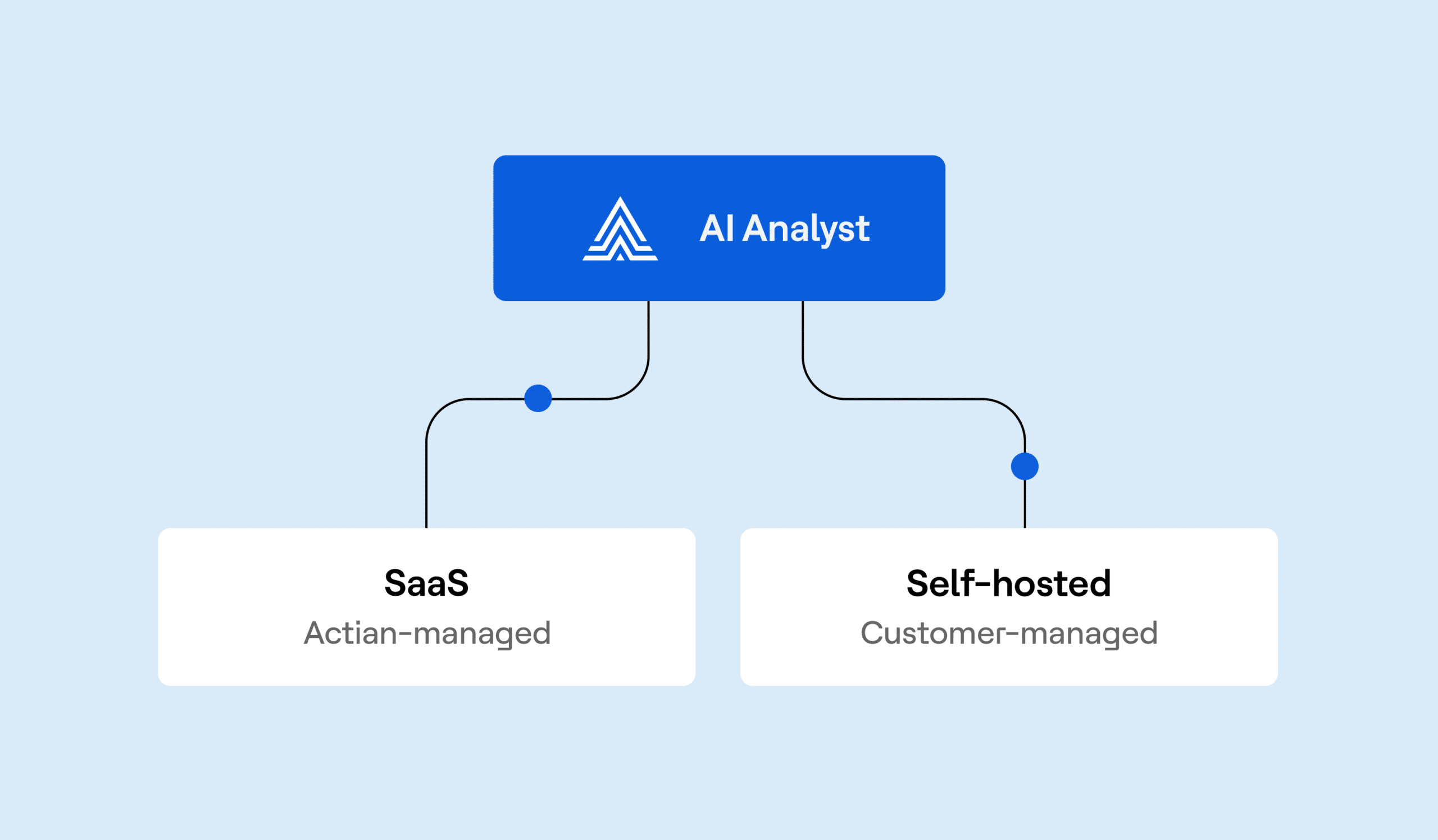
Actian AI Analyst is built on this approach, letting business users ask questions in plain language and get answers from a governed semantic layer that the Steward Agent builds and keeps up to date. Access is limited to approved models and metrics for people and AI agents alike, and each answer shows the joins, filters, and calculations that produced it. Across the wider data estate, the Actian Data Intelligence Platform provides end-to-end lineage and an audit trail of every access request, so teams can see where data came from and who has used it.
See How it Works: Start the Data Intelligence Platform Product Tour
FAQ
AI is unlikely to replace dashboards entirely, because they remain the fastest way to see how the business is performing at a glance. What AI changes is what happens after someone looks at one. Instead of exporting data to explain a chart, people can ask what changed and get an answer they can act on, which a fixed set of charts was never designed to do.
AI answers are only as trustworthy as the definitions behind them. When AI queries raw tables directly, it has to guess which revenue figure to use, which date field matters, or what counts as an “active customer,” so the same question asked two ways can return two different numbers. A semantic layer fixes this by giving AI one shared set of business definitions, set once and applied every time, so each answer can be traced back to its source.
You need two things: ready data and infrastructure, and security controls that reach into the AI layer. On the data side, that means clean, integrated access, the same pipelines and warehouses your reports use, and a semantic layer that is maintained as definitions change. On the security side, each person and each AI agent should see only the data and metrics they are cleared to see.
It is not a one-for-one tool swap, and two costs tend to catch teams off guard. Usage costs usually grow with the number of questions people ask, so estimate demand before a broad rollout. Validation is the other: in many organizations, checking AI-generated answers can cost as much as generating them. Governed answers reduce that cost because people can see how each number was built.
Most of it is ready today, provided it is governed. Answering plain-language questions is ready now if governed, and monitoring and anomaly detection are ready now. Recommending next steps is ready now with a person making the call. Acting on decisions without a human check is still early and depends on the trust built in the earlier stages.