
Your Governance Stack isn’t a Governance Platform. Here’s Why it Matters.


Key Takeaways
- Dashboards present insights, but data products provide the governed foundation behind those insights.
- A trusted data product includes ownership, definitions, quality standards, lineage, governance, and reuse.
- Conflicting dashboards usually point to deeper problems with the underlying data, not the visualization itself.
- Data products can support dashboards, applications, analytics, machine learning models, and AI agents from one trusted source.
- As AI adoption grows, organizations need reusable and governed data products rather than more disconnected dashboards.
Most organizations don’t deliberately build a fragmented governance architecture. It happens gradually. A catalog gets added to improve discovery. A lineage tool arrives after an audit. Observability comes later to solve quality issues. Data contracts appear as teams adopt data products. Individually, each purchase makes sense. Together, they create a governance stack that still struggles to enforce governance consistently.
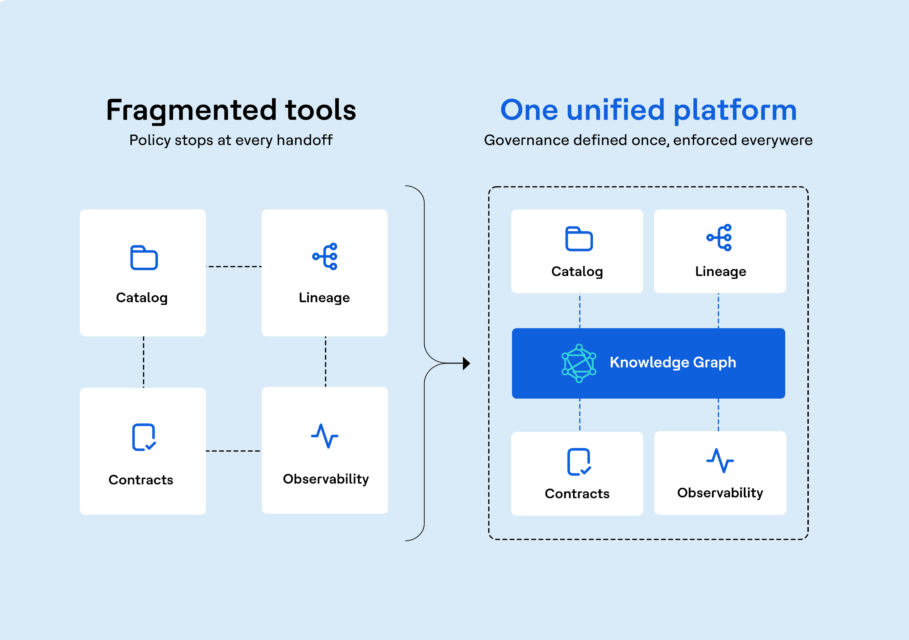
Tool sprawl isn’t the biggest problem. Even when fully assembled, the stack still can’t guarantee consistent governance. A policy defined in the catalog doesn’t automatically enforce itself in the pipeline. A quality rule your data team wrote doesn’t automatically become a trust signal your business users can see. Every handoff between tools is a place governance quietly stops happening.
BARC’s 2026 research puts data product adoption at 69% of organizations, up from 48% in 2024, with 93% of self-identified data leaders reporting operational use. Data contract adoption trails only slightly at 61%, and 41% of organizations with contracts deployed company-wide have already standardized on ODCS for interoperability. Most of your competitors are already partway there, whether they’ve formalized it or not.
Governance only works when policies are defined once and enforced everywhere. Every additional handoff makes that harder to achieve. The difference becomes clear when you look at how governance is defined, enforced, and operationalized across the data lifecycle.
One Unified Platform, Rather Than Several Products Wearing a Shared Logo
Actian Data Intelligence Platform was designed around a simple principle: governance should be defined once and enforced consistently across the entire data lifecycle. Every component, from contract authoring to observability, runs on a shared federated knowledge graph, allowing four distinct workspaces to remain integrated by design rather than through custom integrations or future roadmap promises.
Governance Starts With Defining Policy
Governance can’t be enforced consistently if policies only exist in documentation. We define policies, controls, and monitoring rules directly in the platform, while Item Lifecycle Policies move business definitions through structured draft, review, and approval workflows. The result is a repeatable governance process instead of a stream of emails and approval requests. Monitoring analytics and the Data Observability reports then provide continuous evidence that policies are being followed, giving leaders a clear view of compliance without scrambling to prepare for the next audit.
Defining policies is only half the job. Because metadata, governance, lineage, and quality share the same semantic foundation, policies remain consistent as data moves across systems. Governance delivers value only when policies are enforced consistently everywhere data moves. Actian’s federated knowledge graph and graph-based business glossary give every business term, dataset, and metric a single governed definition, ensuring “active customer” means the same thing in the dashboard your CFO reviews and the model your data science team trains. Smart lineage traces changes across domain boundaries before they reach production, exposing downstream impacts before they disrupt reports or business decisions.
Role-specific workspaces, including Explorer, Studio, Data Contract Builder, and Data Observability, allow data stewards, architects, analysts, and data consumers to work from the same governed foundation through interfaces designed for their responsibilities. The Data Steward Agent automatically routes access requests and stewardship tasks to the appropriate approvers while keeping people in control of every governance decision. SQL-based data quality rules are defined once and applied consistently across every pipeline they support, eliminating duplicated logic and preventing governance from drifting as systems evolve.
AI Grounded in Governed Context
AI has become a standard feature of governance platforms. Leading platforms distinguish themselves by grounding every recommendation in governed business context. Across the platform, AI and machine learning automate or accelerate tasks including:
| Capability | What it automates |
|---|---|
| Data Steward Agent | Classifies ungoverned assets, drafts definitions, flags terminology drift
Suggests business terms and relationships as new data lands |
| Agentic task routing | Routes access requests and approvals without a human triggering each step |
| Federated knowledge graph | Grounds every AI recommendation in real lineage and ownership, not a generic model guess |
| Active metadata synchronization | Detects source changes automatically and refreshes the catalog without a manual re-scan |
| ML-based anomaly detection | Flags quality and freshness drift in Data Observability before it reaches a report |
| Conversational Analytics | Answers natural-language questions against the governed semantic layer, not an ungoverned data copy |
Together, these capabilities reduce manual stewardship while keeping people responsible for governance decisions.
Connectivity at Governance Scale
Governance breaks down when only part of the data estate is visible. Native connectivity determines whether policies apply consistently across warehouses, lakehouses, operational systems, and BI platforms or stop at product boundaries.
75+ native connectors span on-premises, cloud, and hybrid sources, from operational systems and ETL pipelines upstream to BI tools, warehouses, and lakehouses downstream. Bidirectional integration with GRC platforms and other observability tooling means existing governance policies from security and compliance platforms can be reused rather than recreated.
Built for the People Doing the Actual Work, not Just the Architects
Governance only succeeds when every role participates. Data stewards, architects, engineers, analysts, and business users all work from the same governed semantic foundation, with role-specific interfaces tailored to their responsibilities. Whether someone is consuming data or designing the architecture behind it, everyone works from the same trusted source of truth while seeing only the context they need.
Where This Actually Shows up in a Week at Your Company
The value of unified governance becomes clear in everyday work. Consider four common scenarios:
- A data access request gets granted or denied instantly by attribute-based policy instead of a week-long approval chain.
- A business term gets certified through a visible lifecycle instead of surviving in one person’s head.
- A domain team publishes a data product with its contract, lineage, and quality signal already attached, live in the Enterprise Data Marketplace the moment it’s certified.
- An analyst asks a natural-language question and receives an answer grounded in certified business definitions rather than conflicting metrics from multiple dashboards.
Proven at Enterprise Scale
Lufthansa Cargo unified more than 100 data sources and delivered governed, self-service access to over 4,100 employees. Groupe BPCE, a globally systemic bank, connected 30 platforms natively, enabled self-service discovery for more than 1,000 weekly active users, and governed over 80,000 certified business terms, eliminating the third-party middleware required by its previous catalog while generating zero IT support tickets.
Why This Matters More as AI Enters the Picture
As organizations expand self-service analytics and AI, governance must scale without becoming fragmented. Every data consumer, whether human or AI, depends on policies that are defined once and enforced consistently across the enterprise.
Actian’s Data Intelligence Platform brings together Data Contract Builder, Item Lifecycle Policies, Smart Lineage, and Data Observability to define, enforce, and continuously monitor governance across the data lifecycle. A Data Steward Agent further automates routine tasks by classifying assets, routing approvals, and surfacing policy violations before they reach production. The result is consistent governance that scales across operational pipelines, analytics, and AI without adding administrative overhead.
When trust is built into the platform, business users spend less time validating numbers, engineers spend less time investigating downstream issues, and AI systems produce answers grounded in consistent business context. That’s how data products deliver their full value. Data products don’t simply make data easier to discover. They give organizations the confidence to use it for decisions at scale.
The Real Question to Ask Before Your Next Renewal
Not “does this vendor have a catalog, a contract tool, a lineage graph, and some AI.” Almost everyone does now. The next time you evaluate a governance platform, don’t count features. Ask whether governance is defined once and enforced everywhere. If every capability depends on integrations between separate products, governance will eventually drift. In one architecture, governance travels with the data. In the other, governance has to be recreated every time data crosses another tool boundary. Eventually, governance becomes something teams maintain manually instead of something the platform enforces automatically.
See the Data Intelligence Platform in action and judge which one you’re currently running.
See it in Action
Stay connected
Data insights delivered to you.
(i.e. sales@..., support@...)
