
What is a VPC and Why are More Enterprises Asking for One?


Key Takeaways
- A virtual private cloud gives organizations greater control over networking, access, security, and how applications communicate.
- Dedicated VPCs provide stronger infrastructure isolation for sensitive, regulated, and security-critical workloads.
- AI increases the number of systems accessing enterprise data, making network boundaries and infrastructure control more important.
- Metadata can reveal sensitive business information, so protecting it is an important part of enterprise data security.
- Dedicated VPCs support private networking, compliance, data residency, and secure connections to enterprise systems.
Cloud computing is built on a core idea: Instead of owning and maintaining all the infrastructure required to run applications and store data themselves, organizations can use computing resources when and where they need them. For many workloads, that model works extremely well.
What some organizations are discovering, however, is that this model can become more complicated when moving sensitive data to the cloud or expanding their use of AI. This is prompting some business leaders to ask an important question: “How much of our infrastructure do we really want to share?”
That question is driving greater interest in virtual private clouds (VPCs).
For some organizations, traditional shared cloud environments provide everything they need. Others want another layer of isolation and control, which is why they turn to a VPC.
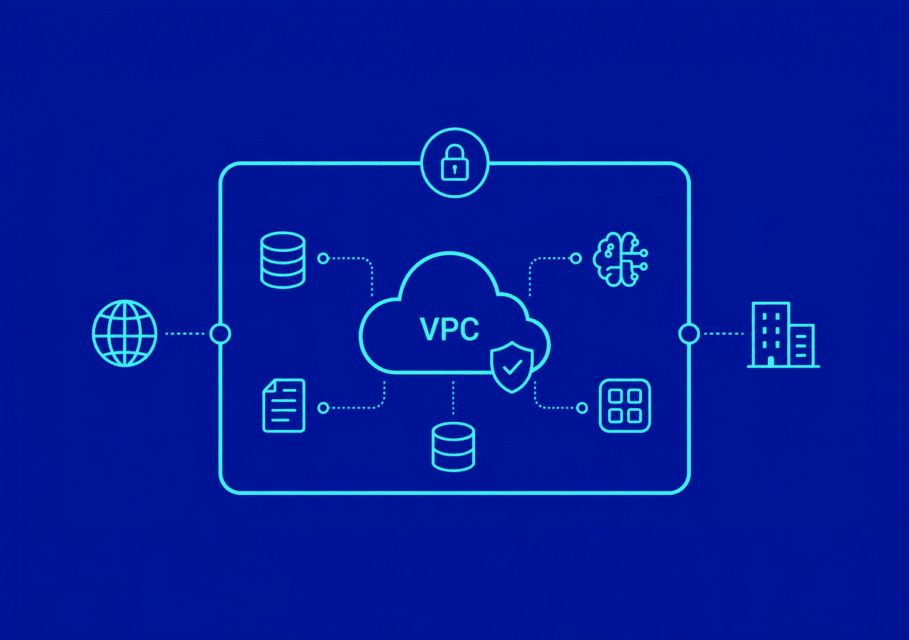
A VPC gives a business a private cloud environment where it has greater control over networking, access, security, and how applications communicate with other systems. It offers the same scalability and flexibility advantages as public clouds, along with greater infrastructure isolation.
How Cloud Approaches Differ
The key differences between public cloud and private cloud offerings are:
Standard Public Cloud. Public clouds like AWS, Azure, and Google Cloud Platform (GCP) host workloads alongside other customers on shared infrastructure that is logically isolated but physically shared. Think of it like a shared office building. Multiple tenants occupy the same building and share underlying infrastructure. Each company has its own office space, but shares elevators, HVAC systems, and building-level resources. The infrastructure is multi-tenant and physically shared.
VPC. A VPC adds a layer of separation. It’s like a company having its own secure floor within the building with private entrances and internal pathways. The organization controls its own networking, firewalls, and access policies within that floor. However, the building owner still manages the underlying infrastructure, and other organizations’ VPCs may exist within the same cloud environment.
Dedicated VPC. A dedicated VPC makes a company the sole tenant. It’s like owning the entire building. The organization controls everything: networking, firewalls, access policies, data residency controls, and compliance boundaries. The company benefits from cloud scalability and flexibility without sharing infrastructure with other customers.
What is a Virtual Private Cloud?
From a technical standpoint, a VPC is a logically isolated virtual network within a public cloud. Organizations can define elements such as private IP address ranges, routing rules, firewalls, network gateways, and access controls.
Companies can determine how resources inside the environment communicate with one another, the internet, on-premises systems, and other cloud services. Organizations benefit from cloud infrastructure without treating every workload like it has the same security, networking, and compliance requirements.
Why Shared Infrastructure isn’t Right for Every Workload
The two primary benefits of VPC are control and isolation. In a public-cloud or multi-tenant SaaS environment, organizations share underlying infrastructure with other customers. It doesn’t mean the data is inherently exposed. In fact, cloud platforms invest in security, and multi-tenant cloud services support some of the world’s largest companies.
The issue is that different organizations have different risk profiles. A highly regulated or security-focused enterprise may want tighter control over where sensitive data and metadata are stored, how they’re accessed, and what systems can connect to them.
For example, a retailer analyzing product information has different requirements than a hospital working with patient data. Similarly, a marketing department managing campaign data faces different risks than a financial firm handling customer account information.
AI adds another dimension because AI systems can significantly increase the ways enterprise data is accessed and used. For example, an AI assistant might access information from databases, data catalogs, documents, and metadata repositories to answer a question. That creates concerns such as accidental data exposure, overly broad permissions, sensitive information appearing in AI-generated responses, or data being sent to an external AI model.
The issue is that each new connection to the data is a boundary that needs governance. AI multiplies those connections and access patterns. A VPC provides the infrastructure control to manage this, such as clear network boundaries and visibility into what’s accessing sensitive information. The more access points an organization has, the more critical infrastructure isolation becomes.
Differences between approaches become especially important as organizations put more sensitive information in the cloud. A 2025 Thales Cloud Security Study found that 54% of cloud data was classified as sensitive, up from 47% in 2024. The same research noted that 55% of organizations consider cloud security more complex than on-premises infrastructure.
Even Metadata Can Contain Sensitive Information
Organizations often focus security conversations on the data itself, such as customer records, financial transactions, or intellectual property. It’s important to not overlook metadata, which can also reveal sensitive information.
Metadata is data that describes other data. A data intelligence platform, for example, may contain information about database schemas, table and column names, data lineage, business definitions, ownership, usage, classifications, and relationships among data products.
Picture a pharmaceutical company whose metadata includes table names associated with an unreleased drug, clinical trial locations, research projects, or acquisition targets. The underlying patient or research records might never leave the company’s environment, but the metadata could still reveal sensitive information about the business.
The same can happen with a bank. Metadata might identify tables associated with high-net-worth customers, fraud investigations, credit risk models, or regulatory reporting.
The takeaway is simple: Someone doesn’t need to see the underlying data to learn something important about an organization. As data catalogs, governance platforms, AI systems, and other applications use rich metadata, protecting that information becomes part of protecting the enterprise.
5 Benefits of a Dedicated VPC
Moving an application or workload into a VPC can provide several important advantages. They include:
- Stronger infrastructure isolation. Organizations can isolate workloads from other environments and establish clear security boundaries around sensitive applications and data.
- Private networking. Applications can communicate with databases, cloud resources, and enterprise systems through private network connections rather than exposing traffic to the public internet.
- Greater control. Security teams can establish their own network architecture, access rules, firewall policies, IP ranges, and connectivity requirements.
- Easier compliance. A clearly defined environment can make it easier to apply security controls consistently and demonstrate how sensitive information is protected.
- Support for security strategies. Organizations can align applications with their own networking, monitoring, and security requirements rather than adapting to requirements in a shared environment.
Who Needs a Dedicated VPC?
Any organization can choose a dedicated VPC, but the need is greatest when one or more of these apply:
- Sensitive or regulated data and metadata. Organizations handle patient records, financial transactions, intellectual property, or classified information, and the metadata describing that data is equally sensitive.
- Internal requirements for network isolation. Security or compliance policies mandate that critical systems remain isolated from shared infrastructure, regardless of cloud provider assurances.
- Restrictions on public-internet connectivity. Regulatory, policy, or security requirements prohibit certain workloads or data from moving across the public internet.
- Customer-controlled cloud and network policies. Organizations need to define and enforce their own network architecture, access rules, and security boundaries rather than adapting to a provider’s shared environment.
- Integration with private enterprise systems. The company requires secure, private connections between its cloud environment and on-premises infrastructure, databases, or legacy systems.
- Data-residency or governance requirements. Regulations, contracts, or internal policy dictate where data physically resides and who can access it. These are requirements that demand explicit control.
- AI applications accessing sensitive enterprise information. The organization is deploying AI agents or systems that need access to proprietary data, metadata, or knowledge repositories, expanding the number of systems touching sensitive information.
Infrastructure is Becoming Part of the Data Trust Conversation
Trusting enterprise data increasingly means trusting the environment around it. AI applications often require access to large amounts of enterprise data and metadata, expanding the number of systems interacting with sensitive information.
As a result, organizations aren’t only asking who can access their data. They’re asking where applications operate, how information moves between systems, what infrastructure they share, and how much control they maintain.
The stakes are also rising. IBM’s 2026 Cost of a Data Breach Report found that the global average breach now costs $4.99 million, while AI-enabled malicious breaches cost an average of $6 million.
A dedicated VPC gives organizations a way to address those concerns. It provides greater infrastructure isolation without giving up the advantages of the cloud.
For enterprises with sensitive data, stringent regulatory requirements, or strict security policies, an additional layer of control can become an important part of building a cloud environment they can trust. A VPC does not eliminate security risk, but it gives organizations additional control over the network boundaries and connectivity surrounding sensitive workloads.
Get more insights by subscribing to our blog.

Stay connected
Data insights delivered to you.
(i.e. sales@..., support@...)
