
What AI Data Analysts Can Do for Business Teams


Key Takeaways
- AI for business intelligence helps teams get answers faster without relying on dashboards, SQL, or constant analyst support.
- AI data analysts let business users ask follow-up questions naturally and explore data in the flow of work.
- The biggest benefits are faster answers, fewer BI bottlenecks, more consistent metrics, and more time for strategic data work.
- Trust is critical because inconsistent definitions or unclear calculations can undermine confidence in AI-generated insights.
- Actian AI Analyst combines conversational analytics with governed logic so teams can move from questions to trusted action faster.
Most data teams don’t have a data problem. They have a time problem.
You start the week with a plan. Maybe you’re finally going to clean up a messy model or fix something that’s been bothering you for months. There’s a sense, at least briefly, that you might get ahead.
Then the requests start coming in.
A quick number for a meeting. A breakdown someone needs before a call. A follow-up to something that came up in a dashboard. None of these are unreasonable, but together, they turn your job into a constant stream of interruptions.
And for the business? It’s just as frustrating. They need answers but getting them takes too long.
That gap between having data and actually being able to use it in the moment is exactly where AI for business intelligence is starting to change how teams operate.
What is AI for Business Intelligence?
AI for business intelligence uses natural language and automation to help teams ask questions, analyze data, and get answers without navigating dashboards or relying on SQL.
Instead of navigating tools built for analysts, business users can interact with data the same way they think about the business. They can ask a question, get an answer, and immediately follow up.
Why Traditional BI Breaks Down in Business Use
Dashboards were built to answer known questions. But most real work doesn’t happen that way.
You open a dashboard, see a number, and immediately want to go deeper:
- Why did this change?
- What’s driving it?
- Is this happening everywhere or just one segment?
Answering those follow-ups is where things slow down. It usually means opening another report, writing a new query, or asking someone on the data team. By the time you get clarity, the conversation has already moved on.
From the data team’s side, it’s the same pattern repeating:
- Ad-hoc requests keep piling up.
- Dashboards continue to grow.
- The backlog never really clears.
AI data analysts don’t replace BI. They fill the gap between dashboards and real decision-making.
What AI Data Analysts Actually Change for Business Teams
One of the biggest shifts is something you feel almost immediately: you stop being the middleman for every question.
If you work in analytics, you’ve likely become the default path to answers. You know where the data lives, how metrics are defined, and which numbers can actually be trusted. That makes you essential, but it also makes you a bottleneck. With an AI data analyst, that dynamic starts to shift. Business users can ask questions directly and get answers without waiting, and they can keep digging without restarting the process each time.
Just as important, the way teams interact with data becomes more natural.
Instead of being limited by dashboards, analysis starts to feel more like a conversation. A question leads to an answer, which leads to another question, and then another layer of detail. Teams can explore instead of just observing. That shift is subtle, but it changes how quickly teams move from insight to action.
Another key change is accessibility. Most business users don’t think in SQL or data models. They think in terms of revenue, customers, pipelines, and performance. Traditional tools force them to translate those ideas into something technical. AI for business intelligence removes that barrier. People can ask questions the way they already think, without needing to understand how the data is structured behind the scenes.
Where AI Data Analysts Make the Biggest Impact
When you look across teams, the impact tends to show up in a few consistent ways:
- Faster answers without waiting on BI: Business users can get what they need immediately instead of submitting requests and waiting in a queue
- Real exploration, not static reporting: Teams can ask follow-up questions and dig deeper without switching tools or rebuilding queries
- Consistent metrics across the organization: Shared definitions reduce conflicting numbers and debates over “which version is right”
- More time for data teams to focus on high-value work: Less time spent on repetitive requests means more time improving data quality and systems
- Decisions happen closer to the moment: Instead of waiting for validation, teams can act when the question comes up
Why Trust is the Deciding Factor
For all the promise of AI in analytics, there’s a reason many teams hesitate to fully adopt it. It comes down to trust.
A lot of tools can generate answers quickly. But if those answers are inconsistent, hard to explain, or don’t align with how the business actually defines its metrics, they create more problems than they solve.
Without a governed foundation:
- Metric definitions drift.
- Calculations vary by user.
- Data teams get pulled back into validation work.
At that point, you’re back where you started.
Where Actian AI Analyst Fits In
This is where Actian AI Analyst takes a different approach. Instead of prioritizing speed alone, it’s designed to deliver answers that are accurate, consistent, and aligned with how your business actually defines its data.
Actian AI Analyst operates as an AI data analyst on top of governed enterprise data, allowing business users to ask questions in plain language while ensuring every answer follows shared definitions and logic.
What that looks like in practice:
- Defined logic upfront, not guessed at runtime: Metrics, relationships, and business definitions are maintained in the semantic layer, so answers follow established business logic rather than relying on interpretation at runtime.
- Transparency into every answer: Users can see how results were calculated, including joins, filters, and logic.
- Consistency across teams and time: Answers follow the same governed definitions and business logic, regardless of who asks the question.
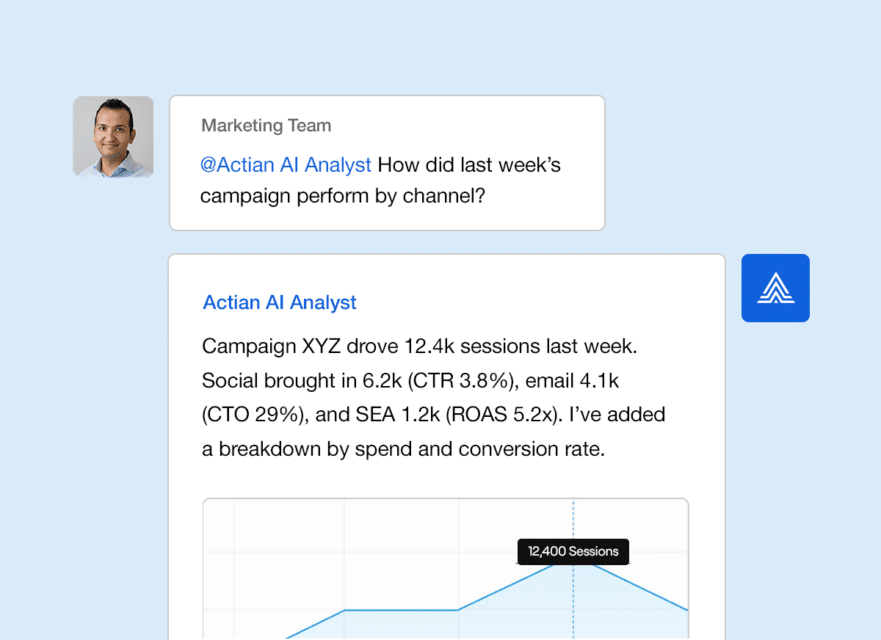
- Embedded into real workflows: Insights can be delivered directly in tools like Slack or Teams, so teams don’t have to leave their workflow to get answers.
The difference isn’t just usability. It’s confidence. If teams don’t trust the answer, they won’t use the tool. And if they don’t use the tool, nothing changes.
The Bigger Shift: From Access to Action
For years, business intelligence has been centered around access; access to dashboards, access to reports, and access to data. But access on its own doesn’t drive outcomes. What moves the business forward is how quickly a team can go from a question to a clear answer, and from that answer to a decision. That’s the shift AI data analysts enable. They close the gap between insight and action, making analytics something that happens naturally within the flow of work rather than something teams have to step away to find.
What This Means for Your Team
If you’re evaluating AI for business intelligence, this isn’t really about adding another tool to your stack. It’s about changing how your team works. Right now, most organizations still operate in a model where questions have to be routed, translated, and validated before anything can move forward. That slows down decisions, creates unnecessary dependency on data teams, and turns even simple questions into multi-step processes.
AI data analysts introduce a different way of working, one where business teams can explore data on their own, answers come back quickly enough to actually use, and data teams aren’t stuck answering the same questions over and over. When that shift happens, it’s noticeable. Conversations move faster, decisions are made with more confidence, and data starts to feel like something the business can actually use instead of something it has to wait on.
That’s ultimately what solutions like Actian AI Analyst are designed to support, not just faster answers, but answers teams can trust and act on in the moment. The real value of analytics isn’t in the dashboard. It’s in what your team is able to do next.
Ready to See it in Action?
Try Actian AI Analyst in your own environment and see how quickly your team can move from questions to trusted answers. Ask business questions in plain language, explore how governed metrics are applied behind the scenes, and validate every result with full visibility into joins, filters, and calculations.
Book a live demo to see how Actian AI Analyst works with your data and how you can scale analytics access across your organization without sacrificing accuracy or control.
Book Demo
Stay connected
Data insights delivered to you.
(i.e. sales@..., support@...)
