
Phi-4-Mini vs. Gemma 4 vs. Qwen3: Best LLM for Raspberry Pi 5


Summary
- Phi-4-Mini, Gemma 4, and Qwen3 each suit different edge AI workloads based on hardware, latency, and application needs.
- Gemma 4 is strongest for multimodal applications, while Phi-4-Mini prioritizes reasoning and code generation.
- Qwen3 stands out for production AI agents that need reliable tool calling and broad multilingual support.
- Hardware significantly affects performance, with Raspberry Pi favoring smaller models and Jetson enabling larger GPU-accelerated options.
- Model selection is only part of edge deployment; quantization and the retrieval architecture also determine overall performance.
Local AI has matured to the point where a Raspberry Pi 5 can run capable language models. Phi-4-Mini, Gemma 4, and Qwen3 vary across reasoning, tool calling, multimodal support, and hardware efficiency. Your choice depends on the hardware you plan to deploy, the latency you can tolerate, and the workloads your AI agent will handle.
This article is for platform engineers and AI engineers who deploy local LLMs on Raspberry Pi 5, Jetson Orin Nano, and similar memory-constrained devices. You will compare confirmed throughput, memory requirements, and hardware compatibility instead of relying on benchmark scores alone. If you plan to run models such as Gemma with a local vector database like Actian VectorAI DB on Raspberry Pi 5, understanding the tradeoffs between these models will help you choose a configuration that fits your hardware and workload.
In this article, you will compare these available models across the hardware tiers that matter for edge deployment.
Hardware Tiers
Before you compare models, establish which hardware tier you are targeting. The same model can deliver very different performance depending on available resources, such as memory, compute, and cooling. Every throughput figure in this article assumes a specific deployment class, so comparing numbers across different devices without that context can lead to the wrong model choice.
The Raspberry Pi 5 with 8 GB RAM represents the most constrained tier. All inference runs on the CPU, making memory pressure the primary limitation. Research done by Build Fast with AI shows that on a Raspberry Pi 5, Gemma 4 E2B delivers approximately 7.6 tok/s. At Q4_K_M quantization, Gemma 4 E4B runs at approximately 2 to 5 tok/s because it relies heavily on swap memory. Under the same conditions, Qwen2.5-3B reaches approximately 8.2 decode tok/s and Qwen3-4B reaches approximately 5 to 7 tok/s.
The Jetson Orin Nano moves into a different performance class. It ships with 8 GB of memory, 67 TOPS AI accelerator, and GPU-accelerated inference. Models that struggle on CPU-only hardware become much more responsive depending on model and quantization level. At the highest tier, edge servers and systems such as the Mac Mini M4 with 16 to 32 GB of unified memory provide enough headroom for larger context windows, higher precision quantization, and multiple concurrent inference workloads.
| Hardware tier | Memory | Approximate throughput at Q4_K_M |
| Raspberry Pi 5 | 8 GB | 2 to 8.2 tok/s (model dependent) |
| Jetson Orin Nano | 8 GB, 67 TOPS | Up to 25.5 tok/s (model dependent) |
| Edge server / Mac Mini M4 | 16 to 32 GB unified memory | Unverified |
Hardware tiers for local LLM deployment
Model Profiles
Gemma 4 E2B and E4B
Gemma 4 E2B and E4B use a dense architecture with Per-Layer Embeddings (PLE). Rather than adding more layers to the model, PLE gives each decoder layer its own small embedding for every token. The Mixture of Experts (MoE) model in the Gemma 4 family is the separate 26B variant.
Gemma 4 E2B has 2.3 billion effective parameters and 5.1 billion total parameters. E4B increases that to 4.5 billion effective parameters and 8 billion total parameters. Both models use the Apache 2.0 license and provide a 128K context window.
On Raspberry Pi 5, Gemma 4 E2B delivers approximately 7.6 tok/s, making it suitable for interactive CPU inference on an 8 GB system. Gemma 4 E4B also runs at approximately 2 to 5 tok/s because it depends heavily on swap memory. On Jetson Orin Nano with GPU acceleration, Gemma 4 E2B reaches approximately 25.5 tok/s, with 8k context window, making the larger model much more practical on GPU-equipped edge hardware. Gemma 4 E4B reaches approximately 11 to 14 tok/s.
Gemma 4 also supports native multimodal input. It accepts text, image, audio, and video inputs and supports native function calling through dedicated special tokens. These capabilities reduce the amount of orchestration required when you build multimodal edge AI applications.
Phi-4-Mini
Phi-4-Mini is a 3.8 billion parameter model released under the MIT license. It distinguishes itself through reasoning performance rather than multimodal capability or tool use. On standard reasoning benchmarks, it scores 88.6 percent on GSM8K and 83.7 percent on ARC-C.
Controlled testing on mobile devices (iPhone 14 Pro, Pixel 8, mid-range Android devices) shows Phi-4-Mini delivers approximately 15 to 20 percent higher throughput than Qwen3-4B. Phi-4-Mini also runs at approximately 5 to 8 tok/s on Raspberry Pi 5.
Another difference appears under sustained agent workloads. Phi-4-Mini produces cleaner chain-of-thought traces during multi-step reasoning, making it well suited to planning and reasoning tasks. However, its tool-calling accuracy trails Qwen3 out of the box, so workflows that rely heavily on structured function calls may require additional prompt tuning.
Qwen3 (4B variants)
Qwen3-4B variants target developers building production AI agents that rely on reliable tool integration. The models use the Apache 2.0 license and support more than 100 languages according to the official Qwen3-4B model card.
According to the available Raspberry Pi 5 benchmark, Qwen3-4B delivers approximately 5 to 7 tok/s on an 8 GB system using Q4 quantization. Qwen3 stands out for its out-of-the-box tool-calling accuracy. It requires less prompt engineering than Phi-4-Mini for workflows that invoke APIs, databases, or local services, making it a strong choice for AI agents that depend on structured function calls.
| Model | Active parameters | Raspberry Pi 5 (tok/s) | Jetson Orin Nano (tok/s) | License | Tool-calling accuracy | Multimodal support |
| Gemma 4 E2B | 2.3B effective (5.1B total) | ~7.6 | 25.5 (with 8k tokens) | Apache 2.0 | Native | Text, image, audio, video |
| Gemma 4 E4B | 4.5B effective (8B total) | ~2 to 5 | ~ 11 to 14 | Apache 2.0 | Native | Text, image, audio, video |
| Phi-4-Mini | 3.8B | ~ 5 to 8 | Unverified | MIT | Standard | Text only (Multimodal requires base Phi-4) |
| Qwen3-4B | 4B | ~5 to 7 | Unverified | Apache 2.0 | Highest accuracy | Text, image |
Model specifications, throughput, and capability by platform
Which Model for Which Situation
If you are deploying on a Raspberry Pi 5 with 8 GB RAM, choose your model conservatively. Memory is the limiting resource, and throughput determines whether your application feels interactive. Gemma 4 E2B is a practical choice at approximately 7.6 tok/s while giving you native multimodal input and function calling. Qwen3-4B delivers approximately 5 to 7 tok/s, but it offers the strongest out-of-the-box tool-calling accuracy and supports more than 100 languages. Gemma 4 E4B technically runs on this hardware, but its reliance on swap memory reduces throughput to approximately 2 to 5 tok/s, making it difficult to recommend for interactive workloads.
Jetson Orin Nano changes the trade-offs. GPU acceleration removes many of the memory and compute constraints that affect Raspberry Pi 5. Gemma 4 E4B becomes a practical option, reaching approximately 11 to 14 tok/s while retaining its native multimodal capabilities, function calling, and 128K context window. If your application depends on tool use, Qwen3 also remains a strong choice, although verified Jetson throughput figures are not yet available. Phi-4-Mini is a strong option for reasoning-intensive agents, but you should verify performance on your target hardware before committing to production.
On edge servers or systems such as the Mac Mini M4 with 16 to 32 GB of unified memory, model selection becomes workload-driven rather than hardware-driven. Choose Phi-4-Mini for reasoning and code generation, Gemma 4 E4B for multimodal AI applications, and Qwen3 when reliable tool calling and multilingual support are the highest priorities. At this hardware tier, there is no single winner because each model optimizes a different capability.
Quantization has as much impact on deployment as model selection. For most edge hardware, Q4_K_M provides the best balance between memory usage, throughput, and quality. It retains approximately 97 to 99 percent of FP16 quality while reducing memory requirements and improving inference speed. If your workload involves precision-sensitive reasoning or code generation and your hardware has sufficient memory, Q5_K_M or Q8_0 is usually worth experimenting.
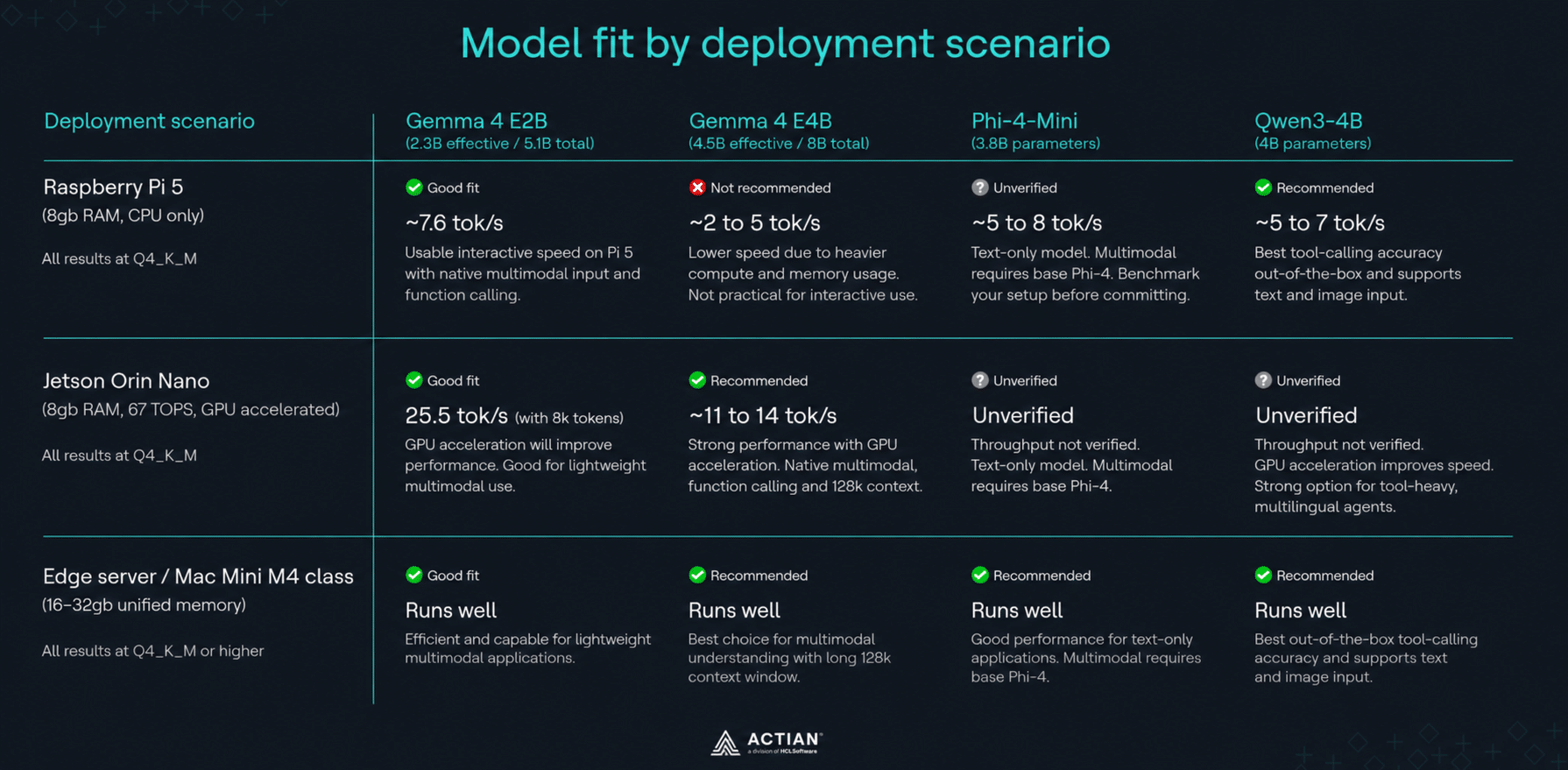
Model fit by deployment scenario
What the Comparison Leaves Out
Choosing the right model is only the first step in building an on-device AI agent. Once you have selected a model and quantization level that fit your hardware, the next decision is how your agent will retrieve and remember information. This is where the retrieval layer becomes just as important as the inference layer.
Retrieval-Augmented Generation (RAG) combines an inference model with a vector store that retrieves relevant information before generation. These are separate components with different resource requirements. A model that fits comfortably within your hardware budget can still perform poorly if the retrieval layer consumes too much memory or storage.
At this stage, you have three deployment options:
- In-memory retrieval. Embeddings remain in RAM, providing the lowest retrieval latency. However, all indexed data is lost when the application restarts.
- Filesystem-based embedded vector database. Embeddings are stored on disk, providing persistence without requiring a separate server. This option is well suited to resource-constrained edge devices.
- Dedicated local vector database. A local database manages production-scale indexing, filtering, and retrieval alongside the inference process. This approach supports larger datasets and more advanced retrieval workloads but requires additional system resources.
The right choice depends on the size of your knowledge base, your latency requirements, and the hardware resources available after model inference.
Wrapping Up
Phi-4-Mini, Gemma 4, and Qwen3 have each established a distinct role for edge AI deployments. Gemma 4 is the strongest choice when your application depends on native multimodal input and long context windows. Phi-4-Mini prioritizes reasoning quality and throughput for planning and code generation workloads. Qwen3 stands out for production AI agents that require reliable tool calling and broad multilingual support. Rather than looking for a single winner, match the model to your hardware, latency target, and workload.
Hardware matters just as much as model selection. A Raspberry Pi 5 with 8 GB RAM rewards smaller, efficiently quantized models, while Jetson Orin Nano makes larger models such as Gemma 4 E4B practical through GPU acceleration. On edge servers and systems with 16 to 32 GB of unified memory, your workload becomes the deciding factor instead of hardware constraints. In every case, the quantization level and the retrieval architecture shape how your application performs.
Get started with Actian VectorAI DB Community Edition today. Check the documentation and participate in the Discord community for support and discussions.
Frequently Asked Questions (FAQs)
Can I run all models on a Raspberry Pi 5 with 8 GB RAM?
Yes, but the experience varies significantly. Gemma 4 E2B runs at approximately 7.6 tok/s and is suitable for interactive use. Gemma 4 E4B also runs, but heavy swap usage reduces throughput to approximately 2 to 5 tok/s, making it slow for conversational workloads. Qwen3-4B reaches approximately 5 to 7 tok/s, which is workable for interactive use and comes with the strongest tool-calling accuracy of the three. Phi-4-Mini reaches approximately 5 to 8 tok/s.
What if I need both multilingual support and function calling?
Choose Qwen3. It provides the strongest out-of-the-box tool-calling accuracy and supports more than 100 languages. Gemma 4 includes native function calling but does not match Qwen3’s multilingual capabilities. Phi-4-Mini prioritizes reasoning over tool use.
Is Q4_K_M good enough for production?
For most edge deployments, yes. Q4_K_M retains approximately 97 to 99 percent of FP16 quality while reducing memory usage and increasing throughput by two to three times. Move to Q5_K_M or Q8_0 for precision-sensitive workloads such as code generation or complex reasoning when your hardware has sufficient memory.
Common Problems
Model exceeds available RAM at Q4
Choose a smaller model variant if quality is your priority. If you must keep the same model, use a more aggressive quantization level such as Q3_K_M, but expect a larger drop in reasoning quality.
Quantization artifacts in reasoning outputs
Use Q5_0 or Q8_0 for reasoning and code generation if memory allows. Q4_K_M is the better choice for general-purpose inference where throughput and memory efficiency matter more than maximum accuracy.
Tool calls are slow or malformed
Verify that your prompt follows the model’s expected tool-calling format. If reliability is critical, choose Qwen3, which provides the strongest out-of-the-box tool-calling performance among the three models.

Stay connected
Data insights delivered to you.
(i.e. sales@..., support@...)
