
Data Steward Agent: The Missing Layer Between AI and Context


Key Takeaways
- The main problem is that AI adoption is moving faster than the business context and governance processes needed to support it reliably.
- As metadata, ownership, definitions, and policies become outdated or inconsistent, both people and AI systems start working from incomplete or conflicting information.
- The Actian Data Steward Agent is presented as an AI-powered governance assistant that works continuously inside catalog workflows to keep metadata and semantic context aligned over time.
- Its role is not to replace human stewards, but to reduce manual stewardship work so teams can focus on higher-value governance tasks.
- The broader point is that AI readiness depends not just on models and tools, but on maintaining trusted semantic context, ownership, lineage, and governance across the data environment.
You’re moving fast to become more data-driven and AI-enabled. You’re rolling out conversational analytics, deploying AI agents, modernizing governance programs, and trying to make data easier to discover, trust, and activate across the business
You’re probably also running into a familiar problem: the business context supporting your AI isn’t keeping up with how fast your governance program and AI usage are expanding.
Metadata, dashboards, reports, and data products are likely spread across disconnected systems. Meanwhile, maintaining a trusted business context across your data environment probably still depends heavily on manual processes.
Outdated and manual workflows can cause data definitions to drift, ownership to become unclear, and metadata to go stale. Governance teams struggle to keep pace as your data ecosystem expands.
As a result, AI systems and business users end up working with incomplete or inconsistent information. That’s where the Actian Data Steward Agent comes into play.
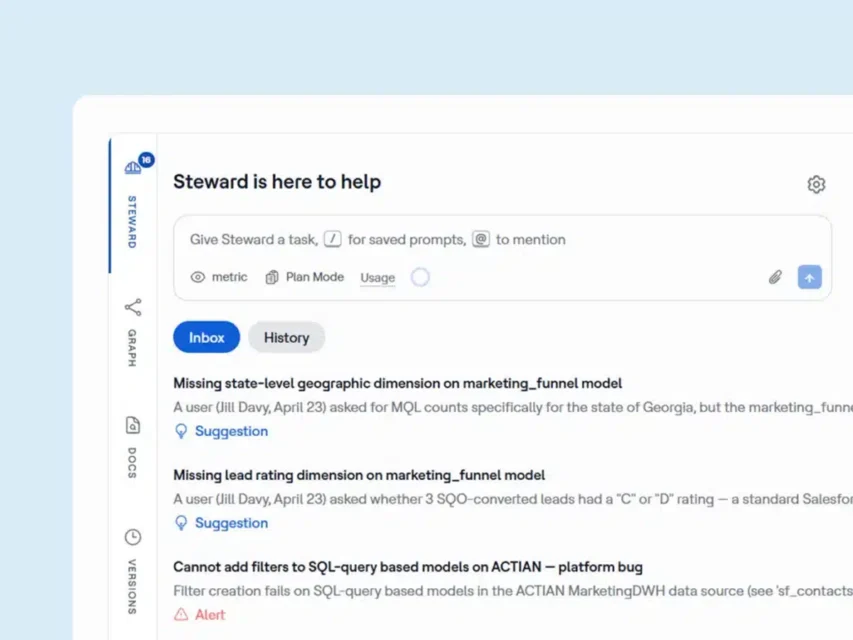
Data Steward Agent is embedded directly in data catalog workflows within the Actian Data Intelligence Platform, where it continuously updates metadata. It works in combination with Actian’s knowledge graph, lineage, and semantic layer to ensure that outputs remain consistent and align with data products and contracts, thereby enforcing structure and ownership.
Unlike traditional workflows that assist users with tasks, our agent continuously supports the operational work of data stewardship itself. It helps maintain trusted metadata, governance context, and semantic consistency without increasing manual overhead or requiring additional headcount.
Eliminating the Bottleneck in Modern Data Programs
Organizations often underestimate how much operational effort is required to maintain data context over time. The technical side of modern data catalogs is largely solved. They can automatically ingest metadata, scan systems, and map lineage across environments.
What slows you down is everything that happens after implementation:
- Defining business terms.
- Maintaining ownership.
- Updating governance policies.
- Keeping metadata current as systems evolve.
These tasks sound manageable in isolation. When you scale them across the enterprise, they quickly become overwhelming.
Every new data domain creates additional governance work. Every AI initiative increases the need for trusted business definitions and consistent context. Every system change introduces the risk of stale metadata and conflicting interpretations.
AI Increases the Need for Scalable and Reliable Context
AI models can generate answers quickly, but speed is not the same as trust. If metadata is incomplete, ownership is unclear, or business definitions vary across systems, AI can confidently deliver inaccurate or conflicting information.
For example, imagine deploying a conversational analytics assistant across finance and operations teams. One group defines “active customer” based on annual revenue. Another defines it based on transaction activity within 90 days. Both definitions exist somewhere in the organization, but neither is consistently governed.
Now your AI assistant starts returning different answers depending on which source it references. The problem is not the AI model itself. It’s the lack of trusted semantic context behind the data.
This challenge becomes even more important in multi-agent AI environments, where multiple copilots, assistants, and autonomous workflows may interact with the same data simultaneously.
Through support for Model Context Protocol (MCP) and emerging agent-to-agent (A2A) architectures, the Data Steward Agent helps ensure that AI systems reference the same trusted semantic context, definitions, lineage, ownership, and governance policies across workflows.
Whether the AI interaction occurs within the Actian Data Intelligence Platform or through external assistants and orchestration frameworks, the governance context remains aligned and operational. As you move toward implementing AI copilots, agentic workflows, and self-service analytics, maintaining consistent governance and context becomes critical. AI readiness increasingly depends on stewardship maturity, which is where the Data Steward Agent can help.
What is the Actian Data Steward Agent?
Our Data Steward Agent is an AI-powered governance assistant. Its role is not to replace your data stewards. Human oversight and governance decisions remain central to the process. Agent helps them scale and deliver more value, faster.
Instead of requiring governance teams to manually maintain every aspect of metadata management, the Agent continuously assists with repetitive stewardship tasks across the environment.
Unlike standalone AI assistants, the Agent operates continuously inside governance workflows instead of as a one-time documentation usage tool. This is important because metadata is never static. Systems evolve. Teams change. Data products expand. AI initiatives introduce new governance requirements.
Without continuous stewardship support, the semantic layer behind analytics and AI begins to degrade over time. The Data Steward Agent helps you maintain context more proactively so you can trust your AI outputs.
From Manual Stewardship to Operational Governance
Traditional governance programs often depend on periodic review cycles and manual coordination between business and technical teams. This creates delays.
For example:
- A healthcare organization onboarding a new analytics domain may spend weeks documenting datasets, validating ownership, and aligning terminology.
- A logistics company may discover that a critical dashboard relies on definitions that haven’t been reviewed in over a year because no one clearly owns the metadata.
- A retail organization deploying AI-driven inventory planning may struggle with inconsistent supplier and product classifications between different systems.
AI-powered stewardship changes the equation. Instead of manually chasing updates across thousands of assets, stewards can focus on higher-value work such as aligning governance policies, improving data quality standards, and collaborating with business domains.
Why Semantic Context Matters More Than Ever
Many organizations still think about governance in terms of compliance and control. In modern AI environments, governance increasingly becomes a usability issue.
Business users need to understand data quickly. AI systems need consistent semantic relationships. Analysts need confidence that definitions are aligned across domains.
Without trusted context, you’ll struggle to scale self-service analytics and AI adoption effectively. This is why semantic layers, knowledge graphs, lineage, governance rules, and data contracts are becoming increasingly important. Together, they help you establish shared meaning across distributed systems and teams.
The Data Steward Agent strengthens your data foundation by continuously maintaining and enriching the metadata and governance context that support your AI and analytics systems. The goal is not simply to collect metadata. It’s to create data environments that remain understandable, trusted, and operational now and over time.
See how the Actian Data Steward Agent helps you scale governance, strengthen semantic consistency, and build a more trusted foundation for AI.

Stay connected
Data insights delivered to you.
(i.e. sales@..., support@...)
