Blog | Data Governance | | 7 min read

From Silos to Self-Service: Data Governance in the AI Era

from silos to self-service data governance in the ai era

Summary

  • 60% of AI projects fail due to weak governance.
  • Shift to data products improves quality and scalability.
  • Federated governance balances autonomy and control.
  • Active metadata and automation enable real-time governance.
  • Actian helps embed governance into AI-driven workflows.

As enterprises double down on AI, many are discovering an uncomfortable truth: their biggest barrier isn’t technology. It’s their data governance model.

Gartner predicts that 60% of organizations will fall short of their goals because their governance frameworks can’t keep up.

Siloed data, ad hoc quality practices, and reactive compliance efforts create bottlenecks that stifle innovation and limit effective data governance. The future demands a different approach: data treated as a product, AI-enabled data governance embedded in data processes including self-service experiences, and decentralized teams empowered by active metadata and intelligent automation.

From Data Silos to Data Products: Why Change is Urgent

Traditional data governance frameworks were not designed for today’s reality. Enterprises operate across hundreds, sometimes thousands, of data sources: cloud warehouses, lakehouses, SaaS applications, on-premises systems, and AI models all coexist in sprawling ecosystems.

Without a modern approach to managing and governing data, silos proliferate. Governance becomes reactive—enforced after problems occur—rather than proactive. And AI initiatives stumble when teams are unable to find trusted, high-quality data at the speed the business demands.

Treating data as a product offers a way forward. Instead of managing data purely as a siloed, domain-specific asset, organizations shift toward delivering valuable and trustworthy data products to internal and external consumers. Each data product has an owner and clear expectations for quality, security, and compliance.

This approach connects governance directly to business outcomes. Organizations drive more accurate analytics, more precise AI models, and faster, more confident decision-making.

Enabling Domain-Driven Governance: Distributed, Not Fragmented

Achieving this future requires rethinking the traditional governance model. Centralized governance teams alone cannot keep pace with the volume, variety, and velocity of data creation. Likewise, fully decentralized models, where each domain sets its own standards without alignment, can’t keep pace either.

The solution is federated governance, a model in which responsibility is distributed to domain teams but coordinated through a shared framework of policies, standards, and controls.

In a federated model:

  • Domain teams own their data products, from documentation to quality assurance to access management.
  • Central governance bodies set enterprise-wide guardrails, monitor compliance, and enable collaboration across domains.
  • Data intelligence platforms serve as the connective tissue, providing visibility, automation, and context across the organization.

This balance of autonomy and alignment ensures that an organization’s AI-enabled data governance scales with the organization, without becoming a bottleneck to innovation.

The Rise of Active Metadata and Intelligent Automation

Active metadata is the fuel that powers modern governance. Unlike traditional data catalogs and metadata repositories that are often static and siloed, active metadata is dynamic, continuously updated, and operationalized into business processes.

By tapping into active metadata, organizations can:

  • Automatically capture lineage, quality metrics, and usage patterns across diverse systems.
  • Enforce data contracts between producers and consumers to ensure shared expectations.
  • Enable intelligent access controls based on data sensitivity, user role, and regulatory requirements.
  • Proactively detect anomalies, schema changes, and policy violations before they cause downstream issues.

When governance processes are fueled by real-time, automated metadata, they no longer slow the business down. They accelerate it.

Embedding Governance into Everyday Work

The ultimate goal of modern governance is to make high-quality data products easily discoverable, understandable, and usable, without requiring users to navigate bureaucratic hurdles.

This means embedding governance into self-service experiences with:

  • Enterprise data marketplaces where users browse, request, and access data products with clear SLAs and usage guidelines.
  • Business glossaries that standardize and enforce consistent data definitions across domains.
  • Interactive lineage visualizations that trace data from its source through each transformation stage in the pipeline.
  • Automated data access workflows that enforce granular security controls while maintaining compliance.

In this model, governance becomes an enabler, not an obstacle, to data-driven work.

Observability: Enabling Ongoing Trust

Data observability is a vital component of an AI data governance framework because it ensures the quality, integrity, and transparency of the data that powers AI models. By integrating data observability, organizations reduce AI failure rates, accelerate time-to-insight, and deliver reliable data to AI models.

Data observability improves data intelligence and helps to:

  • Ensure high-quality data is used for AI model training by continuously monitoring data pipelines and quickly detecting anomalies, errors, or bias before they impact AI outputs.
  • Provide transparency and traceability of data flows and transformations, which are essential for building trust, ensuring regulatory compliance, and demonstrating accountability in AI systems.
  • Reduce model bias by monitoring data patterns and lineage. Data observability helps identify and address potential biases in datasets and model outputs. This is key to ensuring AI systems are fair, ethical, and do not perpetuate discrimination.
  • Improve model explainability by making it easier to understand and explain AI model behavior, providing insights into the data that influences model predictions.

The Foundations of Data Observability: What to Include in an AI Data Governance Framework

How does data observability deliver key benefits? The foundation of a strong data observability framework typically includes these five core components:

1. Data Quality Monitoring

Continuous tracking of freshness, completeness, accuracy, and other quality dimensions, supported by automated rules and anomaly detection. This ensures issues are caught early.

2. Pipeline and Workflow Monitoring

Monitoring job performance, data volumes, schema changes, and pipeline failures provides early warning signals when transformations or dependencies break at any point in the data lifecycle.

3. Data Lineage and Metadata Management

End-to-end lineage paired with rich metadata gives essential context for understanding data flows, dependencies, and the root causes of issues.

4. Log and Event Monitoring

Centralized logs and event streams from data platforms and orchestration tools allow engineers to investigate operational anomalies and trace unexpected behavior.

5. Alerting and Incident Management

Actionable alerts, clear escalation paths, and integrated incident workflows ensure quicker recovery and continuous improvement across the data ecosystem.

Building for the Future: Adaptability is Key

The pace of technological change—especially in AI, machine learning, and data infrastructure—shows no signs of slowing. Regulatory environments are also evolving rapidly, from GDPR to CCPA to emerging AI-specific legislation.

To stay ahead, organizations must build governance frameworks with data intelligence tools that are flexible by design:

  • Flexible metamodeling capabilities to customize governance models as business needs evolve.
  • Open architectures that connect seamlessly across new and legacy systems.
  • Scalable automation to handle growing data volumes without growing headcount.
  • Cross-functional collaboration between governance, engineering, security, and business teams.

By building adaptability into the core of their governance strategy, enterprises can future-proof their investments and support innovation for years to come.

Actian Data Intelligence Platform Turns Governance into a Competitive Advantage

Data governance is no longer about meeting minimum compliance requirements. It’s about driving business value and building a data-driven culture. Organizations that treat data as a product, empower domains with ownership, and activate metadata across their ecosystems will set the pace for AI-driven innovation.

Those that rely on outdated, centralized models will struggle with slow decision-making, mounting risks, and declining trust. The future will be led by enterprises that embed governance into the fabric of how data is created, shared, and consumed, turning trusted data into a true business advantage.

Actian Data Intelligence Platform helps businesses transform the way they handle and automate data governance. Backed by federated knowledge graph technology, the platform allows businesses to democratize their data, trust that data’s accuracy, and activate data into usable products. To see how innovative data governance works, schedule a personalized demonstration today.


Blog | Data Management | | 8 min read

Data Owner vs. Data Steward: What’s the Difference?

data owner versus data steward

Summary

  • Clarifies the difference between a data owner (strategic accountability, governance, access control) and a data steward (day-to-day data quality, metadata, classification).
  • Explains how owners set policies and compliance rules while stewards operationalize and enforce them across datasets.
  • Highlights distinct focus areas:owners align data with business goals, stewards ensure accuracy, consistency, and usability.
  • Shows why both roles are essential to a strong data governance framework that supports trusted, reliable data use.
  • Positions clear role definitions as foundational to effective collaboration and overall data management success.

Companies rely on data to make strategic decisions, improve operations, and drive innovation. However, with the growing volume and complexity of data, managing and maintaining its integrity, accessibility, and security has become a major challenge.

This is where the roles of data owners and data stewards come into play. Both are essential in the realm of data governance, but their responsibilities, focus areas, and tasks differ. Understanding the distinction between data owner vs. data steward is crucial for developing a strong data governance framework.

This article explores the differences between data owners and data stewards. It explains the importance of both roles in effective data management and shares how Actian can help both data owners and data stewards collaborate and manage data governance more efficiently.

What is a Data Owner?

A data owner is the individual or team within an organization who is ultimately responsible for a specific set of data. The data owner is typically a senior leader, department head, or business unit leader who has the authority over data within their domain.

Data owners are accountable for the data’s security, compliance, and overall business value. They are responsible for ensuring that data is used appropriately, securely, and per organizational policies and regulations.

Key responsibilities of a data owner include:

  1. Accountability for Data Security: Data owners are responsible for ensuring that data is protected and secure. This includes managing access permissions, ensuring compliance with data protection regulations such as GDPR or HIPAA, and working with IT teams to prevent data breaches.
  2. Defining Data Usage: Data owners determine how their data should be used within the organization. They help define the policies and rules that govern how data is accessed and shared, ensuring that data serves business needs without exposing the organization to risk.
  3. Compliance and Regulatory Requirements: Data owners must ensure that their data complies with relevant regulations and industry standards. They oversee audits and ensure that proper documentation and controls are in place to meet compliance requirements.
  4. Data Strategy Alignment: Data owners work closely with organizational leadership to ensure that the data aligns with broader business strategies and goals. They ensure that data is properly utilized to drive business growth, innovation, and decision-making.
  5. Data Access Control: Data owners have the authority to define who can access their data. They set up permissions and manage user roles to ensure that only authorized individuals can access sensitive or critical data.

What is a Data Steward?

While the data owner holds the ultimate responsibility for the data, the data steward is the individual who takes a more operational role in managing, maintaining, and improving data quality. Data stewards typically handle the day-to-day management and governance of data, ensuring that it’s accurate, complete, and properly classified.

They act as the custodian of data within the organization, working closely with data owners and other stakeholders to ensure that data is used effectively across different teams and departments.

Key responsibilities of a data steward include:

  1. Data Quality Management: Data stewards play a critical role in maintaining data quality. They are responsible for ensuring that data is accurate, complete, consistent, and up to date. This involves implementing data validation rules, monitoring data integrity, and addressing data quality issues as they arise.
  2. Metadata Management: Data stewards manage the metadata associated with data. This includes defining data definitions, data types, and relationships between datasets and data assets. By organizing and maintaining metadata, data stewards ensure that data can be easily understood and accessed by anyone in the organization who needs it.
  3. Data Classification and Standardization: Data stewards are involved in classifying data, tagging it with relevant metadata, and establishing data standards. This helps ensure that data is consistent, well-organized, and easily searchable.
  4. Collaboration with Data Users: Data stewards often work closely with data users, such as analysts, data scientists, and business units, to understand their needs and provide them with the appropriate resources. They help ensure that data is accessible, usable, and meets the specific needs of different departments.
  5. Data Lineage and Documentation: Data stewards maintain records of data lineage, which track the flow and transformation of data from its source to its destination. This helps ensure traceability and transparency, allowing users to understand where data comes from and how it has been modified over time.

Data Owner vs. Data Steward: Key Differences

While both data owners and data stewards are essential to effective data governance, their roles differ in terms of focus, responsibilities, and authority. Below is a comparison of data owner vs. data steward roles to highlight their distinctions:

  Data Owner Data Steward
Primary Responsibility Overall accountability for data governance and security. Day-to-day management, quality, and integrity of data.
Focus Strategic alignment, compliance, data usage, and access control. Operational focus on data quality, metadata management, and classification.
Authority Holds decision-making power on how data is used and shared. Executes policies and guidelines set by data owners, ensures data quality.
Collaboration Works with senior leadership, IT, legal, and compliance teams. Works with data users, IT teams, and data owners to maintain data quality.
Scope Oversees entire datasets or data domains. Focuses on the practical management and stewardship of data within domains.

Why Both Roles are Essential in Data Governance

Data owners and data stewards play complementary roles in maintaining a strong data governance framework. The success of data governance depends on a clear division of responsibilities between these roles:

  • Data owners provide strategic direction, ensuring that data aligns with business goals, complies with regulations, and is properly secured.
  • Data stewards ensure that the data is usable, accurate, and accessible on a daily basis, helping to operationalize the governance policies set by the data owners.

Together, they create a balance between high-level oversight and hands-on data management. This ensures that data is not only protected and compliant but also accessible, accurate, and valuable for the organization.

How Actian Supports Data Owners and Data Stewards

Actian offers a powerful data governance platform designed to support both data owners and data stewards in managing their responsibilities effectively. It provides tools that empower both roles to maintain high-quality, compliant, and accessible data while streamlining collaboration between these key stakeholders.

Here are six ways the Actian Data Intelligence Platform supports data owners and data stewards:

1. Centralized Data Governance

The centralized platform enables data owners and data stewards to manage their responsibilities in one place. Data owners can set governance policies, define data access controls, and ensure compliance with relevant regulations. Meanwhile, data stewards can monitor data quality, manage metadata, and collaborate with data users to maintain the integrity of data.

2. Data Lineage and Traceability

Data stewards can use the platform to track data lineage, providing a visual representation of how data flows through the organization. This transparency helps data stewards understand where data originates, how it’s transformed, and where it’s used, which is essential for maintaining data quality and ensuring compliance. Data owners can also leverage this lineage information to assess risk and ensure that data usage complies with business policies.

3. Metadata Management

Metadata management capabilities embedded in the platform allow data stewards to organize, manage, and update metadata across datasets. This ensures that data is well-defined and easily accessible for users. Data owners can use metadata to establish data standards and governance policies, ensuring consistency across the organization.

4. Automated Data Quality Monitoring

Data stewards can use the Actian Data Intelligence Platform to automate data quality checks, ensuring that data is accurate, consistent, and complete. By automating data quality monitoring, the platform reduces the manual effort required from data stewards and ensures that data remains high-quality at all times. Data owners can rely on these automated checks to assess the overall health of their data governance efforts.

5. Collaboration Tools

The platform fosters collaboration between data owners, data stewards, and other stakeholders through user-friendly tools. Both data owners and stewards can share insights, discuss data-related issues, and work together to address data governance challenges. This collaboration ensures that data governance policies are effectively implemented and data is managed properly.

6. Compliance and Security

Data owners can leverage the platform to define access controls, monitor data usage, and ensure that data complies with industry regulations. Data stewards can use the platform to enforce these policies and maintain the security and integrity of data.

Data Owners and Stewards Can Tour the Platform to Experience Its Capabilities

Understanding the roles of data owner vs. data steward is crucial for establishing an effective data governance strategy. Data owners are responsible for the strategic oversight of data, ensuring its security, compliance, and alignment with business goals, while data stewards manage the day-to-day operations of data, focusing on its quality, metadata, and accessibility.

Actian supports both roles by providing a centralized platform for data governance, automated data quality monitoring, comprehensive metadata management, and collaborative tools. By enabling both data owners and data stewards to manage their responsibilities effectively, the platform helps organizations maintain high-quality, compliant, and accessible data, which is essential for making informed, data-driven decisions.

Tour the Actian Data Intelligence Platform or schedule a personalized demonstration of its capabilities today.


Blog | Data Governance | | 7 min read

Why Every Data-Driven Business Needs a Data Intelligence Platform

why every data-driven business needs a data intelligence platform

Summary

  • Data intelligence platforms help find, trust, and use data faster.
  • They unify metadata, lineage, catalogs, and governance.
  • Eliminate silos and accelerate AI and analytics initiatives.
  • Enable self-service access while maintaining compliance.
  • Drive data trust, literacy, and faster decision-making.

As data users can attest, success doesn’t come from having more data. It comes from having the right data. Yet for many organizations, finding this data can feel like trying to locate a specific book in a library without a catalog. You know the information is there, but without an organized way to locate it, you’re stuck guessing, hunting, or duplicating work. That’s where a data intelligence platform comes into play. This powerful but often underappreciated tool helps you organize, understand, and trust your data.

Whether you’re building AI applications, launching new analytics initiatives, or ensuring you meet compliance requirements, a well-implemented data intelligence platform can be the difference between success and frustration. That’s why they’ve become critical for modern businesses that want to ensure data products are easily searchable and available for all users. 

What is a Data Intelligence Platform?

At its core, a data intelligence platform offers a centralized inventory of your organization’s data assets. Think of it as a searchable index that helps data consumers—like analysts, data scientists, business users, and engineers—discover, understand, and trust the data they’re working with.

A data intelligence platform goes far beyond simple documentation and is more than a list of datasets. It’s an intelligent, dynamic system that organizes, indexes, and contextualizes your data assets across the enterprise. For innovative companies that rely on data to drive decisions, power AI initiatives, and deliver trusted business outcomes, it’s quickly becoming indispensable.

With a modern data intelligence platform, you benefit from:

  • Federated knowledge graph. Gain better search results—as simple as shopping on an online e-commerce site—along with visualization of data relationships, and enhanced data exploration
  • Robust metadata harvesting automation. See your entire data landscape, reduce manual documentation efforts, ensure current metadata, and power data discovery.
  • Graph-based business glossary. Drive GenAI and other use cases with high-quality business context, ensure consistent terminology across your organization, accelerate insights, and enable semantic search capabilities.
  • Smart data lineage. Have visibility into where data comes from, how it changes, and where it goes. Up-to-date lineage enhances compliance and governance while improving root cause analysis of data quality issues.
  • Unified data catalog and marketplace. Use Google-like search capabilities to locate and access data for intuitive user experiences, while ensuring governance with permission-controlled data products.
  • Ready-to-use data products and contracts. Accelerate data democratization, support governance without compromising agility, create contracts only when relevant data products exist, and support a shift-left approach to data quality and governance.
  • Comprehensive data quality and observability. Reduce data quality incidents, experience faster issue resolution and remediation​, increase your trust in data products​, and benefit from proactive quality management instead of firefighting issues.
  • AI + knowledge graph. Leverage the powerful combination to manage metadata, improve data discovery, and fuel agentic AI.

The result is a single source of truth that supports data discovery, fosters trust in data, and promotes governance without slowing innovation. Simply stated, a data intelligence platform connects people to trusted data. In today’s business environment when data volume, variety, and velocity are all exploding, that connection is critical.

5 Reasons Data Intelligence Platforms Matter More Than Ever

Traditional approaches to data management are quickly becoming obsolete because they cannot keep pace with fast-growing data volumes and new sources. You need a smart, fast way to make data available and usable—without losing control. Here’s how data intelligence platforms help:

  1. Eliminate data silos. One of the biggest challenges facing enterprises today is fragmentation. Data lives in multiple systems across cloud, on-premises, and hybrid environments. Without a data intelligence platform, it’s hard to know what data exists, let alone who owns it, how it’s being used, or whether it can be trusted.

A data intelligence platform creates a single view of all enterprise data assets. It breaks down silos and enables better collaboration between business and IT teams.

  1. Accelerate analytics and AI. When analysts or data scientists spend more time finding, cleaning, or validating data than using it, productivity and innovation suffer. A data intelligence platform not only reduces time-to-insights but improves the quality of those insights by ensuring users start with accurate, trusted, connected data.

For AI initiatives, the value is even greater. Models are only as good as the data they’re trained on. Data intelligence platforms make it easier to identify high-quality, AI-ready data and track its lineage to ensure transparency and compliance.

  1. Enable Governance Without Slowing Processes. Organizations must meet data privacy regulations like GDPR, HIPAA, and CCPA. A data intelligence platform can help teams understand where sensitive data resides, who has access to it, and how it flows across systems.

Unlike traditional governance methods, a data intelligence platform doesn’t create bottlenecks. It supports self-service access while enforcing data policies behind the scenes—balancing control and agility.

  1. Drive Trust and Data Literacy. One of the most underrated benefits of a data intelligence platform is cultural. By making data more transparent, accessible, and understandable, data intelligence platforms empower all users across your business, not just data specialists.

Data intelligence platforms often include business glossaries and definitions, helping users interpret data correctly and leverage it confidently. That’s a huge step toward building a data-literate organization.

  1. Empower Self-Service Analytics. A well-implemented data intelligence platform enables business users to search for and use data without waiting for IT or data teams to step in. This reduces delays and enables more people across the organization to make data-informed decisions. 

When users can confidently find and understand the data they need, they’re more likely to contribute to data-driven initiatives. This democratization of data boosts agility and fosters a culture of innovation where teams across departments can respond faster to market changes, customer needs, and operational challenges. A data intelligence platform turns data from a bottleneck into a catalyst for smarter, faster decisions.

Real-World Data Intelligence Platform Use Cases

Here are a few ways organizations are using data intelligence platforms:

  • A healthcare provider tracks patient data across systems and ensures compliance with health data privacy laws. Metadata tagging helps the compliance team identify where sensitive information lives and how it’s accessed.
  • A retail company accelerates analytics for marketing campaigns. Data analysts can quickly find the most up-to-date product, pricing, and customer data, without waiting for IT support.
  • A financial services firm relies on data lineage features in its data intelligence platform to trace the origin of critical reports. This audit trail helps the firm maintain regulatory compliance and improves internal confidence in reporting.
  • In manufacturing, engineers and analysts explore equipment data, maintenance logs, and quality metrics across systems to identify patterns that can reduce downtime and improve efficiency.

As more organizations embrace hybrid and multi-cloud architectures, data intelligence platforms are becoming part of an essential infrastructure for trusted, scalable data operations.

Optimize a Data Intelligence Platform

Implementing and fully leveraging a data intelligence platform isn’t just about buying the right technology. It requires the right strategy, governance, and user engagement. These tips can help you get started:

  • Define your goals and scope. Determine if you want to support self-service analytics, improve governance, prepare for AI initiatives, or undertake other use cases.
  • Start small, then scale. Focus on high-impact use cases first to build momentum and show value early, then scale your success.
  • Engage both business and technical users. A data intelligence platform is more than an IT tool and should be usable and provide value to business teams, too.
  • Automate metadata collection. Manual processes will not scale. Look for a data intelligence platform that can automatically keep metadata up to date.
  • Focus on data quality and observability. A platform is only as good as the data it manages. Integrate quality checks and data lineage tools to make sure users can trust what they find.

In a data-driven business, having data isn’t enough. You need to find it, trust it, and use it quickly and confidently. A modern data intelligence platform makes this possible.

Actian’s eBook “10 Traps to Avoid for a Successful Data Catalog Project” is a great resource to implement and fully optimize a modern solution. It provides practical guidance to help you avoid common pitfalls, like unclear ownership, low adoption rates for users, or underestimating data complexity, so your project delivers maximum value.

Get eBook
Blog | Data Observability | | 4 min read

Beyond Visibility: How Actian Data Observability Redefines the Standard

actian data observability trends

Summary

  • Actian Data Observability redefines the industry standard by providing 100% data coverage without the need for sampling.
  • A secured zero-copy architecture allows for deep metadata inspection without moving or duplicating original data.
  • The platform eliminates cost surges by decoupling observability workloads from production compute resources.
  • Native support for Open Table Formats like Apache Iceberg ensures seamless reliability across modern, hybrid data stacks.

In today’s data-driven world, ensuring data quality, reliability, and trust has become a mission-critical priority. But as enterprises scale, many observability tools fall short, introducing blind spots, spiking cloud costs, or compromising compliance.

Actian Data Observability changes the game.

This blog explores how Actian’s next-generation observability capabilities outperform our competitors, offering unmatched scalability, cost-efficiency, and precision for modern enterprises.

Why Data Observability Matters Now More Than Ever

Data observability enables organizations to:

  • Detect data issues before they impact dashboards or models.
  • Build trust in analytics, AI, and regulatory reporting.
  • Maintain pipeline SLAs in complex architectures.
  • Reduce operational risk, rework, and compliance exposure.

Yet most tools still trade off depth for speed or precision for price. Actian takes a fundamentally different approach, offering full coverage without compromise.

What Actian Data Observability Provides

Actian Data Observability delivers on four pillars of enterprise value:

1. Achieve Proactive Data Reliability

Actian shifts data teams from reactive firefighting to proactive assurance. Through continuous monitoring, intelligent anomaly detection, and automated diagnostics, the solution enables teams to catch and often resolve data issues before they reach downstream systems—driving data trust at every stage of the pipeline.

2. Gain Predictable Cloud Economics

Unlike tools that cause unpredictable cost spikes from repeated scans and data movement, Actian’s zero-copy, workload-isolated architecture ensures stable, efficient operation. Customers benefit from low total cost of ownership without compromising coverage or performance.

3. Boost Data Team Productivity and Efficiency

Actian empowers data engineers and architects to “shift left”—identifying issues early in the pipeline and automating tedious tasks like validation, reconciliation, and monitoring. This significantly frees up technical teams to focus on value-added activities, from schema evolution to data product development.

4. Scale Confidently With Architectural Freedom

Built for modern, composable data stacks, Actian Data Observability integrates seamlessly with cloud data warehouses, lakehouses, and open table formats. Its decoupled architecture scales effortlessly—handling thousands of data quality  checks in parallel without performance degradation. With native Apache Iceberg support, it’s purpose-built for next-gen data platforms.

Actian Data Observability: What Sets it Apart

Actian Data Observability stands apart from its competitors in several critical dimensions. Most notably, Actian is the only platform that guarantees 100% data coverage without sampling, whereas tools from other vendors often rely on partial or sampled datasets, increasing the risk of undetected data issues. Additional vendors, while offering tools strong in governance, do not focus on observability and lacks this capability entirely.

In terms of cost control, Actian Data Observability uniquely offers a “no cloud cost surge” guarantee. Its architecture ensures compute efficiency and predictable cloud billing, unlike some vendors which can trigger high scan fees and unpredictable cost overruns. Smaller vendors’ pricing models are still maturing and may not be transparent at scale.

Security and governance are also core strengths for Actian. Its secured zero-copy architecture enables checks to run in-place—eliminating the need for risky or costly data movement. In contrast, other vendors typically require data duplication or ingestion into their own environments. Others offer partial support here, but often with tradeoffs in performance or integration complexity.

When it comes to scaling AI/ML workloads for observability, Actian’s models are designed for high-efficiency enterprise use, requiring less infrastructure and tuning. Some other models, while powerful, can be compute-intensive. Others offer moderate scalability, and have limited native ML support in this context.

A standout differentiator is Actian’s native support for Apache Iceberg—a first among observability platforms. While others are beginning to explore Iceberg compatibility, Actian’s deep, optimized integration provides immediate value for organizations adopting or standardizing on Iceberg. Many other vendors currently offer no meaningful support here.

Finally, Actian Data Observability’s decoupled data quality engine enables checks to scale independently of production pipelines—preserving performance while ensuring robust coverage. This is a clear edge over some other solutions, who tightly couple checks with pipeline workflows.

Why Modern Observability Capabilities Matter

Most data observability tools were built for a different era—before Iceberg, before multi-cloud, and before ML-heavy data environments. As the stakes rise, the bar for observability must rise too.

Actian meets that bar. And then exceeds it.

With full data coverage, native modern format support, and intelligent scaling—all while minimizing risk and cost—Actian Data Observability is not just a tool. It’s the foundation for data trust at scale.

Final Thoughts

If you’re evaluating data observability tools and need:

  • Enterprise-grade scalability.
  • Modern format compatibility (Iceberg, Parquet, Delta).
  • ML-driven insights without resource drag.
  • Secure, in-place checks.
  • Budget-predictable deployment.

then Actian Data Observability deserves a serious look.

Learn more about how we can help you build trusted data pipelines—at scale, with confidence.


Blog | Data Intelligence | | 4 min read

Shedding Light on Dark Data With Actian Data Intelligence

data intelligence and dark data

Summary

  • Up to 80% of enterprise data is “dark” and unused.
  • Dark data increases risk, cost, and limits insights.
  • Siloed tools miss hidden, static, or misclassified data.
  • Actian unifies catalog + observability for full visibility.
  • Enables discovery, quality monitoring, and data activation.

In a world where data is the new oil, most enterprises still operate in the dark—literally. Estimates suggest that up to 80% of enterprise data remains “dark”: unused, unknown, or invisible to teams that need it most. Dark Data is the untapped information collected through routine business activities but left unanalyzed—think unused log files, untagged cloud storage, redundant CRM fields, or siloed operational records.

Understanding and managing this type of data isn’t just a matter of hygiene—it’s a competitive imperative. Dark Data obscures insights, introduces compliance risk, and inflates storage costs. Worse, it erodes trust in enterprise data, making transformation efforts slower and costlier.

That’s where the Actian Data Intelligence Platform stands apart. While many solutions focus narrowly on metadata governance or data quality alone, Actian’s integrated approach is engineered to help you surface, understand, and operationalize your hidden data assets with precision and speed.

What Makes Dark Data so Difficult to Find?

Traditional data catalogs offer discovery—but only for data already known or documented. Data observability tools track quality—but typically only for data actively moving through pipelines. This leaves a blind spot: static, historical, or misclassified data, often untouched by either tool.

That’s the problem with relying on siloed solutions offered by other vendors. These platforms may excel at metadata management but often lack deep integration with real-time anomaly detection, making them blind to decaying or rogue data sources. Similarly, standalone observability tools identify schema drifts and freshness issues but don’t reveal the context or lineage needed to re-integrate that data.

The Actian Advantage: Unified Catalog + Observability

Actian Data Intelligence Platform closes this gap. By combining metadata management and data observability, the  platform, when combined with Actian Data Observability, offers a dual-lens approach:

  • Discover Beyond the Known: Actian goes beyond surface-level metadata, crawling and indexing both structured and semi-structured data assets—regardless of their popularity or usage frequency.
  • Assess Quality in Real-Time: Actian ensures that every discovered asset isn’t just visible—it’s trustworthy. AI/ML-driven anomaly detection, schema change alerts, and data drift analysis provide full transparency.
  • Drive Business Context: The Actian Data Intelligence Platform connects data to business terms, ownership, and lineage—empowering informed decisions about what to govern, retire, or monetize.

Compared to the Market: Why Actian is Different

Most platforms only solve part of the Dark Data challenge. Here are five ways the Actian Data Intelligence Platform stands apart:

Comprehensive Metadata Discovery:

  • Other Solutions: Offer strong metadata capture, but often require heavy configuration and manual onboarding. They might also focus purely on observability, with no discovery of new or undocumented assets.
  • Actian: Automatically scans and catalogs all known and previously hidden assets—structured or semi-structured—without relying on prior documentation.

Real-Time Data Quality Monitoring:

  • Other Solutions: Little to no active data quality assessment or reliance on external tools. They provide robust data quality and anomaly detection, but without metadata context.
  • Actian: Integrates observability directly into the platform—flagging anomalies, schema drifts, and trust issues as they happen.

Dark Data Discovery:

  • Other Solutions: May uncover some dark data through manual exploration or lineage tracking, but lack automation. Or, they may not address dark or dormant data at all.
  • Actian: Actively surfaces hidden, forgotten, or misclassified data assets—automatically and with rich context.

Unified and Integrated Platform:

  • Other Solutions: Often a patchwork of modular tools or loosely integrated partners.
  • Actian: Offers a cohesive, natively integrated platform combining cataloging and observability in one seamless experience.

Rich Business Context and Lineage:

  • Other Solutions: Provide lineage and business glossaries, but often complex for end-users to adopt.
  • Actian: Automatically maps data to business terms, ownership, and downstream usage—empowering both technical and business users.

Lighting the Path Forward

Dark Data is more than a nuisance—it’s a barrier to agility, trust, and innovation. As enterprises strive for data-driven cultures, tools that only address part of the problem are no longer enough.

Actian Data Intelligence Platform, containing both metadata management and data observability, provides a compelling and complete solution to discover, assess, and activate data across your environment—even the data you didn’t know you had. Don’t just manage your data—illuminate it.

Find out more about Actian’s data observability capabilities.


Summary

  • Data quality focuses on the state of data at a specific point, measuring accuracy, completeness, and consistency.
  • Data observability complements quality by providing a real-time, end-to-end view of the entire data pipeline.
  • While quality tools detect known errors, observability identifies the root cause of unknown anomalies and system failures.
  • Combining both practices ensures that data is not only correct in isolation but also reliable throughout its journey.

As data becomes more central to decision-making, two priorities are taking precedence for data leaders: data quality and data observability. Each plays a distinct role in maintaining the reliability, accuracy, and compliance of enterprise data.

When used together, data quality and data observability tools provide a powerful foundation for delivering trustworthy data for AI and other use cases. With data systems experiencing rapidly growing data volumes, organizations are finding that this growth is leading to increased data complexity.

Data pipelines often span a wide range of sources, formats, systems, and applications. Without the right tools and frameworks in place, even small data issues can quickly escalate—leading to inaccurate reports, flawed models, and costly compliance violations.

Gartner notes that by 2026, 50% of enterprises implementing distributed data architectures will have adopted data observability tools to improve visibility over the state of the data landscape, up from less than 20% in 2024. Here’s how data quality and observability help organizations:

Build Trust and Have Confidence in Data Quality

Every business decision that stakeholders make hinges on the trustworthiness of their data. When data is inaccurate, incomplete, inconsistent, or outdated, that trust is broken. For example, incomplete data can negatively impact the patient experience in healthcare, or false positives in credit card transactions that incorrectly flag a purchase as fraudulent erode customer confidence and trust.

That’s why a well-designed data quality framework is foundational. It ensures data is usable, accurate, and aligned with business needs.

With strong data quality processes in place, teams can:

  • Identify and correct errors early in the pipeline.
  • Ensure data consistency across various systems.
  • Monitor critical dimensions such as completeness, accuracy, and freshness.
  • Align data with governance and compliance requirements.

Embedding quality checks throughout the data lifecycle allows teams and stakeholders to make decisions with confidence. That’s because they can trust the data behind every report, dashboard, and model. When organizations layer data observability into their quality framework, they gain real-time visibility into their data’s health, helping to detect and resolve issues before they impact decision-making.

Meet Current and Evolving Data Demands

Traditional data quality tools and manual processes often fall short when applied to large-scale data environments. Sampling methods or surface-level checks may catch obvious issues, but they frequently miss deeper anomalies—and rarely reveal the root cause.

As data environments grow in volume and complexity, the data quality architecture must scale with it. That means:

  • Monitoring all data, not just samples.
  • Validating across diverse data types and formats.
  • Integrating checks into data processes and workflows.
  • Supporting open data formats.

Organizations need solutions that can handle quality checks across massive, distributed datasets. And these solutions cannot slow down production systems or cause cost inefficiencies. This is where a modern data observability solution delivers unparalleled value.

Comprehensive Data Observability as a Quality Monitor

To understand the powerful role of data observability, think of it as a real-time sensor layer across an organization’s data pipelines. It continuously monitors pipeline health, detects anomalies, and identifies root causes before issues move downstream. Unlike static quality checks, observability offers proactive, always-on insights into the state of the organization’s data.

A modern data observability solution, like Actian Data Observability, adds value to a data quality framework:

  • Automated anomaly detection. Identify issues in data quality, freshness, and custom business rules without manual intervention.
  • Root cause analysis. Understand where and why issues occurred, enabling faster resolution.
  • Continuous monitoring. Ensure pipeline integrity and prevent data errors from impacting users.
  • No sampling blind spots. Monitor 100% of the organization’s data, not just a subset.

Sampling methods may seem cost-effective, but they can allow critical blind spots in data. For instance, an anomaly that only affects 2% of records might be missed entirely by the data team, until it breaks an AI model or leads to unexpected customer churn.

By providing 100% data coverage for comprehensive and accurate observability, Actian Data Observability eliminates blind spots and the risks associated with sampled data.

Why Organizations Need Data Quality and Observability

Companies don’t have to choose between data quality and data observability—they work together. When combined, they enable:

  • Proactive prevention, not reactively fixing issues.
  • Faster issue resolution, with visibility across the data lifecycle.
  • Increased trust, through continuous validation and transparency.
  • AI-ready data by delivering clean, consistent data.
  • Enhanced efficiency by reducing time spent identifying errors.

An inability to effectively monitor data quality, lineage, and access patterns increases the risk of regulatory non-compliance. This can result in financial penalties, reputational damage from data errors, and potential security breaches. Regulatory requirements make data quality not just a business imperative, but a legal one.

Implementing robust data quality practices starts with embedding automated checks throughout the data lifecycle. Key tactics include data validation to ensure data meets expected formats and ranges, duplicate detection to eliminate redundancies, and consistency checks across systems.

Cross-validation techniques can help verify data accuracy by comparing multiple sources, while data profiling uncovers anomalies, missing values, and outliers. These steps not only improve reliability but also serve as the foundation for automated observability tools to monitor, alert, and maintain trust in enterprise data.

Without full visibility and active data monitoring, it’s easy for errors, including those involving sensitive data, to go undetected until major problems or violations occur. Implementing data quality practices that are supported by data observability helps organizations:

  • Continuously validate data against policy requirements.
  • Monitor access, freshness, and lineage.
  • Automate alerts for anomalies, policy violations, or missing data.
  • Reduce the risk of compliance breaches and audits.

By building quality and visibility into data governance processes, organizations can stay ahead of regulatory demands.

Actian Data Observability Helps Ensure Data Reliability

Actian Data Observability is built to support large, distributed data environments where reliability, scale, and performance are critical. It provides full visibility across complex pipelines spanning cloud data warehouses, data lakes, and streaming systems.

Using AI and machine learning, Actian Data Observability proactively monitors data quality, detects and resolves anomalies, and reconciles data discrepancies. It allows organizations to:

  • Automatically surface root causes.
  • Monitor data pipelines using all data—without sampling.
  • Integrate observability into current data workflows.
  • Avoid the cloud cost spikes common with other tools. 

Organizations that are serious about data quality need to think bigger than static quality checks or ad hoc dashboards. They need real-time observability to keep data accurate, compliant, and ready for the next use case.

Actian Data Observability delivers the capabilities needed to move from reactive problem-solving to proactive, confident data management. Find out how the solution offers observability for complex data architectures.


Blog | Data Observability | | 6 min read

Actian Data Observability: A Platform for the Future

Actian Data Observability

Summary

  • Actian Data Observability uses AI-powered anomaly detection to identify issues like schema drift and outliers in real-time.
  • The platform eliminates blind spots by providing 100% data coverage without the need for expensive data sampling.
  • A zero-copy architecture allows the system to access metadata without creating costly and redundant data duplicates.
  • It features a “no cloud cost surge” guarantee, ensuring predictable economics even as data volumes scale significantly.

Introducing Actian Data Observability: Quality Data, Reliable AI

Summary

This blog introduces Actian’s Data Observability platform—a proactive, AI-powered solution designed to ensure data reliability, reduce cloud costs, and support trustworthy AI by monitoring 100% of data pipelines in real-time.

  • Proactive AI-powered monitoring prevents data issues: ML-driven anomaly detection identifies schema drift, outliers, and freshness problems early in the pipeline—before they impact downstream systems. 
  • Predictable costs with full data coverage: Unlike sampling-based tools, Actian processes every data record on an isolated compute layer, delivering no-cost surge assurance and avoiding cloud bill spikes.
  • Flexible, open architecture for modern data stacks: Supports Apache Iceberg and integrates across data lakes, lakehouses, and warehouses without vendor lock-in or performance degradation on production systems.

The Real Cost of Reactive Data Quality

Gartner® estimates that “By 2026, 50% of enterprises implementing distributed data architectures will have adopted data observability tools to improve visibility over the state of the data landscape, up from less than 20% in 2024”. But data observability goes beyond monitoring—it’s a strategic enabler for building trust in data while controlling the rising data quality costs across the enterprise.

Today’s enterprise data stack is a patchwork of old and new technologies—complex, fragmented, and hard to manage. As data flows from ingestion to storage, transformation, and consumption, the risk of failure multiplies. Traditional methods can’t keep up anymore.

  • Data teams lose up to 40% of their time fighting fires instead of focusing on strategic value.
  • Cloud spend continues to surge, driven by inefficient and reactive approaches to data quality.
  • AI investments fall short when models are built on unreliable or incomplete data.
  • Compliance risks grow as organizations lack the visibility needed to trace and trust their data.

Today’s data quality approaches are stuck in the past:

1. The Legacy Problem

Traditional data quality methods have led to a perfect storm of inefficiency and blind spots. As data volumes scale, organizations struggle with manual rule creation, forcing engineers to build and maintain thousands of quality checks across fragmented systems. The result? A labor-intensive process that relies on selective sampling, leaving critical data quality issues undetected. At the same time, monitoring remains focused on infrastructure metrics—like CPU and memory—rather than the integrity of the data itself.

The result is fragmented visibility, where issues in one system can’t be connected to problems elsewhere—making root cause analysis nearly impossible. Data teams are stuck in a reactive loop, chasing downstream failures instead of preventing them at the source. This constant firefighting erodes productivity and, more critically, trust in the data that underpins key business decisions.

  • Manual, rule-based checks don’t scale—leaving most datasets unmonitored.
  • Sampling to cut costs introduces blind spots that put critical decisions at risk.
  • Monitoring infrastructure alone ignores what matters most: the data itself.
  • Disconnected monitoring tools prevent teams from seeing the full picture across pipelines.

2. The Hidden Budget Drain

The move to cloud data infrastructure was meant to optimize costs—but traditional observability approaches have delivered the opposite. As teams expand monitoring across their data stack, compute-intensive queries drive unpredictable cost spikes on production systems. With limited cost transparency, it’s nearly impossible to trace expenses or plan budgets effectively. As data scales, so do the costs—fast. Enterprises face a difficult choice: reduce monitoring and risk undetected issues, or maintain coverage and justify escalating cloud spend to finance leaders. This cost unpredictability is now a key barrier to adopting enterprise-grade data observability.

  • Inefficient processing drives excessive compute and storage costs.
  • Limited cost transparency makes optimization and budgeting a challenge.
  • Rising data volumes magnify costs, making scalability a growing concern.

3. The Architecture Bottleneck

Most data observability solutions create architectural handcuffs that severely limit an organization’s technical flexibility and scalability. These solutions are typically designed as tightly integrated components that become deeply embedded within specific cloud platforms or data technologies, forcing organizations into long-term vendor commitments and limiting future innovation options.

When quality checks are executed directly on production systems, they compete for critical resources with core business operations, often causing significant performance degradation during peak periods—precisely when reliability matters most. The architectural limitations force data teams to develop complex, custom engineering workarounds to maintain performance, creating technical debt and consuming valuable engineering resources. 

  • Tightly coupled solutions that lock you into specific platforms.
  • Performance degradation when running checks on production systems.
  • Inefficient resource utilization requiring custom engineering.

Actian Brings a Fresh Approach to Data Reliability

Actian Data Observability represents a fundamental shift from reactive firefighting to proactive data reliability. Here’s how we’re different:

actian data observability chart

1. Proactive, Not Reactive

Traditional Way: Discovering data quality issues after they’ve impacted business decisions.
Actian Way: AI-powered anomaly detection that catches issues early in the pipeline using ML-driven insights.

2. Predictable Cloud Economics

Traditional Way: Unpredictable cloud bills that surge with data volume.
Actian Way: No-cost-surge guarantee with efficient architecture that optimizes resource consumption.

3. Complete Coverage, No Sampling

Traditional Way: Sampling data to save costs, creating critical blind spots.
Actian Way: 100% data coverage without compromise through intelligent processing.

4. Architectural Freedom

Traditional Way: Vendor lock-in with limited integration options.
Actian Way: Open architecture with native Apache Iceberg support and seamless integration across modern data stacks.

Real-World Impact

Let’s take a brief look at how Actian’s Data Observability platform works in the day-to-day reality of a business or organization.

Use Case 1: Data Pipeline Efficiency With “Shift-Left”

Transform your data operations by catching issues at the source:

  • Implement comprehensive DQ checks at ingestion, transformation, and source stages.
  • Integrate with CI/CD workflows for data pipelines.
  • Reduce rework costs and accelerate time-to-value.

Use Case 2: GenAI Lifecycle Monitoring

Ensure your AI initiatives deliver business value:

  • Validate training data quality and RAG knowledge sources.
  • Monitor for hallucinations, bias, and performance drift.
  • Track model operational metrics in real-time.

Use Case 3: Safe Self-Service Analytics

Empower your organization with confident data exploration:

  • Embed real-time data health indicators in catalogs and BI tools.
  • Monitor dataset usage patterns proactively.
  • Build trust through transparency and validation.

The Actian Advantage: Five Differentiators That Matter

  1. No Data Sampling: 100% data coverage for comprehensive observability.
  2. No Cloud Cost Surge Guarantee: Predictable economics at scale.
  3. Secured Zero-Copy Architecture: Access metadata without costly data copies.
  4. Scalable AI Workloads: ML capabilities designed for enterprise scale.
  5. Native Apache Iceberg Support: Unparalleled observability for modern table formats.

Take Control of Your Data with Actian Data Observability

Take a product tour and better understand how to transform your data operations from reactive chaos to proactive control.


Blog | Data Governance | | 5 min read

The Governance Gap: Why 60% of AI Initiatives Fail

governance gap and why ai initiatives can fail

Summary

  • 60% of AI projects fail due to weak data governance.
  • Common issues: siloed teams, legacy tools, reactive strategies.
  • Modern approach uses federated, context-aware governance.
  • Data catalogs enable active metadata, lineage, and stewardship.
  • Improves trust, scalability, and AI business outcomes.

Summary

This blog presents a critical insight: without modern, proactive governance, a majority of AI initiatives will fail to deliver value. It explains what causes breakdowns and how federated, context-aware practices can close the “governance gap.”

  • Gartner projects that 60% of AI projects will miss their value targets by 2027 due to fragmented, reactive governance structures that don’t align with business objectives.
  • Common pitfalls include compliance-driven rollouts, siloed teams, and outdated tools, hindering scalability and strategic impact.
  • A modern solution involves federated data governance via active metadata, context-rich data catalogs, and “shift-left” stewardship at the source—empowering decentralized teams while ensuring oversight.

AI initiatives are surging, and so are the expectations. According to Gartner, nearly 8 in 10 corporate strategists see AI and analytics as critical to their success. Yet there’s a sharp disconnect: Gartner also predicts that by 2027, most organizations, 60%, will fail to realize the anticipated value of their AI use cases because of incohesive data governance frameworks.

What’s holding enterprises back isn’t intent or even IT investments. It’s ineffective data processes that impact quality and undermine trust. For too many organizations, data governance is reactive, fragmented, and disconnected from business priorities.

The solution isn’t more policies or manual controls. It’s modern technology, with a modern data catalog and data intelligence platform as the cornerstones. Modern catalogs can play a key role in data management and governance strategies.

Why Governance Efforts Fail

While many organizations strive toward and commit to better data governance, they often fall short of their goals. That’s because governance programs typically suffer from one of three common pitfalls:

  • They’re launched in response to compliance failures, not strategic goals.
  • They struggle to scale due to legacy tools and siloed teams.
  • They lack usable frameworks that empower data stewards and data users.

According to Gartner, the top challenges to establishing a data governance strategy include talent management (62%), establishing data management best practices (58%), and understanding third-party compliance (43%). With these issues at play, it’s no wonder that data governance remains more aspirational than operational.

Shifting this narrative requires organizations to embrace a modern approach to data governance. This approach entails decentralizing control to business domains, aligning governance with business use cases, and building trust and understanding of data among all users across the organization. That’s where a modern data catalog comes into play.

Going Beyond Traditional Data Catalogs

Traditional data catalogs can provide an inventory of data assets, but that only meets one business need. A modern data catalog goes much further by embedding data intelligence and adaptability into data governance, making it more beneficial and intuitive for users.

Here’s how:

Shift-Left Capabilities for Data Stewards

Moving data governance responsibility upstream can enable new benefits. This shift-left approach empowers data stewards at the source—where data is created and understood the best, supporting context-aware governance and decentralized data ownership.

With granular access controls, flexible metamodeling, and business glossaries, data stewards can apply governance policies when and where they make the most sense. The result? Policies that are more relevant, data that’s more reliable, and teams that gain data ownership and confidence, not friction or bottlenecks.

Federated Data Governance With Active Metadata

A modern data catalog supports federated governance by allowing teams to work within their own domains while maintaining shared standards. Through active metadata, data contracts, and data lineage visualization, organizations gain visibility and control of their data across distributed environments. 

Rather than enforcing a rigid, top-down approach to governance, a modern catalog uses real-time insights, shared definitions, and a contextual understanding of data assets to support governance. This helps mitigate compliance risk and promotes more responsible data usage.

Adaptive Metamodeling for Evolving Business Needs

 Governance frameworks must evolve as data ecosystems expand and regulations change. Smart data catalogs don’t force teams into a one-size-fits-all model. Instead, they enable custom approaches and metamodels that grow and adapt over time.

From supporting new data sources to aligning with emerging regulations, adaptability helps ensure governance keeps pace with the business, not the other way around. This also promotes governance across the organization, encouraging data users to see it as a benefit rather than a hurdle.

Support Effective Governance With the Right Tools

Adopting a modern data catalog isn’t just about using modern features. It’s also about providing good user experiences. That’s why for data governance to succeed, tools must integrate seamlessly and work intuitively for users at all skill levels.

This experience includes simplifying metadata collection and policy enforcement for IT and data stewards, and providing intuitive search and exploration capabilities that make data easy to find, understand, and trust for business users. For all groups of users, the learning curve should be short, encouraging data governance without being limited by complex processes.

By supporting all types of data producers and data consumers, a modern data catalog eliminates the silos that often stall governance programs. It becomes the connective tissue that aligns people, processes, and policies around a shared understanding of data.

Go From Data Governance Aspirations to Outcomes

Most organizations know that data governance is essential, yet few have the right tools and processes to fully operationalize it. By implementing a modern data catalog like the one from Actian, organizations can modernize their governance efforts, empower their teams, and deliver sustainable business value from their data assets.

Organizations need to ask themselves a fundamental question: “Can we trust our data?” With a modern data catalog and strong governance practices, the answer becomes a confident yes.

Find out how to ensure accessible and governed data for AI and other use cases by exploring our data intelligence platform with an interactive product tour or demo.


Summary

  • Data chaos from siloed systems slows analysis and reduces trust.
  • Data catalogs centralize discovery, lineage, and governance.
  • Knowledge graphs enable fast, contextual data search.
  • Built-in quality, compliance, and data products improve reliability.
  • Organizations gain faster insights, collaboration, and efficiency.

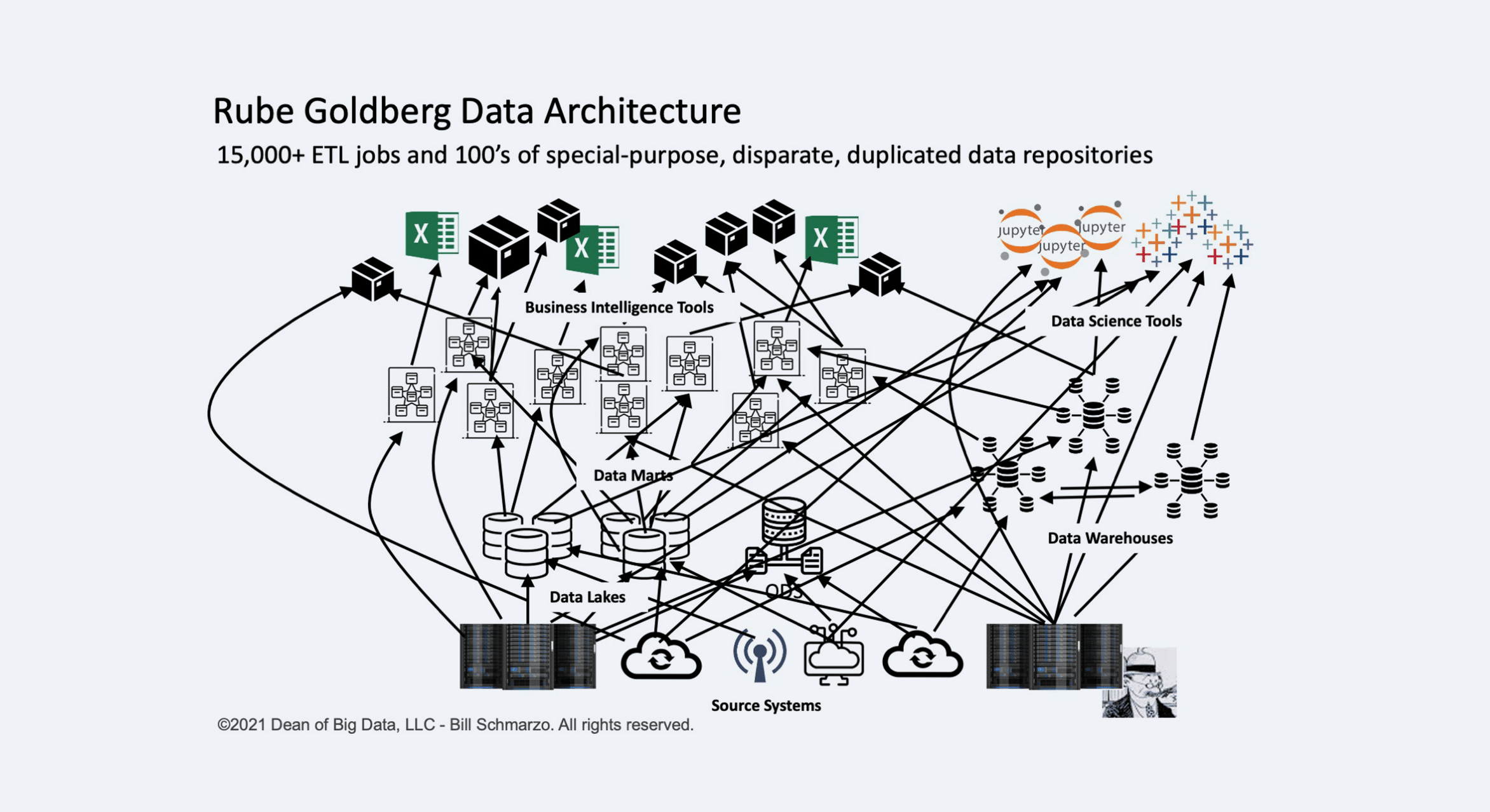
In the world of enterprise data management, there’s perhaps no image more viscerally recognizable to data professionals than the infamous “Rube Goldberg Data Architecture” diagram. With its tangled web of arrows connecting disparate systems, duplicate data repositories, and countless ETL jobs, it perfectly captures the reality many organizations face today: data chaos.

Life Before a Data Catalog

Imagine starting your Monday morning with an urgent request: “We need to understand how customer churn relates to support ticket resolution times.” Simple enough, right?

Without a data catalog or metadata management solution, your reality looks something like this:

The Dig

You start by asking colleagues which data sources might contain the information you need. Each person points you in a different direction. “Check the CRM system,” says one. “I think that’s in the marketing data lake,” says another. “No, we have a special warehouse for customer experience metrics,” chimes in a third.

The Chase

Hours are spent exploring various systems. You discover three different customer tables across separate data warehouses, each with slightly different definitions of what constitutes a “customer.” Which one is the source of truth? Nobody seems to know.

The Trust Crisis

After cobbling together data from multiple sources, you present your findings to stakeholders. Immediately, questions arise: “Are you sure this data is current?” “How do we know these calculations are consistent with the quarterly reports?” “Which department owns this metric?” Without clear lineage, business glossary or governance, confidence in your analysis plummets.

The Redundancy Trap

A week later, you discover a colleague in another department conducted almost identical analysis last month. Their results differ slightly from yours because they used a different data source. Both of you wasted time duplicating efforts, and now the organization has conflicting insights.

This scenario reflects what MIT Technology Review described in their article “Evolution of Intelligent Data Pipelines”: complex data environments with “thousands of data sources, feeding tens of thousands of ETL jobs.” The result is what Bill Schmarzo aptly illustrated – a Rube Goldberg machine of data processes that’s inefficient, unreliable, and ultimately undermines the strategic value of your data assets.

Enter the Data Catalog:

Now, let’s reimagine the same scenario with a data intelligence solution like Actian in place.

Knowledge Graph-Powered Discovery in Minutes, Not Days

That Monday morning request now begins with an intelligent search in your data catalog. Leveraging knowledge graph technology, the system understands semantic relationships between data assets and business concepts. Within moments, you’ve identified the authoritative customer data source and the precise metrics for support ticket resolution times. The search not only finds exact matches but understands related concepts, synonyms, and contextual meanings, surfacing relevant data you might not have known to look for.

Federated Catalogs With a Unified Business Glossary

Though data resides in multiple systems across your organization, the federated catalog presents a unified view. Every term has a clear definition in the business glossary, ensuring “customer” means the same thing across departments. This shared vocabulary eliminates confusion and creates a common language between technical and business teams, bridging the perennial gap between IT and business users.

Comprehensive Lineage and Context

Before running any analysis, you can trace the complete lineage of the data – seeing where it originated, what transformations occurred, and which business rules were applied. The catalog visually maps data flow across the entire enterprise architecture, from source systems through ETL processes to consumption endpoints. This end-to-end visibility provides critical context for your analysis and builds confidence in your results.

Integrated Data Quality and Observability

Quality metrics are embedded directly in the catalog, showing real-time scores for completeness, accuracy, consistency, and timeliness. Automated monitoring continuously validates data against quality rules, with historical trends visible alongside each asset. When anomalies are detected, the system alerts data stewards, while the lineage view helps quickly identify root causes of issues before they impact downstream analyses.

Data Products and Marketplace

You discover through the catalog that the marketing team has already created a data product addressing this exact need. In the data marketplace, you find ready-to-use analytics assets combining customer churn and support metrics, complete with documentation and trusted business logic. Each product includes clear data contracts defining the responsibilities of providers and consumers, service level agreements, and quality guarantees. Instead of building from scratch, you simply access these pre-built data products, allowing you to deliver insights immediately rather than starting another redundant analysis project.

Regulatory Compliance and Governance by Design

Questions about data ownership, privacy, and compliance are answered immediately. The catalog automatically flags sensitive data elements, shows which regulations apply (GDPR, CCPA, HIPAA, etc.), and verifies your authorization to access specific fields. Governance is built into the discovery process itself – the system only surfaces data you’re permitted to use and provides clear guidance on appropriate usage, ensuring compliance by design rather than as an afterthought.

Augmented Data Stewardship

The catalog shows that the customer support director is the data owner for support metrics, that the data passed its most recent quality checks, and that usage of these specific customer fields is compliant with privacy regulations. Approval workflows, access requests, and policy management are integrated directly into the platform, streamlining governance processes while maintaining robust controls.

Discovery in Minutes, Not Days

That Monday morning request now begins with a quick search in your data catalog. Within moments, you’ve identified the authoritative customer data source and the precise metrics for support ticket resolution times. The system shows you which tables contain this information, complete with detailed descriptions.

Tangible Benefits

The MIT Technology Review article highlights how modern approaches to data management have evolved to address exactly these challenges, enabling “faster data operations through both abstraction and automation.” With proper metadata management, organizations experience:

  • Reduced time-to-insight: Analysts spend less time searching for data and more time extracting value from it
  • Enhanced data governance: Clear ownership, lineage, and quality metrics build trust in data assets
  • Automated data quality monitoring: The system continually observes and monitors data against defined quality rules, alerting teams when anomalies or degradation occur
  • SLAs and expectations: Clear data contracts between producers and consumers establish shared expectations about the usage and reliability of data products
  • Improved collaboration: Teams build on each other’s work rather than duplicating efforts
  • Greater agility: The business can respond faster to changing conditions with reliable data access

From Rube Goldberg to Renaissance

The “Rube Goldberg Data Architecture” doesn’t have to be your reality. As data environments grow increasingly complex, data intelligence solutions like Actian become essential infrastructure for modern data teams.

By implementing a robust data catalog, organizations can transform the tangled web depicted in Schmarzo’s illustration into an orderly, efficient ecosystem where data stewards and consumers spend their time generating insights, not hunting for elusive datasets or questioning the reliability of their findings.

The competitive advantage for enterprises doesn’t just come from having data – it comes from knowing your data. A comprehensive data intelligence solution isn’t just an operational convenience; it’s the foundation for turning data chaos into clarity and converting information into impact.


This blog post was inspired by Bill Schmarzo’s “Rube Goldberg Data Architecture” diagram and insights from MIT Technology Review’s article “Evolution of Intelligent Data Pipelines.”


Blog | Data Governance | | 4 min read

Implementing Data Governance: A Step-by-Step Guide

data governance blog

Summary

  • Data governance ensures trusted, secure, and compliant data across the business.
  • Align strategy with business goals and define clear ownership roles.
  • Implement policies, classification, security, and access controls.
  • Enable collaboration while maintaining governance and compliance.
  • Use observability and training to monitor, enforce, and scale governance.

Data governance isn’t just about compliance—it’s about taking control over your data. For organizations managing fast-growing data ecosystems, governance determines whether data is trusted, usable, and secure across the business.

But too often, governance efforts stall. Siloed ownership, inconsistent policies, and a lack of visibility make it difficult to enforce organization-wide standards or scale. That’s why successful programs combine a clear strategy with tools that surface issues early, clarify responsibilities, and make governance part of day-to-day data operations, not an afterthought.

modern data and analytics governanceImage courtesy of Gartner


To make data governance sustainable and impactful, it must be aligned with business priorities and flexible enough to evolve with organizational needs. Too often, governance programs are implemented in isolation—rigid in design and disconnected from how data is actually used. That disconnect has real consequences: according to Gartner, by 2027, 60% of AI initiatives will fail to deliver expected outcomes due to fragmented governance frameworks.

A modern governance roadmap should emphasize tangible outcomes, continuous improvement, and adaptability. That means:

  • Establishing a clear and scalable governance structure.
  • Defining practical policies and standards that reflect real data usage.
  • Continuously measuring performance and adjusting where needed.
  • Fostering a culture of ongoing learning and iteration.

This step-by-step guide walks through a practical approach to data governance—from defining ownership and policies to enabling secure access and monitoring enforcement at scale.

Step 1: Define the Objectives of Data Governance

Before launching any tools or technologies, it’s essential to first define the key objectives of the organization’s data governance initiative. This will serve as the foundation for the overall strategy and ensure that all efforts align with the broader goals of the organization.

Key Considerations

  • Connect to all your data and overcome the challenge of data silos.
  • Work with trusted data that is high quality and compliant.
  • Ensure data security, privacy, and compliance.
  • Enable governed data sharing across teams.
  • Empower data consumers to easily discover and use the right data.

Step 2: Identify Data Stakeholders and Data Ownership

Next, identify the key stakeholders involved in the management and use of data within the organization. This typically includes data stewards, business users, IT teams, legal and compliance officers, and executives. Defining clear roles and responsibilities for data ownership ensures that accountability is distributed, and data governance policies are consistently enforced.

Step 3: Conduct a Data Inventory and Classification

Data inventory and data classification are crucial steps for identifying and managing an organization’s data assets. This involves cataloging all available data assets and sources, understanding where the data resides, and classifying it based on its sensitivity, value, and usage.

Step 4: Define Data Policies and Standards

After understanding an organization’s data landscape, decision makers need to define and implement policies and standards that govern data usage, security, and quality. These may include data access policies, data retention policies, and data security standards. Clear policies ensure that data is used responsibly and in compliance with applicable regulations throughout the organization.

Step 5: Implement Data Security and Privacy Controls

Data security and privacy are at the heart of any data governance initiative. Depending on the type of data being handled, organizations may need to implement encryption, access control, and monitoring measures to protect sensitive data. This includes ensuring compliance with relevant regulations such as GDPR or HIPAA, which govern personal and medical information.

Step 6: Enable Data Access and Collaboration

Data governance shouldn’t hinder the free flow of information within an organization. Instead, it should enable responsible access to data while maintaining security. It’s important to ensure that data can be easily accessed by authorized users and that collaboration between teams is facilitated.

Step 7: Monitor and Enforce Data Governance Policies

Data governance is an ongoing process that requires continuous monitoring and enforcement. Regular audits, reviews, and updates to governance policies are necessary to adapt to new business needs, technological changes, and evolving compliance requirements.

Step 8: Educate and Train Employees

A successful data governance strategy requires buy-in and participation from all levels of the organization. Employees need to understand the importance of data governance, their role in maintaining data quality, and the consequences of non-compliance.

Data Governance and Observability: Cornerstones to a More Robust Data Foundation

Data governance often breaks down where it matters most—in execution. Policies are defined, but not enforced. Ownership is assigned, but not followed through. And without visibility into how data flows and changes, issues go unnoticed until they create real damage.

That’s where enterprise-grade data observability adds power to your governance strategy. It gives teams real-time visibility into data quality, helps reconcile inconsistencies across systems, and makes it easier to monitor policy enforcement at scale. The result: a more automated, trusted, and scalable foundation for delivering AI-ready data across the business.


Summary

  • HIPAA ensures privacy and security of patient health data (PHI).
  • Applies to providers, insurers, vendors, and anyone handling PHI.
  • Violations include unauthorized access, poor safeguards, or breaches.
  • Penalties range from fines to criminal charges and reputational damage.
  • Strong governance, access controls, and audits ensure compliance. :contentReference[oaicite:0]{index=0}

Safeguarding patient data is more critical than ever as most patient data is now digitized. The Health Insurance Portability and Accountability Act (HIPAA) provides a comprehensive framework for protecting the privacy and security of health information.  

However, compliance with HIPAA is not just about following a set of rules; it’s about implementing robust healthcare data governance strategies to ensure that health information is managed, protected, and used responsibly. 

In this article, we’ll look at the types of organizations that are expected to comply with HIPAA regulations, the different ways HIPAA can be violated, the consequences for violating HIPAA, and the steps an organization can take to successfully implement HIPAA data governance. 

Who Needs to Follow HIPAA Guidelines?

HIPAA guidelines apply to a wide range of individuals, organizations, and businesses that handle Protected Health Information (PHI) in the United States. The following entities and individuals are required to follow HIPAA guidelines: 

  • Covered entities: Organizations or individuals who directly handle PHI are subject to HIPAA regulations, including healthcare providers, health insurance companies, health maintenance organizations, employer health plans, and healthcare clearinghouses. 
  • Business associates: Third-party vendors or contractors that work with covered entities and have access to PHI to perform services on their behalf are also subject to HIPAA regulations. These include data storage providers, IT and security vendors, billing and coding companies, and legal and accounting firms. 
  • Healthcare workers and employees: All employees, contractors, or anyone working for a covered entity or business associate who has access to PHI must adhere to HIPAA regulations. This includes doctors and nurses, administrative staff, medical researchers, and support staff.  
  • Individuals handling health information: Any individual who works with or has access to health data, even if not directly involved in providing healthcare, must follow HIPAA rules to protect patient information. This can include employees in various industries like law firms, insurance companies that handle medical information, and health technology.  
  • State and local governments: Government agencies that manage or use PHI in healthcare-related programs like Medicaid, public health services, etc., also need to comply with HIPAA regulations to protect health data. 
  • Healthcare apps and tech companies: As healthcare data is increasingly digitized, technology companies that develop or provide healthcare apps, patient portals, and telemedicine platforms may also be required to comply with HIPAA if they process or store PHI. 

What are HIPAA Violations?

HIPAA violations occur when an individual or organization fails to comply with the provisions set out by the Health Insurance Portability and Accountability Act (HIPAA). These violations can range from accidental breaches to intentional misconduct, and they typically involve the unauthorized access, disclosure, or mishandling of PHI. Violations can occur in various forms, whether due to negligence, poor security practices, or malicious intent.  

Types of HIPAA violations include: 

  • Unauthorized access to PHI. 
  • Failure to implement safeguards. 
  • Improper disposal of PHI. 
  • Failure to report data breaches. 
  • Unauthorized disclosure of PHI. 
  • Lack of Business Associate Agreements (BAAs). 
  • Failure to implement proper access controls. 

What are the HIPAA Violation Penalties?

Violating HIPAA can result in serious consequences, including civil and criminal penalties, civil lawsuits, and reputation damage. 

Civil Penalties

The U.S. Department of Health and Human Services (HHS) may impose fines for violations. These penalties can range from $100 to $50,000 per violation, depending on the severity of the breach and whether the violation was due to willful neglect.  

The total penalty can be as high as $1.5 million per year for violations of the same provision. 

Criminal Penalties

For more severe violations, such as knowingly acquiring or disclosing PHI without authorization, criminal penalties can be imposed, including fines and imprisonment: 

  • Up to $50,000 and up to 1 year in prison for offenses committed without malicious intent or for personal gain. 
  • Up to $100,000 and up to 5 years in prison for offenses committed under false pretenses. 
  • Up to $250,000 and up to 10 years in prison for offenses committed with the intent to sell or distribute PHI.  

Civil Lawsuits

In some cases, patients whose PHI has been improperly disclosed may file civil lawsuits against the violator. 

Reputation Damage

A HIPAA violation can cause significant damage to an organization’s reputation. Public disclosure of a breach can lead to a loss of trust among patients and clients, resulting in a decline in business.  

How to Implement HIPAA Data Governance

For a business or organization to Implement HIPAA data governance, it needs to create and enforce policies, procedures, and controls to ensure the protection, security, and privacy of Protected Health Information (PHI). Effective data governance helps safeguard sensitive health data, reduce the risk of data breaches, and ensure the organization meets legal and regulatory obligations. 

Here’s a step-by-step approach to implementing HIPAA data governance: 

1. Establish a Data Governance Framework

A solid framework is essential for defining how PHI will be managed, protected, and shared within the organization. The data governance framework should be aligned with HIPAA’s key principles: confidentiality, integrity, and availability of PHI. Organizations should define data ownership, designate data stewards, and develop data governance policies. 

2. Conduct a Data Inventory

Before implementing data governance practices, it’s necessary to understand the types of PHI an organization handles, where it’s stored, how it’s used, and who has access to it. Map out where PHI resides and who has access to it, and perform a risk assessment to identify vulnerabilities in the current system that could compromise PHI security.  

3. Implement Access Control Mechanisms

HIPAA requires that only authorized individuals can access PHI. Proper access controls are critical to data governance. Implement a system that grants access to PHI based on job roles and use multi-factor authentication and secure password policies to strengthen access controls. It’s also a good idea to make sure that employees and contractors only have access to the minimum amount of PHI necessary to perform their job duties. 

4. Establish Data Protection and Security Measures

Implement data security practices to protect PHI from unauthorized access, alteration, or destruction. It’s possible to do this by using encryption to protect PHI both in transit (such over the internet or through email) and at rest, when stored on servers or devices. Ensure that all critical PHI is regularly backed up and that there is a disaster recovery plan in place in case of system failures, natural disasters, or cyber-attacks.

Implement firewalls, anti-malware software, and intrusion detection systems to detect and prevent unauthorized access attempts. 

5. Monitor and Audit Access to PHI

Regular monitoring and auditing are essential to track access to PHI, identify potential breaches, and ensure compliance with HIPAA requirements. Maintain detailed audit trails that track who accessed PHI, what actions they performed, and when it occurred. This can help identify potential security threats or non-compliant behavior. 

Organizations should perform regular audits of system activity to detect any unauthorized access or misuse of PHI. These audits should be part of an ongoing compliance program and use tools that provide real-time monitoring of systems and alerts for suspicious activities involving PHI. 

6. Ensure Proper Data Retention and Disposal

HIPAA requires that PHI be retained for a certain period, and that it be securely disposed of when no longer needed. Failure to properly manage data retention and disposal can result in violations. 

Develop and enforce policies specifying how long different types of PHI should be retained. Retain records according to HIPAA’s minimum necessary retention periods or as required by law. When PHI is no longer needed, ensure it is securely deleted. This can involve securely wiping electronic devices or shredding physical records. 

7. Conduct Regular Staff Training and Awareness

Employees must understand the importance of HIPAA compliance and their role in protecting PHI. Provide initial and ongoing training to all employees, contractors, and business associates about HIPAA’s privacy and security requirements. Training should cover access control, data handling, and breach response protocols. 

Foster a culture of security and privacy within the organization by regularly reminding staff of their responsibility to safeguard PHI and encouraging them to report potential security incidents. 

8. Develop a Breach Response Plan

A breach response plan ensures that if PHI is compromised, the organization can respond quickly and in accordance with HIPAA’s notification requirements. 

Implement systems to detect and report breaches immediately. This includes monitoring for signs of unauthorized access or data loss. In the event of a breach, HIPAA requires covered entities to notify affected individuals, the Department of HHS, and in some cases, the media. Make sure the plan includes these requirements and timelines for notification (within 60 days of discovery of a breach). 

Designate an incident response team to handle breaches and mitigate potential damage. This team should be trained and ready to respond to any potential violation of PHI security. 

9. Create Business Associate Agreements (BAAs)

If an organization works with third-party vendors or contractors (business associates) who have access to PHI, it should ensure that there is a Business Associate Agreement (BAA) in place. 

The BAA should outline how the business associate will handle PHI and their responsibilities for maintaining security and compliance with HIPAA standards. Ensure that all existing BAAs are up-to-date and in compliance with HIPAA, especially if business associates change their practices or security measures. 

10. Continuous Improvement and Compliance Monitoring

HIPAA compliance is an ongoing process, so it’s important to continuously review and improve data governance practices. Regularly conduct internal audits and assessments to evaluate the effectiveness of the organization’s data governance policies and identify any potential gaps. 

HIPAA regulations can evolve, so it’s crucial to stay informed about any changes to HIPAA standards and incorporate them into the data governance strategy. Consider using third-party auditors or penetration testers to assess the data governance program and identify vulnerabilities that may need to be addressed. 

Implementing HIPAA data governance is a comprehensive process that requires a clear framework, access controls, data protection measures, training, and continuous monitoring. By following best practices and staying proactive about compliance, businesses and organizations can effectively protect PHI, mitigate risks, and ensure they meet HIPAA’s stringent privacy and security requirements. 

Partner With Actian for Data Discovery and Governance Needs

Actian provides advanced solutions for data discovery, governance, and lineage tracking. With powerful automation and integration capabilities, Actian’s platform helps businesses maintain accurate data lineage, ensure compliance, and optimize data management. By partnering with Actian, organizations can gain better control over their data assets and drive informed decision-making. 


Blog | Data Governance | | 3 min read

The Crucial Role of Technology in Ensuring BCBS 239 Compliance

bcbs compliance with technology

Summary

  • BCBS 239 requires accurate, timely risk data aggregation and reporting.
  • Siloed systems and manual processes hinder compliance and data accuracy.
  • Metadata platforms centralize governance, improving consistency and trust.
  • Data lineage and quality tools ensure transparency and traceability.
  • Technology enables efficient compliance and stronger risk management.

If you’re just joining us, start with Part 1: An Introduction to BCBS 239, then continue with Part 2: Overcoming Challenges in BCBS 239 Implementation.

Typically, in the wake of financial crises, regulatory standards are significantly tightened, imposing stringent demands for greater transparency and efficiency in bank risk management practices. The Basel Committee on Banking Supervision’s standard 239 (BCBS 239) specifically targets the critical areas of risk data aggregation and risk reporting. This standard underscores the need for robust governance and advanced technological frameworks to manage and report risk accurately. Let’s explore how technology is not merely an aid but a central pillar in achieving compliance with rigorous regulations.

The Problem: Integrating Data and Ensuring Accuracy

BCBS 239 presents a formidable challenge, prompting some banks to thoroughly overhaul their risk data aggregation and reporting processes. Traditionally, financial institutions have grappled with data being siloed across disparate, often incompatible systems. This fragmentation can lead to inconsistent data sets, obscuring a unified view of risk profiles, particularly under stress conditions.

The reliance on manual data-handling processes compounds these issues, being not only time-consuming but also fraught with potential errors. Consequently, achieving the high standards of accuracy and timeliness demanded by BCBS 239 becomes a significant challenge.

The Solution: Data Accessibility, Governance, and Trust

Addressing the demands of BCBS 239 requires banks to embrace technology, particularly through the use of metadata management platforms. These platforms are instrumental in transforming the landscape of risk data aggregation and reporting by providing a comprehensive solution that enhances data accessibility, integrity, and governance. Here’s a closer look at how they meet the core requirements of BCBS 239:

  • Centralized Data Governance: Metadata management platforms facilitate centralized visualization of data assets, ensuring that all data elements are accurately defined and maintained consistently across the organization. This uniform data governance is vital for compliance because it eliminates discrepancies and significantly enhances data integrity by ensuring that everyone within the institution adheres to the same data standards.
  • Enhanced Data Quality and Lineage: These metadata management platforms are equipped with tools that bolster the quality and traceability of data. By meticulously tracking the origin, movement, and modifications of data, banks can guarantee that the information utilized for risk reporting is precise and can be traced back to its source. This traceability is crucial for meeting the transparency requirements of BCBS 239.

The Benefits: Having Confidence in Compliance

Implementing metadata management platforms streamlines the compliance process, markedly reducing the complexities and resource demands typically associated with adherence to BCBS 239. These platforms significantly bolster risk management capabilities by enhancing the accuracy and accessibility of data, thereby providing banks with a more detailed and comprehensive view of their risk profiles.

This improved data landscape facilitates more informed and confident decision-making throughout the organization. Moreover, the increased consistency, timeliness, and accuracy in reporting not only ensure regulatory compliance but also substantially mitigate the risk of penalties arising from non-conformance.

What it All Boils Down To

As the financial industry continues to navigate the post-crisis regulatory environment, the role of technology in ensuring compliance with standards like BCBS 239 has become indispensable. Banks that proactively adopt advanced metadata management technologies will find themselves better equipped to meet these challenges, ensuring they not only comply with current regulations but are also poised to adapt to future demands in an ever-evolving regulatory landscape.

Actian for BCBS239

To learn how the Actian Data Intelligence Platform can transform a bank’s approach to BCBS 239 compliance and see firsthand Actian’s advanced metadata management capabilities, try an interactive product tour today!