

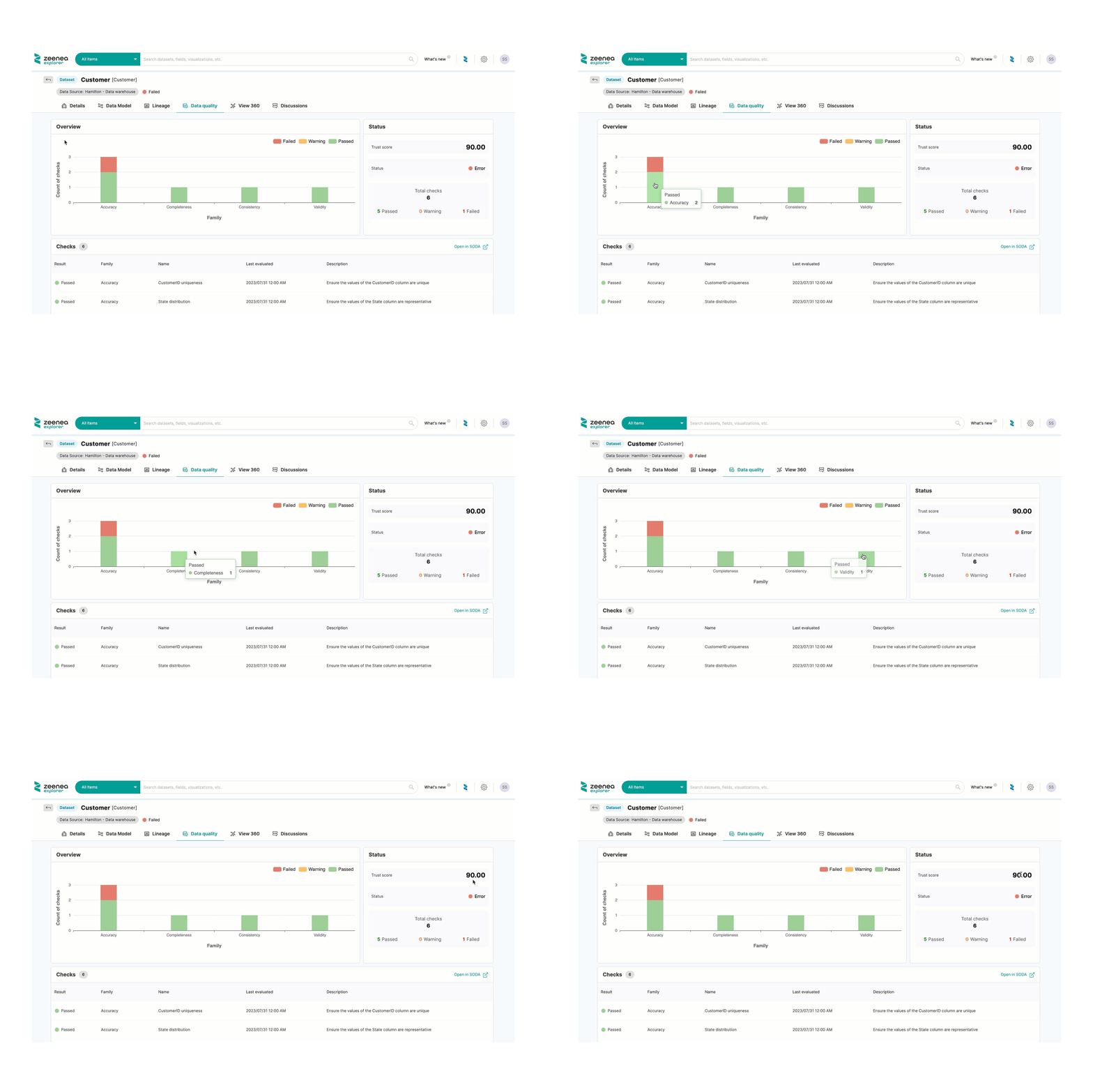
Actian Data Intelligence Platform automatically synchronizes with your data quality solutions, enabling users to view their datasets’ quality metrics from the discovery phase of their data use cases. This seamless integration allows data consumers to assess the quality of data before it’s used in downstream processes, improving transparency and accelerating trust.
Our platform helps organizations make better business decisions by enabling data users to quickly detect, understand, and take action on a dataset’s quality. By surfacing key indicators of data integrity, accuracy, and reliability, Actian empowers teams to evaluate a dataset’s trustworthiness before an issue arises.

Data quality capabilities
Empower teams with reliable, consistent, and accurate data for smarter decisions.

Connect to any data quality management (DQM) solution in seconds
Actian Data Intelligence Platform uses GraphQL and knowledge graph technologies to provide a flexible approach to integrating best-of-breed data quality solutions into our catalog. Sync the datasets of your third-party DQM tools via simple API operations. Our powerful catalog API capabilities will automatically update any modifications made in your tool directly within our platform.

Identify trustworthy data at a glance
The platform signals a dataset’s trustworthiness directly in the search results page as well as in the lineage graph to enable users to know if it is safe to use. Similar to traffic lights on the road, our intuitive quality indicator guides data users on the status of their datasets while navigating their catalog.

Easily view your data quality metrics
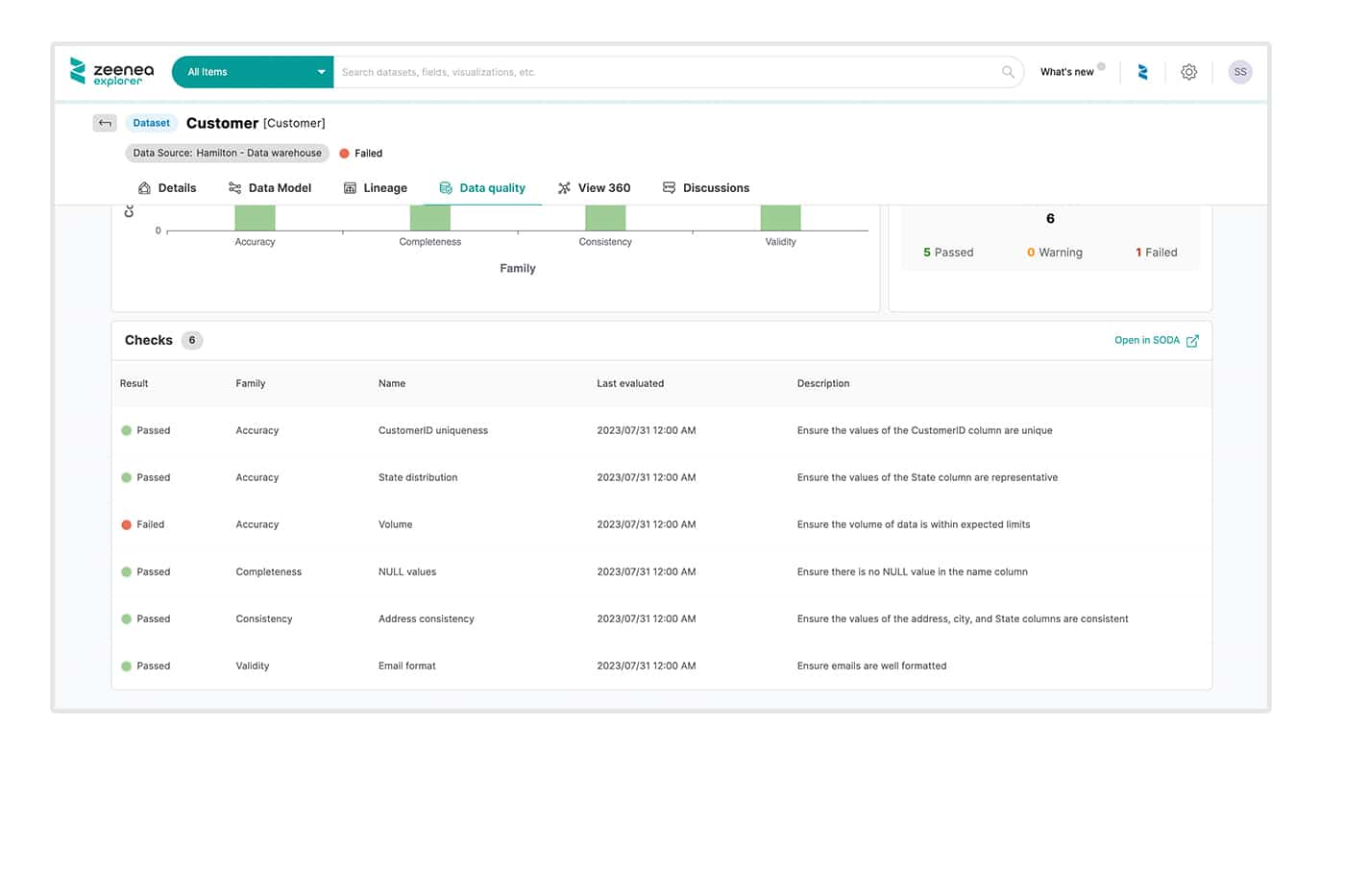
With the Actian Data Intelligence Platform, easily visualize your quality metrics via a user-friendly graph. Instantly identify the quality checks that were performed, their quantity, and if they passed, failed, or issued warnings. Get more information on the checks with detailed tables showing check descriptions, evaluation dates, and more, helping you take timely action.
Go even further in your quality discovery
To get even more information on your dataset’s quality metrics, the Actian Data Intelligence Platform enables you to directly view the selected dataset in your third-party DQM solution’s dashboard. Our end-to-end connectivity helps your users save time in their data quality journey by providing a place to find, trust, and utilize data in just a few clicks.
A Guide to Data Quality Management
A guide to answer all your questions about the discipline of data quality management.





Find, Trust and Unlock the Value of Your Data
Easy to set up. Easy to use. Easy to scale. Schedule to meet with one of our data experts to:
- Understand how Actian gives access to a comprehensive and reliable data asset landscape.
- Browse through our data discovery software and its features.
- Get pricing information.
 Understand how Actian gives access to a comprehensive and reliable data asset landscape.
Request a Product Demo
(i.e. sales@..., support@...)

FAQ
Data quality refers to the condition of a dataset based on attributes like accuracy, completeness, consistency, reliability, and relevance. High-quality data is essential for effective decision-making, regulatory compliance, and analytics outcomes.
The five commonly recognized elements of data quality are accuracy, completeness, consistency, timeliness, and relevance. Together, these attributes help ensure that data is trustworthy, reflects reality, and is fit for its intended use.
The “3 C’s” of data quality typically refer to consistency, completeness, and correctness. Completeness means no missing essential data; Correctness ensures data reflects reality; and Consistency ensures uniformity across systems. Together, these factors ensure data is trustworthy, leading to better analysis, more effective strategies, and confident decision-making for any organization.
The “6 C’s” of data quality are about ensuring your data is current, complete, clean, consistent, credible, and compliant. These principles provide a comprehensive framework for evaluating and improving data quality across systems.
Improving data quality involves profiling, cleansing, standardizing, and monitoring datasets to detect and resolve issues. Having a data governance framework enables you to go from reacting to issues to proactively addressing them.