
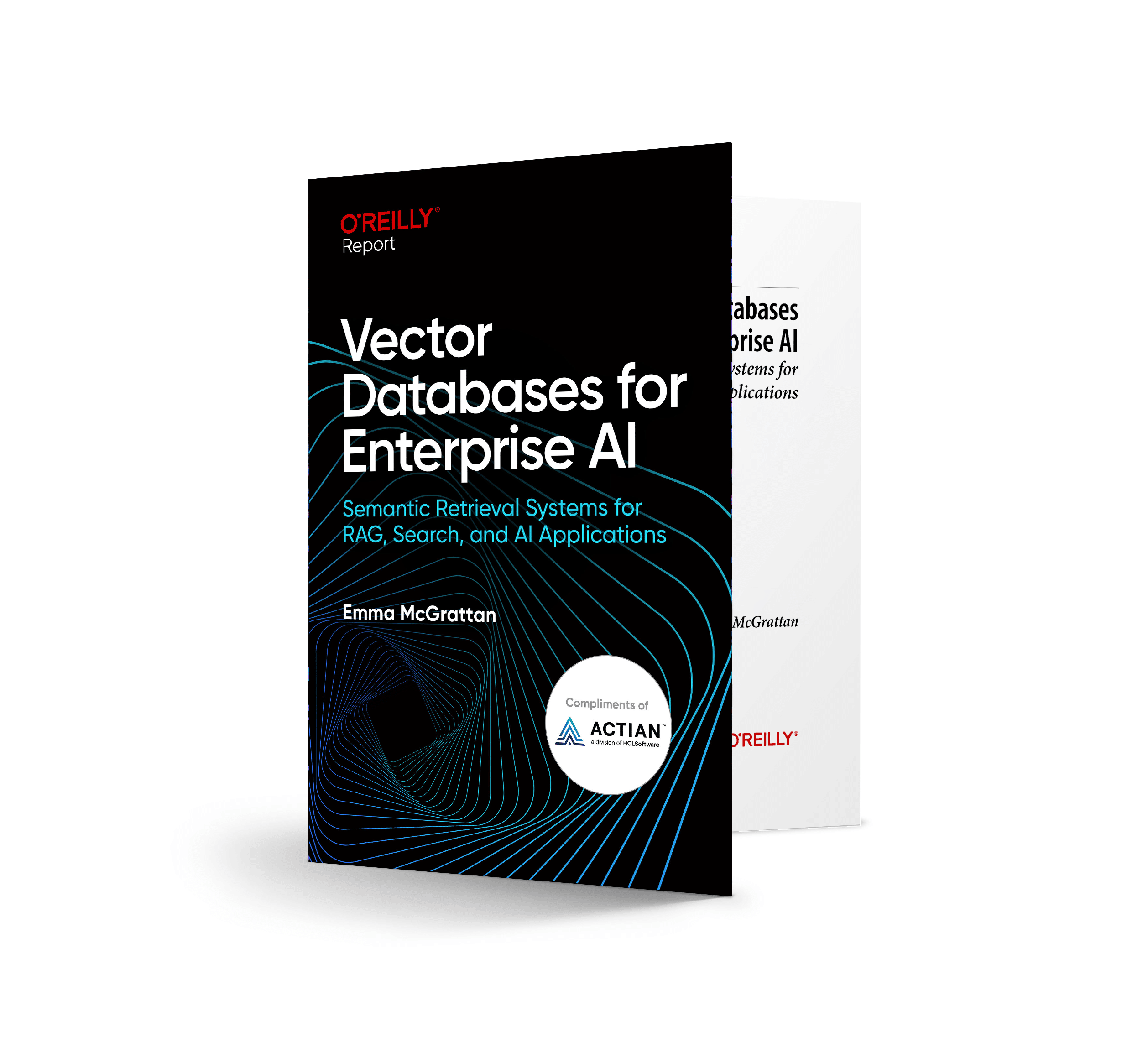
Vector Databases for Enterprise AI
In this exclusive O’Reilly report, Actian CTO Emma McGrattan explains why vector databases matter now, how semantic retrieval changes enterprise data architecture, and what it takes to move from AI experimentation to governed production systems.
Built for data engineers, architects, and technical leaders, this report provides a practical framework for integrating vector retrieval into enterprise platforms with rigor and confidence.

AI changes how data is accessed. Architecture must evolve.
For decades, enterprise data platforms were built for human consumers: analysts writing SQL, applications executing deterministic transactions, and dashboards reflecting predefined metrics.
AI-driven systems introduce a different kind of consumer — retrieving information probabilistically based on meaning rather than exact matches. Large language models, retrieval-augmented generation (RAG) systems, and agent-based applications depend on context, not just queries or predefined structures. That shift exposes the limits of traditional databases and keyword-based search.
This report explains why vector databases are emerging as an architectural response to that shift — and how enterprise teams can evaluate, integrate, govern, and operationalize them as part of the broader data platform. It is a practical guide to the tradeoffs that shape real-world deployments: performance, cost, accuracy, governance, and operational complexity.
Get Your Free Copy!
Fill out the form below to get instant access to the digital report.
(i.e. sales@..., support@...)

About the Report
Most organizations encounter vector databases through pilots, proofs of concept, or developer-led AI experiments. But moving from promising demos to production-grade systems requires more than semantic search. It requires understanding how retrieval behavior changes, how embeddings and chunking impact results, how RAG pipelines assemble context, and how governance must operate directly inside retrieval workflows.
The report treats vector databases as a complementary capability to existing enterprise architecture — not as a replacement for existing platforms. It helps teams understand when vector databases are appropriate, how they differ from relational and keyword-based systems in ways that matter architecturally, and how to integrate them with existing data, metadata, and governance frameworks.
“Vector databases are not a new technology category — they reflect a deeper shift in how systems retrieve and reason over data as context.” — Emma McGrattan, CTO, Actian
What’s Inside
Preface: A shift in the consumer of enterprise data
How AI shifts data access from queries to context.
Chapter 1: Why Vector Databases Matter Now
Where traditional systems break down and why semantic retrieval changes architecture.
Chapter 2: How Vector Retrieval Behaves at Query Time
What actually happens inside vector search, and where it fails.
Chapter 3: The Vector Pipeline in RAG Systems
How context is retrieved, filtered, and assembled for AI systems.
Chapter 4: Governing Vector Databases in Production
Why governance must operate inside retrieval workflows.
Chapter 5: Evaluating Tradeoffs and Planning Adoption
How to move from pilot projects to production-ready systems.
What You’ll Learn
✔️ Why vector databases matter now as AI systems become primary consumers of enterprise data.
✔️ How semantic retrieval differs from keyword search and deterministic querying.
✔️ What happens at query time inside a vector system (and where things break).
✔️ How RAG pipelines retrieve, filter, rerank, and assemble context.
✔️ Why many “model failures” are actually retrieval and context failures.
✔️ How governance must constrain filtering, ranking, and context selection.
✔️ What it takes to move from pilots to scalable, observable production systems.
Who Should Read This Report?
- Data architects.
- Data engineers.
- Enterprise data platform leaders.
- AI platform and RAG system builders.
- Data governance teams evaluating semantic retrieval in production.
About the Author

Emma McGrattan
CTO, Actian
Emma McGrattan is Chief Technology Officer at Actian, where she leads the technology vision and engineering strategy for the company’s data and AI platforms. She has more than three decades of experience designing and operating mission-critical database and data management systems, spanning the evolution from traditional relational architectures to modern, AI-driven data platforms.
Emma is a recognized industry speaker and practitioner known for her pragmatic approach to emerging technologies. Her work focuses on the architectural foundations required to make AI systems reliable in production, including data quality, governance, metadata, and integration. Rather than emphasizing tools in isolation, she advocates designing data platforms that are resilient, explainable, and suited to enterprise-scale AI workloads.
This report reflects her perspective that vector databases are not experimental add-ons, but an architectural response to the changing ways AI systems access and reason over data—and that data engineers and architects play a central role in enabling responsible, scalable adoption of AI.