
Better data intelligence, simpler TCO: Actian vs. Alation
Make metadata intelligence simple, federated, and enterprise–ready. Not complex, disconnected, and slow to adopt.


Real Alation users. Real frustrations.
Don’t just take our word for it. Here’s what real users are saying about their experiences with Alation:

“The built-in lineage feature … it’s not really that good. So, I’d consider that to be one that it’s missing. … their lineage feature is not that great.”
– Reddit User Review

"Alation Data Catalog is not user-friendly for business users. Its user experience is comparable to a Wikipedia page, lacking good visualization."
– PeerSpot User Review

“Usage is sometimes not user-friendly or as flexible as it should be.”
– Gartner User Review
Actian vs. Alation
Compare the difference between Alation’s data governance tool and Actian’s active metadata platform and catalog.
|
|
|
|---|---|---|
Federated knowledge graph & active metadata |
Actian’s Federated Knowledge Graph, along with the Model Context Protocol (MCP) Server, unifies metadata, lineage, and business context across distributed systems, creating a shared semantic layer that connects domains, tools, and AI assistants in real time. |
Uses an active metadata graph to represent relationships among data assets, but this graph is largely confined within its own catalog and lacks a truly federated or ontology-driven knowledge-graph architecture. |
Data lineage |
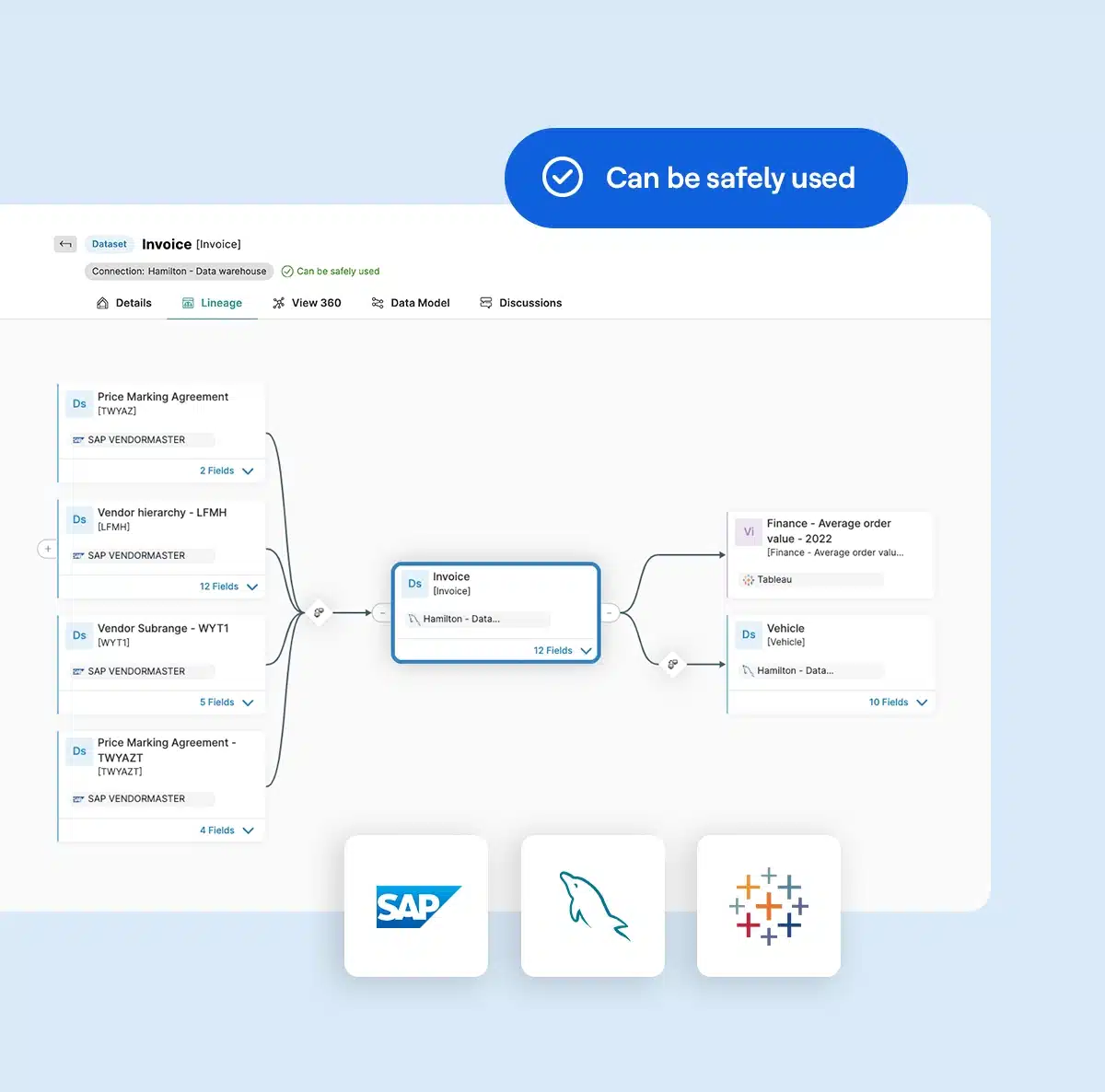
Delivers automated, field-level smart lineage tracing data across your ecosystem via its Federated Knowledge Graph, providing cross-platform lineage and consistency across domains. |
Provides table- and column-level lineage through supported connectors. Still, coverage depends on source compatibility and query completeness, meaning complex or unsupported systems can leave gaps in end-to-end visibility. |
Speed of implementation & value time–to–insight |
Rapid setup with built–in connectors, automated metadata ingestion, and minimal manual overhead – you can be completely live in weeks. |
Longer implementation times, complexity around connector setup, and slower adoption. |
Dual user experience: Business + technical |
Dual interfaces tailored for both business users (data consumers/discovery) and technical users/stewards – enabling broad organizational adoption. |
Lacks the “business user” experience, self–service discovery or non–technical adoption requires more customization and effort. |
Cost, total cost of ownership (TCO) & maintenance |
Lower overhead: less manual stewardship, fewer implementation hurdles, more “built–in” automation – reducing long–term cost and burden. |
With longer roll–out, heavier governance processes, and complex pricing, TCO for Alation in some organizations may be higher, unpredictable, and with value slower to realize. |
Modern architecture & future readiness (AI, data mesh, multi–cloud, active metadata) |
Modern architecture with an innovative, market–leading roadmap, backed by HCL Software. |
Some users suggest a slower innovation pace and limitations in advanced architecture patterns. |


The Actian difference: Governance for the AI era
More reasons why you should consider choosing Actian over Alation.

Federated knowledge graph
Delivers a powerful, Google–like search across all your business domains without sacrificing local data control and autonomy.

Metadata harvesting automation
Synchronizes your metadata automatically across cloud, on-premises, and hybrid environments, keeping an up-to-date view of your complete data landscape.

Graph-based business glossary
Maps critical relationships between policies, KPIs, and business terms, enhancing data literacy and bringing relevant context to AI initiatives.

Smart data lineage
Automatically visualizes end–to–end data flow across the ecosystem, enabling impact analysis, root cause tracing, and up–to–date documentation with no manual effort.

MCP Server
Actian’s new MCP Server connects AI agents directly to trusted enterprise data through its Federated Knowledge Graph, ensuring that every AI interaction is context–rich, governed, and grounded in a single, unified source of truth.

Data catalog and marketplace
Unify a data catalog with an e-commerce–style marketplace on a single platform, streamlining workflow for data producers and discovery for data consumers.

Ease of implementation and use
Purpose–built for high adoption with two unique interfaces: Studio for managing data assets and Explorer for data discovery, ensuring rapid time–to–value.

Data products and contracts
Integrates governance into your data using Data Contracts, allowing you to create trusted, ready–to–use data products that are automatically validated, accelerating data democratization.

Cloud-native design
Offers a scalable enterprise data marketplace that covers your entire data landscape – from hybrid to multi–cloud – while reducing risk and optimizing costs with a truly flexible SaaS solution.
