
¿Qué es un marco de calidad de datos?



Principales conclusiones
- Definir un marco práctico de calidad de los datos y adaptarlo a las normas oficiales.
- Hay que diferenciar la observabilidad de los datos de los controles de calidad a nivel de contenido.
- Mostrar los requisitos de calidad específicos de la IA y el aprendizaje automático (representatividad, desviación).
- Proporcione un modelo de madurez, indicadores clave de rendimiento (KPI) y una lista de comprobación para la implementación.
Introducción
Lamala calidad de los datosno solo da lugar a paneles de control desordenados. Ralentiza la toma de decisiones, aumenta el riesgo operativo, merma los resultados de la inteligencia artificial y obliga a los equipos a dedicar tiempo a conciliar los datos en lugar de utilizarlos.
Un marco de calidad de datos ofrece a las organizaciones un método sistemático para definir, medir, supervisar y mejorar la fiabilidad de sus datos. Combina gobernanza, normas, responsabilidad, métricas y tecnología para que los equipos puedan detectar problemas antes, resolver las causas fundamentales con mayor rapidez y aumentar la fiabilidad de los datos en las iniciativas de análisis, operaciones, cumplimiento normativo e inteligencia artificial.
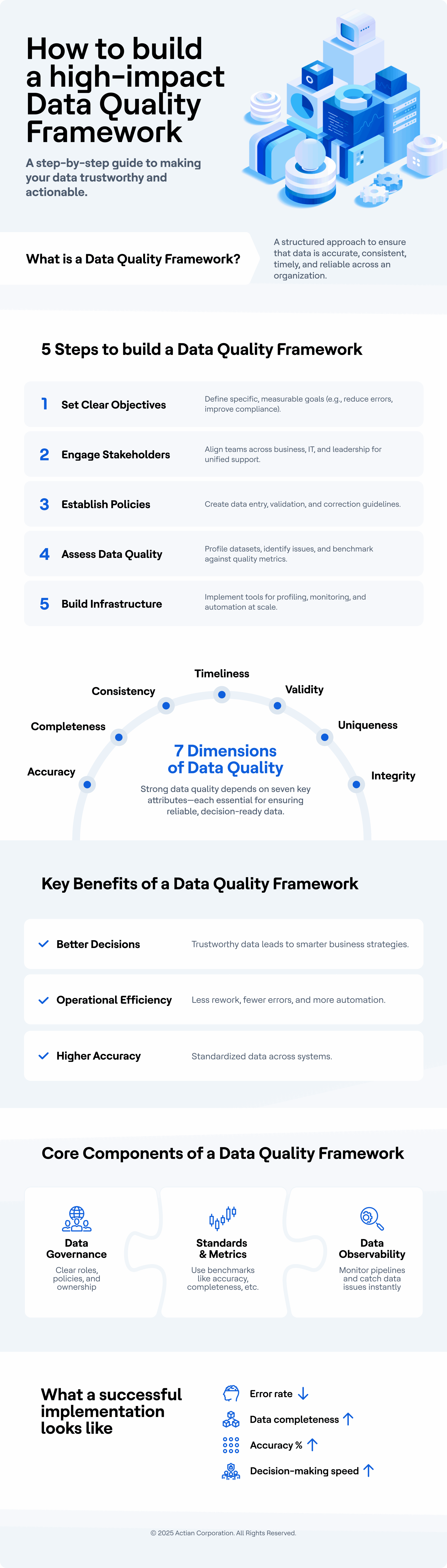
En este blog se explica qué es un marco de calidad de datos, cuáles son las siete dimensiones fundamentales de la calidad de datos, los cinco pasos para crear uno y los indicadores que permiten saber si tu implementación está funcionando.
¿Qué es un marco de calidad de datos?
Un marco de calidad de datos es un enfoque estructurado destinado a garantizar que los datos sean precisos, completos, coherentes, actuales, válidos, únicos y lo suficientemente fiables para el uso empresarial al que están destinados. Define las funciones, las normas, los indicadores, los procesos y las tecnologías necesarias para prevenir, detectar y resolver los problemas de calidad de los datos en toda la organización.
Un marco sólido responde a cinco preguntas:
- ¿Qué se entiende por datos «de calidad» en cada caso de uso empresarial?
- ¿Quién es responsable de la calidad de cada conjunto de datos críticos?
- ¿Qué normas, umbrales y estándares deben cumplir los datos?
- ¿Cómo se detectarán, priorizarán y resolverán los problemas?
- ¿Cómo se medirá la mejora a lo largo del tiempo?
Por qué son importantes los marcos de calidad de los datos
- Mejores decisiones: Cuando los usuarios empresariales pueden confiar en los datos que sustentan los informes, los paneles de control y los resultados de la inteligencia artificial, pueden tomar decisiones con menos dudas y menos conciliaciones manuales.
- Eficiencia operativa: Las normas estandarizadas y la supervisión automatizada reducen las tareas repetitivas de corrección, disminuyen el volumen de incidencias y ayudan a los equipos a resolver los problemas antes de que afecten a los usuarios finales.
- Mayor precisión: Un marco establece normas comunes sobre cómo se introducen, validan, transforman y utilizan los datos en todos los sistemas.
Para las organizaciones que invierten en IA, la calidad de los datos cobra aún más importancia. Los modelos, los copilotos y los flujos de trabajo autónomos dependen de datos de entrada fiables, un linaje claro y el contexto empresarial. Si los datos subyacentes están incompletos, desactualizados, duplicados o mal gestionados, los sistemas de IA pueden generar resultados inexactos, irrelevantes o difíciles de explicar.
Las 7 dimensiones de la calidad de los datos.
| Dimensión | Qué significa | Ejemplo de pregunta |
|---|---|---|
| Precisión | Los datos reflejan el valor real que representan. | ¿Es correcta la dirección de este cliente? |
| Integridad | Se han incluido los campos, registros y atributos obligatorios. | ¿Se han rellenado todos los campos obligatorios? |
| cohérence | Los datos se sincronizan entre los distintos sistemas y fuentes. | ¿Coincide el estado del cliente en el CRM y en la facturación? |
| Oportunidad | Los datos están disponibles y se actualizan cuando es necesario. | ¿Este informe utiliza los datos de transacciones más recientes? |
| Validez | Los datos se ajustan al formato, tipo o norma exigidos. | ¿Está la dirección de correo electrónico escrita correctamente? |
| Singularidad | Los datos no contienen duplicados involuntarios. | ¿Aparece este cliente más de una vez? |
| Integridad | Se conservan las relaciones, el linaje y las dependencias. | ¿Es posible asignar este pedido al cliente y al sistema de origen correctos? |
¿Qué aspectos de la calidad de los datos son los más importantes?
No todos los conjuntos de datos requieren el mismo nivel de control en todas las dimensiones. Las prioridades adecuadas dependen del caso de uso.
En la información financiera, la precisión, la coherencia y la integridad suelen ser fundamentales. En las operaciones con clientes, la exhaustividad, la unicidad y la puntualidad suelen ser lo más importante. En el caso de la inteligencia artificial y el aprendizaje automático, los equipos también deben evaluar la representatividad, la relevancia, la deriva y la actualidad de los datos de entrada.
Cómo crear un marco de calidad de datos en 5 pasos
1. Establecer objetivos claros
Empieza por definir qué aspectos del marco hay que mejorar. Evita objetivos vagos como «mejorar los datos». En su lugar, vincula los objetivos de calidad a los resultados empresariales.
Ejemplos:
| Objetivo empresarial | Objetivo de calidad de los datos |
|---|---|
| Mejorar la segmentación de clientes | Mejorar la exhaustividad de los campos del perfil del cliente. |
| Reducir los retrasos en la presentación de informes | Mejorar la puntualidad de los datos financieros y operativos. |
| Preparar los datos para la IA | Verificar el origen, la actualidad y la representatividad de los datos de entrenamiento. |
| Mejorar la preparación para el cumplimiento normativo | Estandarizar la titularidad, las políticas y los registros de auditoría. |
2. Involucrar a las partes interesadas
La calidad de los datos no es solo una cuestión de TI. Los equipos de negocio definen el significado de los datos, los responsables de datos se encargan de la aplicación práctica de las políticas, los ingenieros de datos automatizan los controles y los usuarios de los datos comprueban si estos son aptos para su uso.
Un modelo RACI simplificado puede ayudar a aclarar las responsabilidades:
| Función | Responsabilidad |
|---|---|
| Titular de los datos | Responsable del valor empresarial y la calidad de un conjunto de datos. |
| Responsable de datos | Mantiene las definiciones, las normas, las políticas y los flujos de trabajo de corrección. |
| Ingeniero de datos | Implementa flujos de trabajo, pruebas, alertas y automatización. |
| Analista o consumidor | Informa de los problemas y comprueba si las soluciones satisfacen las necesidades de la empresa. |
| Consejo de gobernanza | Aprueba las normas y da prioridad a las mejoras de gran repercusión. |
3. Establecer políticas
Las políticas convierten las expectativas en normas aplicables de forma sistemática. Entre ellas pueden figurar normas de nomenclatura, reglas de validación, metadatos obligatorios, requisitos de conservación de datos, umbrales aceptables y procesos de escalación.
Por ejemplo, una política relativa al conjunto de datos de clientes podría exigir que cada registro de cliente activo incluya una dirección de correo electrónico válida, una región, el titular de la cuenta, el estado del consentimiento y la fecha de la última actualización.
4. Evaluar la calidad de los datos
Antes de incorporar nuevas herramientas o procesos, establece una referencia. Analiza los conjuntos de datos críticos para identificar valores que faltan, duplicados, formatos incoherentes, registros obsoletos y relaciones erróneas.
Preguntas útiles para la evaluación:
- ¿Qué conjuntos de datos respaldan los procesos empresariales de mayor valor?
- ¿Qué informes, modelos de IA o aplicaciones dependen de esos conjuntos de datos?
- ¿En qué aspectos los usuarios ya desconfían de los datos?
- ¿Qué problemas son los más frecuentes, costosos o arriesgados?
- ¿Qué aspectos relacionados con la calidad son los más importantes para cada conjunto de datos?
5. Crear infraestructuras
El último paso consiste en implementar la tecnología y los flujos de trabajo necesarios para supervisar y mejorar la calidad de los datos a gran escala. Esto puede incluir la elaboración de perfiles de datos, motores de reglas, herramientas de observabilidad, gestión de metadatos, linaje de datos, alertas, integraciones con sistemas de gestión de incidencias y paneles de control.
Supervisión de la calidad de los datos frente a observabilidad de los datos
La supervisión de la calidad de los datos comprueba si los valores de los datos cumplen las reglas definidas. La observabilidad de los datos supervisa el estado de los flujos de datos, los sistemas y los activos para detectar anomalías antes de que afecten a los usuarios posteriores.
| Capacidad | Control de la calidad de los datos | Observabilidad de datos |
|---|---|---|
| Enfoque | Valores y reglas de los datos. | Estado de los procesos y los activos de datos. |
| Ejemplos | Exhaustividad, validez, duplicados, rangos. | Actualización, cambios de volumen, desviación del esquema, latencia. |
| Usuarios principales | Responsables de datos, analistas, ingenieros de calidad. | Ingenieros de datos, equipos de plataformas, operaciones de datos. |
| Objetivo | Comprueba que los datos sean aptos para su uso. | Detectar a tiempo los problemas operativos. |
Ambos son necesarios. El control de calidad ayuda a determinar si el contenido de los datos es fiable. La observabilidad ayuda a identificar cuándo algo en el proceso, el esquema o la cadena de dependencias puede haber cambiado de forma inesperada.
Cómo evaluar el éxito del marco de calidad de los datos
Una implementación satisfactoria de la calidad de los datos debería traducirse en mejoras cuantificables. La infografía destaca cuatro indicadores prácticos: menores índices de error, mayor exhaustividad, mayor precisión y una toma de decisiones más rápida.
Tabla de indicadores clave de rendimiento (KPI) sugerida:
| KPI | Qué mide | Por qué es importante |
|---|---|---|
| Índice de error | Porcentaje de registros o campos que no superan los controles de calidad. | Indica si los errores en los datos están disminuyendo. |
| Índice de exhaustividad | Porcentaje de campos obligatorios rellenados. | Indica si los datos pueden utilizarse para los flujos de trabajo clave. |
| Índice de precisión | Porcentaje de registros correctos incluidos en la muestra o conciliados. | Contribuye a reforzar la confianza en la presentación de informes y en las operaciones. |
| Tiempo de inactividad de los datos | Los datos de hora no están disponibles, son incorrectos o no son fiables. | Cuantifica las interrupciones operativas. |
| MTTR | Tiempo medio de resolución de incidencias relacionadas con los datos. | Muestra si los equipos están resolviendo los problemas más rápidamente. |
| Incidentes notificados por los consumidores | Problemas comunicados por los usuarios finales. | Ayuda a evaluar si los problemas se detectan antes de que los usuarios los encuentren. |
| Rapidez en la toma de decisiones | Tiempo necesario para elaborar o aprobar los informes clave. | Relaciona la calidad de los datos con la productividad empresarial. |
Crear e implantar marcos de calidad de datos
La plataforma Actian Data Intelligence utiliza gráfico de conocimiento federado para ayudar a las organizaciones a optimizar sus conjuntos de datos. Los equipos pueden aprovechar, compartir y descubrir productos de datos según sus necesidades. La plataforma, nativa de la nube, se integra plenamente con los ecosistemas de datos existentes de las organizaciones mediante un conjunto de escáneres y API integrados.
Programe una demostración gratuita de Actian Data Intelligence Platform para ver cómo está transformando la gestión de la calidad de los datos.

Mantente conectado
Te ofrecemos información detallada sobre los datos.
(por ejemplo, sales@..., support@...)
